TL;DR: Moonshot AI launched Kimi K3.1 Pro on 23 October 2026 — the first of the K3.1 series, ~3T-class open weights (2.8T total / 104B active), 1M-token context. API pricing: $2 per 1M input / $10 per 1M output tokens, $0.20 cached input — exactly half of Claude Opus 5.5's price and 33% below Kimi K3. A 2–3x faster Highspeed variant costs $4/$20. On Terminal-Bench 4.0 it scores 65.7%, within one point of Claude Opus 5.5 (66.4%) and ahead of GPT-6 Astra (58.2%) — but these are vendor-reported numbers with no independent replication yet. Full open weights land by 4 November 2026. A heavy agentic coding session (200K in + 50K out tokens) costs $0.90 (~৳111). It's not on tokens.bd yet — here's the honest switch math anyway. Prices, benchmarks and catalog status checked 24 October 2026.
Yesterday Moonshot AI did something the market has stopped expecting: it launched a model that is both nearly the best in the world at driving a terminal and priced like the second tier. Kimi K3.1 Pro went live on 23 October 2026 and shot to the top of Hacker News the same day. The interesting number isn't the benchmark — it's the price tag next to it: $2/$10 per million tokens, exactly what Claude Sonnet 5.5 costs and half what Opus 5.5 charges, for a model that scores within a point of Opus on the most respected coding-agent benchmark. This post has everything we could verify in the first 24 hours: the prices, the API IDs, the benchmarks (with honest caveats), the open-weights plan, and the worked cost math in USD and BDT.
What is Kimi K3.1 Pro?#
Kimi K3.1 Pro is Moonshot AI's new flagship coding and agentic model, launched 23 October 2026. It is a post-trained version of Kimi K3 — the same ~3T-class MoE base (2.8 trillion total parameters, ~104B active, per parameter reporting in the launch coverage) with substantially more post-training compute, keeping the 1-million-token context window. It is multimodal (text + images), works across the Kimi product family (Kimi.ai, Kimi Work, Kimi Code, Kimi API), and Moonshot promises the full open weights by 4 November 2026 — which would make it, per Artificial Analysis, the highest-scoring open-weight model on its Intelligence Index.
There is also a Kimi K3.1 Pro Highspeed variant: 2–3x faster serving at double the price ($4/$20). Both model IDs are live now: kimi-k3.1-pro and kimi-k3.1-pro-highspeed on the Kimi API.
One unusual detail from the launch post: Moonshot deliberately stripped cyberattack-related training data out of both the mid-training corpus and the RL mix before the open-weight release, and measured the effect — the sanitized checkpoint solves 81.0% of its internal xdev-bench-hard exploit tasks vs 90.5% for the unsanitized pipeline checkpoint. The open weights will therefore be less cyber-capable by design, while still "behind frontier proprietary models" on that axis. That's a genuinely novel safety posture for an open release, and worth reading as such.
What does Kimi K3.1 Pro cost?#
$2 per 1M input tokens, $10 per 1M output tokens, $0.20 per 1M cached input — a flat 33% cut from Kimi K3's $3/$15/$0.30 across the board, per Moonshot's official pricing page (updated 23 Oct 2026). Highspeed doubles the standard rate: $4/$20, cached input still $0.20. Context caching is automatic on the Kimi API for repeated prefixes (5-minute default TTL).
| Model | Input / 1M | Output / 1M | Cached input / 1M | Source |
|---|---|---|---|---|
| Kimi K3.1 Pro | $2.00 | $10.00 | $0.20 | Moonshot official pricing, 23 Oct 2026 |
| Kimi K3.1 Pro Highspeed | $4.00 | $20.00 | $0.20 | Moonshot official pricing, 23 Oct 2026 |
| Kimi K3 (previous) | $3.00 | $15.00 | $0.30 | Moonshot official pricing |
| Claude Opus 5.5 | $4.00 | $20.00 | — | Vendor list price (as reported 23 Oct 2026) |
| Claude Sonnet 5.5 | $2.00 | $10.00 | — | tokens.bd catalog, 24 Oct 2026 |
| GPT-6 Astra | $10.00 | $50.00 | — | Reported in launch coverage, 23 Oct 2026 |
| DeepSeek V4.1 Flash 1017 | $0.30 | $0.80 | — | tokens.bd catalog, 24 Oct 2026 |
Two things jump out of this table. First, K3.1 Pro is priced exactly at Sonnet 5.5's level while benchmarking near Opus 5.5 — if the benchmark gains hold in your workload, you're getting Opus-class coding at Sonnet-class prices. Second, the gap to the budget tier is still enormous: DeepSeek V4.1 Flash 1017 costs nine times less for the same session (we'll do that math below). K3.1 Pro isn't a cheap model; it's a flagship model at a mid-tier price.
How good is Kimi K3.1 Pro, really?#
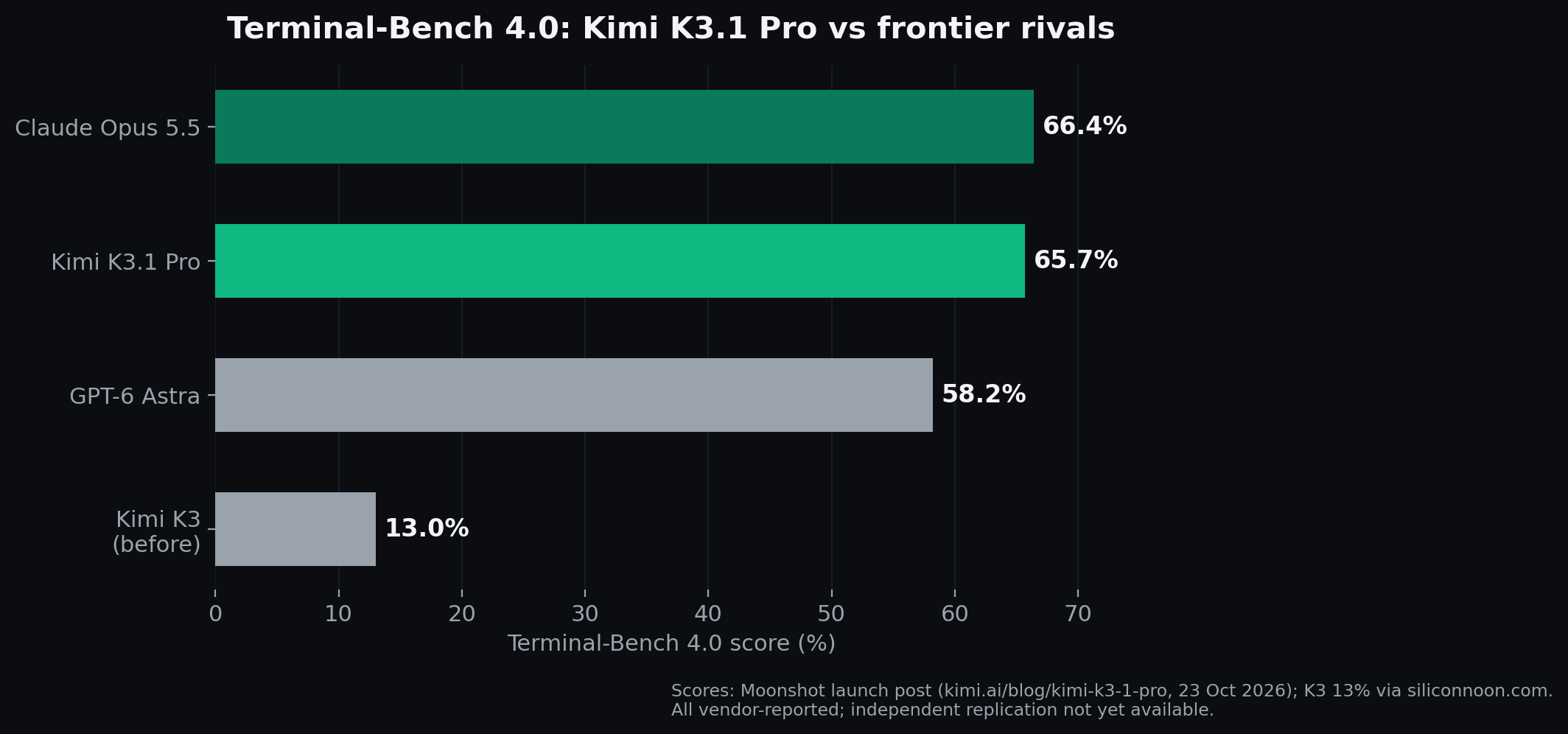
On coding-agent benchmarks it is genuinely close to the frontier — with the standard vendor-number caveats. Moonshot reports 65.7% on Terminal-Bench 4.0, the benchmark most labs now treat as the practical proxy for "can it do my job": ahead of GPT-6 Astra (58.2%) and 0.7 points behind Claude Opus 5.5 (66.4%). Independent benchmarker Artificial Analysis measured it even higher on the same family — 67%, its best-tested score — though harness differences mean the two numbers aren't directly comparable. On AA's composite Intelligence Index it scores 55, fourth globally behind only Claude Opus 5.5 (58), Sonnet 5.5 and Muse Wonder Full.
The full scorecard, as reported in the launch post (vendor-reported unless noted):
| Benchmark | K3.1 Pro | Nearest rival | Notes |
|---|---|---|---|
| Terminal-Bench 4.0 (coding agents) | 65.7% | Opus 5.5 66.4%, GPT-6 Astra 58.2% | AA independently measured 67% (different harness) |
| Kimi Code Bench 3.0 Long-horizon | 61.2% | K3 55.95% | Internal benchmark |
| BenchCAD (3D CAD generation, with tools) | 92.7% | Opus 5.5 96.2%, Astra 95.9% | Approaching frontier on spatial reasoning |
| OfficeQA Pro v2 (finance documents) | 64.4% | Leads the reported field | Claimed state-of-the-art |
| Internal hallucination stress test | 8.3% claim error rate | K3 23.4% | Stress test, not a general error rate |
| Artificial Analysis Intelligence Index | 55 | Opus 5.5 58 | 4th globally; K3 was 44 on the rebased index |
Honest caveats, because a launch-day post owes you these: all of this is vendor-reported — no independent replication exists yet, and Moonshot's own footnotes take rival scores from blog posts and leaderboards rather than re-running them. One sharp-eyed analyst noted the index gain is partly re-basing: K3 was widely reported at 57 when it launched, so the "eleven-point jump" to 55 isn't all new capability. And the biggest jump of all — K3 going from 13% to 65.7% on Terminal-Bench in one post-training pass — is the kind of number that deserves a second lab to confirm before anyone rebuilds a stack around it.
How do I call Kimi K3.1 Pro in my code?#
Through the Kimi API at platform.kimi.ai — it's OpenAI-compatible, so it's a base-URL swap. The model IDs are kimi-k3.1-pro and kimi-k3.1-pro-highspeed.
from openai import OpenAI

client = OpenAI(
    base_url="https://api.moonshot.ai/v1",
    api_key="YOUR_KIMI_API_KEY",  # from platform.kimi.ai
)

resp = client.chat.completions.create(
    model="kimi-k3.1-pro",
    messages=[{"role": "user", "content": "Refactor this module to remove the circular import."}],
    # thinking is always on; reasoning effort: low | high | max (default max)
)
print(resp.choices[0].message.content)
Four things to know before you wire it in. Thinking mode is always on — requests with reasoning disabled are rejected, per Kimi's model docs, so budget reasoning tokens into every call. Temperature 1.0 and top-p 0.95 are fixed (per Moonshot's footnotes) — you can't tune them down for determinism. Reasoning effort is low, high, or max (default max), and that dial directly moves your output bill since reasoning tokens are billed as output. And the Kimi API offers zero data retention as an option for API customers — worth enabling if your prompts carry anything sensitive. (On the Kimi chat app side, the model is already live on Kimi.ai, Kimi Work 3.1.0, and Kimi Code via the /model command; Kimi Code puts the standard model behind a Plus plan and Highspeed behind Pro.)
What about the open weights coming on 4 November?#
Moonshot has committed to publishing the full K3.1 Pro weights by 4 November 2026 — and per Artificial Analysis that would make it the highest-scoring open-weight model on the Intelligence Index, ahead of everything you can currently download. That matters because the weights are what make a model yours: no per-token bill, no rate limits, no data leaving your infrastructure.
For comparison, another fast new release worth watching is Mercury 3: The 1,068 tok/s Diffusion LLM Explained, which takes a very different speed-first approach.
The practical reality check: this is a 2.8-trillion-parameter model. NVIDIA's published serving configurations for the K3 family run on Blackwell GB200 systems; self-hosting needs datacenter-class multi-accelerator infrastructure, not a workstation. For almost every reader, "open weights" here means option value — cheaper hosted inference from third parties once weights are public, fine-tuning access, and auditability — not running it yourself. (Yesterday's open-weights self-host guide for MiniMax M3.1 Flash shows what a 428B-class model already demands: a 2.8T model is an order of magnitude beyond that.) The cybersecurity data-stripping is also part of the weights story: what you download will be deliberately less offensive-cyber-capable than Moonshot's internal pipeline could produce. If the story develops — license terms, actual file sizes, first hosted prices — we'll update this post rather than publish a duplicate.
Should you switch? The honest math#
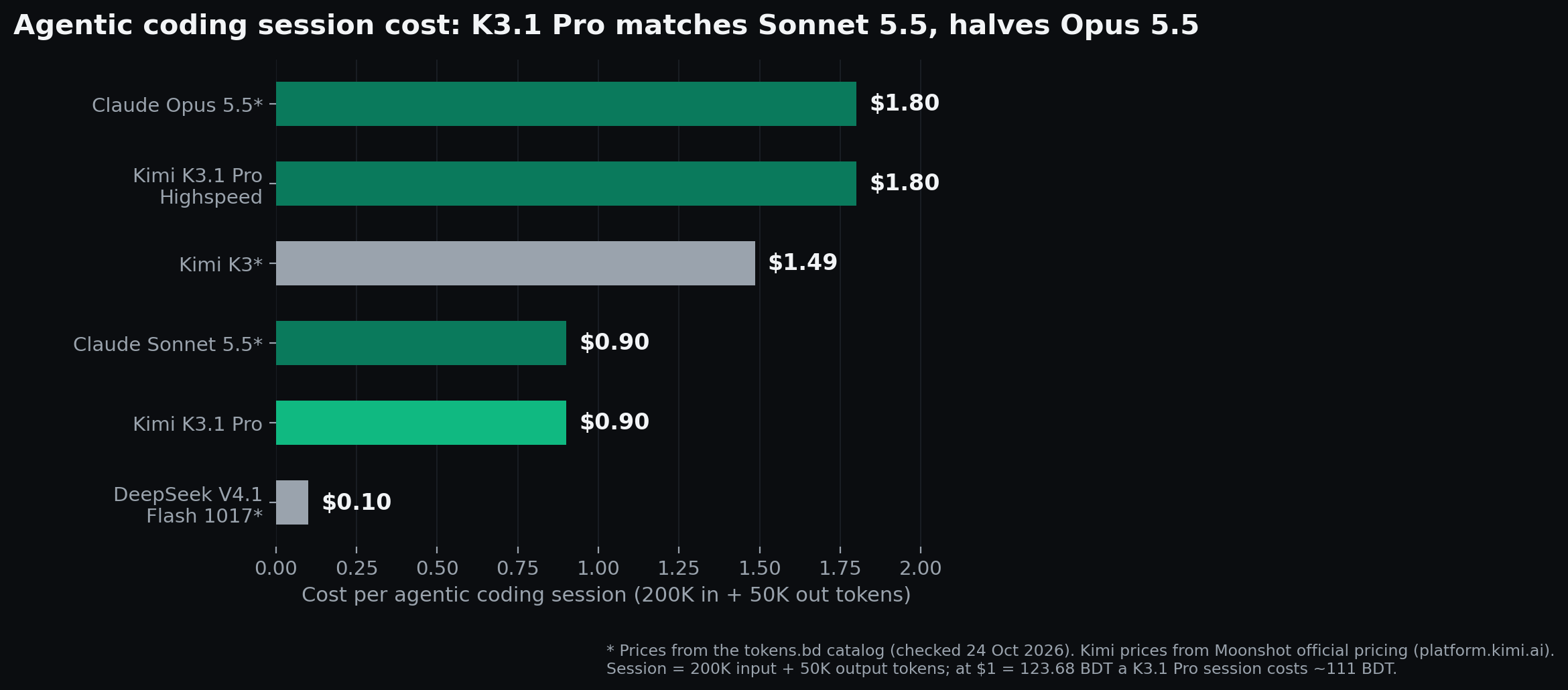
It depends on what you're paying for now — run this on your own token mix. Here's the session math on a heavy agentic coding session (200K input + 50K output tokens; prices checked 24 October 2026):
| Model | Session cost | vs K3.1 Pro |
|---|---|---|
| Kimi K3.1 Pro | $0.90 | — |
| Claude Sonnet 5.5* | $0.90 | same price, lower benchmark tier |
| Kimi K3* | $1.49 | 66% more for the older model |
| Kimi K3.1 Pro Highspeed | $1.80 | 2x for 2–3x speed |
| Claude Opus 5.5* | $1.80 | 2x for ~1 extra Terminal-Bench point |
| GPT-6 Astra | $4.50 | 5x |
| DeepSeek V4.1 Flash 1017* | $0.10 | 9x cheaper — different capability tier |
* Catalog prices on tokens.bd, checked 24 Oct 2026; Kimi prices from Moonshot official pricing.
Three verdicts from this table:
- If you run Kimi K3 anywhere: switch to K3.1 Pro immediately. Same API shape, 33% cheaper, dramatically better benchmarks. There is no reason to keep paying K3 prices.
- If you run Claude Opus 5.5 for coding agents: trial K3.1 Pro this week. You're paying 2x per session for roughly one Terminal-Bench point. At 100 heavy sessions a month, switching saves
$90 (৳11,130) — if your workload confirms the benchmark gap is really one point. - If you run Sonnet 5.5 or DeepSeek: don't switch on price. K3.1 Pro matches Sonnet's price exactly, so the question is purely capability — and DeepSeek V4.1 Flash 1017 at $0.10/session is still 9x cheaper for everything it handles well. (Our DeepSeek V4.1-Flash-1017 breakdown covers that tier in detail.)
The meta-lesson for anyone who prices their stack: a launch like this compresses the price ladder from the middle. Flagship-adjacent capability at $2/$10 makes $4/$20 Opus pricing look expensive and makes budget models look smarter for everything below the frontier. Expect pricing responses within weeks — that's the real story to watch.
What does Kimi K3.1 Pro cost in Taka?#
At today's rate ($1 = ৳123.68, 24 October 2026): 1M input tokens cost ৳247, 1M output tokens cost ৳1,237, and one heavy agentic coding session runs ~৳111. A month of 100 such sessions is ~৳11,130 on K3.1 Pro vs ~৳22,260 on Claude Opus 5.5.
For Bangladeshi developers the access path today is Moonshot's own channels (Kimi API, app, Kimi Code) — the launch post lists no country restrictions. If you prefer paying in BDT rather than wiring an international card to yet another provider, that's exactly the gap tokens.bd fills: one API key across 60+ models with bKash/Nagad payment. The ৳25/week Weekly 5X plan carries $10 in credits — roughly eleven of these heavy K3.1 Pro sessions — which tells you honestly where this model sits: it's a flagship-tier spend, not a free-tier toy. (On actually-free tiers, see our free LLM API comparison.)
Is Kimi K3.1 Pro on tokens.bd yet?#
Not yet — checked the catalog on 24 October 2026. The Moonshot lineup on tokens.bd currently runs K2.5 through K3 (K3 lists at $3.30/$16.50). Given the launch was 24 hours ago, that lag is normal: the Oct-20 MiniMax M3.1 Flash launch post covered a model in the same position, and it landed later. If K3.1 Pro arrives on tokens.bd, the catalog-watch math to remember is $2/$10 official — and Highspeed at $4/$20. We'll update this post when it lands rather than publishing a duplicate.
Kimi K3.1 Pro FAQ#
What are the Kimi K3.1 Pro API model IDs?
kimi-k3.1-pro and kimi-k3.1-pro-highspeed, live on the Kimi API at platform.kimi.ai. The endpoint is OpenAI-compatible. In Kimi Code, select it with the /model command; on Kimi.ai and the Kimi app it's already the default flagship.
Is Kimi K3.1 Pro cheaper than Claude Opus 5.5? Exactly half: $2/$10 vs $4/$20 per 1M input/output tokens, with cached input at $0.20. It also costs exactly the same as Claude Sonnet 5.5 ($2/$10). Highspeed ($4/$20) matches Opus 5.5's price while promising 2–3x the speed.
Can I run Kimi K3.1 Pro's weights on my own hardware? Not until the weights release (promised by 4 November 2026), and not practically even then: it's a 2.8T-parameter MoE needing datacenter-class multi-GPU infrastructure. The realistic win from open weights is cheaper third-party hosting and fine-tuning access, not home servers.
Does Kimi K3.1 Pro let me turn off reasoning?
No — thinking mode is always on, and requests with it disabled are rejected. You can set reasoning effort to low, high, or max (default max), but every response carries reasoning tokens billed as output. Budget for that.
Is Kimi K3.1 Pro available in Bangladesh? Moonshot's launch post lists no country restrictions, and the model is live on Kimi.ai, the Kimi apps, and the Kimi API globally. The usual caveat applies to any new launch: check the platform's signup terms in your region before building on it.
Prices, benchmarks and catalog status checked 24 October 2026. Launch-day numbers are vendor-reported until independent labs replicate them — the provider's own pages are the authority. Browse the model catalog for 60+ models with USD and BDT pricing.
Sources: Introducing Kimi K3.1 Pro (Moonshot, official launch post) · Kimi API pricing (Moonshot, updated 23 Oct 2026) · Kimi K3.1 Pro: benchmarks, pricing, open weights Nov. 4 (Skimwire) · Kimi K3.1 Pro nearly matches Claude Opus 5.5 (MadRobot) · Moonshot AI Releases Kimi K3.1 Pro (MarkTechPost) · Kimi K3.1 Pro: 55 on the AI index (SiliconNoon) · Moonshot AI Releases Kimi K3.1 Pro (OfficeChai) · Kimi K3.1 Pro debuts fourth globally (Intelligent Living) · tokens.bd model catalog · USD/BDT rate via Finnhub, 24 Oct 2026.
Update 4 Nov 2026: The weights deadline-day briefing is now live — see Kimi K3.1 Pro Open Weights: Due Today, What to Expect for the 1.5 TB download, the hardware math and the licence watch. The model is now live on tokens.bd.