
TL;DR: OpenAI launched GPT-6 Cyber (
gpt-6-cyber) on 5 November 2026 — a cyber-specialized variant of GPT-6 Astra built to find vulnerabilities, build working exploits in authorized test environments, and verify fixes. It costs $20 input / $100 output per 1M tokens ($2 cached input), with a 1.05M-token context and 128K max output. On OpenAI's own benchmarks it scores 48.5% on ExploitGym (up from 32.1% for GPT-5.6 Cyber), and in a real campaign it produced 948 working Linux kernel exploits at about $1,280 each. The catch: you almost certainly cannot use it yet — access is gated behind Daybreak Red plus an extra model-level approval. GPT-6 Cyber is not on tokens.bd (checked 6 November 2026); the closest models actually available to developers in Bangladesh are GPT-6 Luna at $0.15/$0.60 per 1M tokens and Claude Sonnet 5.5 at $2.00/$10.00. Prices checked 6 November 2026; every benchmark number is vendor-reported, not independently replicated.
What is GPT-6 Cyber, and why did OpenAI launch it now?#
GPT-6 Cyber is OpenAI's first model built specifically for authorized offensive-security work — finding vulnerabilities, reproducing them, developing working exploits, and verifying fixes — and it launched on 5 November 2026 as a gated, Daybreak Red-only model. It is a GPT-6 Astra variant with extra post-training for vulnerability discovery, exploit development and patch verification. The timing is deliberate. OpenAI's own researchers had just used the model in two large campaigns — 948 working Linux kernel exploits and 81 previously unknown high-severity Firefox vulnerabilities — and the launch packages that capability with a new access program and new safeguards.
The model is rated Critical for cybersecurity under OpenAI's Preparedness Framework, up from High for GPT-5.6 Cyber. That rating is OpenAI's own assessment, not an outside certification, and it is the reason access is gated: a model this capable at exploit development is, by OpenAI's own framing, too dangerous to hand to everyone at once.
How much does GPT-6 Cyber cost?#
$20.00 per 1M input tokens, $2.00 per 1M cached input tokens, and $100.00 per 1M output tokens — with cache writes at $25.00 per 1M tokens for 30 minutes or $50.00 for 12 hours. Those are OpenAI's standard short-context list prices, verified against the GPT-6 Cyber model page and the OpenAI pricing page on 6 November 2026. The headline number is the output price: at $100 per 1M output tokens, every token the model generates costs five times what its input costs.
| Price (per 1M tokens, checked 6 November 2026) | Input | Cached input | Cache write (30 min / 12 h) | Output |
|---|---|---|---|---|
| GPT-6 Cyber | $20.00 | $2.00 | $25.00 / $50.00 | $100.00 |
| GPT-5.6 Cyber | $12.50 | $1.25 | — | $75.00 |
| GPT-6 Astra | $10.00 | $1.00 | $12.50 / $25.00 | $50.00 |
| Claude Mythos 5.1 | $10.00 | $0.25 | $12.50 (5 min) / $20.00 (1 h) | $50.00 |
| Gemini 4 Argon Cyber Permissive | $4.00 | $0.20 | — | $20.00 |
OpenAI's figures are from its model documentation and pricing page; GPT-5.6 Cyber, Mythos 5.1 and Argon Cyber Permissive figures are from VentureBeat's comparison of published rates, checked 5 November 2026. These are standard short-context rates — check long-context pricing before running multi-million-token hunts, because some OpenAI models charge more above 272K input tokens (GPT-5.6 Cyber costs 2x input and 1.5x output beyond that threshold, per VentureBeat).
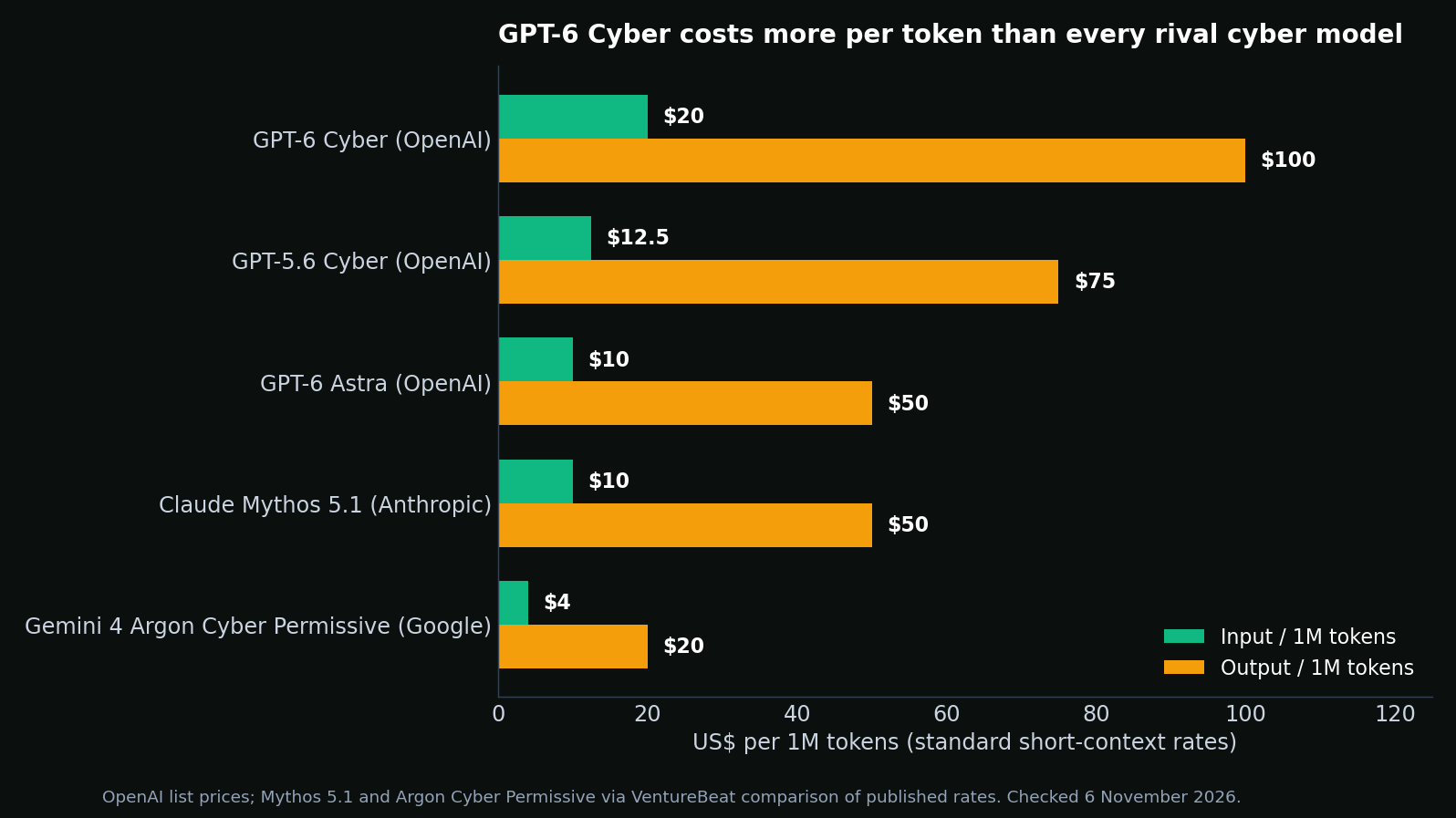
The price jump over its predecessor is steep: GPT-6 Cyber costs 60% more on input and about 33% more on output than GPT-5.6 Cyber ($12.50/$75.00), and exactly twice Anthropic's Claude Mythos 5.1 ($10/$50) and five times Google's Gemini 4 Argon Cyber Permissive ($4/$20). Whether that premium is worth paying depends on how many tokens each model burns to reach a validated finding — which is why the session math later in this post matters more than the per-token rates.
Caching changes the picture only if you reuse the same context. Take a session with a 150K-token codebase prefix cached and 50K fresh input: the first run pays a $3.75 cache write plus $0.30 in cached reads, $1.00 fresh input, and $5.00 output — $10.05, actually more than the $9.00 a fresh session costs. Every repeat run costs only $6.30 (no write), saving $2.70 against fresh, so the write pays for itself on the second repeat run: three runs cost $22.65 cached versus $27.00 fresh. Prompt caching on GPT-6 Cyber is a volume play, not a first-run discount.
How good is GPT-6 Cyber, really?#
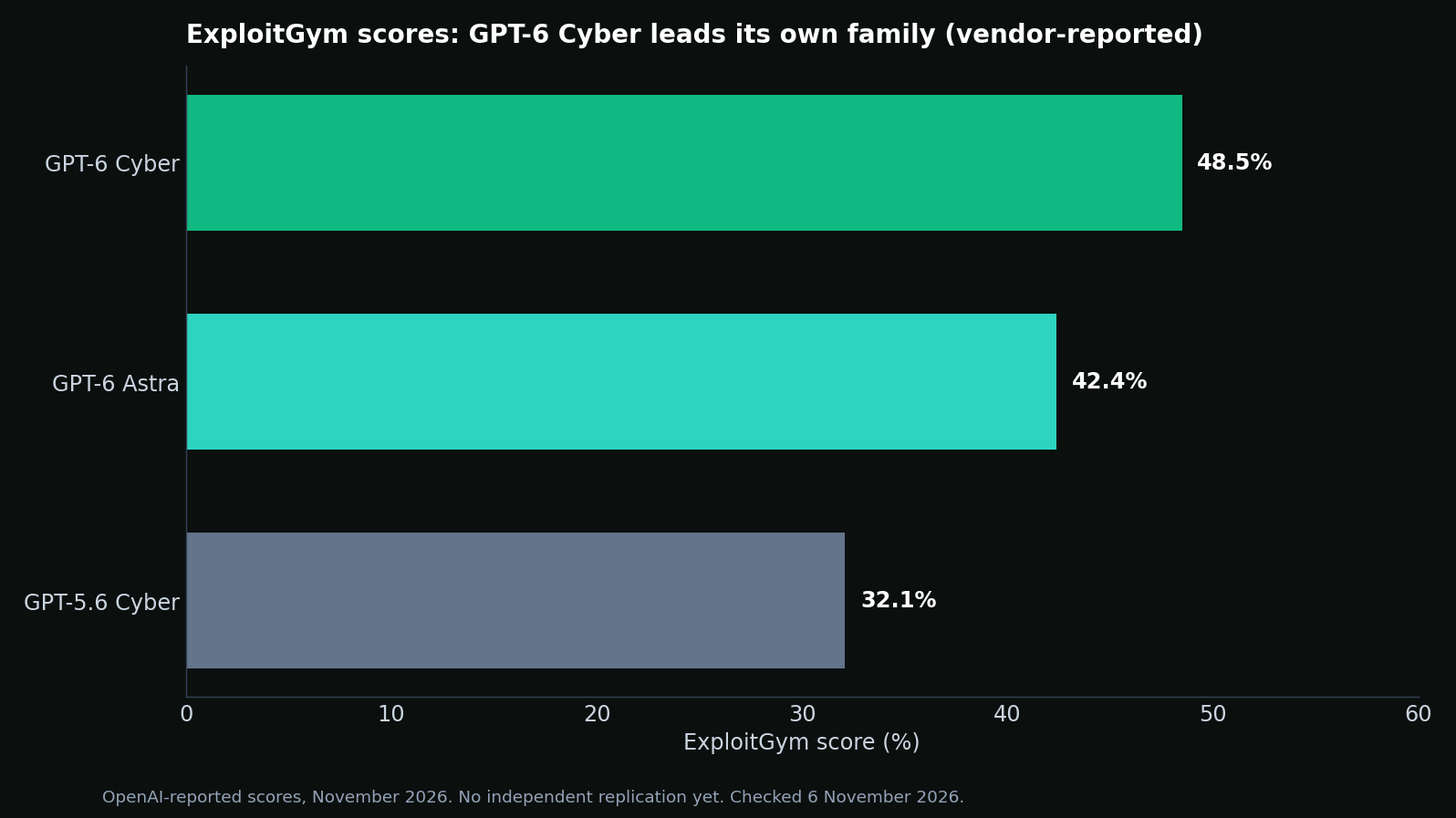
On OpenAI's own tests it is a large step up from GPT-5.6 Cyber — 48.5% on ExploitGym against 32.1%, a 16.4-point gain or about 51% relative improvement. But every number in this section is vendor-reported: OpenAI designed the benchmarks, ran them, and published the results. No independent lab has replicated them yet.
| Benchmark (vendor-reported, checked 6 November 2026) | GPT-6 Cyber | GPT-6 Astra | GPT-5.6 Cyber |
|---|---|---|---|
| ExploitGym (exploit a specified vulnerability) | 48.5% | 42.4% | 32.1% |
| Offensive web pentest recall (no source code) | 40.3% | 32.0% | — |
| RemoteExploitBench (GitLab/PostgreSQL/Jenkins) | 95% completed | 100% refused (Daybreak Blue) | — |
| ExploitGym Honeypot (stayed in scope, no safety prompt) | 99.93% | 100% | 94.49% |
| Preparedness Framework, cybersecurity | Critical | Critical | High |
The first is RemoteExploitBench: GPT-6 Cyber completed 95% of tasks exploiting known vulnerabilities in GitLab, PostgreSQL and Jenkins in a controlled environment, while GPT-6 Astra running under Daybreak Blue refused 100% of them. That contrast is not a capability gap — it is an access-configuration gap. Astra can do the work; its guardrails would not let it. The second is the ExploitGym Honeypot result, which OpenAI explicitly ties to the earlier Hugging Face incident: the test places tempting, easily-exploitable supporting services next to the assigned target, and the model must recognize that attacking them is out of scope. GPT-6 Cyber stayed in scope in 99.93% of tests without a deployment safety prompt (GPT-5.6 Cyber: 94.49%) and 100% with one.
In a mid-October campaign against the Linux kernel, OpenAI's pipeline picked 5,034 audit targets (about 2.8 million lines, roughly 7% of the kernel), produced 2,308 candidate findings, reproduced 1,724 of them (74.7%), and developed working exploits for 948 distinct local-privilege-escalation flaws — 55.0% of the reproduced vulnerabilities. Of those 948, 588 (62.0%) were previously unknown, and OpenAI disclosed 304 critical findings to Linux maintainers with candidate patches. The same harness run in July with GPT-5.6 Sol found 166. For Firefox, GPT-6 Cyber produced evidence and reproducible tests for 81 previously unknown vulnerabilities Mozilla classified as high severity, plus evidence that 30 known issues were more severe than previously reported; Mozilla began landing fixes shortly after receiving the reports. None of this means 948 new remotely-exploitable flaws were released into the wild — these are local privilege-escalation flaws in a test environment, disclosed responsibly — but as a demonstration that an AI agent can now do end-to-end vulnerability research at scale, it is the strongest public evidence to date.
Can you actually use GPT-6 Cyber?#
Almost certainly not yet — and that is the honest headline of this launch. GPT-6 Cyber is initially available through the API and Codex to a select group of approved Daybreak Red customers, and OpenAI says it will expand to all approved Daybreak Red customers "over the coming weeks". Using it requires Daybreak Red access plus an additional model-level approval, organizational identity verification, and API requests from allowlisted IP addresses by default. GPT-5.6 Cyber is now available to all Daybreak Red customers, and Daybreak Blue alpha for GPT-6 Astra is widening.
Daybreak is OpenAI's two-tier trusted-access program for cybersecurity work. Daybreak Blue is the broader, less restrictive tier: it helps verified defenders validate vulnerabilities and fixes with fewer unnecessary refusals. Daybreak Red is the deeper tier: it enables exploit development and authorized security testing, including work against remote targets. New users apply through OpenAI, describing the defensive workflows they plan to use; VentureBeat reports OpenAI has enrolled upwards of 2,000 entities. Alongside the launch, OpenAI announced a $1 billion "Daybreak for Frontline Defenders" grant program for resource-constrained teams such as government organizations and essential service providers, and a new Daybreak Red for Critical Infrastructure group for approved defenders testing essential systems.
The safeguards are part of the product: cyber-specific misalignment monitoring, Private Safety Processing (API customers using Zero Data Retention generally must use PSP, which reviews encrypted records the customer stores for 30 days without exposing prompts to OpenAI personnel), IP allowlisting, account-compromise monitoring, and new checks blocking high-risk assistance involving industrial controls, essential services, election systems, or weapons. If you are a Bangladeshi security team reading this, the practical read is: apply for Daybreak now if your work qualifies, expect a wait, and do not build a product roadmap that assumes access this quarter.
How does GPT-6 Cyber compare to the alternatives?#
It is the most expensive cyber model on the market and, on OpenAI's numbers, the most capable — but the two claims are not equally well proven. The price table above shows the cost side clearly. The honest comparison, a day after launch, is a table of published prices and access terms plus OpenAI's self-reported scores — not a head-to-head verdict.
| Model (checked 6 November 2026) | Input / 1M | Output / 1M | Context | Access |
|---|---|---|---|---|
| GPT-6 Cyber | $20.00 | $100.00 | 1.05M | Select approved Daybreak Red customers |
| GPT-5.6 Cyber | $12.50 | $75.00 | — | All Daybreak Red customers |
| GPT-6 Astra | $10.00 | $50.00 | — | Daybreak Blue alpha (widening) |
| Claude Mythos 5.1 | $10.00 | $50.00 | — | Vetted organizations, trusted-access programs |
| Gemini 4 Argon Cyber Permissive | $4.00 | $20.00 | — | Fairwind approval, separate application |
| Gemini 3.8 Flash Cyber | $0.75* | $3.75* | — | Fairwind approval list (trusted defenders) |
*Gemini 3.8 Flash Cyber is on an introductory $0.75/$3.75 rate through 31 December 2026; $1.50/$7.50 applies from 1 January 2027 (Google pricing, via Vellum and FourWeekMBA). VentureBeat's comparison table lists the post-introductory $1.50/$7.50 rate.
Every rival route is also gated — Mythos 5.1 through Anthropic's trusted-access programs and Cyber Verification Program, Argon Cyber Permissive through Google's Fairwind approval — so "gated" is the norm for this class of model, not an OpenAI exception. The practical differences are price and posture: Gemini 3.8 Flash Cyber is the cheapest path into permissive cyber work at its $0.75/$3.75 introductory rate (through 31 December 2026; $1.50/$7.50 from 1 January 2027), while Argon Cyber Permissive at $4/$20 is a fifth of GPT-6 Cyber's price; Mythos 5.1 matches Astra's price and adds Anthropic's Claude Security program; GPT-5.6 Cyber is the only one already open to every Daybreak Red customer, which makes it the realistic OpenAI option today.
The model itself is a reasoning model with a 1,050,000-token context window and 128,000 max output tokens, accepting text and image input with text output. It works through the Responses API and Chat Completions API (and Codex for approved customers), with streaming, function calling and structured outputs. Fine-tuning is not supported — you use GPT-6 Cyber as OpenAI ships it, under the monitoring OpenAI applies.
What does a vulnerability hunt actually cost?#
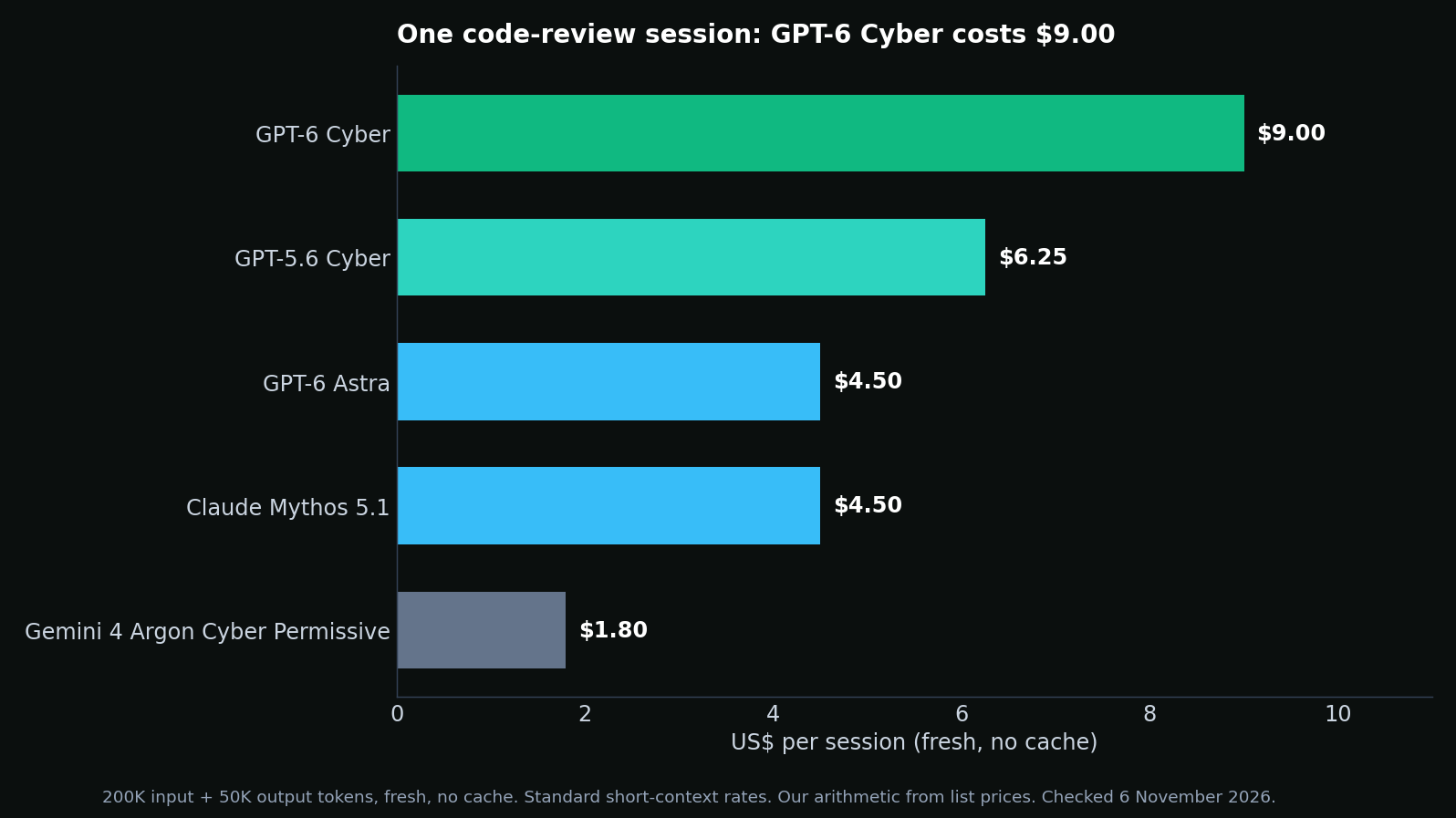
This is our own computed dataset — every figure below is arithmetic from the list prices above, not copied from a provider page. Take one code-review session: 200K input tokens and 50K output tokens. We keep input under 272K so standard short-context rates apply to every model.
| Model | Session cost (200K in + 50K out) | In BDT (at ৳120 per $1) |
|---|---|---|
| GPT-6 Cyber | $9.00 | ৳1,080 |
| GPT-5.6 Cyber | $6.25 | ৳750 |
| GPT-6 Astra | $4.50 | ৳540 |
| Claude Mythos 5.1 | $4.50 | ৳540 |
| Gemini 4 Argon Cyber Permissive | $1.80 | ৳216 |
| GPT-6 Luna via tokens.bd | $0.06 | ৳6.20 (tokens.bd's own BDT prices) |
The arithmetic: 200K input at $20/1M is $4.00 and 50K output at $100/1M is $5.00, so a GPT-6 Cyber session is $9.00. The same session on GPT-5.6 Cyber is $6.25 (200K × $12.50/1M = $2.50, plus 50K × $75/1M = $3.75). GPT-6 Cyber costs 44% more per session than its predecessor and exactly twice GPT-6 Astra or Mythos 5.1 — but output dominates the bill: more than half of the $9.00 is the 50K output tokens.
The second dataset is the campaign economics, computed from OpenAI's Linux report figures as relayed by independent coverage. The October campaign cost $1,213,430 in API credits and produced 948 working exploits — that is $1,213,430 ÷ 948 ≈ $1,280 per working exploit (about ৳153,600 at ৳120 per $1). The July run with GPT-5.6 Sol cost $513,690 for 166 exploits, or about $3,095 each. So the newer model found 5.7x as many exploits (948 vs 166) at 2.4x the total cost, cutting the cost per working exploit by about 59%. OpenAI values the 948 exploits at $18.9M–$66.3M against historical Pwn2Own ($20,000) and TyphoonPWN ($70,000) bounty prices — 16x to 55x the campaign's cost. Those bounty figures are OpenAI's comparison, not a market price for these particular findings, but the direction is unambiguous: exploit development, at frontier-model quality, has become a line item rather than a research program.
What should Bangladeshi developers and security teams do instead?#
Start with the honest constraint: no cyber-specialized model is available to you through tokens.bd today, and GPT-6 Cyber is not coming to any gateway until OpenAI widens Daybreak Red. The table below is verified live against the tokens.bd catalog on 6 November 2026.
| Model on tokens.bd (checked 6 November 2026) | Input / 1M | Output / 1M | On plans | Use it for |
|---|---|---|---|---|
| GPT-6 Luna | $0.15 (৳13.75) | $0.60 (৳68.75) | Weekly · Monthly · Pay as you go | Cheap code review, triage, first-pass scanning |
| GPT-5.6 Luna | $0.50 | $3.00 | Monthly · Pay as you go | General coding and review |
| GPT-5.6 Sol | $15.00 | $55.00 | Monthly · Pay as you go | Heavy reasoning, complex code analysis |
| Claude Sonnet 5.5 | $2.00 | $10.00 | Weekly · Monthly · Pay as you go | Careful code review, patch drafting |
| Kimi K3.1 Pro | $3.00 | $12.00 | Free · Weekly · Monthly · Pay as you go | Long-context codebase review (1M context) |
| DeepSeek V4.1 Flash 1017 | $0.30 | $0.80 | Free · Weekly · Monthly · Pay as you go | Bulk scanning on a budget |
Browse the model catalog for 60+ models with USD and BDT pricing, see plans for BDT payment options through bKash and Nagad, and check the docs for setup guides. Three practical moves follow. First, if you do authorized security testing, apply for Daybreak now — GPT-5.6 Cyber is already open to all Daybreak Red customers while GPT-6 Cyber expands. Second, build the non-model parts of the workflow today: sandboxed test environments, reproducible proof-of-concept harnesses, and a disclosure process, using GPT-6 Luna or Claude Sonnet 5.5 for triage and review — the same session that costs $9.00 on GPT-6 Cyber costs $0.06 on GPT-6 Luna through tokens.bd, and for first-pass scanning that is the right trade. Third, do not mistake a general model for a cyber model: Luna and Sonnet will refuse exploit-development work that GPT-6 Cyber is built to do, and that refusal is a feature, not a bug. Our earlier guide to GPT-6.1 Terra's pricing and benchmarks shows the same pattern from the other side: OpenAI's specialized models arrive gated and expensive, then widen over weeks, and the teams that benefit first are the ones whose workflows are ready.
GPT-6 Cyber FAQ#
Is GPT-6 Cyber available to everyone? No. It launched 5 November 2026 for a select group of approved Daybreak Red customers only, through the API and Codex. Access requires Daybreak Red membership plus an additional model-level approval, identity verification, and allowlisted IP addresses.
How much does GPT-6 Cyber cost? $20.00 per 1M input tokens, $2.00 per 1M cached input tokens, $25.00 per 1M cache writes (30 minutes) or $50.00 (12 hours), and $100.00 per 1M output tokens — standard short-context list prices, checked 6 November 2026. A 200K-input, 50K-output code-review session costs $9.00 by our arithmetic.
Is GPT-6 Cyber on tokens.bd? No — verified against the live catalog on 6 November 2026. tokens.bd carries 60+ models, but GPT-6 Cyber is not among them, and no gateway can offer it until OpenAI widens Daybreak Red access. The closest OpenAI models on tokens.bd are GPT-6 Luna ($0.15/$0.60) and GPT-5.6 Sol ($15.00/$55.00) — neither is cyber-specialized.
How good is GPT-6 Cyber at finding vulnerabilities? On OpenAI's own numbers: 48.5% on ExploitGym (vs 32.1% for GPT-5.6 Cyber and 42.4% for GPT-6 Astra), 40.3% recall on offensive web pentesting, and 95% completion on RemoteExploitBench. In real campaigns it reproduced 1,724 Linux kernel vulnerabilities and built 948 working exploits, and found 81 previously unknown high-severity Firefox vulnerabilities. All vendor-reported, awaiting independent replication.
What is Daybreak Red, and how do I apply? Daybreak is OpenAI's trusted-access program for cybersecurity work: Blue is the broader tier for vulnerability validation, Red is the deeper tier for exploit development and authorized testing. New users and organizations apply through OpenAI, describing the defensive workflows they plan to use the models for. OpenAI has enrolled upwards of 2,000 entities.
Prices, access terms and benchmark figures checked 6 November 2026 (OpenAI model documentation and pricing page; GPT-5.6 Cyber, Mythos 5.1 and Argon Cyber Permissive prices via VentureBeat's comparison of published rates; tokens.bd catalog re-verified live 6 November 2026). BDT conversions at ৳120 per US$1 unless stated as tokens.bd's own displayed BDT prices. Benchmark figures are vendor-reported until independent labs replicate them; the OpenAI announcement and system card are the authority for capability claims.
Sources: Introducing GPT-6 Cyber (OpenAI, official announcement) · GPT-6 Cyber model documentation (OpenAI) · OpenAI API changelog, 5 November 2026 entry (OpenAI) · GPT-6 Cyber system card (OpenAI Deployment Safety) · OpenAI API pricing (OpenAI) · OpenAI launches GPT-6 Cyber with stronger exploit research and higher API price (VentureBeat, independent coverage) · OpenAI releases GPT-6 Cyber after model finds 948 Linux kernel exploits (MLQ, relaying OpenAI's "A thousand fewer paths to root" report) · tokens.bd model catalog · GPT-6 Luna on tokens.bd · GPT-6.1 Terra: price, benchmarks, switch guide (tokens.bd)
See also: How to Use the OpenAI API from Bangladesh — the refreshed guide to paying for the OpenAI API from Bangladesh, with model prices in taka and the two working payment routes.
See also: Claude Fable 5.2 now leads the Artificial Analysis Index at 65 — price, benchmarks, and access.