TL;DR: Inception Labs' Mercury 3, launched 19 October 2026, is the first diffusion language model that seriously challenges the fast tier — on architecture, not price alone. Instead of writing one token at a time like every frontier model you use today, it drafts the whole answer and refines it in parallel — how Inception reaches a claimed 1,068 tokens per second with a 1M-token context window. The honest version of that number is smaller: OpenRouter's live traffic measured a 160–254 tok/s median in launch week. Even the smaller number beats GPT-6 Luna, and at launch pricing ($0.10/$0.35 per 1M tokens, 50% off list) a typical agent session costs about $0.068 — roughly 10% less than Claude Haiku 5.5 or GPT-6 Luna. But the list price is 80% more than both, the launch discount has no end date, and no independent lab has verified any Mercury 3 number yet. Try it for agent loops and subagents; don't rebuild your stack on it this week.
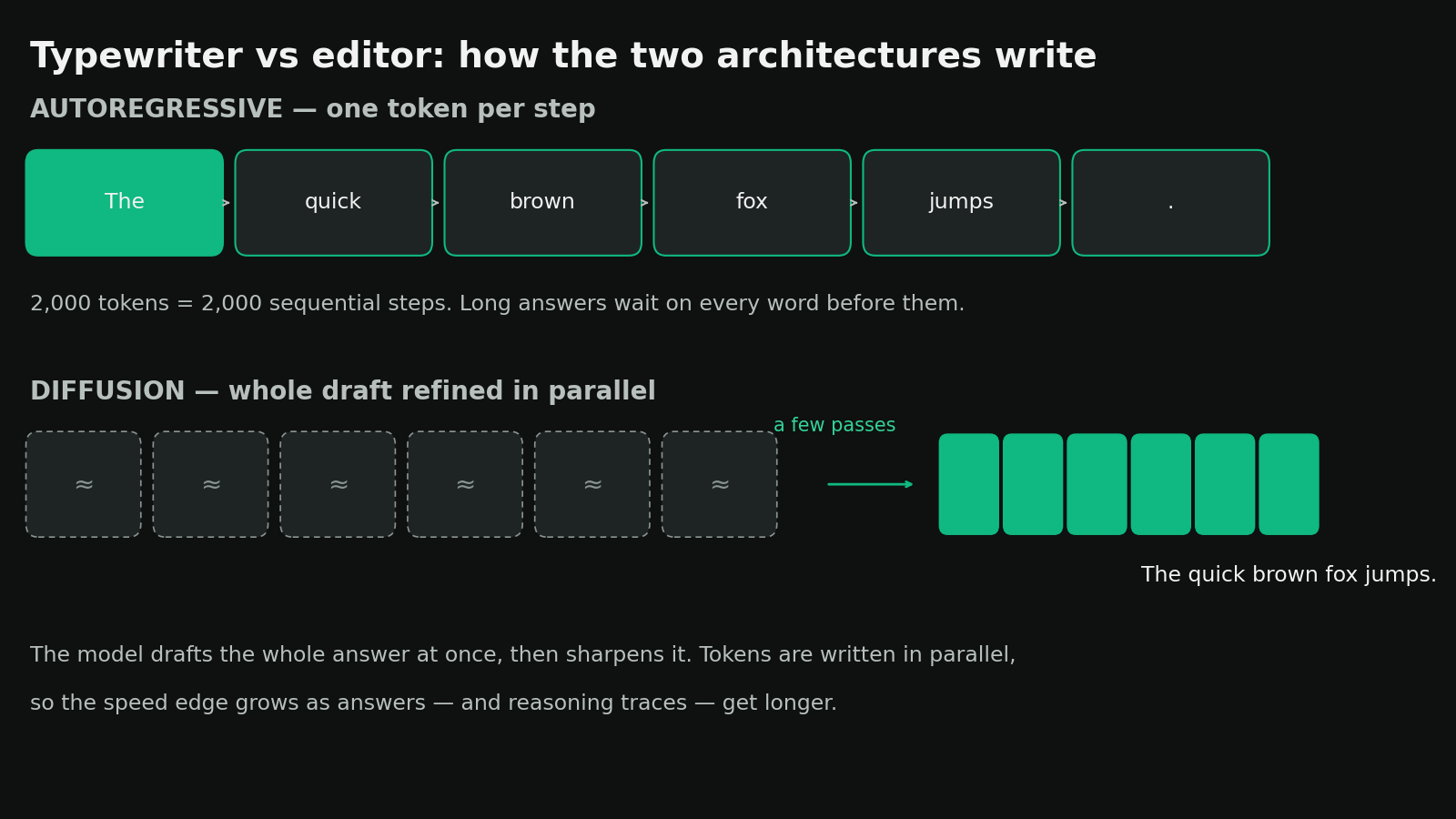
Every fast model you've used works the same way: it predicts the next word, appends it, and repeats. That is why long answers take long — a 2,000-token reply is 2,000 sequential steps. Mercury 3 is the first commercial model to make a serious case for a different way of writing. This post separates what Inception proved from what it merely claimed: the speed, the benchmarks, the price, and the exact point where switching makes sense.
What is Mercury 3, and what makes it different?#
Mercury 3 is Inception Labs' flagship diffusion language model (dLLM), launched 19 October 2026 as a closed-weights, API-only model with a 1M-token context window, tool calling, structured outputs, and a maximum output of 131,072 tokens per response. It replaces Mercury 2.5, which shipped only six weeks earlier, and Inception calls it "the most capable diffusion-based LLM released to date" — more than 40 times larger than Mercury 1 while running at the same speed, though the company has not published an absolute parameter count. The difference that matters is architectural: where autoregressive models write word by word, a diffusion model starts from a rough, noisy draft of the entire answer and refines all of it in parallel over a small number of passes — the same coarse-to-fine idea image generators use to sharpen a picture out of static.
That parallel structure is why diffusion models were always supposed to be fast, and why they were never supposed to be smart. The open question was whether a diffusion LLM could match autoregressive quality at all; Inception's answer is a scaling chart showing quality climbing roughly 3x from Mercury 1 (mini) to Mercury 3 as the model grew 40x. If that scaling holds, the speed edge grows with answer length: longer reasoning traces mean more of the bill is output tokens, exactly where parallel generation wins. Inception's chief scientist put it in the launch thread — diffusion generates tokens in parallel through iterative denoising, so as reasoning traces get longer, the speed advantage over same-size autoregressive models grows.
Two practical consequences follow. First, Mercury 3 is text-in, text-out only — voice is a separate sibling, Mercury Voice, tuned for time-to-first-token under 170ms. Second, it is a portfolio play: alongside Mercury 3, Inception sells Mercury Decide, a classification model at $0.02 per 1M input tokens with output unbilled, and Mercury Edit 2 for code autocomplete. The launch targets latency-sensitive production systems — browser agents, real-time search, tutoring, support — where a two-second response is the requirement and a five-second one is a bug.
How fast is Mercury 3 in the real world?#
The honest answer is: much faster than its rivals, but nowhere near the headline. Inception's 1,068 tokens per second is measured on its own NVIDIA hardware, with the GPU, batch size, and reasoning-effort setting undisclosed — all four change the number by multiples. The only independent measurement available in launch week comes from OpenRouter, which routes every Mercury 3 request to Inception itself and publishes live throughput: two captures on 20 October showed medians of 160 and 254 tok/s, with a one-week median average of 203. That is roughly a fifth of the headline, and it is still faster than both models Inception prices against — about 240 tok/s for Claude Haiku 5.5 and about 130 tok/s for GPT-6 Luna in Inception's own table.

The gap is normal, not scandalous — OpenRouter measures across real traffic, at whatever effort settings callers pick and whatever load the servers carry, and diffusion's edge is strongest at low concurrency. But it changes the buying math. A single 2,000-token reply takes about 1.9 seconds at the vendor figure, 9.9 seconds at OpenRouter's 203 median, 8.3 seconds on Haiku 5.5, and 15.4 seconds on Luna. An agent chain of 12 calls at 600 tokens each (7,200 tokens) finishes generating in 6.7 seconds at 1,068 tok/s, 28–45 seconds at OpenRouter's measured 254–160 range, 30 seconds on Haiku, and 55 seconds on Luna. So the right framing is Inception's own chief scientist's: Luna-class smarts, much faster output — a pick for loops, not for single replies. One more caveat: time-to-first-token can feel slow even when throughput is high, and Octen's smart-glasses tests put median generation at 0.9 seconds but median end-to-end response at 2.2 seconds. Throughput is not latency, and your users feel latency.
What do Inception's benchmarks actually show?#
Inception's comparison table, reproduced from its launch materials, puts Mercury 3 against the two models it is priced to replace — GPT-6 Luna and Claude Haiku 5.5 — all at medium reasoning effort. Read across it, Mercury 3 holds the top score on 8 of 12 rows, and head to head it beats each rival on 10 of 12. The wins are widest exactly where agent builders care: agentic coding and agentic search. The losses are narrow and specific: long-context recall and one coding test, where Haiku 5.5 stays ahead. Every number below is Inception's own run — no independent lab has published Mercury 3 scores yet, and there is no low-to-high effort curve, so you cannot tell how far Luna or Haiku close the gap with more thinking.
| Benchmark | What it tests | Mercury 3 | GPT-6 Luna | Claude Haiku 5.5 |
|---|---|---|---|---|
| GDPval (Elo) | Real work tasks | 1,237.2 | 1,204.0 | 1,225.0 |
| τ³-bench Banking | Agent customer service | 30.24 | 23.00 | 13.06 |
| MultiChallenge | Multi-turn chat | 60.35 | 51.49 | 52.48 |
| AA-Omniscience | Factual recall | 46.44 | 46.94 | 37.22 |
| IFBench | Instruction following | 76.84 | 61.82 | 54.65 |
| GPQA Diamond | Graduate-level science | 89.23 | 86.36 | 84.51 |
| AA-LCR v1.1 | Long-context reasoning | 77.67 | 78.30 | 74.70 |
| MRCR v2 | Long-context recall | 75.50 | 62.72 | 78.40 |
| SWE-Bench Atlas | Agentic coding | 51.08 | 33.33 | 32.26 |
| DeepSWE v1 | Agentic coding | 46.31 | 37.76 | 51.62 |
| BrowseComp+ | Agentic search | 55.18 | 50.50 | 45.78 |
| DeepSearchQA | Agentic search | 71.33 | 60.00 | 65.22 |
All benchmarks checked 25 October 2026; figures are Inception's own runs at medium effort, not independent measurements.
Three readings matter more than the win count. First, the agent-task gaps are large: SWE-Bench Atlas 51.08 against 33.33 and 32.26, and τ³-bench Banking 30.24 against 23.00 and 13.06 — if those reproduce, Mercury 3 is a genuinely better subagent engine, not just a faster one. Second, the losses cluster where long-context work lives: Haiku leads MRCR v2 recall (78.40 vs 75.50) and DeepSWE coding (51.62 vs 46.31), and Luna edges both long-context tests — so retrieval over a large codebase or a long session is where you should test hardest before trusting it. Third, the one task-level result with a real harness behind it is Inception's own: Mercury 3 completed 50% of 50 live Mind2Web web-navigation tasks in its production web-agent harness, "significantly more than GPT-6.1 Sol" on the same token volume and step count — a small sample on Inception's own harness, but task completion on live sites is harder to game than a multiple-choice suite. Until a neutral harness publishes Mercury 3 numbers, treat the whole table as a vendor claim with the right shape, not a verdict.
What does Mercury 3 cost?#
Mercury 3 lists at $0.20 per 1M input and $0.70 per 1M output tokens, with cached input at $0.02 — and at launch all three are half price: $0.10, $0.35, and $0.01. New API accounts get 100 million free tokens, worth about $10 of input at launch rates. The catch is the one every launch discount carries: Inception has stated no end date, so the launch price is a promotion, not a rate card. Plan against list; enjoy launch while it lasts. Against its two rivals, both listing at $0.10 input and $0.50 output, the launch price undercuts on output and the list price loses badly on it — which is why the discount's end date is the most important number Inception hasn't published.
| Model | Input per 1M | Cached input per 1M | Output per 1M | Context |
|---|---|---|---|---|
| Mercury 3 (launch) | $0.10 | $0.01 | $0.35 | 1M |
| Mercury 3 (list) | $0.20 | $0.02 | $0.70 | 1M |
| Claude Haiku 5.5 | $0.10 | $0.05 | $0.50 | 200K |
| GPT-6 Luna | $0.10 | $0.05 | $0.50 | 1M+ |
All prices checked 25 October 2026; provider list prices in USD per 1M tokens. Haiku and Luna cached-input rates are their standard 50% cache discounts; Mercury's cached rate is 90% off input.
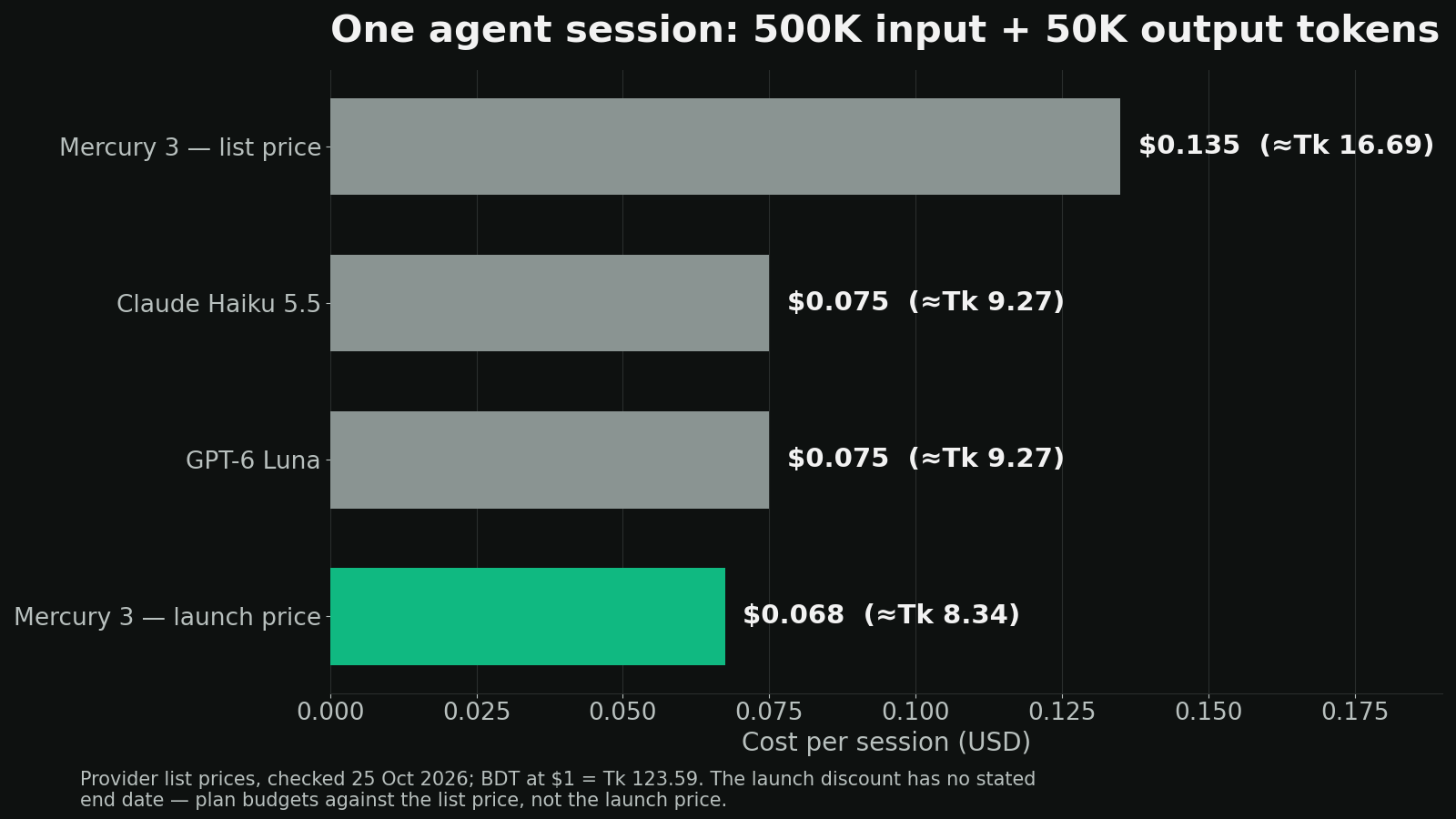
The session math makes the trade-off concrete. Take one agent session of 500K input and 50K output tokens — the same assumption this blog's cost comparisons use, so the numbers are comparable. At launch rates Mercury 3 costs $0.05 + $0.0175 = $0.0675, about ৳8.34 at $1 = ৳123.59. Haiku 5.5 and GPT-6 Luna each cost $0.05 + $0.025 = $0.075, about ৳9.27 — so Mercury 3 at launch is 10% cheaper per session than both. At list rates it costs $0.10 + $0.035 = $0.135, about ৳16.68 — 80% more than either rival. The cache line is where agents actually save: a 20,000-token system prompt resent every step costs $0.004 per call uncached at list input rates, but $0.0004 cached — over a 50-step run, $0.20 of preamble versus $0.02. That 90% cache discount is the quiet reason Mercury 3's economics work for long agent loops even after the launch discount ends.
How do you call Mercury 3 from your code?#
Mercury 3 is OpenAI API compatible, so it drops into an existing stack with no rewrites — the model id is mercury-3, served from Inception's own API platform and through OpenRouter, Baseten, Vercel, and Venice. New accounts get 100 million free tokens, so your first experiments cost nothing — put the key in INCEPTION_API_KEY and the snippet below runs as-is. A minimal call looks like any OpenAI chat completion, with one parameter that deserves attention: reasoning_effort, which takes instant, low, medium, or high. Mercury 3 defaults to low when you leave it out — Mercury 2.5 defaulted to medium, so a straight model swap also changes how hard the model thinks, and Inception's benchmark claims are all at medium. If you benchmark it yourself, pin the effort level explicitly or your numbers will not be comparable to anyone else's.
import os
from openai import OpenAI

client = OpenAI(
    base_url="https://api.inceptionlabs.ai/v1",
    api_key=os.environ["INCEPTION_API_KEY"],
)

response = client.chat.completions.create(
    model="mercury-3",
    messages=[{"role": "user", "content": "Summarise this log file in five bullets."}],
    reasoning_effort="medium",  # pin it: default is "low" on Mercury 3
    temperature=0.7,             # range is 0.5–1.0
    max_tokens=131072,           # Mercury 3's maximum output
)
Three gotchas to code around. First, temperature only runs 0.5 to 1.0 — a client sending temperature: 0 for deterministic tool calls needs changing. Second, the free tier caps output at 100,000 tokens per minute, rising to 300,000 on pay-as-you-go — fine for evaluation, a real ceiling for production bursts. Third, reasoning tokens bill inside the completion total, so don't add them twice when estimating costs; the session math above already counts billed output, thinking included. On access: Mercury 3 is not on the tokens.bd model catalog yet (checked 25 October 2026), so for now you call it on an Inception key or through OpenRouter — the fast tier already on tokens.bd, including Haiku 5.5 and GPT-6 Luna, is the fallback side of the two-model pattern below.
Should you switch to Mercury 3?#
Switch the latency-critical tier, not the whole stack. Mercury 3 earns a week of evaluation for any workload where waiting compounds — agent loops, subagents, web navigation, real-time search, support drafting — and where a wrong answer is recoverable by a human or an escalation path. It does not yet earn a migration where a wrong answer is expensive and unmonitored: the quality claim is vendor-only, the measured speed is a fifth of the headline, the launch price has no end date, and the model loses the long-context recall test to Haiku 5.5. The pattern that fits an unproven, unusually fast release is the two-model path from our model routing guide: send the latency-critical tier to Mercury 3 on an Inception key, and keep fallback and hard cases on models you already trust, with automatic failover if the new provider degrades.
Two dates frame the decision. Mercury 2 and 2.5 keep running through 15 November 2026, so existing Mercury users have three weeks to test Mercury 3 before the old models go dark — and the effort default changes under them when they move, from medium to low. The weights question has a clean answer: there are none. Mercury 3 is proprietary and API-only, unlike the recent open-weight releases — Kimi K3.1 Pro's weights are due by 4 November and MiniMax's M3.1 Flash weights are already out. If downloadable weights matter, Google's DiffusionGemma is the open diffusion model to compare against, not Mercury 3. Watch three things: an independent Mercury 3 measurement, whether Inception publishes the hardware and effort setting behind its figures, and whether the launch discount gets an end date. The first independent benchmark will settle both the speed and the quality question in one go — until then, Mercury 3 is a real release with a defensible architectural story, an aggressive price, and a quality claim nobody outside Inception has yet tested.
Mercury 3 FAQ#
Is Mercury 3 really 1,068 tokens per second? That is Inception's measurement on its own NVIDIA hardware, with the GPU, batch size, and effort setting undisclosed. The only independent live measurement in launch week, from OpenRouter's published throughput, showed medians of 160 and 254 tok/s across two captures on 20 October, with a one-week median average of 203. Expect the measured number, not the headline, and measure it on your own traffic before promising anything to users.
Is Mercury 3 better than Claude Haiku 5.5 and GPT-6 Luna? On Inception's own table at medium effort, Mercury 3 leads 8 of 12 rows and beats each rival on 10 of 12 head to head — widest gaps on agentic coding and search, losses on long-context recall (Haiku) and one coding test. No independent lab has published Mercury 3 scores yet, so the honest answer is "better on Inception's tests, unverified everywhere else."
How much does Mercury 3 cost? List price is $0.20 per 1M input and $0.70 per 1M output, with cached input at $0.02. At launch everything is half price — $0.10, $0.35, and $0.01 cached — with no stated end date, and new accounts get 100 million free tokens. A 500K-input, 50K-output session costs about $0.068 at launch rates and $0.135 at list, against $0.075 on Haiku 5.5 or GPT-6 Luna.
Can I self-host Mercury 3? No. Mercury 3 is proprietary and API-only — no weights are available to download. It is served through Inception's API platform, OpenRouter, Baseten, Vercel, and Venice, with an OpenAI-compatible API. If you need open weights, look at Kimi K3.1 Pro (weights due by 4 November 2026) or MiniMax M3.1 Flash (weights already released), not Mercury.
Should existing Mercury 2 or 2.5 users migrate now?
Yes, but test first. Mercury 2 and 2.5 keep running through 15 November 2026, giving you three weeks. When you move, remember the effort default changes from medium to low — pin reasoning_effort explicitly — and re-check temperature settings, since Mercury only accepts 0.5 to 1.0.
All prices, speeds, and benchmark figures checked 25 October 2026. Vendor-reported numbers are labelled as such; the provider's own docs are the authority, and the model catalog is the authority for prices on Tokens.
Sources: Inception Labs — Introducing Mercury 3 (launch post) · Inception Mercury 3 explained: speed, benchmarks, price, access · Mercury 3: 1,068 tokens a second, and no benchmarks · Mercury 3 agent cost: session math and API limits · Inception Labs claims Mercury 3 beats Haiku and GPT-6 Luna at 1,068 tokens a second · Mercury 3: a diffusion LLM at 1,068 tokens/sec · Venice lists Mercury 3 for API use · Inception releases Mercury 3 with faster diffusion inference and 1M-token context · tokens.bd model catalog, checked 25 October 2026