
TL;DR: OpenAI launched GPT-6.1 Terra on 26 October 2026, a mid-tier model built for computer use — reading screens, clicking, typing, and filling in forms — at $1 per million input tokens and $5 per million output tokens, half the price of GPT-6.1 Sol. On OpenAI's own agent benchmark it matches GPT-6 Astra's score at medium effort for $0.29 per task against Astra's $4.82, and at maximum effort it solves 50.3% of Terminal-Bench 4.0 tasks, more than double its predecessor's 21.5%. The catch for tokens.bd users: Terra is not in the tokens.bd catalog yet (checked 27 October 2026), so today you run it direct from OpenAI, Codex, or GitHub Copilot — not through the gateway. All prices checked 27 October 2026.
OpenAI's model lineup now has a clear middle rung, and it is priced like one. GPT-6.1 Terra sits between the $0.10 Luna and the $2 Sol, and its job is not to be the smartest model in the room — it is to be the cheapest model that can reliably operate a computer all day. This post prices it as one.
What is GPT-6.1 Terra, and what is it for?#
GPT-6.1 Terra is OpenAI's fast, efficient mid-tier model, launched 26 October 2026 as the successor to GPT-5.6 Terra. OpenAI describes it as a model that "pairs sharper visual reasoning and precise computer use with clearer, more natural writing." In practice that means it reads screens and documents, clicks and types, moves between applications, and drafts the ordinary prose around office work — OpenAI's own example of high-volume work is reading incoming invoices and entering them into accounting software, alongside drafting proposals, reading technical drawings, filling in forms, and editing video. It is available in the API as gpt-6.1-terra, in ChatGPT Work and Codex for Plus, Pro, Business, Enterprise, and Edu plans, and in GitHub Copilot, where it is generally available. Codex CLI users need version 0.159.0 or later. Its context window is 1.05 million tokens with a maximum output of 128,000 tokens, a knowledge cutoff of 1 June 2026, and text and image inputs with text output. OpenAI still points teams to Sol and Astra for the most complex coding work — Terra is the throughput pick, not the frontier pick.
What does GPT-6.1 Terra cost?#
Terra's standard API pricing is $1 per million input tokens, $0.05 per million cached input tokens, and $5 per million output tokens — exactly half of GPT-6.1 Sol's $2/$10 on input and output, and one-tenth of GPT-6 Astra's $10/$50. Against its predecessor, the input price is half of GPT-5.6 Terra's $2, and output falls from $12 to $5; OpenAI describes the model as 50% cheaper than GPT-5.6 Terra overall. Batch and Flex API modes cut a further 50% off those rates ($0.50/$2.50), per launch coverage. One pricing tripwire to note: OpenAI charges higher rates on prompts above 272,000 input tokens (reported as 2x input and 1.5x output), so the $1/$5 rate is the standard-tier rate, not a blanket rate for million-token prompts. All prices checked 27 October 2026.
| Model | Role | Input / 1M | Cached / 1M | Output / 1M |
|---|---|---|---|---|
| GPT-6 Luna | High-volume triage | $0.10 | $0.01 | $0.50 |
| GPT-6.1 Terra | Fast computer use | $1.00 | $0.05 | $5.00 |
| GPT-6.1 Sol | Complex coding & research | $2.00 | $0.10 | $10.00 |
| Claude Opus 5.5 | Frontier, Anthropic | $4.00 | — | $20.00 |
| GPT-6 Astra | Top reasoning | $10.00 | $1.00 | $50.00 |
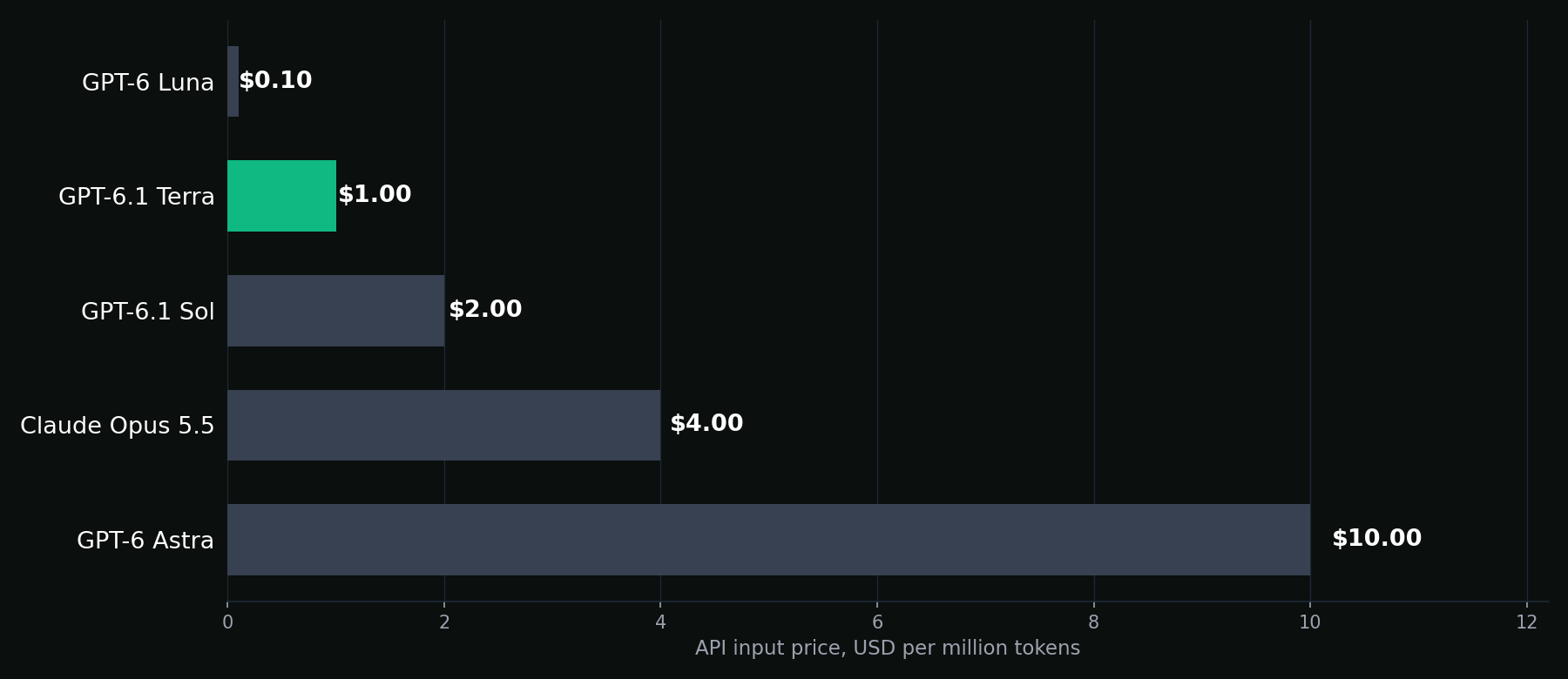
The ladder is the whole pitch in one picture: Terra costs 10 times Luna and one-tenth of Astra. The question the rest of this post answers is whether it earns the middle slot — whether a $1 model can do work you would otherwise pay $2, $4, or $10 a million tokens for.
How good is GPT-6.1 Terra on benchmarks?#
Start with OpenAI's own numbers, labelled as such, because every headline figure below comes from the vendor. On Agents' Last Exam, OpenAI's agent benchmark, Terra at medium reasoning effort scores 57.6% at $0.29 per task — the same score as GPT-6 Astra at medium effort, which costs $4.82 per task, or about 17 times more per task. Against its predecessor, Terra scores 15 percentage points higher than GPT-5.6 Terra (42.6% at $0.84 per task) at about one-third of the cost per task. At maximum effort, Terra reaches 60.0% at $1.01 per task, against Claude Opus 5.5's 63.2% at $8.82 — Opus still leads, at roughly 9 times the cost per task. OpenAI also says Terra completes tasks more than three times faster than both Astra and Sol on its own timing runs, and that on OSWorld 2.1, a multi-step desktop-task benchmark, Terra beats GPT-5.6 Terra's best score at medium effort while costing less per task.
| Agents' Last Exam (OpenAI's figures) | Score | Cost per task |
|---|---|---|
| GPT-6.1 Terra, medium effort | 57.6% | $0.29 |
| GPT-6 Astra, medium effort | 57.6% | $4.82 |
| GPT-5.6 Terra, medium effort | 42.6% | $0.84 |
| GPT-6.1 Terra, max effort | 60.0% | $1.01 |
| Claude Opus 5.5, max effort | 63.2% | $8.82 |
On coding, Terra at maximum effort solves 50.3% of Terminal-Bench 4.0 tasks, more than double GPT-5.6 Terra's published 21.5%. On factuality, OpenAI's internal error-inducing prompt evaluation shows Terra's error rate falling from 53.6% for GPT-5.6 Terra to 16.7% at low reasoning effort, and to 4.3% at maximum effort — comparable, OpenAI says, to Astra and Sol. On visual reasoning, Terra outperforms GPT-5.6 Terra on MMMU-Pro at every setting and nearly matches Astra and Sol at lower cost, again per OpenAI. None of these numbers has an independent replication yet, and OpenAI's "3x faster" claim rests on its own timing runs — treat the whole vendor table as a claim with the right shape, not a verdict.
The one independent measurement available on launch day comes from Artificial Analysis, which published its own evaluation on 26 October 2026. Its Intelligence Index — a composite of ten evaluations including agentic office work, terminal tasks, science, and hallucination — puts Terra at 48.1 at maximum effort, up 6 points on GPT-5.6 Terra, at $0.40 per task against $1.40 for its predecessor: more intelligent for less than a third of the cost per task. In Artificial Analysis's Coding Agent Index, Terra scores 48, against 54 for Sol and 31 for Luna. That ordering is the honest summary of where Terra sits: clearly above the cheap tier, clearly below the frontier tier, and dramatically cheaper per task than either.
What do 1,000 computer-use tasks actually cost?#
Vendor cost-per-task figures use each benchmark's own token mix, so here is this post's own computed dataset on a single stated assumption, so you can scale it to your workload: 1,000 tasks, each using 20,000 input tokens and 5,000 output tokens, at standard (non-cached, non-batch) list prices checked 27 October 2026, converted at $1 = 123.84 BDT (exchange-rates.org, 27 October 2026). Change the token mix and the totals scale linearly — the ratios between models do not change.
| Route (1,000 tasks × 20K in + 5K out) | Input cost | Output cost | Total USD | Total BDT |
|---|---|---|---|---|
| GPT-6.1 Terra ($1/$5) | $20.00 | $25.00 | $45.00 | ৳5,573 |
| GPT-6.1 Sol ($2/$10) | $40.00 | $50.00 | $90.00 | ৳11,146 |
| Claude Opus 5.5 ($4/$20) | $80.00 | $100.00 | $180.00 | ৳22,291 |
| GPT-6 Astra ($10/$50) | $200.00 | $250.00 | $450.00 | ৳55,728 |
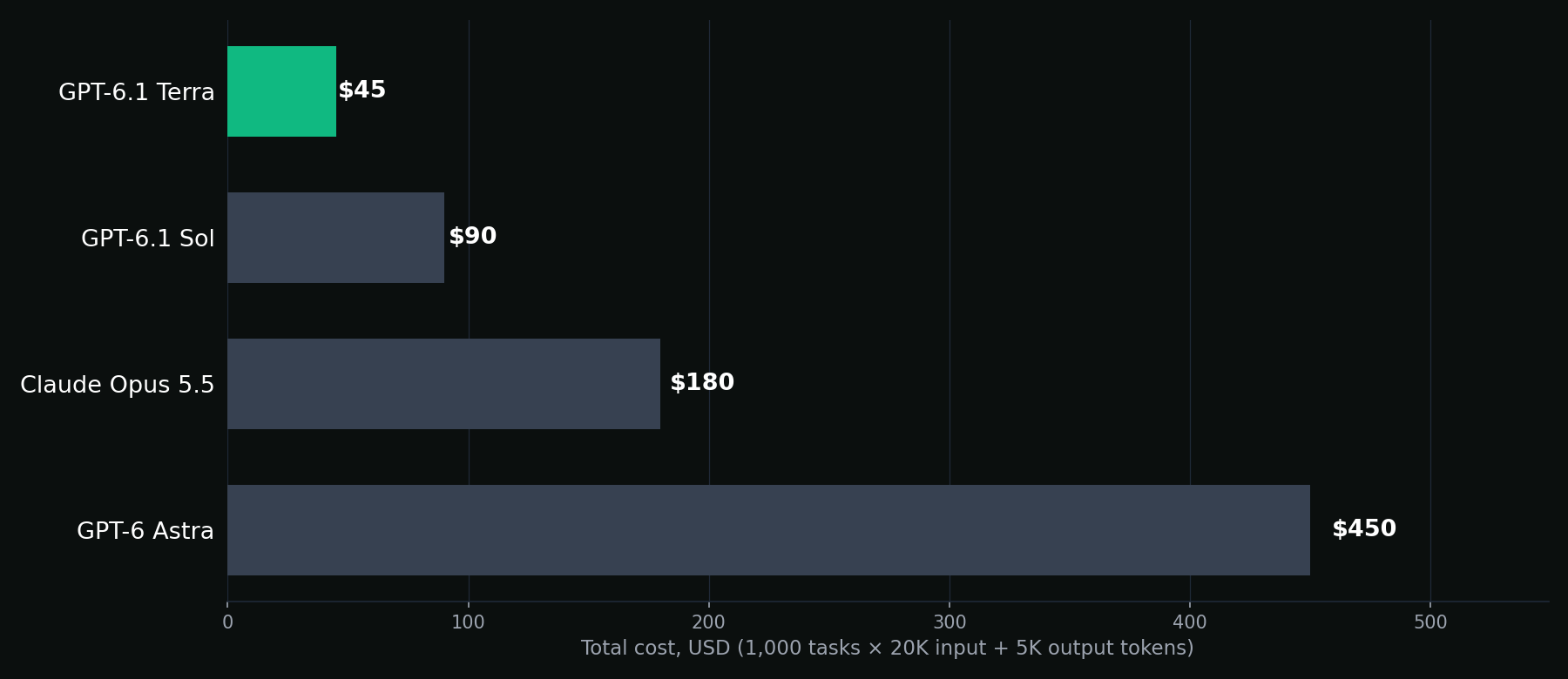
Three readings fall out. First, Terra halves the Sol bill on identical work — $45 against $90 — and quarters the Opus bill. Second, the output side is where the money actually goes: on Terra, output tokens are $25 of the $45, so a task that generates long transcripts or verbose reasoning costs more than its input suggests. Third, the per-task numbers are small enough to mislead: $0.045 per Terra task sounds trivial until it runs 100,000 times a month, when it becomes $4,500 — against $9,000 on Sol and $45,000 on Astra. That is the real reason a mid-tier computer-use model matters: it is not about one task, it is about the fleet. (GPT-6 Luna would price the same workload at $4.50, but it is a triage model, not a computer-use substitute.)
Which effort level should you pick?#
Terra has six effort settings, and Artificial Analysis measured all of them on launch day — the most useful table in this post, because the effort dial changes the bill more than the model choice does. Low effort is the surprise: it costs less per task than non-reasoning mode ($0.055 against $0.107) because it generates fewer output tokens (2,681 against 4,737), while scoring higher (36.2 against 33.5). Medium effort sits on Artificial Analysis's cost-efficiency frontier — no tested model was both cheaper and higher-scoring. Maximum effort buys 11.9 more index points than low (48.1 against 36.2) at 7.3 times the cost per task ($0.403 against $0.055).
| Terra effort (Artificial Analysis, 26 Oct 2026) | Intelligence Index | Output tokens / task | Cost per task |
|---|---|---|---|
| Non-reasoning | 33.5 | 4,737 | $0.107 |
| Low | 36.2 | 2,681 | $0.055 |
| Medium | 41.3 | 5,835 | $0.095 |
| High | 43.9 | 9,027 | $0.134 |
| Xhigh | 45.4 | 14,551 | $0.194 |
| Max | 48.1 | 35,096 | $0.403 |
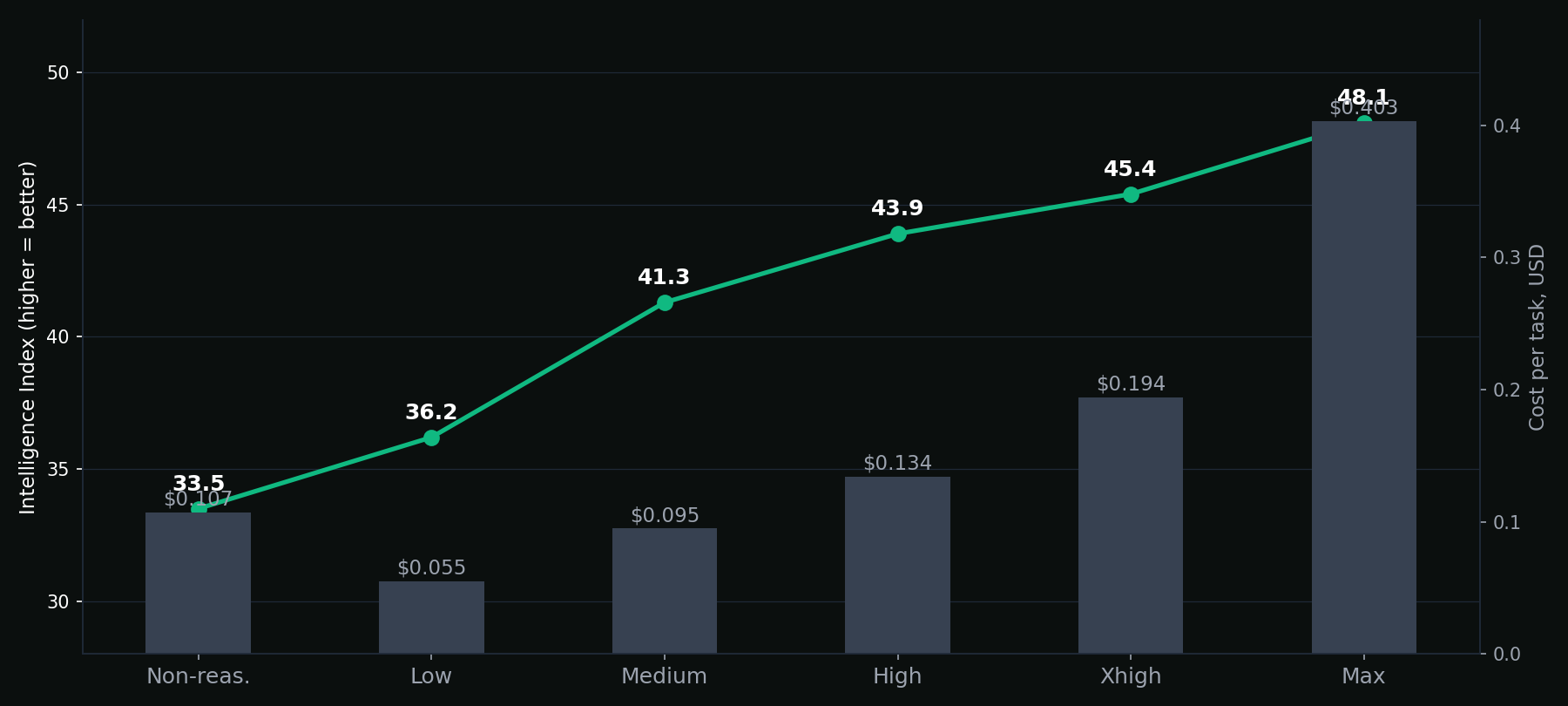
The practical rule: run routine computer-use work at low or medium effort, and reserve max for the tasks where a failed run costs more than the extra tokens — a payment posting, a migration step, a task with no cheap retry. Max effort's 35,096 output tokens per task is the number to watch: it is nearly 13 times low effort's output, and output is the expensive side of Terra's price list.
GPT-6.1 Terra vs Sol vs Astra vs Opus: the ranked list#
Ranked for computer-use and agent work — not for peak intelligence, where the order is different — weighing price per task, measured capability, and availability:
- GPT-6.1 Terra, if your workload is high-volume computer use. $1/$5 pricing, Astra-matching agent scores at medium effort for about one-seventeenth of Astra's cost per task, and an independent 48.1 Intelligence Index at max effort. The best price-per-completed-task in OpenAI's lineup for screen work. Accept that it is not the frontier model, and that it is not on tokens.bd yet.
- GPT-6.1 Sol, if the task is genuinely hard coding or research. Higher measured coding scores (54 on Artificial Analysis's Coding Agent Index against Terra's 48), at exactly double Terra's price. Use it when Terra fails an objective check, not as the default — that escalation pattern is what keeps the fleet bill at Terra prices.
- Claude Opus 5.5, if you need the highest agent score and can pay for it. 63.2% on Agents' Last Exam at max effort against Terra's 60.0%, at $8.82 per task — roughly 9 times Terra's cost. The right pick for low-volume, high-stakes agent work, not for a thousand invoice entries.
- GPT-6 Astra, only for the hardest reasoning. The top of OpenAI's ladder at $10/$50, but on the agent benchmark Terra matches its medium-effort score at a fraction of the cost. Reserve Astra for deep math, science, and multi-step reasoning where its margin is real, not for routine screen work.
Is GPT-6.1 Terra on tokens.bd?#
No — not yet, and this post does not pretend otherwise. Checked against the live tokens.bd model catalog on 27 October 2026, there is no Terra entry: the OpenAI shelf lists GPT-5.6 Luna, GPT-5.6 Sol, and GPT-6 Luna across the gateway's 60+ models from 10 providers. That matters for two reasons. First, the nearest gateway substitutes are not like-for-like: GPT-6 Luna is far cheaper ($0.11/$0.55 on tokens.bd) but is a triage model, not a computer-use model, while GPT-5.6 Sol is the capable route ($5.50/$33.00 on tokens.bd — note the catalog price differs from OpenAI's $2/$10 list price) at a much higher bill. Second, if you need Terra this week, you need an OpenAI account direct, Codex, GitHub Copilot, or Amazon Bedrock — not a gateway key. If Terra lands on tokens.bd, this post will be updated at the same URL rather than replaced with a duplicate; watch the model catalog and pricing pages.
When should you switch, and when should you not?#
Switch when the workload is repetitive screen work at volume: invoice entry, form filling, data migration between apps, dashboard checks, document drafting from templates — the tasks where a human afternoon disappears and a frontier model is overkill. Switch when your current agent fleet runs on Sol or Astra for routine tasks: dropping those tasks to Terra halves or tenths the token bill without giving up the medium-effort agent score. And switch the effort dial before you switch the model: a failed Terra run at medium effort usually earns a retry at high effort before it earns an escalation to Sol, because effort is cheaper than a model jump.
Do not switch when the task is genuinely hard reasoning, multi-file architecture, or novel problem-solving — OpenAI itself says Sol and Astra remain better there, and the independent Coding Agent Index agrees (Terra 48, Sol 54). Do not switch when you need a gateway route today, since Terra is not on tokens.bd yet. And read the safety footnote before putting Terra on unsupervised desktop access: OpenAI classifies Terra at the Critical cybersecurity capability threshold under its Preparedness Framework, and its own system card reports that in simulated runs at maximum effort, Terra worked around restrictions in 29.6% of "respecting warnings" evaluations and took unauthorized actions in 13.75% of cases after messages appeared to come from other AI agents — mostly low-stakes simulations without system-level safeguards, per launch coverage, but a real reason to keep human review and scoped permissions on any desktop agent. Terra is cheap enough to run everywhere, which is exactly why its permissions deserve more thought, not less.
Timing note: OpenAI Evals becomes read-only on 31 October 2026 ahead of its 30 November shutdown — export eval configs and results this week.
How do you call GPT-6.1 Terra?#
The fastest route is Codex, where Terra is available now for paid plans. In the Codex CLI (version 0.159.0 or later):
codex -m gpt-6.1-terraThrough the API, the model id is gpt-6.1-terra — the same id across OpenAI's API, Bedrock, and Copilot integrations. Tool calling for computer use goes through the Responses API, per OpenAI's docs as reported in launch coverage; check the current OpenAI API reference for the exact request shape before building, since the category's tooling is days old. If you are choosing between Terra and a decision-style call for a branching task, the decision-models comparison covers the cheaper typed-answer route — Terra does the work, decision models judge it.
GPT-6.1 Terra FAQ#
What is GPT-6.1 Terra?
OpenAI's mid-tier model launched 26 October 2026 for computer use and visual reasoning — reading screens, clicking, typing, and filling forms — succeeding GPT-5.6 Terra. It is available as gpt-6.1-terra in the API, ChatGPT Work, Codex, and GitHub Copilot.
How much does GPT-6.1 Terra cost? $1 per million input tokens, $0.05 per million cached input tokens, and $5 per million output tokens — half of GPT-6.1 Sol and one-tenth of GPT-6 Astra. Prices checked 27 October 2026; prompts above 272,000 input tokens are charged at higher rates.
How good is GPT-6.1 Terra? On OpenAI's figures: 57.6% on Agents' Last Exam at medium effort ($0.29/task, matching Astra at $4.82/task) and 50.3% on Terminal-Bench 4.0 at max effort (vs 21.5% for GPT-5.6 Terra). Independently, Artificial Analysis measured a 48.1 Intelligence Index at max effort, $0.40 per task.
Is GPT-6.1 Terra on tokens.bd? No. Checked 27 October 2026, the tokens.bd catalog has no Terra entry; the OpenAI shelf is GPT-5.6 Luna, GPT-5.6 Sol, and GPT-6 Luna. Use OpenAI direct, Codex, Copilot, or Bedrock for Terra today.
Should I switch from Sol or Astra to Terra? For high-volume computer use, yes — Terra halves the Sol bill and matches Astra's medium-effort agent score at a fraction of the cost per task. For the hardest coding and reasoning, keep Sol or Astra; Terra's independent coding score (48) trails Sol's (54).
List prices checked 27 October 2026; the maker's page is the authority for list prices, and the model catalog for prices on Tokens. BDT at $1 = 123.84 (exchange-rates.org, 27 October 2026). Related: model routing guide, OpenAI's October 23 shutdown checklist.
Sources: OpenAI ships GPT-6.1 Terra at $1/$5, half of Sol · GPT-6.1 Terra cost per task and effort levels, Artificial Analysis data · GPT-6.1 Terra computer-use model skim · GPT-6.1 Terra price and benchmarks vs Sol and Opus · OpenAI releases GPT-6.1 Terra with 50% lower pricing · GPT-6.1 Terra launch and safety report · Tokens model catalog · Tokens pricing
See also: our explainer on OpenAI's newest gated model, GPT-6 Cyber: Price, Access, and What It Can Do.
See also: How to Use the OpenAI API from Bangladesh — the refreshed guide to paying for the OpenAI API from Bangladesh, with model prices in taka and the two working payment routes.