
TL;DR: OpenAI's API accepts credit or debit cards only, billed in USD — no bKash, Nagad, or mobile banking, and API credit purchases are USD-only. Credits are prepaid with a $5 minimum and expire 12 months after purchase. Current pricing: GPT-6 Luna at $0.10/$0.50 per 1M tokens (
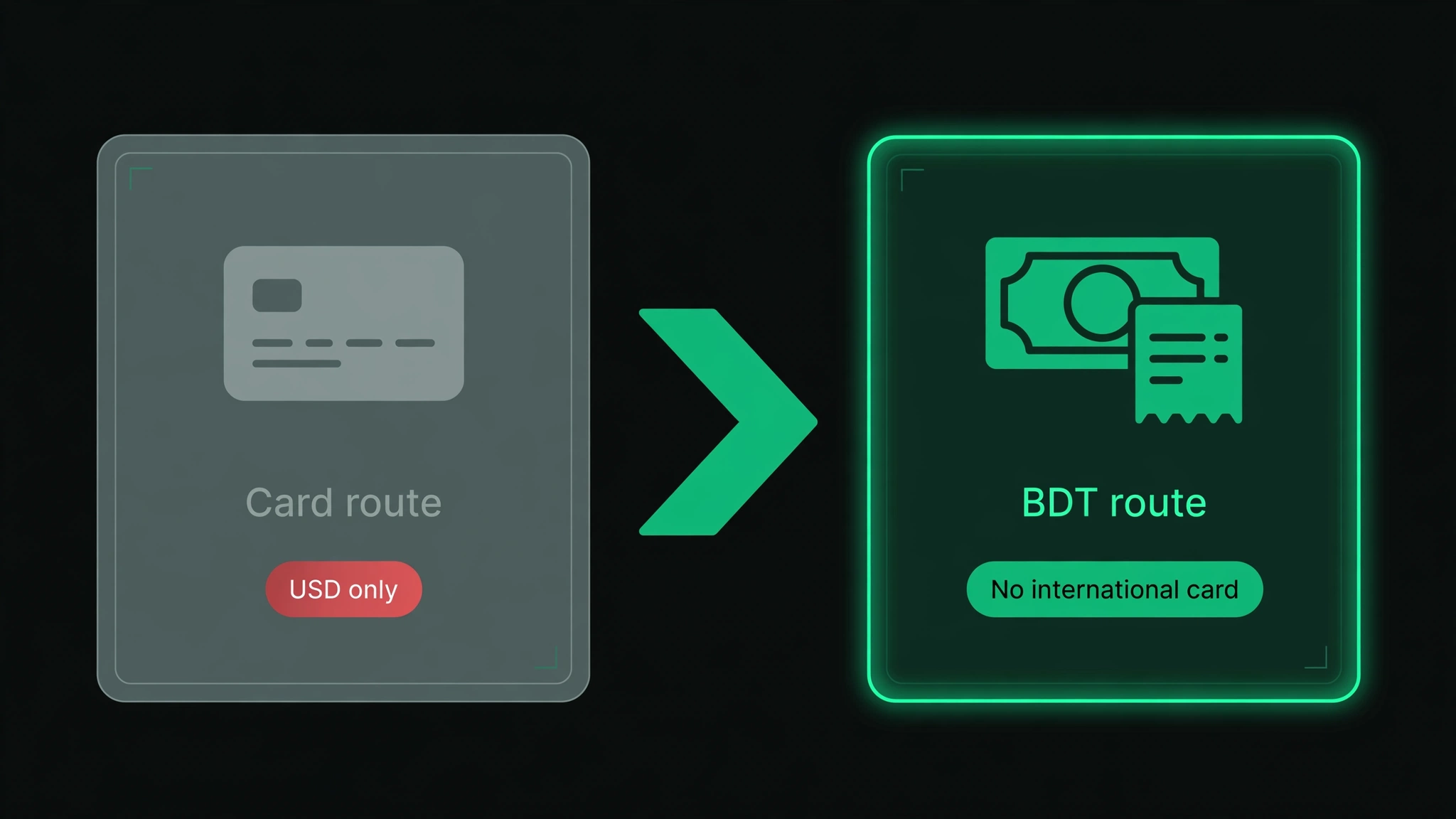
৳12/৳62), GPT-6 Sol at $2/$10 (৳247/৳1,233). If you don't have a dual-currency card, the working route is a BDT gateway: Tokens takes invoice top-ups in taka and serves the same OpenAI models through an OpenAI-compatible endpoint.
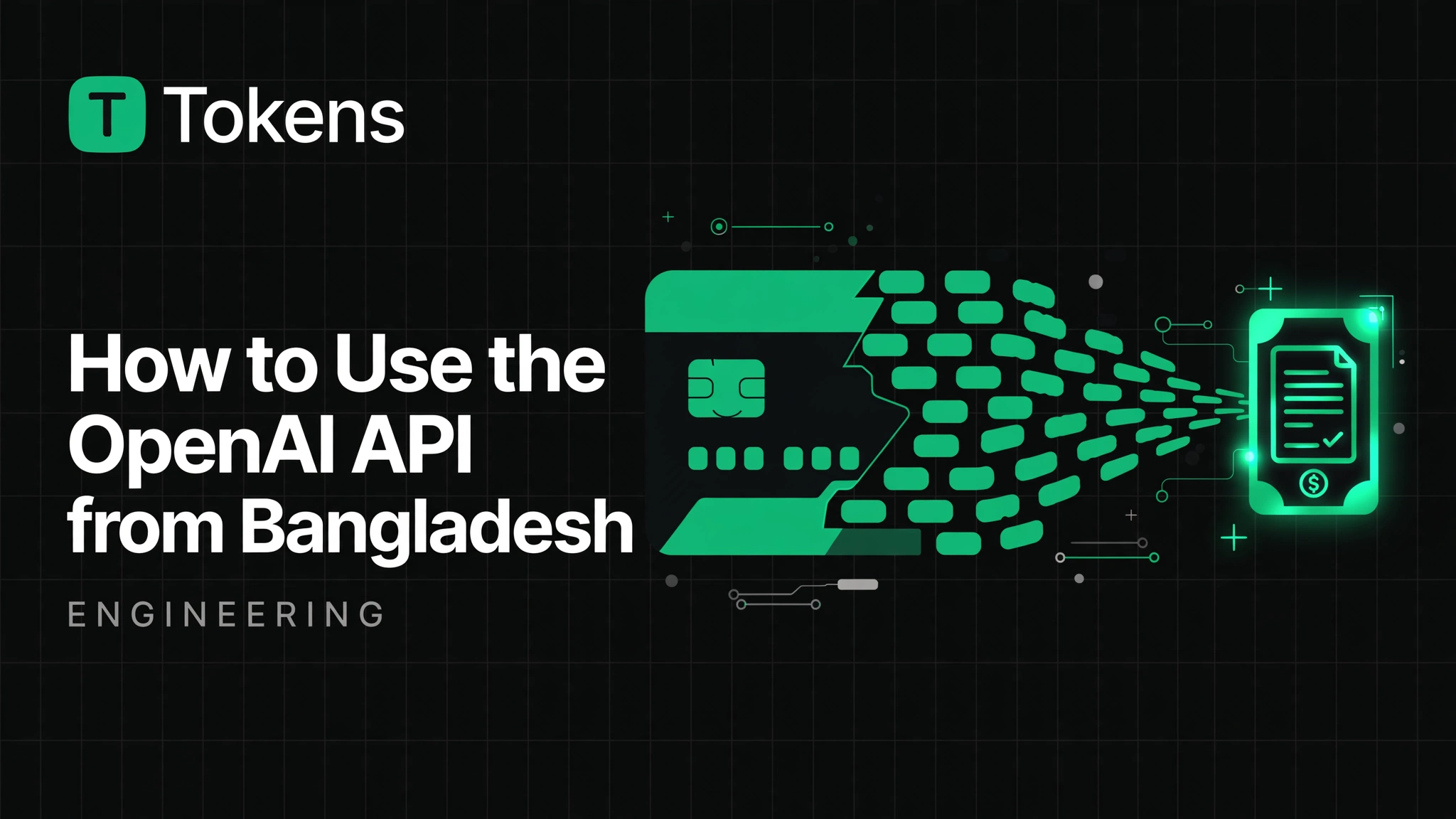
Getting OpenAI's API to work from Bangladesh is not a coding problem — it's a payments problem. The API itself works fine from Dhaka. The checkout page is what stops most developers. This guide maps the three walls between you and a working API key, prices the models in taka, and shows the two routes that actually work.
The three walls#
Wall 1: OpenAI only takes cards, in dollars. OpenAI's billing help is explicit: API credit purchases are limited to USD, and the accepted payment methods are credit and debit cards (Visa, Mastercard, Amex, Discover). Domestic rails like bKash, Nagad, or Rocket cannot settle with a foreign API provider — no documentation will change that. India got UPI and Brazil got Pix for subscriptions; Bangladesh got nothing, and the API side is card-only worldwide.
Wall 2: most Bangladeshi cards can't pay in USD. A regular local debit card typically can't clear an international online charge. What works is a dual-currency card with a passport endorsement from your bank, or a virtual dollar card funded another way. This is also the single most common reason cards get declined everywhere: the card's issuing country and billing setup don't line up with what the payment processor expects.
Wall 3: the billing fine print. OpenAI's API is prepaid. The minimum credit purchase is $5, the balance is deducted per token as you go, and purchased credits expire one year after purchase — they're non-refundable and OpenAI won't extend them. Small test balances quietly vanish; developer forums are full of people discovering this the hard way. So a card is only the entry ticket — you're also committing to a dollar-denominated balance with a 12-month fuse.
What the OpenAI API costs, in taka#
List prices checked 8 October 2026. Converted at ~৳123.3 per USD (interbank rate, 8 October 2026).
| Model | Input / 1M (USD) | Output / 1M (USD) | Input / 1M (BDT) | Output / 1M (BDT) | Role |
|---|---|---|---|---|---|
| GPT-6 Luna | $0.10 | $0.50 | ৳12.3 | ৳61.7 | Cheapest OpenAI model; high-volume, latency-sensitive work |
| GPT-6 Sol | $2.00 | $10.00 | ৳246.6 | ৳1,233 | Coding and agentic workflows |
| GPT-6.1 Sol | $2.00 | $10.00 | ৳246.6 | ৳1,233 | Astra-class performance at one-fifth the price |
| GPT-5.6 Luna | $0.20 | $1.20 | ৳24.7 | ৳148 | Budget reasoning (older generation) |
| GPT-5.6 Terra | $2.00 | $12.00 | ৳246.6 | ৳1,480 | Balanced reasoning |
| GPT-5.6 Sol | $4.00 | $20.00 | ৳493.2 | ৳2,466 | Frontier reasoning; promo price runs through Nov 21, 2026 |
| GPT-6 Astra | $10.00 | $50.00 | ৳1,233 | ৳6,165 | Flagship; long-horizon and computer-use work |
Two things worth noticing. First, output is the expensive side on every model — at 4–5x the input rate — so for coding agents (which generate lots of output) the output column is the one that sets your bill. Second, the price war is real: GPT-6 Luna launched in September 2026 at half the price of its GPT-5.6 predecessor, which is why it's the default for high-volume work now.
Worked example: one month of coding-agent usage, in taka#
Assumptions, to show the arithmetic: 10M input tokens and 2M output tokens in a month — a realistic volume for one developer using a coding agent daily.
| Model | Monthly cost (USD) | Monthly cost (BDT) |
|---|---|---|
| GPT-6 Luna | $2.00 | ~৳247 |
| GPT-6 Sol | $40.00 | ~৳4,932 |
| GPT-6 Astra | $200.00 | ~৳24,660 |
The same workload costs 100x more on Astra than on Luna. Pick the model for the task — Luna for volume, Sol for the hard reasoning — and put a ceiling on the rest, as our pricing guide for small models argues.
Route 1: pay OpenAI directly with an international card#
If you have (or can get) a dual-currency card with a passport endorsement, the direct route is straightforward:
- Create an account at platform.openai.com.
- Go to the API billing overview and select Add payment details.
- Enter the card and purchase at least $5 in credits (default is $10).
- Generate an API key and start calling.
Practical notes: auto-reload is on by default during setup — turn it off if you don't want the card recharged automatically, or set a monthly reload limit as a cap. New accounts get conservative rate limits that rise with cumulative spend (usage tiers), so don't load-test on day one. And remember the 12-month expiry: don't park a big balance you're not going to burn.
The honest downside: you're now paying in dollars with a 3–4% FX markup on every top-up, and every future recharge needs the card to keep working.
Route 2: pay in taka, keep the OpenAI SDK (no international card)#
This is the route most Bangladeshi developers end up on. Tokens is an AI model gateway built for this exact problem: you pay in BDT by invoice — no international card, a receipt for every payment — and call the models through an OpenAI-compatible endpoint. Same SDK, same code; only the base URL and key change.
The catalog carries the OpenAI models directly (prices checked 8 October 2026):
| Model id | Input / 1M | Output / 1M |
|---|---|---|
openai/gpt-6-luna | $0.11 | $0.55 |
openai/gpt-5.6-luna | $0.22 | $1.32 |
openai/gpt-5.6-sol | $5.50 | $33.00 |
The full catalog holds 62 models from 10 providers, so the same key also reaches Claude, DeepSeek, Kimi, Gemini and the rest — model ids are written as provider/model. Per-key monthly spend caps and usage alerts at 50%, 75% and 90% stop a runaway agent loop before it bills you, and prompts are never stored. The direct-vs-gateway trade-offs are laid out in full at /vs/openrouter.
Setup is one base-URL change — see the docs for every agent:
from openai import OpenAI

client = OpenAI(
    api_key="tok_live_…",          # your Tokens key
    base_url="https://tokens.bd/v1",
)

resp = client.chat.completions.create(
    model="openai/gpt-6-luna",
    messages=[{"role": "user", "content": "Explain recursion in one paragraph."}],
)
print(resp.choices[0].message.content)
Which route should you pick?#
| Direct OpenAI API | Tokens (BDT gateway) | |
|---|---|---|
| Payment | International card, USD only | Invoice top-up in BDT or USD, receipt per payment |
| International card needed | Yes | No |
| Minimum to start | $5 (~৳617) in credits | Prepaid wallet top-up in taka |
| Credit expiry | 12 months from purchase | — |
| Models | OpenAI only | 62 models across 10 providers |
| Spend control | Monthly auto-reload limit | Per-key monthly caps + email alerts |
| Prompt storage | OpenAI's data policy | Never stored by Tokens |
| Best for | Teams already expensing in USD | Bangladeshi developers and students without dual-currency cards |
If you already have a working international card and only ever need OpenAI models, the direct route is fine. If you don't have the card — or you want BDT invoices, 60+ models on one key, and a hard ceiling per key — the gateway route removes the payment problem entirely.
OpenAI API from Bangladesh FAQ#
Can I pay for the OpenAI API with bKash or Nagad? No. OpenAI's API billing accepts credit and debit cards only, and API credit purchases are denominated in USD. Domestic mobile-banking rails like bKash, Nagad and Rocket cannot settle with foreign API providers.
Will my regular Bangladeshi debit card work? Usually not for USD API billing. You need a dual-currency card with a passport endorsement from your bank, a virtual dollar card, or a BDT gateway that invoices you locally. Card declines are also the most common failure worldwide — make sure the balance covers the credit purchase plus any tax and pre-authorization.
Do OpenAI API credits expire? Yes. Purchased credits expire one year after purchase, are non-refundable, and OpenAI cannot extend the expiration date. Don't park a large balance you won't use within twelve months.
Does a ChatGPT Plus subscription pay for API usage? No. API credits and ChatGPT subscriptions are billed entirely separately — having ChatGPT Plus does not fund your API calls, and vice versa. If you want GPT models in your own code, you need API credits (or a gateway that carries the models).
How do I get a receipt for API spend in Bangladesh? Direct OpenAI billing gives you a card statement entry in USD. If you need a proper receipt in taka, pay through a local gateway: Tokens issues a receipt for every BDT invoice top-up, visible in Dashboard → Billing.
List prices checked 8 October 2026. USD→BDT conversion uses the interbank rate (~৳123.3) on that date; your bank's rate will differ slightly. OpenAI revises prices and policies — the pricing page and billing help are the authorities.
Sources: OpenAI prepaid billing help · OpenAI multi-currency billing · OpenAI API pricing 2026 · GPT-6 Sol/Luna launch · GPT-6.1 Sol pricing · OpenAI billing model · API free tier status · Paying in card-blocked countries · USD/BDT rate · Tokens model catalog