
LLM API Pricing in BDT: What 1M Tokens Really Costs You
TL;DR: A million tokens of agent coding work costs anywhere from ~৳6.9 to ~৳1,375 in Bangladesh, depending on the model (at a typical 80% input / 20% output mix). At today's rate (৳123.31 per USD, 11 October 2026), a typical agent session — 500K input tokens plus 50K output — runs about ৳14.4 on DeepSeek V4.1 Flash, ৳10.3 on GPT-6 Luna, and ৳206 on Claude Sonnet 5.5. On tokens.bd, prices are set separately in taka and dollars, so the ৳ figure on each model page is exactly what you pay — no card markup, no international card needed.
Every model page on the internet quotes prices the same way: "$2.20 per million input tokens." If you pay your rent in taka, that number means nothing until it becomes a number in taka — and the gap between the per-million price and your actual bill is where all the surprises live. This post converts the abstract unit into real money: how to read a per-1M price, what popular models cost in BDT for real workloads, and the five traps that make the bill bigger than the table.
How to read "per 1M tokens"#
Three facts do 90% of the work:
- Input and output are priced separately. Input is what you send (prompts, code context); output is what the model generates. Output is always the expensive side — roughly 3–10x the input price at every provider. An agent that summarizes a big repo and writes a short patch pays mostly input; an agent that writes long code pays mostly output.
- A million tokens is bigger than it sounds. Roughly 750,000 English words — about a dozen novels. A single heavy agent turn can move 200K+ input tokens when a large repo is in context, so millions of tokens a month is normal for daily agent coding.
- The price on the page is a unit rate, not a bill. Multiply it by your workload:
bill = (input_tokens ÷ 1M × input_price) + (output_tokens ÷ 1M × output_price).
On tokens.bd, each model page lists the price in taka and dollars separately — the ৳ number is set by the platform, not converted at checkout, so the exchange rate never ambushes you mid-month. The taka figures in this post are the platform's listed prices, checked 11 October 2026.
The catalog in taka: what popular models cost#
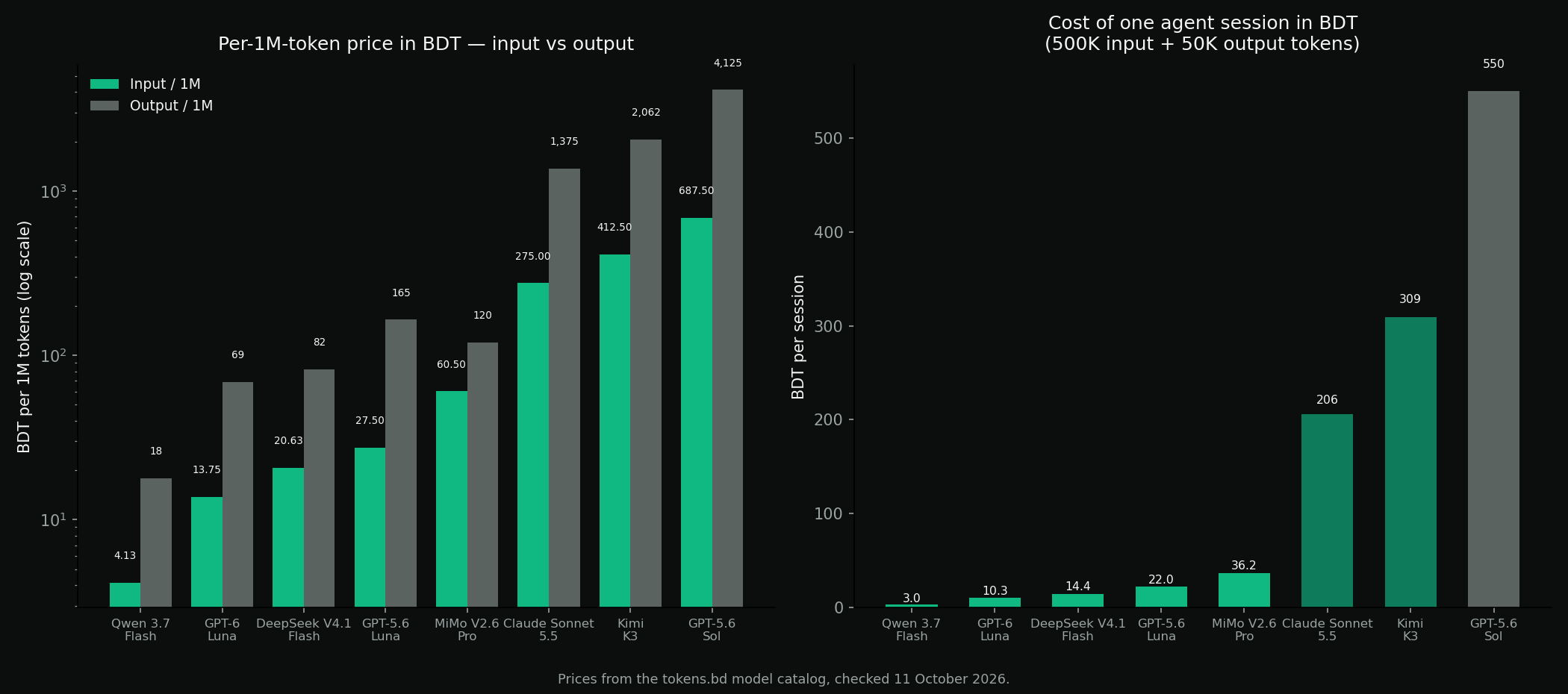
Featured models from the catalog, per 1M tokens, with the cost of a typical small agent session (500K input + 50K output tokens):
| Model | Input / 1M | Output / 1M | Per-session cost |
|---|---|---|---|
| Qwen 3.7 Flash | ৳4.13 | ৳17.88 | ~৳3.0 |
| GPT-6 Luna | ৳13.75 | ৳68.75 | ~৳10.3 |
| DeepSeek V4.1 Flash | ৳20.63 | ৳82.50 | ~৳14.4 |
| GPT-5.6 Luna | ৳27.50 | ৳165.00 | ~৳22.0 |
| MiMo V2.6 Pro | ৳60.50 | ৳119.63 | ~৳36.2 |
| Claude Sonnet 5.5 | ৳275.00 | ৳1,375.00 | ~৳206 |
| Kimi K3 | ৳412.50 | ৳2,062.50 | ~৳309 |
| GPT-5.6 Sol | ৳687.50 | ৳4,125.00 | ~৳550 |
Two things jump out. First, the spread is enormous: the cheapest session costs less than a rickshaw fare, the dearest more than a week of lunches. Second, output price dominates the session math even at a modest 10% output share — because output is where the multiplier lives.
What 1M tokens of real work buys you#
Per-1M prices are still abstract, so here are the platform's own worked estimates for the same workloads across models (from each model's page, checked 11 October 2026):
| Workload | Qwen 3.7 Flash | GPT-6 Luna | MiMo V2.6 Pro | Claude Sonnet 5.5* | GPT-5.6 Sol |
|---|---|---|---|---|---|
| One agent turn (25K in, 1.5K out) | ৳0.13 | ৳0.45 | ৳1.69 | ~৳8.9 | ৳23.38 |
| An hour of agent work (1M in, 60K out) | ৳5.20 | ৳17.88 | ৳67.68 | ~৳350 | ৳935.00 |
| A month of daily use (20M in, 1.2M out) | ৳104.06 | ৳357.50 | ৳1,353.56 | ~৳7,150 | ৳18,700.00 |
* Sonnet 5.5 computed from its listed ৳275/৳1,375 rates.
Read the "month of daily use" column as the real answer to the headline question: serious daily agent coding costs roughly ৳100–৳350 a month on a budget model, ৳1,300–৳2,000 on a mid-range one, and ৳7,000+ once you go frontier. That is the number to budget against — not the per-million rate.
For a full method on turning your own session sizes into a monthly number, see how to estimate your monthly token bill.
Taka prices vs dollar prices: the FX footnote#
Today's market rate is ৳123.31 per US dollar (11 October 2026). If you pay a dollar-billed provider with an international card, you don't pay the market rate — your bank converts at its own rate plus a markup, so a "$10" top-up quietly costs more than ৳1,233.10, and the number drifts every month.
Tokens sets prices separately in taka and dollars — the platform's own words — so the ৳ price on a model page is a fixed taka price, not a conversion of the dollar one. The practical effect: the number you see is the number you pay, and it doesn't move when the exchange rate does. If you're comparing dollar-listed providers, convert at the day's rate and add your card's markup before you compare.
Plans change the math#
Per-token billing is only one way to buy. The platform plans, priced in taka:
- Weekly 5X — ৳25/week: $10 in credits, roughly
5K requests. At DeepSeek V4.1 Flash session math (৳14.4/session, $0.118), that's on the order of 400+ cheap sessions a week — canteen money. - Monthly Max — ৳490/month: $50 in credits (up to ~$60 usage with deals), roughly ~30K requests. This is the tier where a month of daily agent coding on mid-range models stops being per-token math and becomes a flat budget line.
- Pay as you go: top up a prepaid wallet and pay per token at the catalog prices, with per-key spend caps.
Which one wins depends on volume. Under a few hundred sessions a month, pay-as-you-go is cheapest. Above that, the Monthly Max plan's included credits beat per-token billing — run the worked method in estimate your monthly bill with your own session sizes before choosing. Our student-budget guide works the same comparison for the ৳25/week tier (building AI apps on a student budget).
Five traps that make the bill bigger than the table#
- Output is the multiplier. A model that "thinks out loud" generates reasoning tokens billed at output rates. On GPT-5.6 Sol that's ৳4,125 per million thinking tokens — a long reasoning trace can cost more than the answer.
- Cache misses. Prompt caching makes repeated context near-free, but caches are per model — switching models pays full input price again. Route to the cheap model first and escalate only on failure (see frontier coding models in October 2026).
- Context refills. A 1M-token context window is a ceiling, not a cost — but agents that re-send the whole repo every turn burn input fast. Compact context and let the cache do its job.
- FX drift on dollar billing. A 2–3% card markup on every top-up compounds over a year of heavy use. Fixed taka pricing removes it entirely.
- No cap on the key. A runaway loop can issue thousands of requests overnight. Give every key a monthly cap and a model allow-list; the setup takes minutes and is covered in the OpenAI API payment guide for Bangladesh.
FAQ#
How much does 1 million tokens cost in BDT? It depends on the model and the input/output mix. On tokens.bd's listed taka prices (checked 11 October 2026), 1M tokens of typical agent work (80% input, 20% output) costs roughly ৳6.9 on Qwen 3.7 Flash, ৳24.8 on GPT-6 Luna, ৳33 on DeepSeek V4.1 Flash, ~৳495 on Claude Sonnet 5.5, and ৳1,375 on GPT-5.6 Sol.
What is the cheapest capable coding model in 2026? Qwen 3.7 Flash at ৳4.13/৳17.88 per 1M input/output tokens is the cheapest credible coding model in the catalog — a typical agent session costs about ৳3. DeepSeek V4.1 Flash (৳20.63/৳82.50, ~৳14.4 per session) is the usual daily-driver pick for harder agentic work.
Do I need a dollar card to pay for LLM APIs from Bangladesh? No — not on a platform that prices in taka. Tokens lists every model price in BDT and USD separately and accepts bKash, Nagad and cards for top-ups, with a receipt for each payment. See paying for AI APIs from Bangladesh and the OpenAI API Bangladesh payment guide.
Why is the taka price not just the dollar price times the exchange rate? Because tokens.bd sets prices separately in taka and dollars rather than converting at checkout. That means the ৳ figure is stable month to month even when the USD/BDT rate moves — and you never pay a bank's conversion markup.
How much should I budget per month for daily agent coding? Budget ৳100–৳350/month on a budget model (Qwen 3.7 Flash, GPT-6 Luna), ~৳1,300–৳2,000 on a mid-range model (MiMo V2.6 Pro), and ৳7,000+ on frontier models (Claude Sonnet 5.5, GPT-5.6 Sol) — based on a month of daily use at 20M input / 1.2M output tokens. The ৳490/month Monthly Max plan covers roughly ~30K requests for heavy users.
Model prices checked on tokens.bd 11 October 2026; USD/BDT market rate ৳123.31 the same day. Promotional prices and catalog prices change — the model catalog is the authority.
Sources: tokens.bd model catalog · Qwen 3.7 Flash pricing · GPT-6 Luna pricing · MiMo V2.6 Pro pricing · GPT-5.6 Sol pricing · USD/BDT rate