
TL;DR: Bengali is still officially a low-resource language for LLMs, but the frontier models handle it well: Gemini 3.1 Pro tops the multilingual leaderboard, Claude was the strongest Bengali annotator in a 2026 Dhaka-university study, and cheap multilingual models (GPT-6 Luna, Qwen 3.8 Flash) are solid for everyday Bangla tasks. Watch the tokenization tax: on older tokenizers one Bengali word can cost 8–12 tokens versus ~1 for English, so always estimate Bengali usage in tokens, not words. At tokens.bd prices (checked 10 Oct 2026), processing 1 million Bengali words costs roughly Tk 26 on GPT-6 Luna and Tk 42 on Qwen 3.8 Flash — with bKash/Nagad payment, no international card needed.
Bengali has over 230 million native speakers, and it's the language of daily life for one of the world's fastest-growing developer communities. Yet when AI teams build for Bangla, the advice is still vague: "multilingual models should work." Should — how well? Which one? At what cost?
This post is the specific version. What the benchmarks actually say about Bengali in 2026, which models to reach for, the hidden tokenization tax that quietly inflates every Bengali API bill, and the real cost in taka of running Bangla workloads — computed on current tokens.bd prices.
What the benchmarks say about Bengali#
The honest headline first: in the MMMLU multilingual benchmark (the multilingual extension of MMLU covering 14 languages), Bengali is classified as low-resource, alongside Swahili and Yoruba — while French, Spanish and German sit in the high-resource tier. On the April 2026 leaderboard, the average scores across all languages were: Gemini 3.1 Pro ~92.6%, Claude Opus 4.6 ~91.1%, and GPT-5.2 ~89.6%. The gap between high-resource and low-resource languages can reach 10–13 percentage points on individual models — a reminder that the frontier model's Bengali score is always a few steps behind its English score.
But "low-resource" is a relative label, and the absolute numbers are now good enough for production. A few results that matter for builders:
- GPT-5 was marginally better in Bengali than its predecessor on MMMLU, part of a pattern of steady gains in low-resource languages (Bengali, Hindi, Indonesian, Swahili, Yoruba) — so the trend line points the right way.
- Claude is the strongest Bengali annotator. MultiSoc-4D, a 2026 study from North South University in Dhaka, tested ChatGPT, Gemini, Claude and Grok on 58,000+ real Bengali social media comments across classification, sentiment, hate speech and sarcasm. Claude came out as the most effective annotator of the four — relevant if your use case is Bangla content moderation or labeling.
- Small multilingual models are genuinely usable. Qwen3 advertises support for 119 languages and dialects with explicitly strong less-common-language performance, and Gemma 3 supports 140+ languages. A developer who built a Bengali scam-detection reader on open-weight Gemma in October 2026 reported Hindi, Bengali, Marathi and Tamil as "good" even on the 4B model.
The nuance: the same Dhaka study found that all four models systematically under-detect difficult labels — missing 79% of hateful and 75% of sarcastic Bengali content compared to humans, collapsing toward safe fallback labels like "neutral" and "no." If you're building Bangla moderation or sentiment analysis, don't trust raw zero-shot labels; evaluate on your own data.
The tokenization tax: why Bengali costs more tokens#
Here's the cost mechanic most teams discover too late. LLM pricing is per token, and tokenizers were trained overwhelmingly on English. The result is a tokenization tax on Bengali: the same words turn into far more tokens.
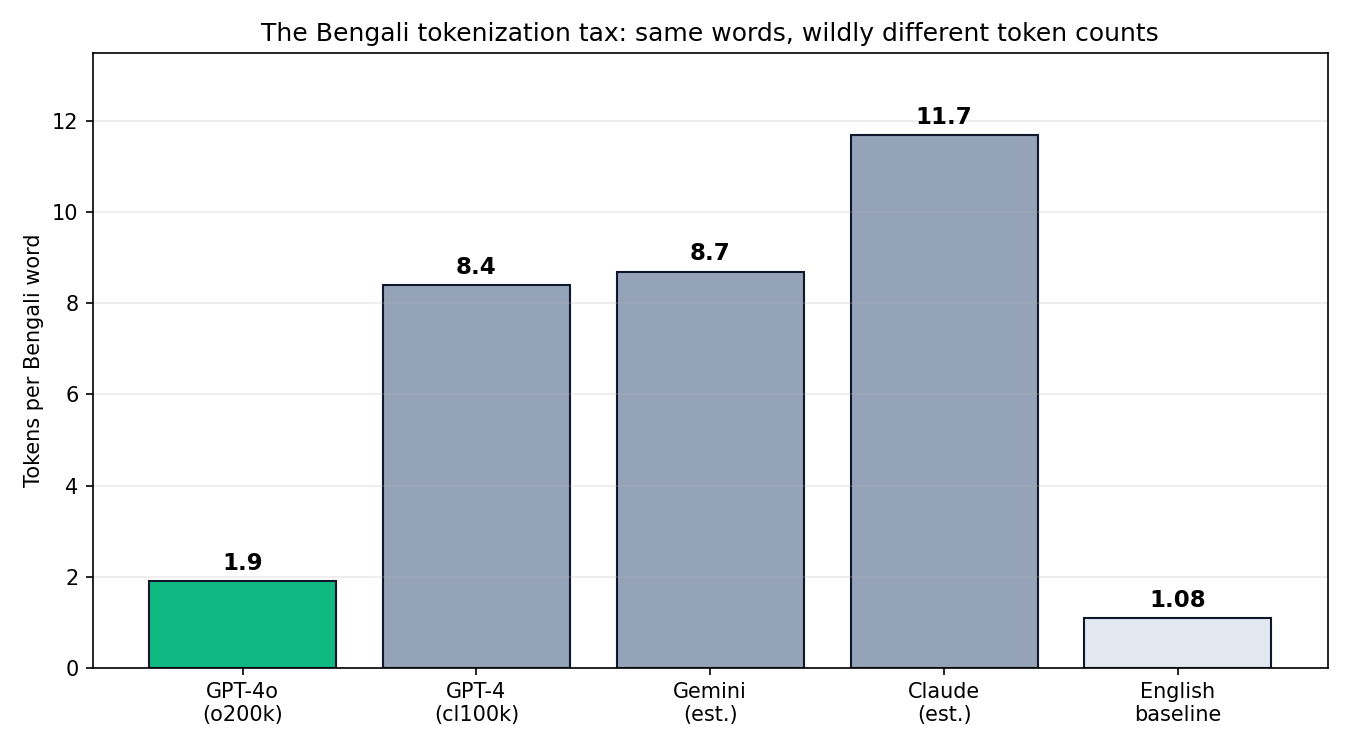
Measurements from the MotherTongueIndex project (tokenizer efficiency study, updated September 2026) put it in numbers — fertility means tokens per whitespace-separated word:
| Tokenizer | Bengali fertility | vs English |
|---|---|---|
| GPT-4o (o200k) | 1.90 | 1.73x |
| GPT-4 (cl100k) | 8.40 | 7.64x |
| Gemini (est.) | 8.70 | ~10x |
| Claude (est.) | 11.70 | ~10x |
On the older generation of tokenizers, a single Bengali word like বিশ্ববিদ্যালয় ("university") burns through 30 tokens — while the English word costs one. A purpose-built Bengali tokenizer compresses that same word to 1 token, but you're not using one; you're paying per token through someone else's tokenizer.
Two things to take from this:
- Model choice changes your token count, not just your per-token price. A cheaper model with an efficient tokenizer can be dramatically cheaper on Bengali than a premium model whose tokenizer fragments every word — the bill is price × tokens, and tokens vary by up to 10x between tokenizer generations.
- Estimate Bengali workloads in tokens, not words. "Our app processes 50,000 Bengali words a day" means nothing until you know the fertility. Multiply words by ~1.9 for modern o200k-class tokenizers, more for others.
Which models to use for Bangla tasks#
Match the model to the job. All prices below are from the tokens.bd catalog, checked 10 October 2026, per million tokens (input / output), with taka converted at the day's rate of ~৳123 per USD.
Best quality — Claude Sonnet 5.5 ($2.20 / $11.00 per 1M). The strongest Bengali annotator in independent testing and the frontier choice for nuanced Bangla: summarization, moderation review, customer-facing generation. Pay for it when quality differences are visible to users.
Best general-purpose — Gemini 3.7 / 3.8 Flash ($1.65 / $8.25 per 1M). Top of the multilingual leaderboard family, fast, and a natural fit for multimodal Bangla tasks (document OCR, image-plus-text).
Best value — GPT-6 Luna ($0.11 / $0.55 per 1M) or Qwen 3.8 Flash ($0.18 / $0.52 per 1M). For bulk Bangla work — classification, translation, drafting, chatbots — these are the workhorses. Qwen's explicitly multilingual training makes it a strong pick; GPT-6 Luna's price is hard to argue with.
Free tier — Ling 3.1 Flash ($0.00 / $0.00 per 1M). Available free on tokens.bd for prototyping Bangla features before you spend anything.
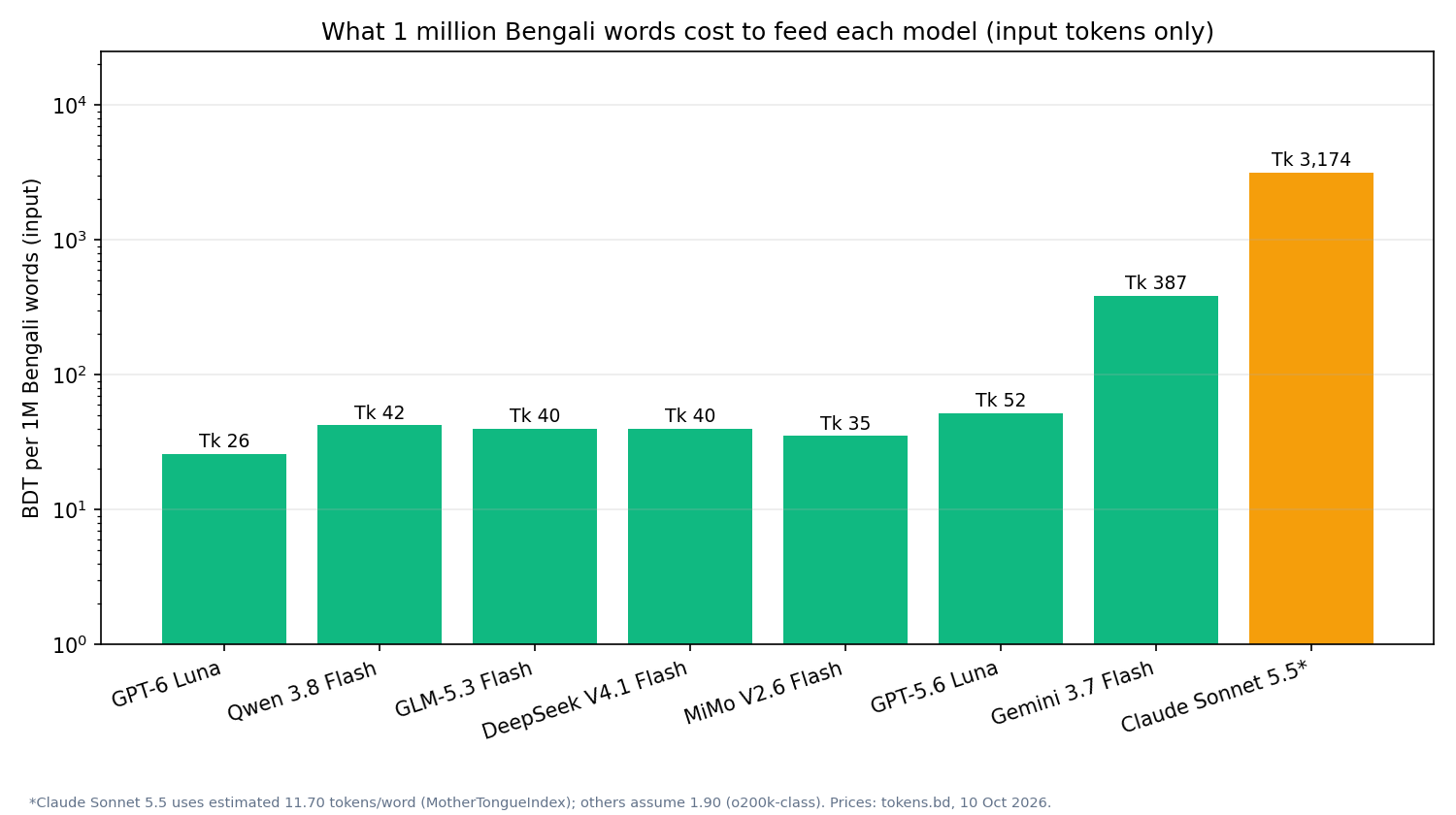
| Model | Input / 1M | Output / 1M | Input cost per 1M Bengali words* |
|---|---|---|---|
| GPT-6 Luna | $0.11 | $0.55 | Tk 26 |
| MiMo V2.6 Flash | $0.15 | $0.31 | Tk 35 |
| GLM-5.3 Flash | $0.17 | $0.55 | Tk 40 |
| DeepSeek V4.1 Flash | $0.17 | $0.66 | Tk 40 |
| Qwen 3.8 Flash | $0.18 | $0.52 | Tk 42 |
| GPT-5.6 Luna | $0.22 | $1.32 | Tk 52 |
| Gemini 3.7 Flash | $1.65 | $8.25 | Tk 387 |
| Claude Sonnet 5.5 | $2.20 | $11.00 | Tk 6,030† |
*Assumes ~1.9 tokens per Bengali word (measured on o200k-class tokenizers). †Claude row uses the MotherTongueIndex estimated 11.70 tokens/word for Claude's tokenizer.
Worked example: summarizing a Bengali news article#
Say your app summarizes a 2,000-word Bengali article into a 300-word summary. These are illustrative — your tokenizer and text will differ — but the arithmetic is the point.
On GPT-6 Luna (1.90 tokens/word): input ≈ 3,800 tokens → 0.0038M × $0.11 = $0.00042. Output ≈ 570 tokens → 0.00057M × $0.55 = $0.00031. Total ≈ $0.00073 — about nine poisha. A thousand summaries a day costs under Tk 100 a month.
On Claude Sonnet 5.5 (estimated 11.70 tokens/word): input ≈ 23,400 tokens → 0.0234M × $2.20 = $0.051. Output ≈ 3,510 tokens → 0.00351M × $11.00 = $0.039. Total ≈ $0.090 — about Tk 11. Roughly 123x the Luna cost, mostly driven by the tokenizer, not the sticker price.
This is why the tokenization tax matters more than it looks: it multiplies the expensive model most. If you need Sonnet's quality, consider a routing pattern — cheap model drafts, strong model reviews — which the catalog makes easy since every model shares one API.
Five practical rules for building Bangla features#
- Prompt in Bangla for Bangla tasks. Instructing the model in the target language keeps the style, register and cultural context aligned. Few-shot examples in Bangla beat English instructions with Bangla examples.
- Watch the "Banglish" trap. Mixed Roman-script Bengali (Banglish) is everywhere in Bangladesh's real text — chats, comments, reviews. Models handle it inconsistently; if your users write Banglish, test on Banglish, not textbook Bangla.
- Budget with fertility, not word counts. Multiply Bengali word counts by ~2x for modern tokenizers (more for Claude/Gemini-class) before estimating. Then confirm with the usage dashboard after the first week.
- Evaluate the hard cases yourself. The Dhaka study's finding — models missing most hateful and sarcastic Bangla content — generalizes: zero-shot works for the easy majority and fails quietly on the edges. Build a 200-example golden set in Bangla and score every model switch against it.
- Don't let payment friction stop you. Every model above is one API key away on tokens.bd, payable in BDT via bKash, Nagad or cards — no international card required. See the docs for setup.
Calling any of these models from code#
One key, one base URL, any model — swap the model id to switch between the tiers above:
from openai import OpenAI

client = OpenAI(
    base_url="https://tokens.bd/v1",
    api_key="tkbd_your_key_here",
)

summary = client.chat.completions.create(
    model="openai/gpt-6-luna",  # swap for anthropic/claude-sonnet-5.5 when quality matters
    messages=[
        {"role": "system", "content": "তুমি একজন বাংলা সংবাদ সারাংশকারী। সংক্ষিপ্ত ও নিরপেক্ষ সারাংশ দাও।"},
        {"role": "user", "content": f"এই সংবাদটির সারাংশ দাও:\n\n{article_text}"},
    ],
)
print(summary.choices[0].message.content)
The system prompt is in Bangla (rule 1), the model id is the only thing that changes between the Tk 26 and Tk 6,030 tiers, and usage for every key shows up in the dashboard — set a spend cap per key so a runaway loop can't surprise you.
Bangla NLP FAQ#
Which LLM is best for Bengali in 2026? For quality: Claude Sonnet 5.5, the strongest Bengali annotator in the 2026 MultiSoc-4D study from North South University, Dhaka. For value: GPT-6 Luna or Qwen 3.8 Flash — Qwen3 supports 119 languages with explicitly strong low-resource performance. For the multilingual leaderboard top: the Gemini 3 family (~92.6% average on MMMLU, April 2026).
Why do Bengali API calls cost more tokens than English? Tokenizers were trained mostly on English, so Bengali script fragments into many more tokens — roughly 1.9 tokens per Bengali word on modern OpenAI-class tokenizers, versus ~1.1 for English, and up to ~10x English on older or less efficient tokenizers. You pay per token, so Bengali text costs more for the same content.
How much does it cost to process 1 million Bengali words? At tokens.bd prices checked 10 October 2026: about Tk 26 on GPT-6 Luna, Tk 42 on Qwen 3.8 Flash, Tk 387 on Gemini 3.7 Flash, and Tk 6,030 on Claude Sonnet 5.5 (input tokens only; Claude's higher figure reflects its tokenizer's estimated 11.7 tokens per Bengali word).
Can I pay for these models in BDT without an international card? Yes. tokens.bd accepts bKash, Nagad and local cards, and every model in this post is available through one API key on the platform's 62-model catalog.
Should I fine-tune a Bangla-specific model instead? For most teams, no — not first. Frontier and strong multilingual models already handle standard Bangla tasks well zero-shot, and the Dhaka study shows the failure modes are in annotation edge cases (hate speech, sarcasm), which fine-tuning on small data often doesn't fix either. Start with a strong model plus a golden evaluation set; fine-tune only when you've measured a specific, repeatable gap.
List prices checked 10 October 2026. USD→BDT at ~123.3 (10 October 2026). Tokenizer fertility figures from the MotherTongueIndex study (September 2026); Claude/Gemini figures are the study's estimates. The model catalog is the authority for prices on Tokens.
Sources: MotherTongueIndex tokenizer paper · MultiSoc-4D, North South University Dhaka · MMMLU leaderboard, April 2026 · GPT-5 multilingual evaluation · Qwen3 119-language support · Gemma 3 model card · tokens.bd model catalog