
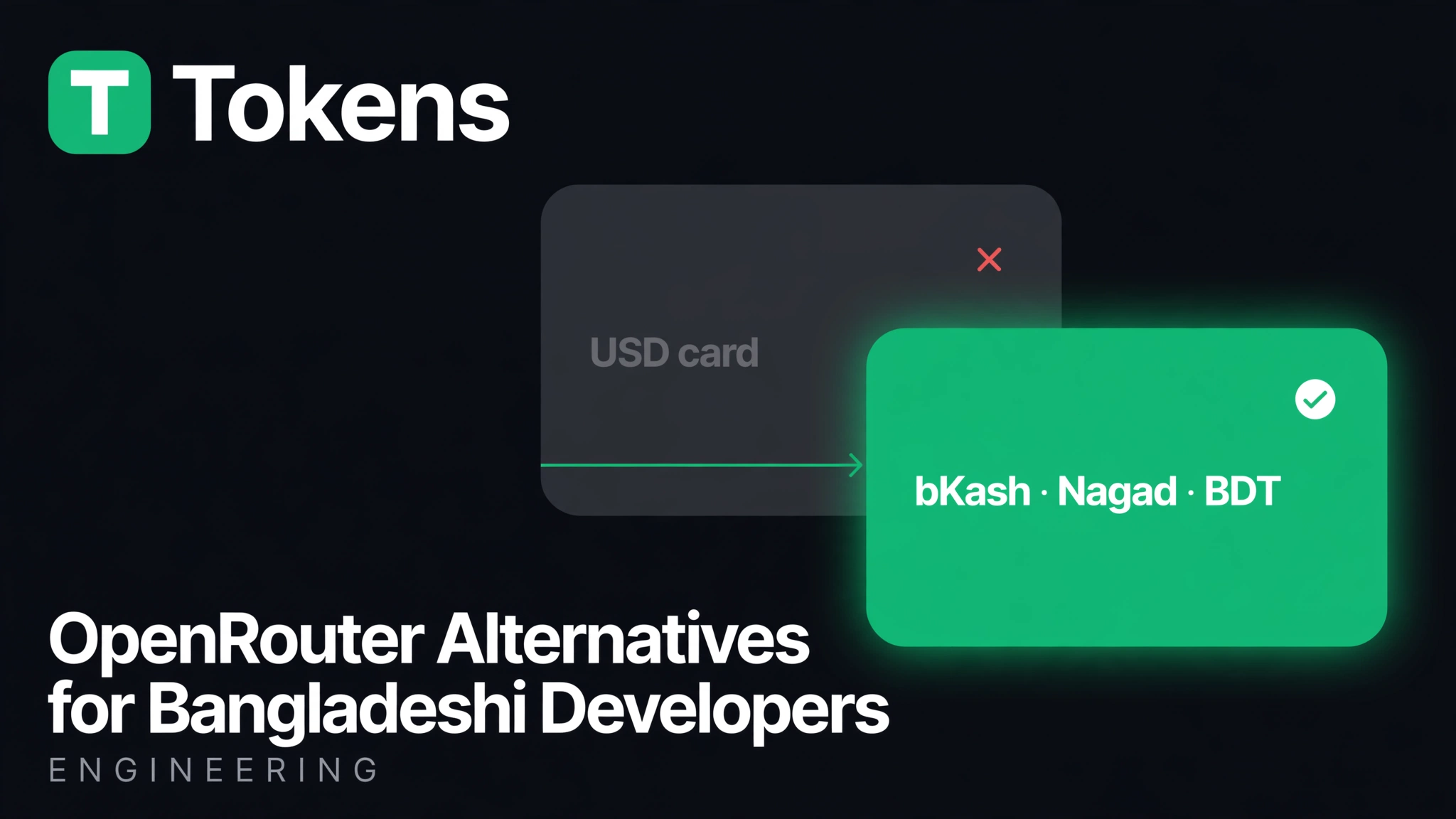
TL;DR: OpenRouter is USD-only (card, AliPay, or USDC), and Bangladesh Bank rules cap international-card online payments at USD 300 per transaction with an OTAF form each time — plus a 5.5% fee on every Standard credit purchase. For developers in Bangladesh, the practical alternative is a gateway that settles in taka: tokens.bd lists 62 coding models from 10 providers (checked 10 October 2026), accepts bKash, Nagad, bank transfer, and invoice, and adds per-key monthly spend caps with usage alerts. The API is OpenAI- and Anthropic-compatible, so switching from OpenRouter is a
base_urland API-key change — the same models, no new SDK.
The payment wall: why OpenRouter is hard to pay for from Bangladesh#
OpenRouter is an excellent product — 466 model IDs on its public list, provider list prices passed through with no inference markup, and an OpenAI-compatible API at https://openrouter.ai/api/v1. The problem for developers in Bangladesh isn't the product. It's the checkout.
OpenRouter accepts exactly four payment routes: credit and debit cards, AliPay, crypto (USDC), and invoicing on Enterprise plans (per OpenRouter's pricing page, checked 10 October 2026). Every one of them is denominated in US dollars. For a developer in Dhaka, that means:
- You need a dual-currency international card. Bangladesh Bank's FE Circular 26 (2019) caps international-card online payments at USD 300 per transaction, and each payment needs an OTAF (Online Transaction Application Form) submission to your bank. Top up twice in a month and you're doing paperwork twice.
- Every top-up carries a fee. OpenRouter charges no markup on inference, but it takes a cut when you buy credits: 5.5% on Standard, 8% on Business — charged on the credit purchase, never per request. A $10 top-up costs $10.55 before you've called a single model.
- AliPay and USDC aren't realistic fallbacks. Most Bangladeshi developers hold neither, and converting BDT into either adds its own fees and friction.
This isn't a corner case. In the OpenAI API payment guide for Bangladesh, the same wall blocks direct OpenAI, Anthropic, and Google billing: the card is the problem, not the model. So the real question isn't "which models?" — it's "who will take my money in taka?"
The alternatives, compared honestly#
There are three realistic ways a developer in Bangladesh gets API access to frontier models today:
| OpenRouter | Direct provider APIs | tokens.bd | |
|---|---|---|---|
| Catalog | 466 model IDs (3 Oct 2026) | One provider each | 62 models, 10 providers (10 Oct 2026) |
| Payment from BD | USD card / AliPay / USDC | USD card per provider | bKash, Nagad, bank wire/BEFTN/NPSB, invoice |
| Fee on top-up | 5.5% on credit purchases (Standard) | Card fees per provider | None — plans and wallet in BDT/USD |
| Free tier | 25+ free models, 50 req/day (1,000/day after $10 credits) | Varies by provider | Free plan plus weekly/monthly plans |
| Spend controls | Per-key credit caps within workspaces | Per provider | Per-key monthly caps + model allow-lists, alerts at 50/75/90% |
| Prompt privacy | Not logged by default; data-collection deny and ZDR flags | Provider policy applies | Prompts never stored — billing metadata only |
| API format | OpenAI-compatible; Anthropic messages endpoint | Provider-native | OpenAI-compatible + Anthropic-compatible, one key |
The table is honest about the trade: OpenRouter wins on catalog breadth and free models; tokens.bd wins on paying locally and controlling spend. Direct provider APIs lose for most Bangladeshi developers because they multiply the card problem — one USD billing relationship per provider instead of one.
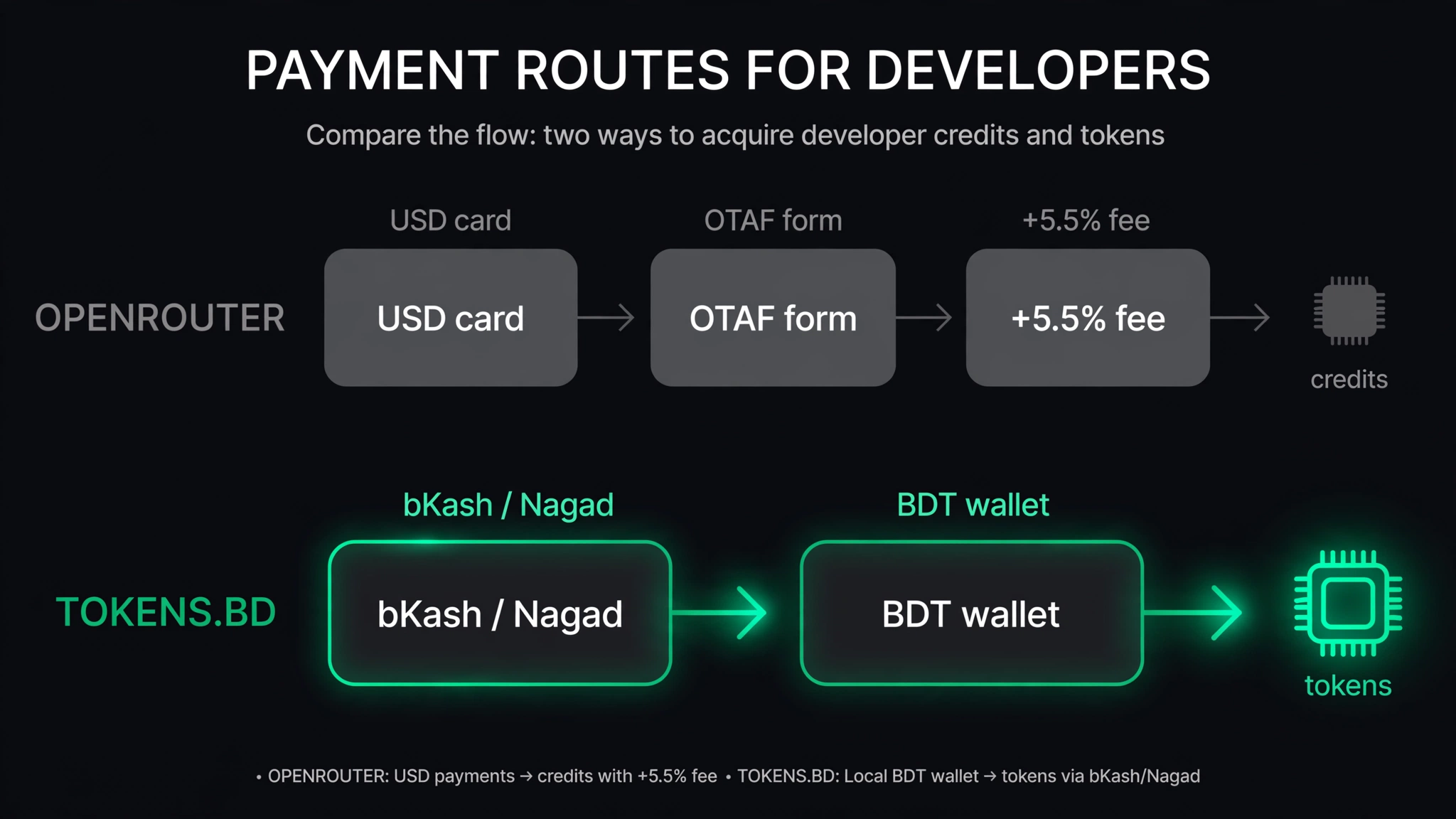
The payment math: what a $10 top-up actually costs#
Take the smallest realistic top-up and trace it:
OpenRouter, by card: $10 of credits costs $10.55 after the 5.5% Standard fee — about ৳1,319 at ~৳125 per USD. Every recharge repeats the fee, and the OTAF form adds a time tax on top of it.
tokens.bd, in taka: the listed plans are priced in BDT directly. Weekly 5X is ৳25/week with $10 in credits included; Monthly Max is ৳490/month with $50 in credits included; or top up a pay-as-you-go wallet in any amount by bKash (Send Money or Payment), Nagad (Send Money or Merchant), bank transfer, or invoice — with a printable receipt in the dashboard for every payment. No card, no OTAF, no per-recharge fee.
The per-token prices are close enough that payment friction dominates the comparison. GPT-6 Luna, for example, lists at $0.10/$0.50 per 1M tokens on OpenRouter (3 Oct 2026) and $0.11/$0.55 (৳13.75/৳68.75) per 1M on tokens.bd (10 Oct 2026) — a penny difference per million tokens, against a 5.5% top-up fee and a paperwork step on every recharge.
Same models, one base_url change#
Switching gateways doesn't mean rewriting your code. Both OpenRouter and tokens.bd speak the OpenAI API format, so the migration is a base_url and key swap:
from openai import OpenAI

client = OpenAI(
    base_url="https://tokens.bd/v1",  # was "https://openrouter.ai/api/v1"
    api_key="tok_live_...",            # your tokens.bd key
)

resp = client.chat.completions.create(
    model="openai/gpt-6-luna",  # stable provider/model id
    messages=[{"role": "user", "content": "Explain this diff."}],
)
Model IDs on tokens.bd use the same provider/model shape (openai/gpt-6-luna, deepseek/deepseek-v4.1-flash, anthropic/claude-sonnet-5.5), and the same key also works on the Anthropic-compatible endpoint at https://tokens.bd — so Claude Code keeps working with ANTHROPIC_BASE_URL pointed at tokens.bd. The full one-line-change pattern is covered in use any LLM with the OpenAI SDK, and the model catalog lists every ID with its price in USD and BDT.
When OpenRouter is still the right call#
A comparison that only recommends one side isn't a comparison. Stay on OpenRouter when:
- You need a model outside the 62. OpenRouter's 466-ID catalog covers long-tail models no curated catalog will — if your work depends on one of them, nothing else substitutes.
- You live on the free tier. Twenty-five-plus free models at 50 requests/day (1,000/day after $10 of credits) is the cheapest way to experiment, and no paid gateway competes with free.
- You need fine routing control. Per-request provider ordering, sorting by price/throughput/latency, and ZDR-only routing flags are OpenRouter features a curated gateway doesn't expose.
- Paying in USD is easy for you. If you already hold a working dual-currency card, OpenRouter's card checkout is quicker than settling a BDT invoice. The payment wall is a Bangladesh problem, not a product problem.
When the BDT route wins#
- The card is the blocker. No dual-currency card, or you're tired of the USD 300 cap and OTAF forms — bKash and Nagad settle it in minutes.
- You run agents, not just chats. Agentic coding loops send thousands of requests a day; per-key monthly caps with model allow-lists and 50/75/90% alerts mean a runaway loop stops at the cap instead of draining your balance — caps, allow-lists, and alerts on every key in one dashboard.
- You need receipts. Every BDT payment produces a printable dashboard receipt — useful for company reimbursement and freelance accounting.
- You want setup done for you. One command (
tokens.mjs setup) configures Claude Code, Codex CLI, OpenCode, and Crush, backing up each config file first.
The full side-by-side with dated, sourced competitor prices is at tokens.bd vs OpenRouter — including the rows where OpenRouter wins.
OpenRouter alternatives FAQ#
Can I pay for LLM APIs with bKash or Nagad? On tokens.bd, yes: bKash (Send Money or Payment), Nagad (Send Money or Merchant), plus bank wire/BEFTN/NPSB and invoice — all in BDT, no international card needed. OpenRouter itself is USD-only (card, AliPay, USDC, or Enterprise invoice).
Is GPT-6 Luna available outside OpenRouter?
Yes. tokens.bd lists openai/gpt-6-luna at $0.11/$0.55 per million tokens (৳13.75/৳68.75), checked 10 October 2026, callable through the same OpenAI-compatible API with a model-ID swap.
How much does OpenRouter charge on top of model prices? OpenRouter passes provider list prices through with no inference markup; the charge is on credit purchases — 5.5% on Standard and 8% on Business, taken when you buy credits, never per request (per OpenRouter's pricing page, checked 10 October 2026).
What is the USD 300 card limit in Bangladesh? Bangladesh Bank's FE Circular 26 (2019) limits international-card online payments to USD 300 per transaction, with an OTAF form submitted to your bank each time — which is why USD-denominated API billing is painful without a local-payment option.
Can I cap what one API key spends? On tokens.bd, yes: each key carries a monthly spend cap and an optional model allow-list, with email alerts at 50%, 75%, and 90% of the cap. Requests past the cap stop with a clear error instead of billing you.
Prices checked 10 October 2026. OpenRouter fee, payment-method, and free-tier figures per OpenRouter's pricing page (checked 10 October 2026); catalog size (466 IDs) and BDT-payment context per tokens.bd's vs OpenRouter comparison (competitor prices checked 3 October 2026). The maker's page is the authority for list prices, and the model catalog for prices on Tokens. BDT conversions at ~৳125 per USD (tokens.bd's listed rate).
Sources: OpenRouter pricing · Tokens vs OpenRouter · Tokens model catalog · GPT-6 Luna on Tokens · Tokens homepage — BDT payments