
TL;DR: Building AI apps on a student budget in Bangladesh is practical today: free models (Ling 3.0/3.1 Flash Sante at $0.00) cost Tk 0 per request; the cheapest capable coding model (Qwen 3.7 Flash, $0.03/1M input) makes a typical agent coding session cost roughly Tk 3; and a Tk 25/week starter plan ($10 in credits) buys around 450 cheap-model sessions or ~80 sessions on DeepSeek V4.1 Flash. Pay in BDT with no international card, cap every API key, and escalate to frontier models only when the cheap tier fails. Prices and catalog checked 9 October 2026 at ~Tk 123 per USD.
If you're a student in Bangladesh building AI apps, the question is never "which model is best" — it's "which model is best at a price I can actually pay." International cards, dollar billing, and runaway agent loops are the three things that kill student AI projects. This post is a practical budget playbook: the real cost of a coding session in taka, the cheapest working models, the 3-tier escalation ladder, and how to set up so one bad loop can't drain your wallet.
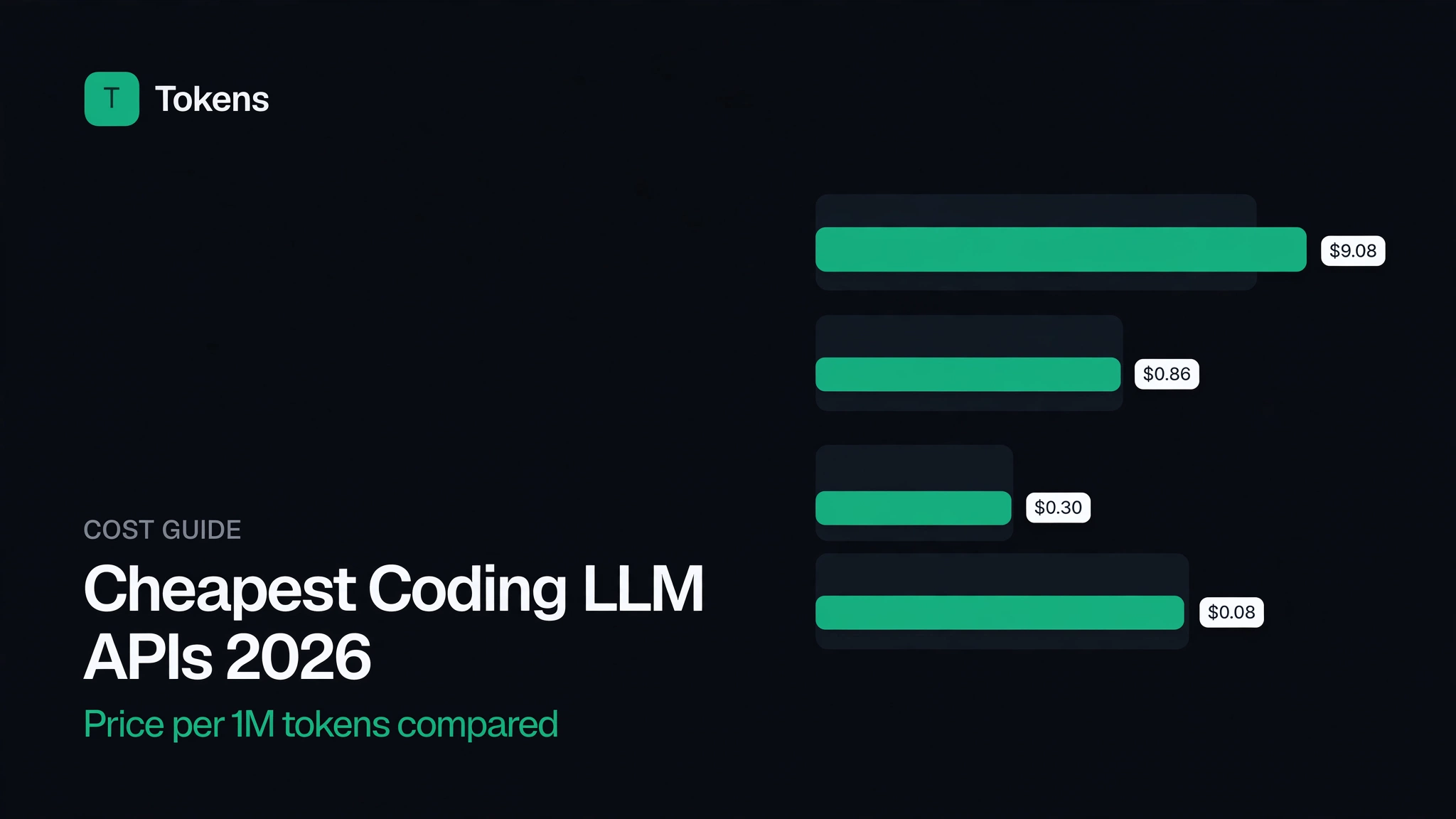
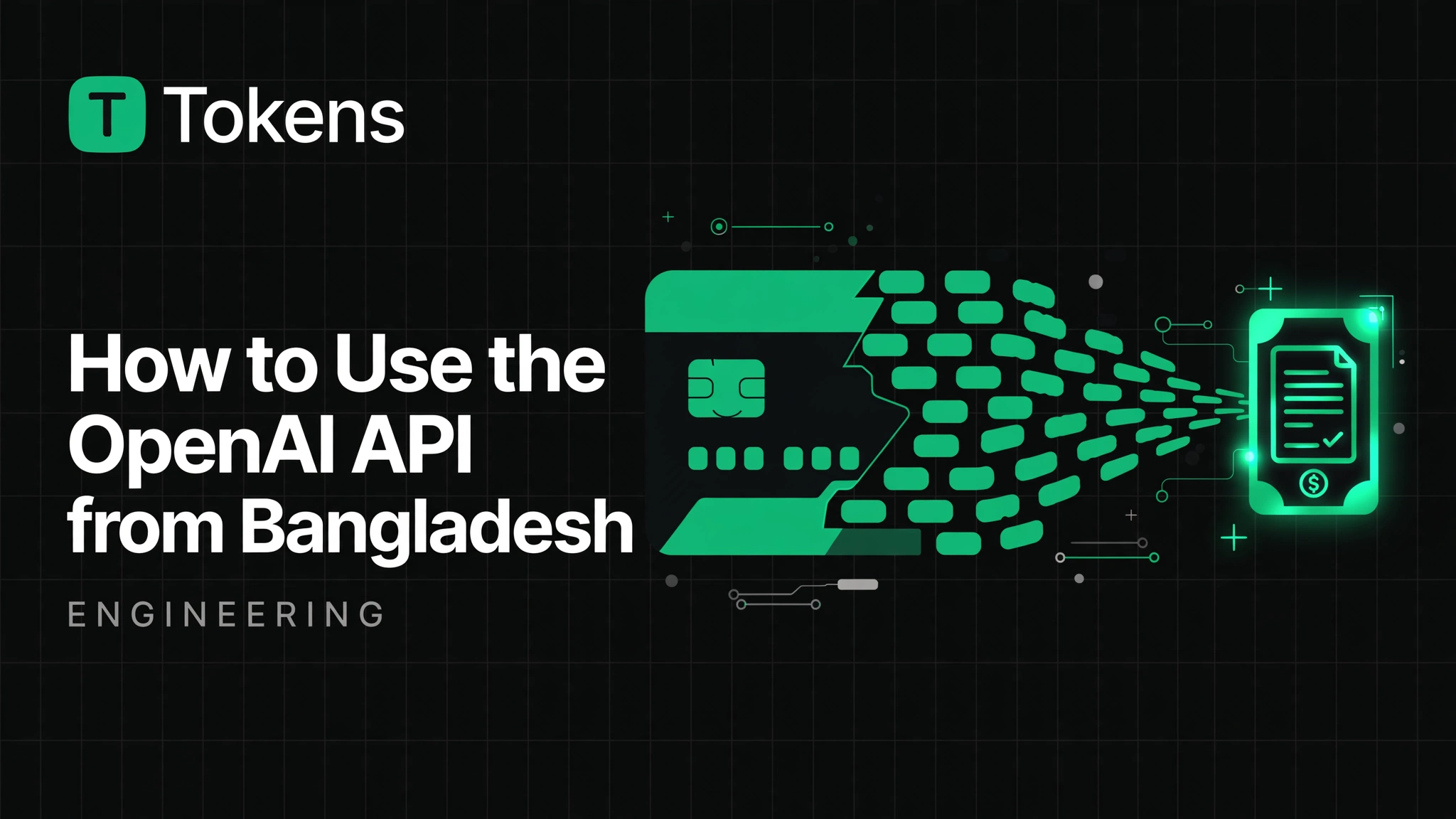
For the full price list this math is drawn from, see our cheapest coding LLM APIs comparison. For paying without a dual-currency card, the payment half of this problem is covered in how to use the OpenAI API from Bangladesh.
Why a student budget works in 2026#
Two things changed in the last year. First, the price floor collapsed: the cheapest capable coding models now charge single-digit dollars per 100M input tokens, and some are genuinely free. Second, payment stopped being a blocker for Bangladeshis — you can now top up an AI API wallet in taka, by invoice, with a receipt, no international card required (see how paying in BDT works).
The realistic tiers for a student:
| Tier | What it costs | What you get |
|---|---|---|
| Tk 0 | Nothing | Free models (Ling 3.0/3.1 Flash Sante, $0.00 input/output on the catalog) |
| Tk 25/week | ~Tk 100/month | Starter plan: $10 in credits, ~5K requests, 5 API keys |
| Tk 490/month | Pro plan | $10 credits, up to ~$60 usage with deals, ~30K requests |
| Pay as you go | Whatever you top up | Per-token billing, spend caps per key |
The Tk 0 tier exists but is unverified for coding quality — use it for chatbots, summarizers, and experiments, not production agents. The real student sweet spot is the Tk 25/week tier.
What a coding session actually costs in BDT#
Per-1M-token prices are meaningless until you multiply them by a session. A typical small agent coding session — one task, a few tool calls — moves roughly 500K input tokens and 50K output tokens. Here's the bill at the catalog prices checked 9 October 2026 (at ~Tk 123 per USD):
| Model | Input / 1M | Output / 1M | Per-session cost | Sessions per $10 |
|---|---|---|---|---|
| Ling 3.1 Flash | $0.00 | $0.00 | Tk 0 | unlimited |
| Qwen 3.7 Flash | $0.03 | $0.14 | ~Tk 2.7 | ~450 |
| Step 3.5 Flash | $0.10 | $0.33 | ~Tk 8.1 | ~150 |
| GPT-6 Luna | $0.11 | $0.55 | ~Tk 10.1 | ~120 |
| DeepSeek V4.1 Flash | $0.17 | $0.66 | ~Tk 14.5 | ~85 |
| MiniMax M3 | $0.33 | $1.32 | ~Tk 28.5 | ~43 |
| Claude Sonnet 5.5 | $2.20 | $11.00 | ~Tk 203 | ~6 |
One $10 credit block (the Tk 25/week starter plan) buys ~450 sessions on Qwen 3.7 Flash — more than two solid coding sessions a day for a whole semester break. Even DeepSeek V4.1 Flash, the student default for agentic coding, gives ~85 sessions per $10: about 3 a day for a month.
The 3-tier escalation ladder (the one rule that matters)#
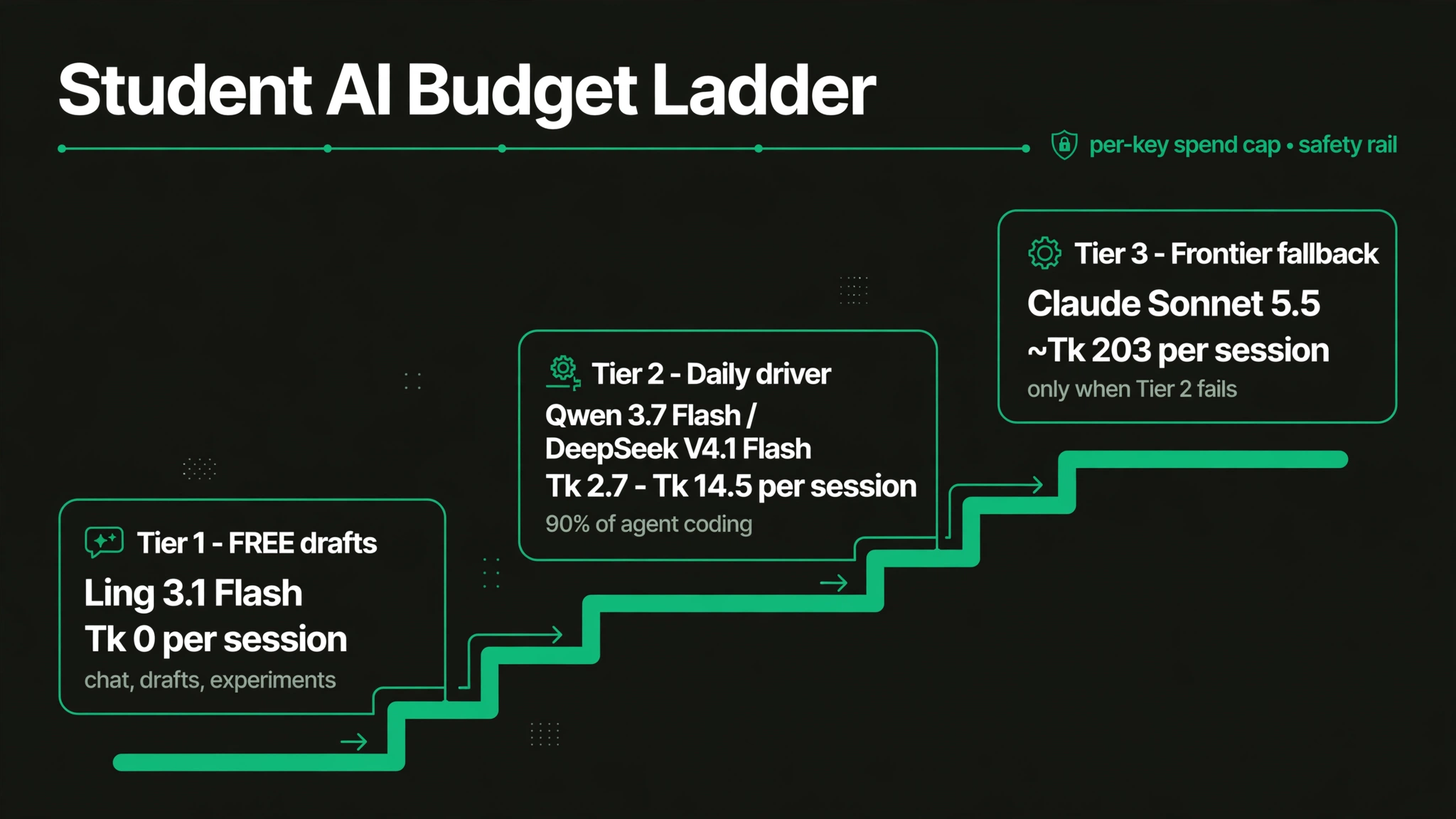
The mistake that burns budgets: sending every request to the smartest model. The fix is an escalation ladder with objective gates:
- Tier 1 — free drafts. Ling 3.1 Flash ($0.00) for classification, summarization, prompt drafting, and low-risk experiments. If the output passes your test, done.
- Tier 2 — cheap daily driver. Qwen 3.7 Flash ($0.03/$0.14) or DeepSeek V4.1 Flash ($0.17/$0.66) for real agent coding. This is where 90% of sessions live.
- Tier 3 — frontier fallback only. Sonnet 5.5 or GPT-5.6 Sol when Tier 2 fails a concrete check (tests fail, the plan is incoherent). A frontier session costs ~70x a Qwen session — it must earn that.
Two refinements that multiply the savings:
- Prompt caching. Agents re-send the same context every turn; cache writes are cheap and cache reads are near-free (Haiku 5.5 cache reads are $0.01/1M). For long repos, caching is the single biggest lever.
- Off-peak timing. DeepSeek's maker list prices are $0.30/$1.20 at peak and half that off-peak — schedule batch evaluations and overnight experiments when they're cheap.
Pair this ladder with the one base-URL change from our OpenAI SDK guide, and switching models is literally changing one model id.
Never let one bug burn your budget#
An agent loop gone wrong can issue thousands of requests before you notice. Every key you hand out needs a spending cap — this is non-negotiable on a student budget. On Tokens, each API key gets a monthly cap plus an optional model allow-list (so the Tier-2 key can never accidentally call a Tier-3 model), with email alerts at 50%, 75%, and 90% of the cap. A runaway loop stops at the cap instead of draining your balance; the setup is covered in API keys and limits and the failure mode in what an AI gateway is.
The student checklist:
- One key per project or tool, each with its own cap sized to a week of Tier-2 sessions.
- Model allow-list: cheap models only on the daily key. The frontier key lives separate, capped lower, and you rotate it.
- Check the alerts email — 50% in the first two days means something is looping.
- Keep keys out of repos: rotate in one click if one leaks.
Paying in taka, without an international card#
Payment is the other half of the student problem, and it's already solved: top up with invoice in BDT and every payment gets a dashboard receipt — no dual-currency card, no per-payment paperwork. The Tk 25/week starter plan is deliberately priced at canteen-lunch money; the Tk 490/month pro plan is the level where ~30K requests/month becomes realistic for a small team or a serious solo project. Plans are set separately in taka and dollars, so the price you see is the price you pay — the exchange-rate math above (~Tk 123 per USD, 9 October 2026) is only for comparing dollar-listed models.
Sample budgets for real student projects#
The Tk 0 hackathon sprint. Ling 3.1 Flash for the demo chatbot, Qwen 3.7 Flash tier via the free requests quota — total cost: Tk 0 plus your time. Caveat: verify free-model output quality before the demo judges see it.
The Tk 100/month side project. Starter plan at Tk 25/week. Budget: ~450 Tier-2 sessions/month on Qwen 3.7 Flash, or ~85 on DeepSeek V4.1 Flash, or a mix (prototyping on Qwen, the hard 10% on DeepSeek). One key per service, caps set, done.
The Tk 490/month team build. Monthly Max plan: ~30K requests with deals, 5 keys with separate caps for each teammate's agent, model allow-lists keeping everyone off Tier 3 by default. At this level you're spending what one Claude Pro-style subscription would cost, but across models.
FAQ#
What's the cheapest way to start building with AI in Bangladesh? Start free: the Ling 3.0 and 3.1 Flash Sante models cost $0.00 per million tokens on the Tokens catalog, so experiments are free. When you outgrow them, the Tk 25/week starter plan ($10 in credits) buys roughly 450 agent sessions on Qwen 3.7 Flash — the cheapest capable coding model at $0.03/1M input. Top up in taka by invoice; no international card needed.
How much does one AI coding session actually cost in taka? A typical small agent session (500K input + 50K output tokens) costs ~Tk 2.7 on Qwen 3.7 Flash, ~Tk 14.5 on DeepSeek V4.1 Flash, and ~Tk 203 on Claude Sonnet 5.5 — prices from the Tokens catalog checked 9 October 2026 at ~Tk 123 per USD. Output tokens cost 3–10x more than input at every provider, so input-heavy agent sessions are where the bill concentrates.
How do I stop an agent loop from burning my whole budget? Give every API key a monthly spending cap and a model allow-list (cheap models only on the daily key), enable email alerts at 50/75/90%, and keep a separate low-cap key for frontier models. A runaway loop then stops at the cap. See what an AI gateway is for how the cap and allow-list mechanism works.
Do I need an international credit card to pay for AI APIs in Bangladesh? No. Tokens accepts payment in BDT by invoice with a dashboard receipt for every payment, and prices are set separately in taka and dollars — no dual-currency card required. See our OpenAI API payment guide for Bangladesh for the full walkthrough.
Which model should a student use for daily coding? DeepSeek V4.1 Flash ($0.17/$0.66, ~Tk 14.5 per session) is the workhorse default; Qwen 3.7 Flash ($0.03/$0.14, ~Tk 2.7 per session) is the cheapest credible alternative for lighter tasks. Escalate to Sonnet 5.5 or GPT-5.6 Sol only when the cheap tier fails an objective check — a frontier session costs roughly 70x a Qwen session.