
TL;DR: Anthropic's Claude API is billed by international card in USD only — no bKash, Nagad, or mobile banking, and the API runs on prepaid credits. Current list prices (checked 12 October 2026): Claude Haiku 5.5 from $0.10/$0.50 per 1M tokens (≈৳12/৳62), Sonnet 5.5 at $2/$10 (≈৳247/৳1,233), Opus 5.5 at $4/$20 (≈৳493/৳2,466). No dual-currency card? The working route is a BDT gateway: Tokens accepts bKash/Nagad top-ups in taka and serves the Claude models through an OpenAI-compatible endpoint — no international card needed.
Getting Claude's API to work from Bangladesh is a payments problem, not a coding problem. The API answers from Dhaka just fine. What stops most developers is the checkout page — Anthropic's console assumes a customer with an international card, and most Bangladeshi cards can't clear a USD charge. This guide maps the wall, prices every current Claude model in taka, and lays out the routes that actually work.
How Anthropic bills you#
Anthropic's console (the Claude Platform) bills in US dollars against a credit or debit card — there is no bKash/Nagad option and no BDT billing. The API is prepaid: you buy a credit balance, usage deducts from it per token, and you can enable auto-reload up to a limit you choose. Two controls are worth setting on day one:
- Monthly spend limits under Settings → Limits. You can cap the whole organization or individual workspaces — the org cap always wins, so a runaway job in one workspace can't blow past the ceiling you set for the company.
- Usage notifications by email as you approach the limit.
Anthropic also enforces tier ceilings whether or not you set your own: roughly $500/month on the Start tier and $1,000/month on Build, rising to $200,000/month on Scale. Hit a tier ceiling and the API returns HTTP 429 until the first of the next month — for every app on the account, not just the one that caused it.
Two recent changes worth knowing. Claude Sonnet 4.5 was deprecated on 30 September 2026 and retires on 30 November 2026 — if you're still on it, the migration checklist covers the switch to Sonnet 5.5. And on 7 October 2026 Anthropic added monthly API credits for Max and Team subscribers ($100 on Max 5x, $200 on Max 20x, up to $500 pooled on Team) usable on the Claude Platform — handy if you already pay for a subscription, though the subscription's own usage allowance still doesn't cover third-party harnesses.
Why most Bangladeshi cards get declined#
The same wall as every other US API provider — our OpenAI API Bangladesh guide covers the mechanics in depth. The short version:
- Most local cards are BDT-only. A regular Bangladeshi debit card typically can't clear an international online charge. What works is a dual-currency card with a passport endorsement from your bank, or a virtual dollar card funded another way.
- Every dollar top-up carries an FX markup. Banks convert at their own rate plus a markup (typically 3–4%), so a "$30" recharge costs more than ৳3,699 and the number drifts every month. This is the cost most people forget to budget.
- Declines are usually the card, not you. When the issuing country and billing setup don't line up with what the processor expects, the charge fails — the single most common card failure worldwide, and almost always the answer in Bangladesh.
What Claude costs, in taka#
List prices checked 12 October 2026, converted at ৳123.31 per USD (12 October 2026).
| Model | Input / 1M (USD) | Output / 1M (USD) | Input / 1M (BDT) | Output / 1M (BDT) |
|---|---|---|---|---|
| Haiku 5.5 (prompts ≤ 100K) | $0.10 | $0.50 | ৳12.3 | ৳61.7 |
| Haiku 5.5 (prompts > 100K) | $0.50 | $2.50 | ৳61.7 | ৳308.3 |
| Sonnet 5.5 | $2.00 | $10.00 | ৳246.6 | ৳1,233 |
| Opus 5.5 | $4.00 | $20.00 | ৳493.2 | ৳2,466 |
| Fable 5.1 | $10.00 | $50.00 | ৳1,233 | ৳6,166 |
Three things to notice. First, Haiku 5.5 is tiered by prompt length: prompts up to 100,000 tokens get the headline $0.10/$0.50 rate, and everything above costs five times more. Agent sessions blow past 100K fast, so budget the upper tier for coding work. Second, output is the multiplier everywhere — 5x the input price on every current Claude model. Third, the ৳ column is what a card actually charges you before your bank's markup; on a gateway that lists taka prices separately, the ৳ number is fixed and the exchange rate never touches it.
The routes that work#
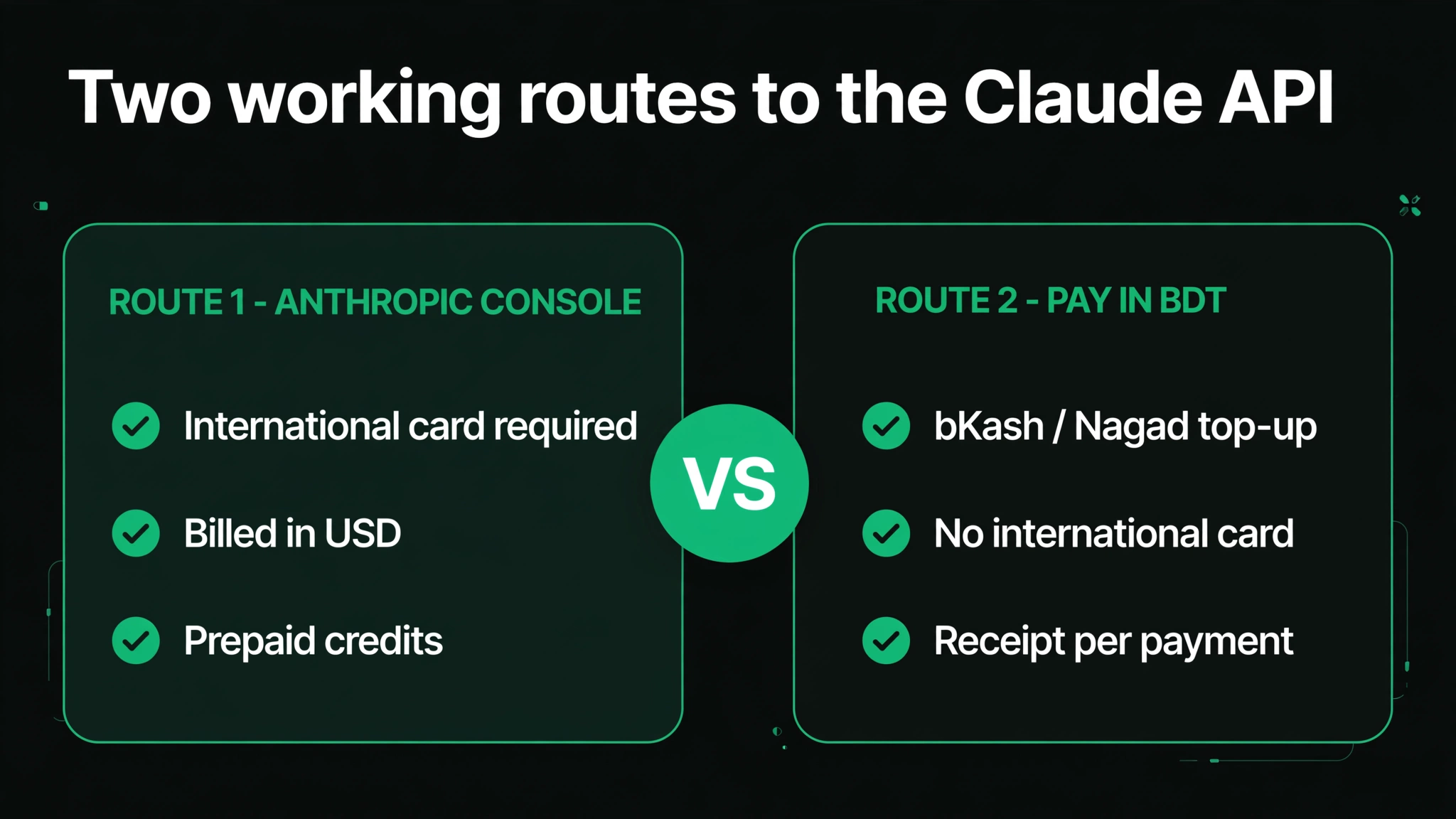
| Route | How you pay | International card | Currency | The catch |
|---|---|---|---|---|
| Anthropic Console (direct) | Card, prepaid credits | Yes — dual-currency | USD | The card wall, plus 3–4% FX markup |
| OpenRouter | Card or crypto, prepaid credits | Yes (or crypto) | USD | 5.5% platform fee on card credit purchases; same card wall |
| Cloud (Bedrock / Vertex) | Cloud billing account | Yes | USD | Only sensible if you already live on that cloud |
| Tokens (BDT route) | bKash / Nagad manual top-up, receipt per payment | No | BDT + USD listed separately | A different provider relationship to trust |
Route 1: pay Anthropic directly. If you have (or can get) a dual-currency card with a passport endorsement, the direct route is straightforward: add the card in the console, buy credits, set your spend limits, generate a key. You get every Claude model at list price with Anthropic's own billing. The honest downside is the one from the section above — you're paying in dollars with an FX markup on every top-up, and every future recharge needs the card to keep working.
Route 2: OpenRouter. OpenRouter sells prepaid credits (minimum purchase around $5–10) and passes through the provider's per-token prices with no markup — its cut is a 5.5% fee on card credit purchases. You get Claude plus every other major model on one key, which is convenient. But the payment wall is identical: an international card (or crypto) in USD. If the card is your problem, OpenRouter doesn't solve it. See the full comparison in OpenRouter alternatives for Bangladeshi developers.
Route 3: the cloud providers. Claude models are also available through AWS Bedrock, Google Vertex AI, and Azure — but each needs a cloud billing account, which needs the same international card. Only worth it if your infrastructure already lives there.
Route 4: pay in taka, keep your code. This is the route most Bangladeshi developers end up on. Tokens is an AI gateway built for exactly this wall: you top up in BDT with bKash (Send Money / Payment) or Nagad (Send Money / Merchant), get a receipt for every payment, and call the Claude models through an OpenAI-compatible endpoint — same SDK, same code, only the base URL and key change. Prices are listed separately in taka and dollars, so the ৳ number is fixed and never drifts with the exchange rate. Each key gets its own monthly spend cap and model allow-list, with email alerts at 50%, 75% and 90% — the guardrails that stop one buggy agent from burning your budget (how spend caps work). Compare the trade-offs in Tokens vs OpenRouter.
Worked example: a month of agent coding#
Say you run an agent 20 days a month, one session a day, each session sending 500K input tokens and generating 50K output tokens:
| Model | Per session | 20 sessions / month | In taka |
|---|---|---|---|
| Sonnet 5.5 | 0.5 × $2.00 + 0.05 × $10.00 = $1.50 | $30.00 | ~৳3,699 |
| Haiku 5.5 (>100K tier) | 0.5 × $0.50 + 0.05 × $2.50 = $0.38 | $7.50 | ~৳925 |
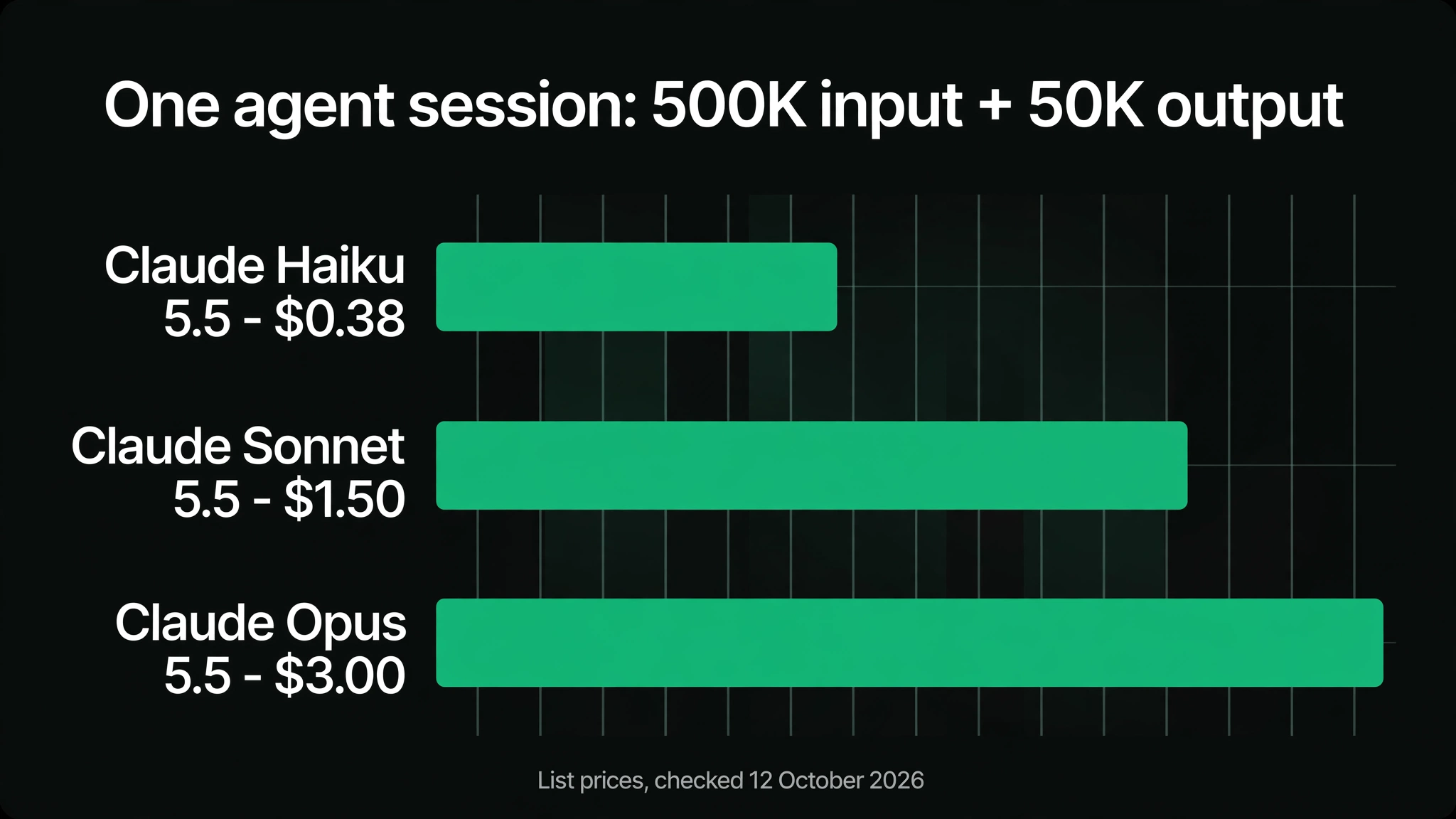
At ৳123.31 per USD: $30.00 → ৳3,699.30; $7.50 → ৳924.83. The Haiku row uses the above-100K tier because a 500K-token session always exceeds the 100,000-token threshold — the headline $0.10 rate doesn't apply to workloads like this. On a card, add your bank's 3–4% markup on top; on a taka-priced gateway, the ৳ figure is the whole story. To turn your own usage into a monthly estimate, use the method in how to estimate your monthly token bill.
Once you're in, cap it#
Getting API access is step one; surviving it is step two. Set a monthly spend limit in Anthropic's console on day one — or, if you're on the BDT route, create each agent's key with its own monthly cap and a short model allow-list, so a runaway loop or a leaked key can only ever spend what you pre-approved. The full playbook (per-key caps, the 403 monthly_spend_cap_exceeded error, alert thresholds) is in spend caps for coding agents, and the API keys docs cover key management in reference form.
Claude API payment FAQ#
Can I pay for the Claude API with bKash or Nagad? Not on Anthropic's console — it bills by card in USD only, and domestic mobile-banking rails can't settle with a foreign API provider. You can pay with bKash or Nagad through a BDT gateway like Tokens, which takes manual top-ups in taka and issues a receipt per payment.
Why does Anthropic decline my Bangladeshi card? Most local cards are BDT-only and can't clear international online charges. You need a dual-currency card with a passport endorsement from your bank. Also check the balance covers the prepaid credit purchase plus any pre-authorization hold.
Does the Claude API have spending limits? Yes. Set monthly spend limits per organization or workspace under Settings → Limits — the org cap always wins. Anthropic also enforces tier ceilings ($500/month Start, $1,000/month Build, $200,000/month Scale); hitting one returns HTTP 429 until the first of the next month.
I have a Claude Max subscription — does it cover API calls? The subscription allowance doesn't cover third-party harnesses, but since 7 October 2026, Max 5x, Max 20x and Team subscribers get monthly API credits ($100, $200, and up to $500 pooled) usable on the Claude Platform.
Is Claude Sonnet 4.5 still available on the API? It was deprecated on 30 September 2026 and retires on 30 November 2026. New work should target Sonnet 5.5 — the migration checklist walks through the switch.
List prices checked 12 October 2026. Model prices and billing policies change; Anthropic's pricing page is the authority for list prices, and the model catalog for prices on Tokens.
Sources: Anthropic pricing · Claude models compared: pricing · Haiku 5.5 launch pricing · Anthropic launches Haiku 5.5 · AI spend controls compared · Anthropic prepaid + workspace caps · OpenRouter pricing fees · USD/BDT rate