TL;DR: The wait is over. Moonshot AI published the full weights of Kimi K3.1 Pro on Hugging Face on 4 November 2026 as
moonshotai/Kimi-K3.1-Pro— 96 safetensors shards totalling 1,561,355,732,732 bytes (about 1.56 TB), ungated, under Moonshot's own Kimi K3.1 Pro Licence. Downloading it takes about 3.5 hours at a sustained 1 Gbps and about 34.7 hours at 100 Mbps, and the weights alone exceed a single 8×B200 node's 1,536 GB of VRAM — so self-hosting is a multi-node project, not a workstation job. The licence permits commercial use but carries two thresholds: a model-as-a-service business over $20 million trailing-12-month revenue needs a separate Moonshot agreement, and a product over 100 million monthly users or $20 million monthly revenue must display "Kimi K3.1-Pro". For almost everyone, the API stays the practical route: Kimi K3.1 Pro is live on tokens.bd at $3.00/$12.00 per 1M input/output tokens (৳312.50/৳1,375.00) — a heavy session of 1M input + 100K output costs $4.20 (৳450.00). Prices, repo contents and licence checked 5 November 2026.
Update note, 5 November 2026: this post was first published on 4 November as a deadline-day briefing, when the repository had not yet appeared. It has now been rewritten around the actual release: the real file list, the real licence text, real download steps, and one correction. Yesterday we estimated the download from Kimi K3's 1,561 GB and said a 4-bit file would barely fit an 8×B200 node; the actual K3.1 Pro weights are 1,561.36 GB, which is 25 GB more than that node's 1,536 GB — so even the flagship single node does not hold them before KV cache. Everything else from yesterday's briefing — the size estimate, the licence thresholds, the API prices — checked out against the real release.
Are the Kimi K3.1 Pro weights really out?#
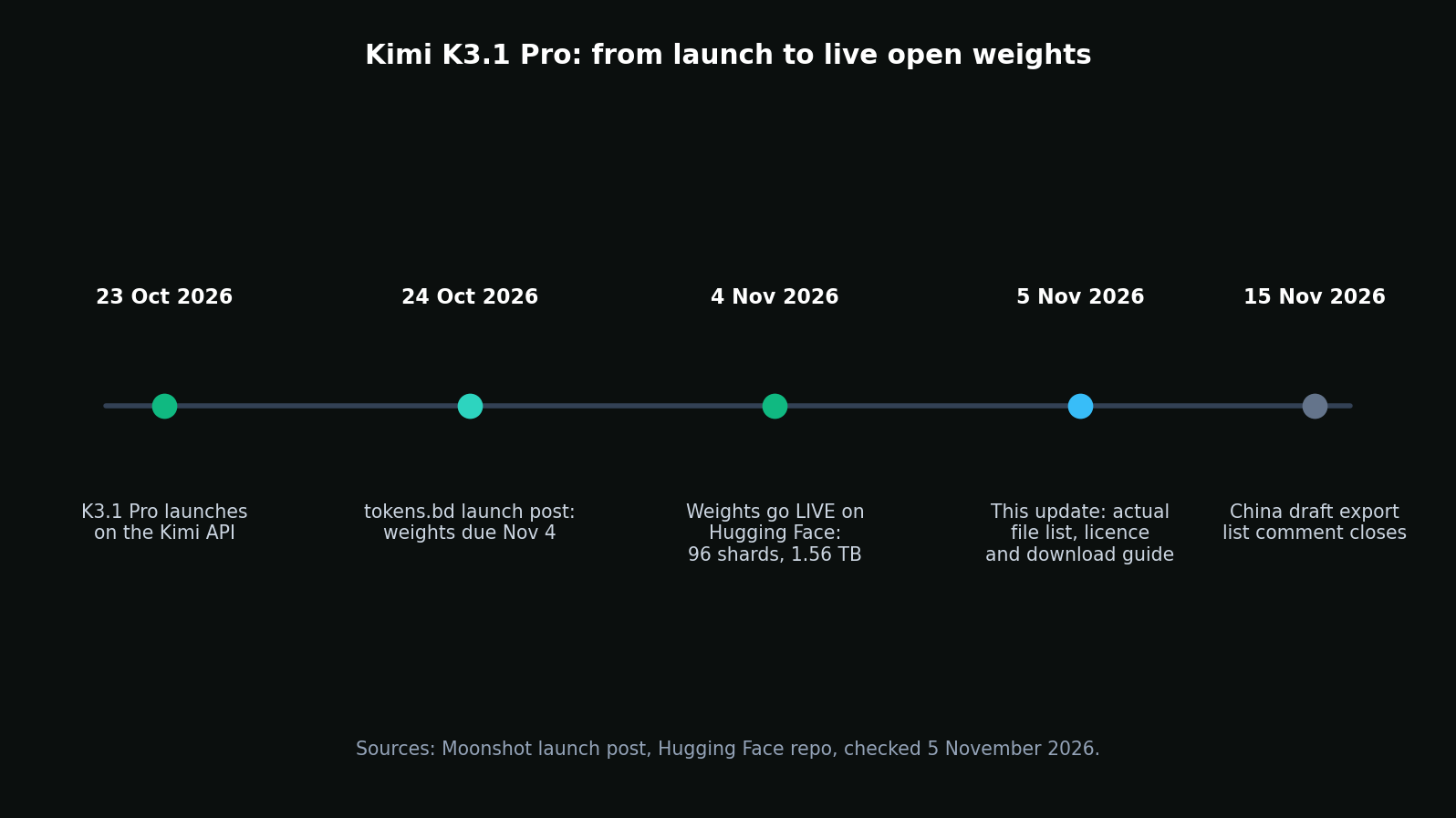
Yes — the repository is public, ungated, and downloadable right now. Moonshot AI published moonshotai/Kimi-K3.1-Pro on Hugging Face on 4 November 2026, the date promised at the model's 23 October launch ("full model weights will be released by Nov 4"). The repository is not gated: Hugging Face lists it as ungated, so no access request or approval stands between you and the download, and its file list is fully visible. Independent trackers recorded the release going public during 4 November, and the repository's own card now carries the full model summary, benchmark tables, deployment recommendations, and licence. If you checked yesterday morning and found nothing, that was accurate then — the release landed later on 4 November, not earlier. The one date nuance worth knowing: the repository's commits are dated 2 November, but the release was not public until 4 November, so 4 November is the release date, not 2 November.
What exactly is in the repository?#
A 2.8-trillion-parameter mixture-of-experts model in 96 shards, plus the code needed to run it. The Hugging Face model card and API record agree on the headline numbers, and we verified them against the live repository on 5 November 2026 rather than trusting launch coverage. The weights use MXFP4 quantization with MXFP8 activations, the result of quantization-aware training — this is why a 2.8T model fits in 1.56 TB at all, at roughly 4.49 bits per parameter including the higher-precision components. Alongside the shards sit the tokenizer files, a config.json, a model.safetensors.index.json mapping weights to shards, and custom code files (including configuration_kimi_k3.py and the tokenizer/processor code) that Transformers needs to load the model. The model is natively multimodal, with a 401M-parameter MoonViT-V2 vision encoder, and a 1-million-token context window.
| Item | Actual value (verified 5 November 2026) |
|---|---|
| Repository | moonshotai/Kimi-K3.1-Pro on Hugging Face, ungated |
| Total parameters | 2,780,110,363,392 (about 2.8T) |
| Active parameters per token | 104B (896 experts, 16 selected per token) |
| Weight files | 96 safetensors shards (model-00001-of-000096 … model-00096-of-000096) |
| Total download size | 1,561,355,732,732 bytes (about 1.56 TB; average shard about 16.26 GB) |
| Quantization | MXFP4 weights / MXFP8 activations (quantization-aware training) |
| Context window | 1,048,576 tokens |
| Architecture | 93 layers (69 KDA + 24 Gated DSA attention layers), 160K vocabulary |
| Licence file | LICENSE — the Kimi K3.1 Pro Licence (see below) |
| Recommended engines | vLLM, SGLang, TokenSpeed (per the model card) |
| API model IDs (unchanged) | kimi-k3.1-pro, kimi-k3.1-pro-highspeed |
The benchmark story is unchanged from launch and still vendor-reported: Moonshot reports 65.7% on Terminal-Bench 4.0, 0.7 points behind Claude Opus 5.5 (66.4%) and ahead of GPT-6 Astra (58.2%), plus 92.1 on BrowseComp and 94.2 on GPQA-Diamond. Treat every one of those numbers as a claim awaiting independent replication, not a measured fact — the Terminal-Bench jump from Kimi K3's 13% to 65.7% in one post-training pass is exactly the kind of number that deserves a second lab before anyone rebuilds a stack around it. What the release changes is not the benchmark story but its verifiability: anyone with the hardware can now reproduce it.
How do I download the weights?#
With the Hugging Face CLI or Python, no access approval needed — but budget disk first. The download is ungated, so you do not need to request access; a Hugging Face token is optional for a public repo. Install the tooling, then pull the whole repository. The command below downloads all 96 shards plus the config, tokenizer, and custom code. Do not start it on a disk with less than about 2 TB free: you need the 1.56 TB download plus headroom for extraction, a second copy if you plan to quantize further, and the serving engine's working space. Because the repository is public and ungated, the only prerequisites are the tooling and enough disk; there is no form to fill, no waitlist, and no approval email to wait for before the transfer starts.
pip install -U "huggingface_hub[cli]"
huggingface-cli download moonshotai/Kimi-K3.1-Pro --local-dir ./kimi-k3-1-pro
Or from Python, which makes it easier to resume and to pin a revision:
from huggingface_hub import snapshot_download

path = snapshot_download(
    repo_id="moonshotai/Kimi-K3.1-Pro",
    local_dir="./kimi-k3-1-pro",
)
print(path)
Two gotchas before you serve anything. First, the repository ships custom code (configuration_kimi_k3.py and friends), so Transformers-based loaders need trust_remote_code=True — read those files before you trust them, as you should with any custom code. Second, Moonshot's card recommends vLLM, SGLang, or TokenSpeed for inference, and the model's thinking effort is configured with a top-level reasoning_effort field (low, high, max, default max); for multi-turn and tool-calling use, the card requires passing the complete assistant message back as-is, including reasoning_content and tool_calls, not just the text. Skip that and long agentic runs will silently degrade. Verify the download before serving: the index file maps every shard, and a missing or truncated shard will fail loudly at load time — better there than mid-benchmark.
How long will the download actually take?#
Hours at datacenter bandwidth, more than a day on a home connection — this is pure arithmetic from the real file size. The repository is 1,561,355,732,732 bytes, which is 12,491 gigabits. Divide by your sustained (not advertised peak) bandwidth and you get the wait. At a sustained 1 Gbps that is 3.5 hours; at 500 Mbps, 6.9 hours; at 100 Mbps, 34.7 hours. Those are best-case figures: they assume the full bandwidth the whole time, no throttling, no resume overhead, and no competing traffic. Treat the advertised speed on your plan as a ceiling, not a promise: real sustained throughput is usually lower, so the table below is the optimistic case. If your link is shared or bursty, plan for longer, and use a resumable downloader (the CLI and snapshot_download both resume) rather than restarting a 1.5 TB transfer from scratch.
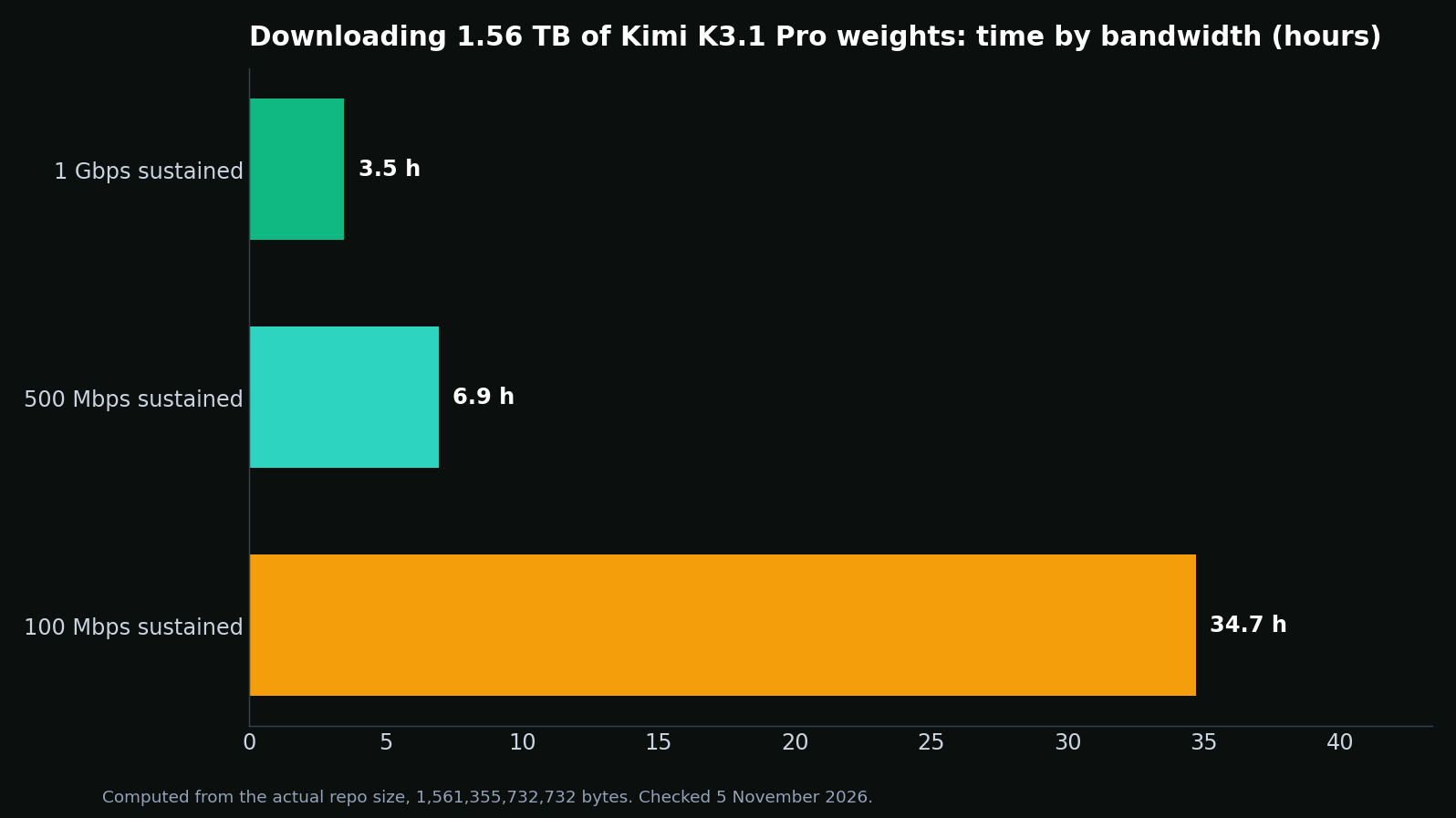
| Sustained bandwidth | Download time for 1.56 TB |
|---|---|
| 1 Gbps | 3.5 hours |
| 500 Mbps | 6.9 hours |
| 100 Mbps | 34.7 hours |
Can I run it on my own hardware?#
Only on a multi-GPU cluster — and the real weights tightened yesterday's verdict by one node class. The weights alone decide this, before a single token of KV cache. The actual 1,561 GB exceeds an 8×B200 node's 1,536 GB, so the configuration yesterday's post described as "barely fits" does not fit at all; that correction matters if you were about to book that hardware. An 8×H200 node (1,128 GB) is further away still, and an 8×H100 node (640 GB) is not in the conversation. The realistic floor for the full weights is a 16×H200-class setup (2,256 GB), which leaves real room for KV cache — and KV cache is the second bill, because a 1M-token context window on a model this size needs memory far beyond the weights themselves. Aggressive quantization below MXFP4 could shrink the footprint, but no official lower-precision release exists yet, and community quantizations will trade quality for size in ways nobody has measured on this model.
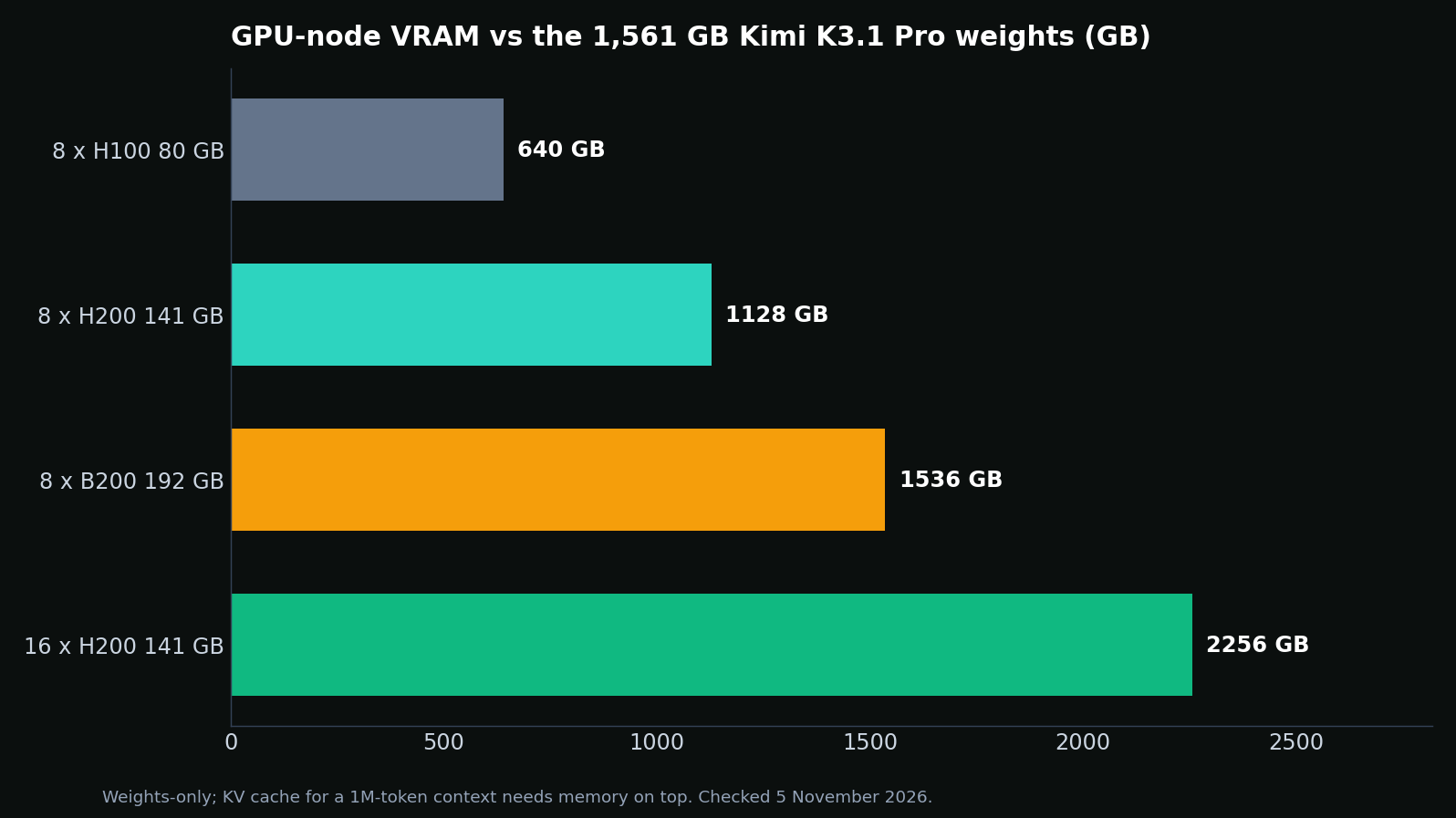
| Setup | Total VRAM | Fits the 1,561 GB weights? |
|---|---|---|
| 8 × H100 80 GB | 640 GB | No |
| 8 × H200 141 GB | 1,128 GB | No |
| 8 × B200 192 GB | 1,536 GB | No — 25 GB short, before KV cache |
| 16 × H200 141 GB | 2,256 GB | Yes — weights plus real KV-cache room |
For almost every reader, the honest conclusion from our MiniMax M3.1 Flash self-host guide applies here with more force: a 428B-class model already demanded datacenter hardware, and a 2.8T model is an order of magnitude beyond that. "Open weights" here mostly means option value — cheaper third-party hosted inference once weights are public, fine-tuning access, and auditability — not running it on hardware you own. If you do not already operate a cluster, the API is not the compromise; it is the plan.
What does the licence actually say?#
It is a custom licence, not MIT or Apache — permissive for most users, with two thresholds that bite only at very large scale. We read the actual LICENSE file in the repository on 5 November 2026, and it matches the shape predicted from Kimi K3's licence, with the model name updated. Permission is granted free of charge to use, copy, modify, merge, publish, distribute, sublicense, and sell the software, including the weights, and to run, deploy, fine-tune, or create derivative works. The conditions are what you must actually check. Internal use — defined as use that does not make the software, its outputs, or its capabilities available to third parties — is exempt from both thresholds, as is use through Moonshot's official products or certified inference partners. Everything is provided "as is", without warranty, which is standard and worth noting for production use.
| Licence condition | Threshold | What it requires |
|---|---|---|
| Model-as-a-Service revenue | You or your affiliates run a MaaS business (third parties get meaningful control over inputs, parameters, or training data) with aggregate revenue over $20 million in any consecutive 12 months | Enter a separate agreement with Moonshot AI before commercial use |
| Large-product display | Your commercial product or service has over 100 million monthly active users or over $20 million monthly revenue | Display "Kimi K3.1-Pro" prominently on the user interface |
| Internal use | Use that does not expose the software, outputs, or capabilities to third parties | Exempt from both conditions above |
| All use | Copyright + permission notice included in copies | Standard attribution condition |
Note the careful definition work in the licence: end-user products with model capabilities embedded within specific features, and mere relaying of requests to models hosted by others, do not count as Model as a Service. So a developer building an app on top of an API, or a team running the model internally, is not caught by the $20M clause; a company reselling raw model access at scale is. If you are anywhere near either threshold, read the file yourself and take legal advice — this section is a summary, not legal counsel. And one deliberate difference from a normal open release carries over into the weights themselves: Moonshot says it removed cyberattack-related data from mid-training and filtered cyber-related reinforcement-learning environments, and its own measurement puts the sanitized checkpoint at 81.0% on its internal xdev-bench-hard set versus 90.5% for the unsanitized pipeline checkpoint. Those are Moonshot's figures, not independent ones — but the direction is the point: what you download is deliberately less offensive-cyber-capable than the internal pipeline could produce, by design.
What does it cost: self-hosting or the API?#
The API route is live today, and the gap between Moonshot's direct price and tokens.bd's routed price is small. Moonshot's own API charges $2.00 per 1M input tokens, $10.00 per 1M output, and $0.20 per 1M cached input; the Highspeed variant doubles the standard rate to $4.00/$20.00. Kimi K3.1 Pro is live in the tokens.bd catalog at $3.00 input / $12.00 output per 1M tokens (৳312.50 / ৳1,375.00), on Free, Weekly, Monthly and pay-as-you-go plans — verified live on the tokens.bd model page on 5 November 2026, unchanged from 4 November. The table below is the original computed dataset for this post: every session figure is recomputed from those list prices, not copied from a provider page.
| Route | Input / 1M | Output / 1M | Heavy session (1M in + 100K out) |
|---|---|---|---|
| Moonshot API direct | $2.00 | $10.00 | $3.00 |
| tokens.bd | $3.00 (৳312.50) | $12.00 (৳1,375.00) | $4.20 (৳450.00) |
| Moonshot API Highspeed | $4.00 | $20.00 | $6.00 |
The arithmetic is straightforward: 1M input tokens at $3.00 plus 100K output at $12.00/1M ($1.20) equals $4.20; in taka, ৳312.50 plus ৳137.50 equals ৳450.00. Per dollar on tokens.bd you get about 333K input tokens, or about 262K tokens at this session's 10:1 input-output mix ($4.20 per 1.1M tokens). A month of daily heavy use at 20M input + 1.2M output tokens runs $74.40 (৳7,900.00) on tokens.bd's live prices — the same figure the model page itself computes. The $1.20 per-session premium over Moonshot direct buys BDT payment through bKash/Nagad, one key across 60+ models, and no international card — which, for developers in Bangladesh, is usually the whole decision. Self-hosting only wins when your sustained token volume is large enough that per-token API spend exceeds the full cost of owning or renting a multi-node cluster plus the engineering time to serve a 2.8T MoE — and for a model at $3.00/$12.00, that bar is very high. If you run Kimi K3 anywhere, the switch case from our launch post still holds: K3.1 Pro is 33% cheaper than K3's $3/$15 direct rates and dramatically stronger on the benchmarks.
Should you download it, or use the API?#
Download it if you have the cluster, a fine-tuning plan, or an audit requirement; use the API for everything else. That is the whole decision, and it has not changed with the release — the release just replaced estimates with facts. If you already operate multi-node GPU capacity, start with the MXFP4 weights as published, benchmark Terminal-Bench-style tasks on your own workload before trusting the 65.7%, and only then move production traffic. If you need data to stay inside your infrastructure, the weights (not the API) are the route, subject to the licence thresholds above. If you want to fine-tune on your own data, only the weights give you that. And if you simply want K3.1 Pro's capability this week, or you run a few hundred sessions a month, the API at $4.20 a heavy session beats cluster economics by an amount that needs no spreadsheet to see.
| Situation | Right call |
|---|---|
| You want K3.1 Pro's capability this week | API — it is live on tokens.bd today |
| You need data to stay inside your infrastructure | Weights — then hosted inference or your own cluster |
| You want to fine-tune on your own data | Weights — the API cannot do this |
| You run a few hundred sessions a month | API — $4.20 a heavy session beats cluster economics |
| You already operate multi-node GPU capacity | Download the MXFP4 weights; benchmark before production |
What to watch next: independent benchmark replications of the 65.7% Terminal-Bench claim, the first community quantizations and hosted-inference prices now that the weights are public, and the 15 November close of comments on China's draft export control list, which is the regulatory backdrop to this release. We will update this post again if any of those change the advice — not publish a duplicate.
Kimi K3.1 Pro open weights FAQ#
Are Kimi K3.1 Pro's open weights available to download?
Yes, since 4 November 2026. The repository moonshotai/Kimi-K3.1-Pro on Hugging Face is public and ungated: 96 safetensors shards totalling about 1.56 TB, under the Kimi K3.1 Pro Licence. No access request is needed.
How big is the Kimi K3.1 Pro weights download? 1,561,355,732,732 bytes — about 1.56 TB across 96 shards (average shard about 16.26 GB). At a sustained 1 Gbps that downloads in about 3.5 hours; at 100 Mbps, about 34.7 hours. Keep about 2 TB free before you start.
Can I run Kimi K3.1 Pro on my own hardware? Practically, only on a multi-GPU cluster. The 1,561 GB weights exceed a single 8×B200 node (1,536 GB) before KV cache; a 16×H200-class setup (2,256 GB) is the realistic floor for the full weights. For most developers, the real win from open weights is cheaper hosted inference and fine-tuning access, not home servers.
What licence do Kimi K3.1 Pro's weights use? Moonshot's own Kimi K3.1 Pro Licence, not MIT or Apache. Commercial use is permitted, but a model-as-a-service business over $20 million trailing-12-month revenue needs a separate Moonshot agreement, and a product over 100 million monthly users or $20 million monthly revenue must display "Kimi K3.1-Pro". Internal use is exempt from both.
Is Kimi K3.1 Pro on tokens.bd, and what does it cost there?
Yes — live in the catalog at $3.00/$12.00 per 1M input/output tokens (৳312.50/৳1,375.00), on Free, Weekly, Monthly and pay-as-you-go, checked 5 November 2026. Call it as moonshotai/kimi-k3.1-pro through the OpenAI- or Anthropic-compatible endpoint with a Tokens key. Browse the model catalog for 60+ models with USD and BDT pricing, and see plans for BDT payment options.
Prices, repo contents and licence checked 5 November 2026 (Moonshot list prices checked 4 November 2026, tokens.bd catalog re-verified live 5 November 2026). Benchmark figures are vendor-reported until independent labs replicate them; the Hugging Face repository and its LICENSE file are the authority.
Sources: Kimi K3.1 Pro model card, Hugging Face · Kimi K3.1 Pro Licence, Hugging Face · Hugging Face model API record for moonshotai/Kimi-K3.1-Pro · Introducing Kimi K3.1 Pro (Moonshot, official launch post) · Kimi K3.1 Pro: price, benchmarks, should you switch? (tokens.bd, 24 Oct 2026) · MiniMax M3.1 Flash weights are out: self-host guide (tokens.bd, 23 Oct 2026) · Kimi K3.1 Pro open weights: release date, license, price (CellCog tracker) · tokens.bd Kimi K3.1 Pro model page · tokens.bd model catalog