TL;DR: MiniMax released the M3.1 Flash open weights on 23 October 2026 — repo
MiniMaxAI/MiniMax-M3.1-Flashon Hugging Face, free to download with no approval gate, ~252 GB in 48 quantized shards. The license is the MiniMax Community License: free for non-commercial use, commercial use allowed with a "Built with MiniMax M3.1-Flash" attribution (written permission required above $20M/year revenue) — it is not MIT like DeepSeek's. Day-one serving support: vLLM, SGLang, TokenSpeed, plus hosted inference on Together AI at the same $0.15/$0.60 per 1M tokens as MiniMax's own API. Our math: with rented H100s, the API stays cheaper than self-hosting at every throughput a 4× H100 node can actually serve — self-host for data residency, fine-tuning, or offline use, not to save money.
Four days ago, MiniMax launched M3.1 Flash as an API product with a promise attached: the weights would follow on October 23. They kept the promise. On 23 October 2026, MiniMax announced the open-sourcing of the M3.1 Flash weights — 428B total parameters, 23B active per token — and the checkpoint is now live on Hugging Face for anyone to download. Together AI is the named production-inference partner, and vLLM, SGLang, Hugging Face, and ModelScope all support it on day one.
This is the follow-up to our M3.1 Flash launch guide from October 20, which covered the API pricing and the switch decision. That post ended with the open-weights release as the open question. Today we answer it: what exactly shipped, what the license really allows, what hardware you need, and — with real numbers — whether you should run it yourself or keep calling the API. If you're deciding between downloading the weights, pointing at Together AI, or staying on MiniMax's API, this post is the complete decision guide.
What shipped on 23 October#
The concrete facts, verified against the live repository and today's announcements:
- Repo:
MiniMaxAI/MiniMax-M3.1-Flashon Hugging Face. Public, not gated — no approval form, no waitlist. Hundreds of downloads within the first hours (per Hugging Face's counter, checked 23 October 2026). - ~252 GB download. 48 safetensors shards in MXFP8-quantized format, plus the DSpark speculative-decoding draft head as a separate artifact. Quantization-aware training (QAT) is why the download is a quarter-terabyte instead of nearly a terabyte — the routed MoE experts and attention paths were quantized during training.
- Three confirmed architecture changes from M3, per the model card: sparse attention throughout the model (the first three full-attention layers replaced with MiniMax Sparse Attention), quantization-aware training, and DSpark speculative decoding replacing the earlier EAGLE-style multi-token prediction approach.
- 1M-token context, text/image/video inputs, text output. Recommended sampling:
temperature=1.0,top_p=0.95. Reasoning is always-on with five effort levels (low→max) set throughreasoning_effortin the chat template — the same effort dial as the API. - Day-one serving: vLLM (recipe published, v0.33.0+), SGLang (cookbook), TokenSpeed. Transformers, KTransformers, unsloth, and ATOM integrations are in progress. Multi-chip deployment via FlagOS, and a ModelScope mirror for regions where Hugging Face is slow.
- Day-one hosts: Together AI (production inference partner), Fireworks, Nebius, Baseten, Modal, DigitalOcean. Chip partners include NVIDIA, AMD, Huawei Ascend, and several domestic Chinese accelerator vendors.
The scale of the launch is worth a pause. MiniMax says real users processed over 100 trillion tokens through M3.1 Flash in the 72 hours after launch — and that's on top of the 200+ trillion tokens the model absorbed anonymously as "Space Bunny" on OpenRouter's stealth leaderboard in the weeks before. Whatever you think of vendor stats, this is one of the most battle-tested open-weight releases in recent memory: the weights dropping today have already served hundreds of trillions of tokens in production-like conditions. That matters for self-hosters because the most common day-one failure of a new open model — broken chat templates, misbehaving tool calls, quantization that collapses on real prompts — has effectively been pre-tested at a scale no lab eval can match.
The fastest way to grab it:
hf download MiniMaxAI/MiniMax-M3.1-Flash --local-dir MiniMax-M3.1-FlashNote the copy rule we apply to every weights release: MiniMax's own benchmark table is on the model card, but treat it as the vendor's numbers. The independent scores that exist — Artificial Analysis's Intelligence Index at 42, and the noted 93% confident-wrong rate on AA-Omniscience — come with their own caveats, which we covered in the launch guide.
What the license actually allows#
This is the section most coverage skips, and it matters more than the parameter count. We read the actual LICENSE file in the repository (checked 23 October 2026). It is the MiniMax Community License — the same license family as M3's — and it is not an OSI-approved open-source license.
The terms, in plain language:
- Non-commercial use is free. Research, tinkering, internal evaluation — no permission needed.
- Commercial use is allowed, with strings attached. You must prominently display "Built with MiniMax M3.1-Flash" on a related website, UI, blog post, about page, or product documentation.
- Revenue over $20M/year needs prior written authorization from MiniMax (email [email protected] with the subject "M3.1-Flash licensing - authorization request"). Below that threshold, a one-time notice email to the same address suffices.
- Prohibited uses include military applications, harming minors, generating disinformation intended to cause harm, and discrimination or hate speech.
How it compares to the alternatives developers actually weigh:
| MiniMax M3.1 Flash | DeepSeek V4.1-Flash-1017 | Typical Apache-2.0 model | |
|---|---|---|---|
| License | MiniMax Community License | MIT | Apache 2.0 |
| Commercial use | Allowed with attribution; written approval above $20M/yr revenue | Allowed, no strings | Allowed, no strings |
| Attribution required | Yes — "Built with MiniMax M3.1-Flash" | No | No |
| Use-restriction clauses | Military, minors, disinformation, discrimination | None | None |
| Weights available | Yes, since 23 Oct 2026 | Yes | Varies |
The practical read: for a startup or indie developer, the license is close to free — the attribution line is a small price. In practice, "prominently display" means a line in your footer, about page, or API docs — the same pattern Llama's community license normalized years ago. For an enterprise, two things need legal review before building on it: the $20M revenue authorization trigger, and the use-restriction clauses (military use is the one that most often trips corporate policy). If your compliance team can't clear those, the MIT-licensed DeepSeek alternative — or a hosted route where the provider holds the license relationship — is the cleaner path. See our DeepSeek V4.1-Flash-1017 release guide for the head-to-head numbers.
What it takes to run it#
The headline number is ~252 GB of weights. Everything else follows from that.
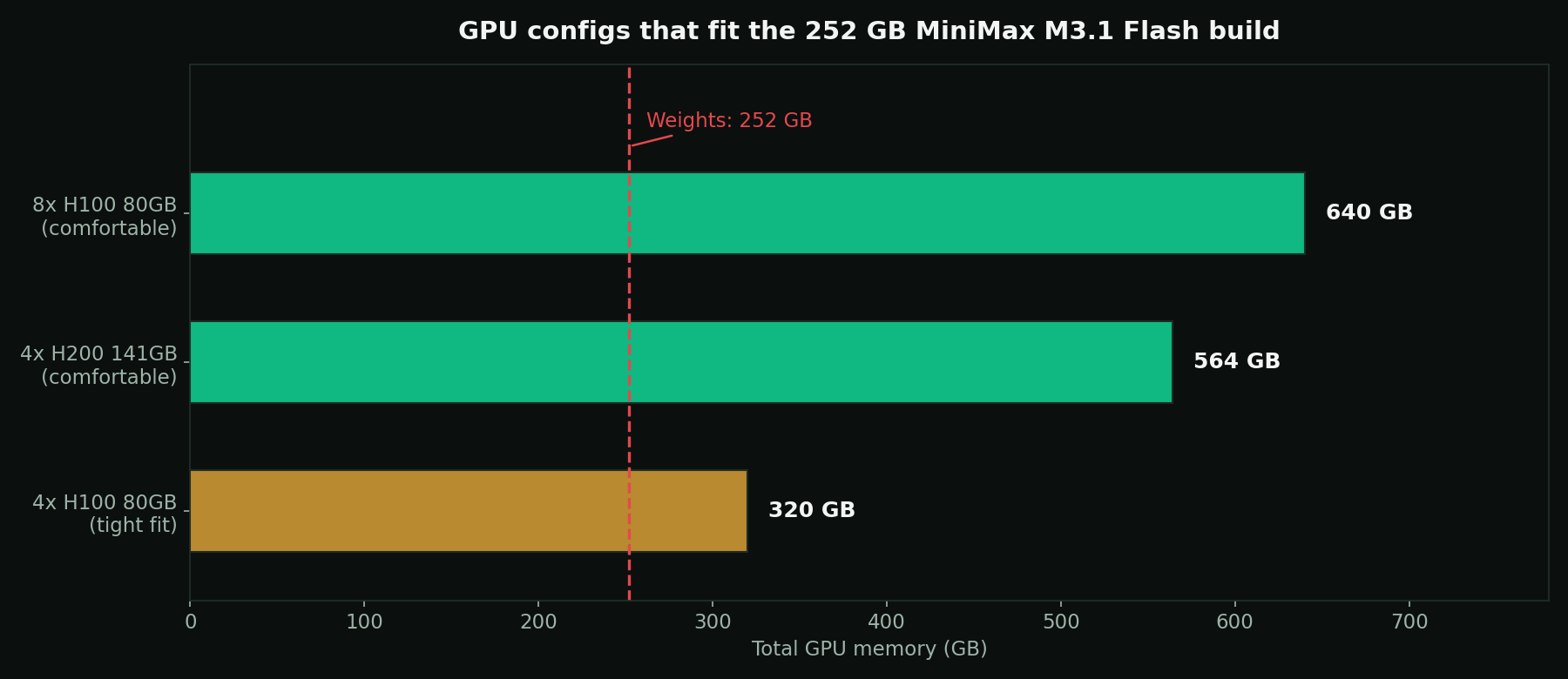
Minimum realistic config: 4× NVIDIA H100 80GB (320 GB total). The weights fit with roughly 68 GB of headroom — enough for the model plus a modest KV cache, but tight for long-context serving. This is the "it runs" tier.
Comfortable config: 8× H100 80GB (640 GB) or 4× H200 141GB (564 GB). The extra memory is KV cache headroom, which is what actually determines how much of the 1M context window you can use in practice. A 428B-parameter model with a million-token context is KV-cache-hungry; the weights are only half the memory story. MiniMax's sparse-attention design helps here — sparser attention means a smaller KV cache per token than a dense-attention model of the same size — but budget generously anyway. As a rule of thumb, the KV cache for long-context serving often rivals the weights themselves in size, which is why the "comfortable" tier has roughly double the weight footprint in total memory.
Three serving notes that are specific to this model:
- Reasoning is always-on, and it bills as compute. You cannot disable thinking — you can only lower the effort. On the API this shows up as output tokens; on your own GPUs it shows up as latency and throughput. Budget for thinking tokens in your capacity planning the same way you'd budget for output tokens in your API bill.
- Use a framework with day-one support. vLLM (v0.33.0+), SGLang, and TokenSpeed have published recipes; the model card warns that third-party quantizations may behave differently from the official weights. Don't roll your own loader on day one.
- The DSpark draft head is included. Speculative decoding needs a compatible serving implementation to actually engage — check your framework's docs before assuming the speedup.
The honest math: self-host vs API vs hosted#
This is the question the release actually raises, so let's do it with real numbers. All figures checked 23 October 2026.
The three routes:
| Route | Input / 1M | Output / 1M | Cached input / 1M | What you manage |
|---|---|---|---|---|
| MiniMax API | $0.15 | $0.60 | $0.015 | Nothing — API key |
| Together AI serverless | $0.15 | $0.60 | $0.015 | Nothing — API key |
| Self-hosted (4× H100) | $0 marginal | $0 marginal | $0 marginal | GPUs, serving stack, uptime |
Together AI's serverless pricing is identical to MiniMax's own API — verified on Together's model library today — so the hosted decision is about data residency and vendor preference, not price. The real comparison is API vs self-hosted.
Self-host fixed costs (H100 80GB rental, market observations from 17 October 2026):
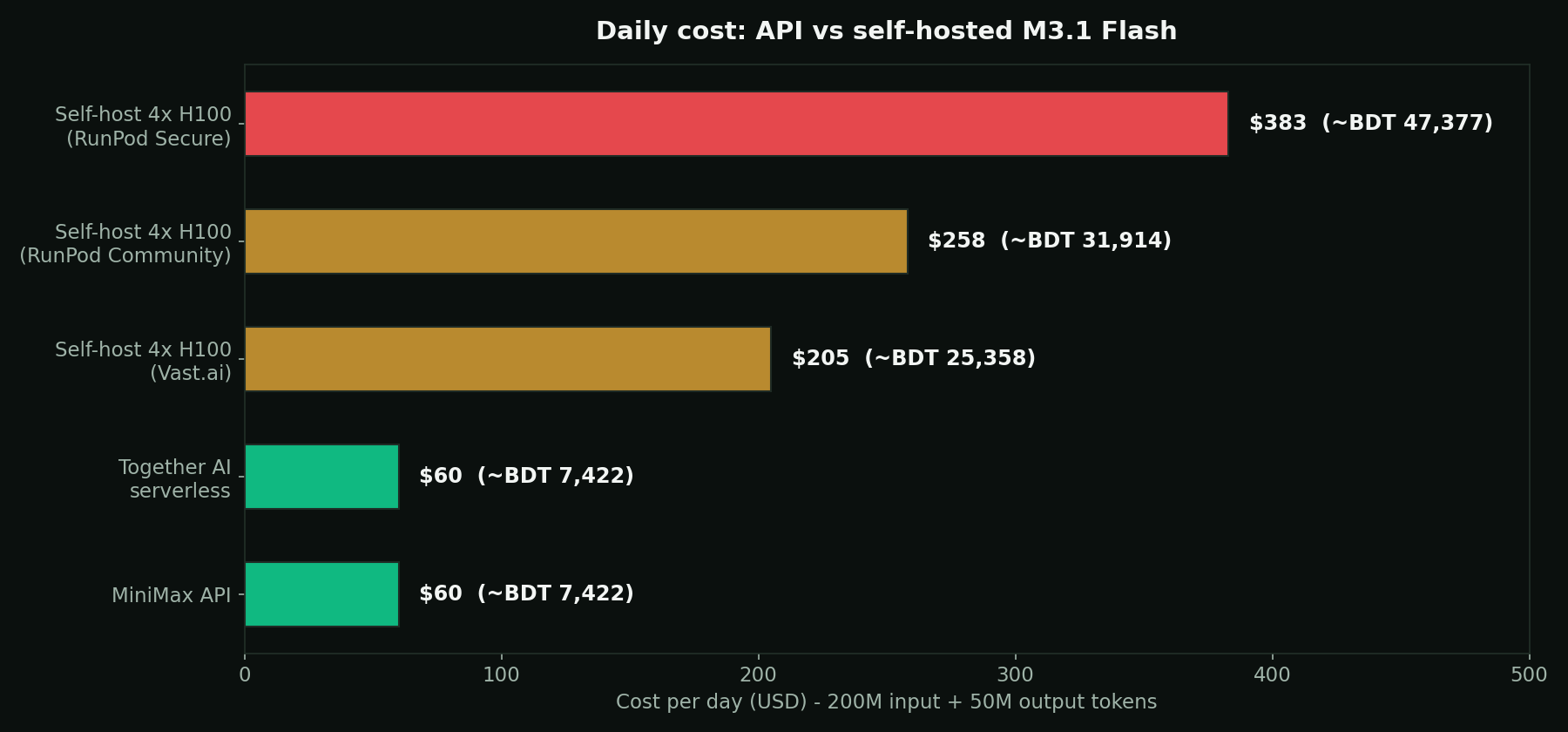
| Source | $/GPU-hour | 4× GPUs, 24/7 |
|---|---|---|
| RunPod Community | $2.69 | $258/day (~BDT 31,914) |
| Vast.ai verified on-demand | ~$2.13 | ~$205/day (~BDT 25,358) |
| RunPod Secure | $3.99 | $383/day (~BDT 47,377) |
(Taka at ৳123.70 per USD, mid-market, 23 October 2026.)
A worked day. Take a busy agent workload: 200M input tokens + 50M output tokens in a day.
- MiniMax API: 200 × $0.15 + 50 × $0.60 = $30 + $30 = $60/day (~BDT 7,422)
- Self-hosted: $205–$383/day depending on the rental tier — and you pay it whether the GPUs are busy or idle.
The API is 3–6× cheaper at this volume. Now the break-even: at the API's blended $0.75 per (1M input + 1M output), a $258/day node breaks even at ~344M input + 344M output tokens per day — roughly 690M total tokens daily. Here's the catch: a 4× H100 node cannot plausibly sustain that throughput on a 23B-active MoE (it would need ~4,000+ output tokens/second, every second, all day). The break-even point sits above what the hardware can deliver.
The honest conclusion: with rented GPUs, the API wins on pure cost at every throughput level a 4× H100 node can actually serve. Self-hosting only wins when one of these is true:
- You own the GPUs (sunk cost changes everything),
- You get spot/interruptible pricing for batch or offline workloads,
- Compliance requires it — data that can't leave your infrastructure, or (the common case with this model) data that can't go to a Chinese provider's API,
- You need to fine-tune — the weights are downloadable; the API is not fine-tunable.
One more honest caveat: the API price can change, and so can your utilization. If you run GPUs at sustained high utilization on cheap power with owned hardware, the math flips. Recompute with your own numbers — the method is the same one in our LLM API bill explainer.
When self-hosting is the right call#
Data residency is the killer feature of this release. Multiple outlets have noted that some teams can't send code or data to a Chinese lab's API for compliance reasons. Until today, those teams simply couldn't use M3.1 Flash. Now they can — either on their own GPUs or through a US-hosted provider like Together AI or Fireworks, where the data-residency story is a contract with an American company. If that's your situation, this release is the whole ballgame.
Fine-tuning is the second unlock. The API gives you the model as-is; the weights let you adapt it. MiniMax's license explicitly covers derivative works (the same commercial terms apply), so LoRA or full fine-tuning for your domain is on the table — Together AI even offers fine-tuning on 100B+ parameter models if you don't want to train it yourself.
Offline and air-gapped deployments are the third: the repo is not gated, so a download-and-carry workflow works.
When the API wins: variable traffic (you pay $0 when idle), small teams without GPU-ops experience, and anyone whose monthly token bill is under a few hundred dollars. Also note: M3.1 Flash is not in the tokens.bd catalog as of 23 October 2026 (MiniMax's shelf there is M2.5, M2.7, and M3) — if you want one API key across 60+ models with BDT billing instead of managing GPUs, that's the managed alternative, and the pricing page shows the current per-model rates.
Your first-week checklist#
If M3.1 Flash is on your radar, here's the highest-value order of operations for this week:
- Try it serverless first. Together AI's endpoint is live today at MiniMax's own rates — no GPUs, no 252 GB download. Run your actual prompts through it before deciding anything about hardware.
- Eval on your tasks, not the leaderboard. The vendor table favors agentic coding; the independent AA-Omniscience result flags overconfidence on factual questions. If your workload is unsupervised factual output (support answers, data extraction), add grounding and verification regardless of which route you choose.
- Clear the license with legal if you're commercial. The attribution requirement and the $20M revenue trigger are unusual enough that most companies' standard open-source approval process won't have a pre-baked answer. The one-time notice email costs nothing — send it early.
- Watch for community quantizations — carefully. The model card warns that third-party quants may differ from the official weights. GGUF and other community builds will appear within days; treat them as unverified until someone reputable benchmarks them.
- Don't buy GPUs for this yet. The math above says rented hardware doesn't beat the API on cost. If you're considering a purchase, run the serverless endpoint for a month, measure your real token mix, then decide.
Getting started#
If you're going the self-hosted route, the happy path on day one:
# 1. Download (~252 GB)
hf download MiniMaxAI/MiniMax-M3.1-Flash --local-dir MiniMax-M3.1-Flash

# 2. Serve with vLLM (v0.33.0+)
vllm serve MiniMaxAI/MiniMax-M3.1-Flash --tensor-parallel-size 4
Then set reasoning_effort in your chat template (low for routine turns, max for hard reasoning — remember it defaults to max and you can't turn it off), keep temperature=1.0 and top_p=0.95 per the model card, and keep the full assistant response in your multi-turn history — MiniMax's docs note this preserves reasoning continuity across turns.
If you'd rather not manage GPUs, Together AI's serverless endpoint (MiniMaxAI/MiniMax-M3.1-Flash) is live today at the same $0.15/$0.60 rates as MiniMax's API — an OpenAI-compatible base URL swap, the same pattern as our one-base-URL guide.
M3.1 Flash open-weights FAQ#
Is MiniMax M3.1 Flash really open source? Not in the OSI sense. The weights are freely downloadable under the MiniMax Community License: free for non-commercial use, commercial use allowed with a "Built with MiniMax M3.1-Flash" attribution, and written permission required above $20M/year in revenue. DeepSeek's V4.1-Flash, by contrast, is MIT-licensed with no strings.
How big is the download?
About 252 GB: 48 safetensors shards in MXFP8-quantized format plus the DSpark speculative-decoding draft head. The repo is public and not gated — hf download MiniMaxAI/MiniMax-M3.1-Flash just works.
What GPUs do I need to run it? 4× H100 80GB is the realistic minimum; 8× H100 or 4× H200 gives you the KV-cache headroom to actually use the 1M context window. Use vLLM (v0.33.0+), SGLang, or TokenSpeed — all have day-one recipes.
Is self-hosting cheaper than the API? With rented GPUs, no — our math shows the API ($60/day for a 200M-in/50M-out workload) beats a 4× H100 node ($205–$383/day) at every throughput the node can actually sustain. Self-host for data residency, fine-tuning, offline use, or owned GPUs — not to save money.
Is M3.1 Flash available on tokens.bd? Not yet (checked 23 October 2026) — the catalog's MiniMax shelf is M2.5, M2.7, and M3. The API, Together AI, Fireworks, and other day-one hosts carry it now; we'll update this post if the catalog adds it.
Model weights, license text, and repo metadata checked 23 October 2026 on Hugging Face. API and hosted prices checked the same day on MiniMax and Together AI. GPU rental rates from public market observations, 17 October 2026. USD/BDT at ৳123.70 mid-market, 23 October 2026.
Related: Mistral Large 4's 1T open weights take a different licence approach, with a MaaS carve-out - see Mistral Large 4 Open Weights: 1T Model, One Licence Catch.
Sources: MiniMax launch post · MiniMaxAI/MiniMax-M3.1-Flash on Hugging Face · LICENSE — MiniMax Community License · ChainCatcher: open-source announcement (23 Oct 2026) · RuntimeWire: Together AI inference partnership · vLLM recipes: MiniMaxAI · Together AI model library · GPU rental market data, Oct 2026 · TechRepublic: pricing and benchmarks · Shattered: 93% hallucination-rate analysis
For how M3.1 Flash ranks against Beam, Mistral Large 4 and the other open-weight models on price and intelligence, see Best Free Open-Weight AI Models (2026).
Related deadline-day guide: see Kimi K3.1 Pro Open Weights: Due Today, What to Expect for Kimi K3.1 Pro's open-weights deadline, download size and hardware math.