TL;DR: MiniMax launched M3.1 Flash on 19 October 2026 at a flat $0.15/$0.60 per 1M input/output tokens (cached input $0.015) — identical to DeepSeek V4.1-Flash-1017's off-peak rates and exactly half its peak rates. Independent testing by Artificial Analysis measured it at ~43 on the Intelligence Index with a $0.22 average task cost, the cheapest they've measured. Open weights are promised for 23 October 2026 (license still undisclosed). It is not in the tokens.bd catalog yet (checked 20 October 2026).
Yesterday, the mystery model that sat at #1 on OpenRouter's stealth leaderboard for ten straight days got a name. "Space Bunny" — which burned through more than 200 trillion tokens anonymously — was revealed as an early build of MiniMax M3.1 Flash, MiniMax's new flagship "flash" model for agentic coding, computer use, and cybersecurity. Three days earlier, DeepSeek had pushed its own cheap-model update (DeepSeek V4.1-Flash-1017). The two releases now sit side by side at the exact same off-peak price, which makes this less a launch story and more a price war worth doing the math on. Here is what shipped, what it costs in dollars and taka, and how to decide whether to switch.
What shipped on 19 October#
The concrete facts, all from MiniMax's official launch post and independent coverage:
- New model ID:
MiniMax-M3.1-Flash. Available now through the MiniMax API, the M Plan subscription, and MiniMax Code. It exposes Anthropic- and OpenAI-compatible endpoints, so existing tooling works. - 428B-parameter mixture-of-experts, ~23B active per token. Roughly the same shape as M3, but with more aggressive sparsity for speed.
- 1M-token context (up to 1M input, up to 524K output per MiniMax's docs). Inputs can be text, image, or video; output is text only.
- ~3x faster than M3. MiniMax claims 200+ tokens/second in everyday use, with a median (P50) of 170+ TPS. Independent measurement (Artificial Analysis) put real-world output at 120–122.8 tok/s — fast for the price, but below the marketing line.
- Always-on reasoning with 5 effort levels — low, medium, high, xhigh, max, defaulting to max. You cannot turn reasoning off (more on this below).
- 70% lower agentic-task cost than M3, per MiniMax's own claim. Artificial Analysis measured the average task cost at $0.22 (≈৳27.20) — versus $0.26 (≈৳32.15) for DeepSeek V4.1-Flash-1017 and $0.51 (≈৳63.06) for M3. It is the cheapest task cost the lab has measured.
- Open weights promised for 23 October 2026 (announced on MiniMax's X account; the blog post only said "later"). The license is still undisclosed — do not assume open-source terms until it's published.
- A larger "Pro" sibling is officially teased ("will also arrive later"), but unconfirmed reports of ~2.7T parameters should be treated as rumor.
One piece of launch-day news matters if you use MiniMax subscriptions: MiniMax silently rerouted M2.5 and M2.7 subscription (M Plan/Token Plan) calls to M3.1 Flash on 19 October, with both older families retiring on 18 November 2026. If your gateway provider routes MiniMax calls, check what is actually serving your requests — tokens.bd currently lists M2.5, M2.7, and M3, and the retirement applies upstream of that.
What it costs#
Flat pricing, no long-context surcharge, no time-of-day doubling. Per-million-token API prices, checked 20 October 2026:
| Input / 1M | Output / 1M | Cached input / 1M | |
|---|---|---|---|
| MiniMax M3.1 Flash (official) | $0.15 | $0.60 | $0.015 |
In taka at ৳123.65 per USD (mid-market, 20 October 2026): input ৳18.55, output ৳74.19, cached input ৳1.85 per million tokens.
Same 50-turn agent session — 5M input, 1M output — on both cheap models:
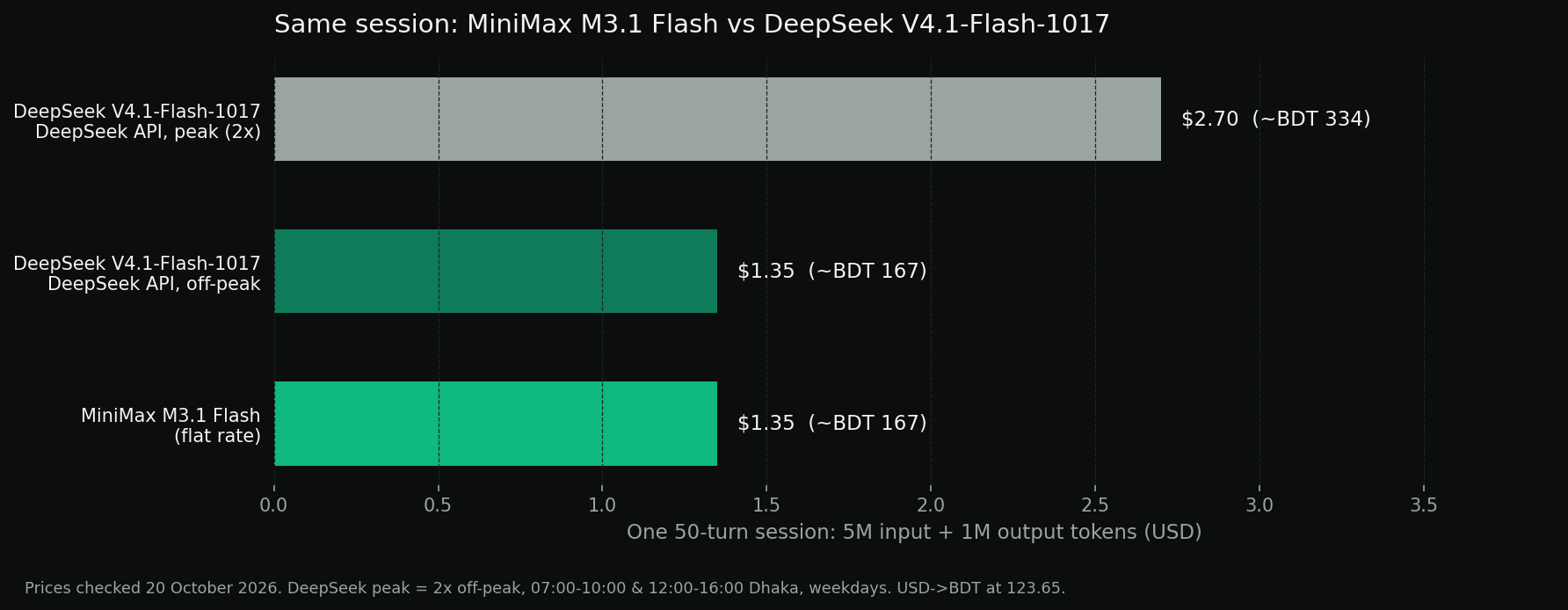
- M3.1 Flash (flat): 5 × $0.15 + 1 × $0.60 = $1.35 (≈৳167)
- DeepSeek V4.1-Flash-1017, off-peak: identical, $1.35 — the two models match exactly
- DeepSeek V4.1-Flash-1017, peak: 5 × $0.30 + 1 × $1.20 = $2.70 (≈৳334) — exactly double
Add caching to the session (1M fresh input, 4M cached, 1M output): M3.1 Flash costs 0.15 + 0.06 + 0.60 = $0.81 (≈৳100); DeepSeek off-peak costs 0.15 + 0.012 + 0.60 = $0.762 (≈৳94). DeepSeek's cheaper cache reads ($0.003 vs $0.015 per million off-peak) give it the edge on warm-cache workloads — see the prompt-caching comparison for the mechanics.
A month of daily agent work (1M input + 60K output per workday, 20 days): about $3.72/month (≈৳460) on M3.1 Flash's flat rate — versus $7.44 (≈৳920) on DeepSeek's peak rate.
Always-on reasoning: the effort dial you can't turn off#
This is the fine print that changes how you budget. M3.1 Flash reasons on every request with no off switch — the API rejects a disabled thinking parameter with HTTP 400, error code 2013. You get five effort levels (low → max), defaulting to max, and thinking tokens are billed at the output rate, the expensive side of the price list.
That default matters. On a model where reasoning cannot be disabled, not touching the dial is itself a pricing decision — max effort on every turn burns the most thinking tokens on drafts, formatting, and small edits, the turns that never needed deep reasoning. The output price is the multiplier on every thinking token — so on this model, the effort dial matters more than on models where reasoning is off by default. A practical default:
- Low effort for routine turns — drafts, formatting, first passes, short explanations.
- High for hard reasoning — debugging, architecture trade-offs, tricky diffs.
- Max for one-shot, failure-is-expensive work — migration plans, security-sensitive changes.
For multi-turn tool calls, keep the full assistant response in the history — MiniMax's docs note this preserves reasoning continuity across turns.
Benchmarks: MiniMax's numbers vs independent measurements#
MiniMax's self-reported scores (label them as such — no independent lab has reproduced them yet):
| Benchmark | Score (vendor-reported) |
|---|---|
| DeepSWE v1.1 | 73.7% |
| BankerToolBench | 76.2 |
| Automation-Bench v1.0.6 | 62.2 |
| OSWorld V2 | 61.7 |
| CyberGym | 82% |
| Agents' Last Exam (ALE) | 29.6 |
| Terminal Bench 4.0 | 38.1 |
MiniMax says M3.1 Flash ranks first among Chinese models on OSWorld V2 and ALE. Read these as the direction, not gospel.
The independent numbers, published 20 October 2026 by Artificial Analysis:
| Model | AA Intelligence Index | AA avg task cost |
|---|---|---|
| DeepSeek V4.1-Flash-1017 | 45 | $0.26 |
| MiniMax M3.1 Flash | ~43 (some outlets report 42) | $0.22 |
| MiMo-V2.6-Pro | 46 | — |
| GLM-5.3 Flash | 42–45 | — |
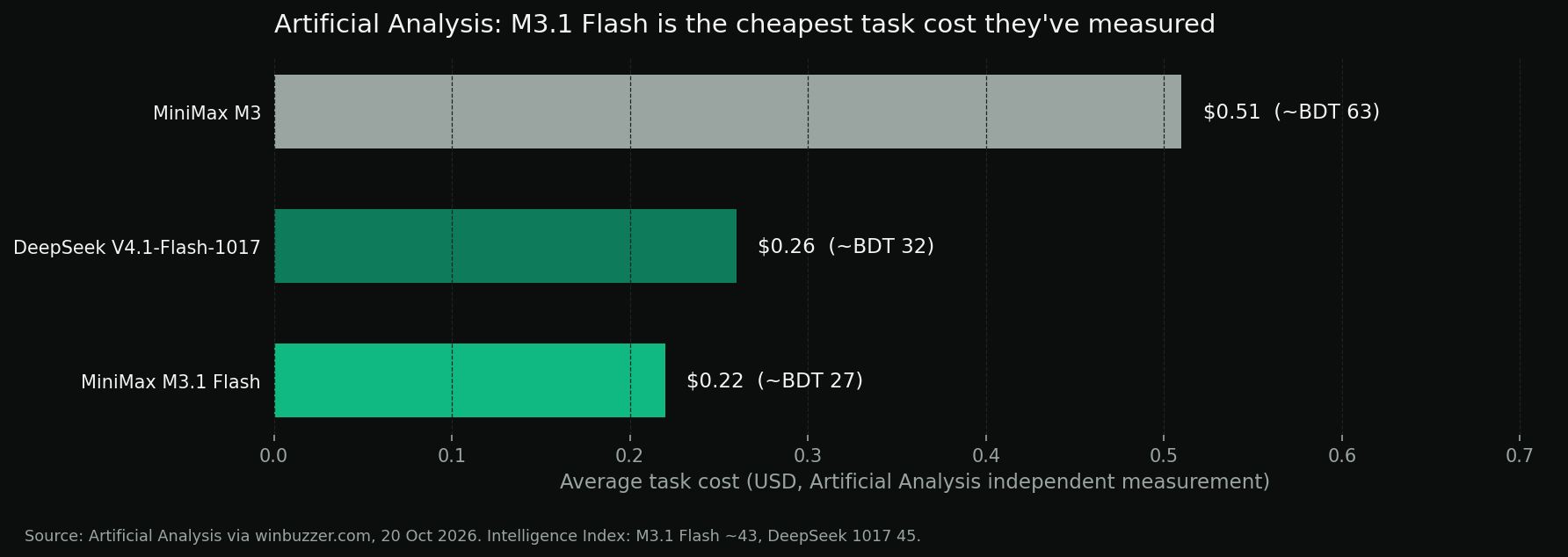
So: on the only independent scoreboard available, M3.1 Flash trails DeepSeek 1017 by ~2 index points and MiMo by ~3, but wins on task cost — it is the cheapest-per-task model Artificial Analysis has measured. Note the speed gap between claim and measurement (170+ TPS claimed median vs ~121 measured) and one more honest caveat from AA: by their definition, the model attempts nearly every question instead of declining, which inflates its "hallucination rate" on knowledge tests. For agentic coding, where refusing is worse than trying, that behavior is arguably a feature.
For context, M3.1 Flash's Code Arena WebDev score is 1,588 points — 12th among open models, 32nd overall — solid mid-pack for a model at this price.
Head-to-head: M3.1 Flash vs DeepSeek V4.1-Flash-1017#
These two launched three days apart and their off-peak price cards are identical. Official API rates, checked 20 October 2026:
| M3.1 Flash (flat) | DeepSeek 1017 off-peak | DeepSeek 1017 peak | |
|---|---|---|---|
| Input / 1M | $0.15 | $0.15 | $0.30 |
| Output / 1M | $0.60 | $0.60 | $1.20 |
| Cached input / 1M | $0.015 | $0.003 | $0.006 |
Where they actually differ:
- Peak pricing. DeepSeek doubles every rate during 01:00–04:00 and 06:00–10:00 UTC on weekdays — 07:00–10:00 and 12:00–16:00 Dhaka time. M3.1 Flash is flat all day, so during Dhaka working hours it costs exactly half what DeepSeek's peak rate charges. Schedule batch work on DeepSeek for evenings and nights to pay off-peak.
- Cache economics. DeepSeek's $0.003 cached reads off-peak are 5x cheaper than M3.1 Flash's $0.015. For warm-context agents (the same repo loaded across turns), DeepSeek wins the bill; for fresh-context work, they tie.
- Weights. DeepSeek 1017's full weights are out now under the MIT license. M3.1 Flash's weights land 23 October with an undisclosed license — self-hosters and fine-tuners have a reason to wait three days.
- Reasoning control. M3.1 Flash's reasoning is always-on with five effort levels; DeepSeek 1017 exposes its own effort controls (low/high/max). Both bill thinking as output.
- Independent standing. Both have exactly one independent scoreboard so far (Artificial Analysis): 45 vs ~43, at $0.26 vs $0.22 per task.
Our DeepSeek V4.1-Flash-1017 breakdown covers its benchmark gains and the 1017 checkpoint in detail — the head-to-head there and here are the two halves of the same decision.
Should you switch?#
If you run agents on DeepSeek V4.1-Flash during Dhaka daytime: M3.1 Flash is the cheaper twin — same off-peak price, half the peak price, no cliff. Switch the daytime workload; keep DeepSeek for cached, off-peak batch work where its $0.003 cache reads win.
If you run agents on Haiku 5.5 or GPT-6 Luna for cost: M3.1 Flash sits one price tier above on input ($0.15 vs $0.10) but holds its rate to 1M tokens with no cliffs — past Haiku's 100K-token cliff it is roughly 3x cheaper per session, with independent benchmark scores neither can touch.
If you self-host open weights: wait for 23 October. DeepSeek 1017's MIT weights are downloadable today; M3.1 Flash's are not, and the license is unknown. No reason to rebuild your serving stack on a promise.
If you just want to try it free: OpenRouter's 72-hour free period ends around 22 October, and Vercel AI Gateway serves it free until the same date. After that, the list price is $0.15/$0.60 everywhere.
Calling it#
For a fresh integration through an OpenAI-compatible endpoint:
from openai import OpenAI

client = OpenAI(
    base_url="https://platform.minimax.io/api/v1",
    api_key="YOUR_MINIMAX_KEY",  # or your gateway key
)

resp = client.chat.completions.create(
    model="MiniMax-M3.1-Flash",   # exact model ID, case-sensitive
    messages=[{"role": "user", "content": "Refactor this module to remove the circular import."}],
)
Two migration notes from the fine print: reasoning is always on (disabling it returns HTTP 400, error 2013), so set the effort level deliberately rather than leaving the max default on routine turns. And if you were on M2.5 or M2.7 subscriptions, you are already running M3.1 Flash — both retire on 18 November 2026.
On tokens.bd, MiniMax is already a provider (M2.5, M2.7, M3) but M3.1 Flash is not in the 60+ model catalog yet (checked 20 October 2026) — so this post is a catalog-watch, not a promise. When it lands, the flat $0.15/$0.60 card and BDT billing with bKash/Nagad make it a natural default for daytime agent workloads. Compare it against the field on /vs/openrouter, and check the docs for the current per-model list.
MiniMax M3.1 Flash FAQ#
How much does MiniMax M3.1 Flash cost? $0.15 per million input tokens, $0.60 per million output tokens, and $0.015 per million cached input tokens — flat, with no long-context surcharge and no time-of-day pricing. At ৳123.65 per USD (20 October 2026), that is roughly ৳18.55 / ৳74.19 / ৳1.85 per million. These are MiniMax's official API rates; MiniMax's launch post is the authority.
Is M3.1 Flash better than DeepSeek V4.1-Flash-1017? On the only independent scoreboard (Artificial Analysis, 20 October 2026), DeepSeek leads on intelligence (45 vs ~43) while M3.1 Flash leads on task cost ($0.22 vs $0.26). Their off-peak prices are identical; M3.1 Flash costs half as much during DeepSeek's Dhaka-daytime peak hours. It is a workload question, not a winner question — see the head-to-head table above.
Can I turn off M3.1 Flash's reasoning to save money? No. Reasoning is always on and the API rejects a disabled setting (HTTP 400, error code 2013). What you can do is lower the effort level: low, medium, high, xhigh, or max (default). Thinking tokens bill at the output rate, so dropping from max to low on routine turns is the direct lever on the bill.
When do the open weights release, and under what license? MiniMax says 23 October 2026; the license is undisclosed as of 20 October. If you need permissive weights today, DeepSeek V4.1-Flash-1017's MIT-licensed weights are already on Hugging Face.
Is M3.1 Flash available on tokens.bd? Not yet — the catalog lists M2.5, M2.7, and M3 under MiniMax (checked 20 October 2026). MiniMax rerouted M2.5/M2.7 subscription traffic to M3.1 Flash on 19 October and retires both on 18 November 2026, so the catalog is likely to change soon. Until then, OpenRouter (free through ~22 October) and Vercel AI Gateway (free until 22 October) are the cheapest ways to try it.
Prices and specs checked 20 October 2026 against MiniMax's official launch post and Artificial Analysis. Benchmark figures are vendor-reported unless labeled independent; the provider's pricing page is the authority for list prices, and the model catalog for prices on Tokens.
Sources: MiniMax official M3.1 Flash launch post · Artificial Analysis results via WinBuzzer · theinference.org on Space Bunny + rerouting · Unite.AI launch coverage · The Decoder on China's price race · madrobot.blog price/benchmarks breakdown · MarkTechPost release summary · USD/BDT rate, Finnhub · tokens.bd model catalog
Update (23 Oct 2026): the open weights are now live — here's the self-host guide — license terms, the 252 GB download, hardware math, and when self-hosting beats the API.
Update: Moonshot's next release is here — read our Kimi K3.1 Pro pricing and benchmarks guide