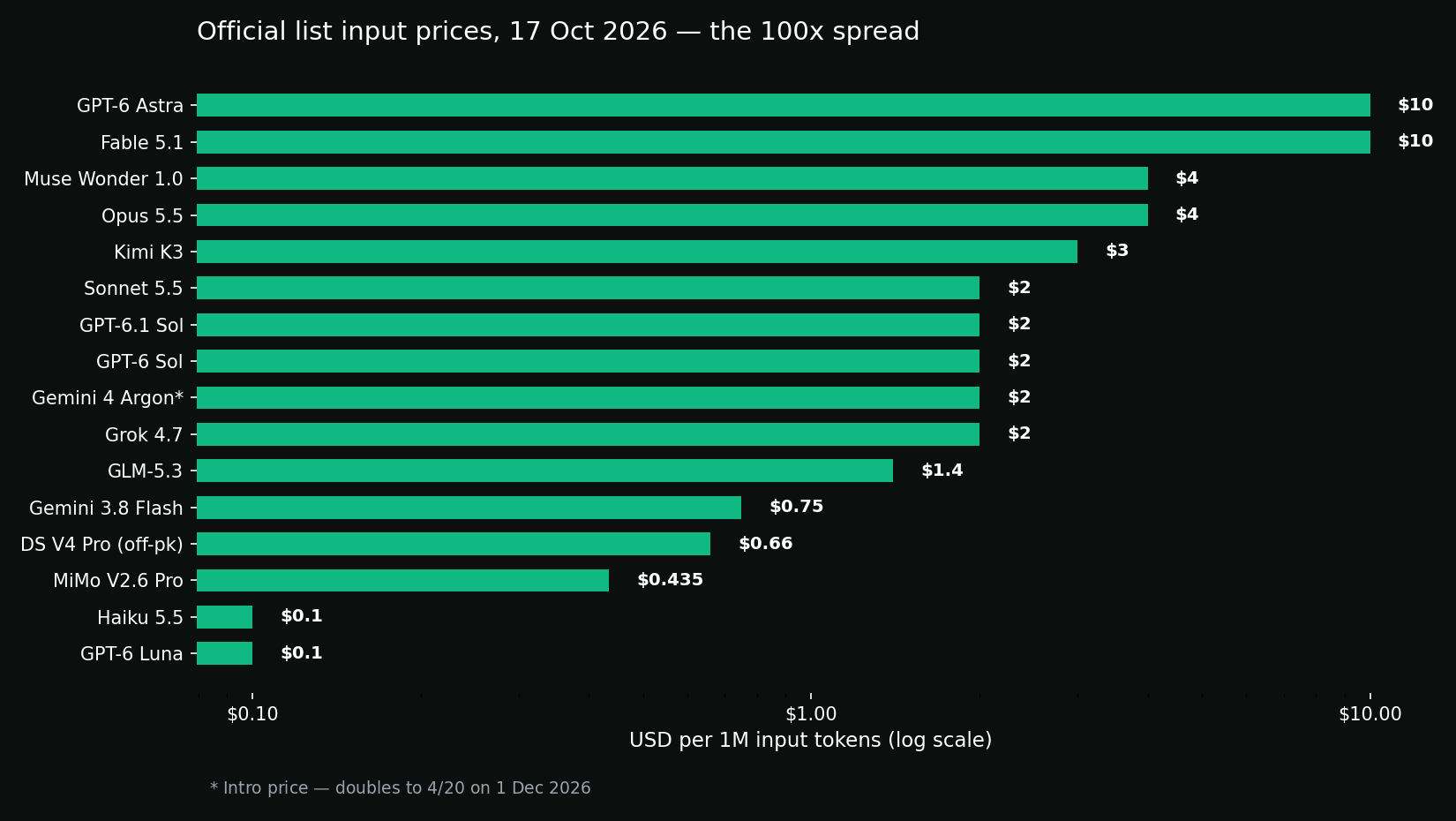
TL;DR: In October 2026, LLM API input prices span $0.10 to $10.00 per million tokens — a 100x spread. The cheapest models are Claude Haiku 5.5 and GPT-6 Luna at $0.10/$0.50, both priced down to the same point in the last two months. The priciest are GPT-6 Astra and Claude Fable 5.1 at $10/$50. Three promo prices expire soon: Gemini 4 Argon's intro rate doubles 1 December 2026, GPT-5.6 Sol's promo ends 21 November, and Gemini 3.8 Flash doubles 1 January 2027. Prices checked 17 October 2026; BDT conversions at ৳123.00 per USD.
Everyone publishes price lists; almost nobody keeps them current. Model prices changed five times in the last thirty days — a flagship launch, a 90% price cut, a deprecation, and two promo deadlines — so a table from September is already wrong. This post is a statistics roundup, not a buying guide: what every major provider charges per million tokens right now, what changed this month, and how cache discounts and promo deadlines change the number you actually pay.
Angle note: no post in the last 14 days answers this question. Our cheapest coding APIs post covered coding models only, the three-family comparison compared three flagships on price, speed and coding quality, and the Haiku vs Luna showdown was a two-model head-to-head. This is the full board: 18 models,10 providers, one verified table.
The master table: frontier models#
Official list prices, USD per million tokens. Checked 17 October 2026.
| Model | Provider | Input / 1M | Output / 1M | Note |
|---|---|---|---|---|
| GPT-6 Astra | OpenAI | $10.00 | $50.00 | Released 3 Sep 2026; long-context (>272K) rates 2x/1.5x |
| Claude Fable 5.1 | Anthropic | $10.00 | $50.00 | Reasoning-tier flagship |
| Claude Opus 5.5 | Anthropic | $4.00 | $20.00 | Replaced Opus 5 on 22 Sep 2026 ($5/$25 → $4/$20) |
| Meta Muse Wonder 1.0 | Meta | $4.00 | $20.00 | Launched 12 Oct 2026; no long-context premium |
| Gemini 4 Argon | $2.00 | $10.00 | Intro price — doubles to $4/$20 on 1 Dec 2026 |
Two patterns stand out. First, the flagship tier is converging: Anthropic, OpenAI and Meta all sell their top reasoning model at roughly the same price — Fable 5.1 and Astra are literally identical at $10/$50. Second, Google's intro pricing makes Argon the cheapest frontier model today and the second-cheapest to budget for, because anyone building on it past December pays $4/$20.
Mid-tier workhorses#
The models doing the bulk of agent coding work in October 2026. Checked 17 October 2026.
| Model | Provider | Input / 1M | Output / 1M | Note |
|---|---|---|---|---|
| Claude Sonnet 5.5 | Anthropic | $2.00 | $10.00 | Cache reads cut to $0.10/M on 7 Oct 2026 |
| GPT-6.1 Sol | OpenAI | $2.00 | $10.00 | Released 29 Sep 2026; cached input $0.10/M |
| GPT-6 Sol | OpenAI | $2.00 | $10.00 | Released 22 Sep 2026; cached input $0.20/M |
| Grok 4.7 | xAI | $2.00 | $6.00 | $4/$12 for whole request at ≥200K prompt tokens |
| Kimi K3 | Moonshot | $3.00 | $15.00 | Open-weight; cache hits $0.30/M |
| GLM-5.3 | Z.ai | $1.40 | $4.40 | Cached input ~$0.26/M |
| GPT-5.6 Sol | OpenAI | $4.00 | $20.00 | Promo to 21 Nov 2026; list $5/$30 |
Three statistics worth pausing on. GPT-6.1 Sol costs exactly the same as GPT-6 Sol at list price — the upgrade was a price cut on caching (cached input $0.20 → $0.10), not on the headline rate. Grok 4.7's long-context rule is the harshest in the industry: cross 200K prompt tokens and the entire request — including the first 199K tokens — rebills at $4/$12. And Kimi K3 remains the most expensive mid-tier model at $3/$15, which is why the effort-level pricing from our reasoning-effort post matters so much on it.
Budget models and open weights#
Checked 17 October 2026.
| Model | Provider | Input / 1M | Output / 1M | Note |
|---|---|---|---|---|
| Claude Haiku 5.5 | Anthropic | $0.10 | $0.50 | ~90% cut vs Haiku 4.5 ($1/$5), 7 Oct 2026; $0.50/$2.50 for prompts >100K tokens |
| GPT-6 Luna | OpenAI | $0.10 | $0.50 | Released 22 Sep 2026; cheapest current OpenAI model |
| MiMo V2.6 Pro | Xiaomi | $0.435 | $0.87 | Released 21 Sep 2026; cache hits $0.0036/M (99% off) |
| DeepSeek V4 Pro | DeepSeek | $1.32 / $0.66 | $3.96 / $1.98 | Peak / off-peak (peak 01:00–04:00 & 06:00–10:00 UTC Mon–Fri) |
| Gemini 3.8 Flash | $0.75 | $3.75 | Doubles to $1.50/$7.50 on 1 Jan 2027; 3.7 Flash deprecated 8 Oct 2026, auto-routed to 3.8 Flash at same rate | |
| Reflection Beam 1.0 | Reflection AI | — | — | Weights released 16 Oct 2026 (Apache 2.0); first-party API free public beta, no token rate — hosted from $0.25/$1.00 per 1M via OpenRouter |
The two cheapest big-lab models now cost exactly the same — Anthropic priced Haiku 5.5 down to GPT-6 Luna's $0.10/$0.50 point. This is the price war we tracked in the Haiku vs Luna showdown, and it has now converged to a tie. The quiet winner of the budget tier is Xiaomi: MiMo V2.6 Pro at $0.435/$0.87 with a 99%-off cache-hit rate is the cheapest serious model for cache-heavy agent loops, and it ships MIT-licensed weights.
What changed in the last 30 days#
The velocity is the story. Five price events in five weeks:
- 22 Sep 2026 — Claude Opus 5.5 replaced Opus 5, cutting the flagship to $4/$20 (from $5/$25). Same day: GPT-6 Sol and GPT-6 Luna launched at $2/$10 and $0.10/$0.50.
- 29 Sep 2026 — GPT-6.1 Sol launched at $2/$10, undercutting its predecessor on cached input ($0.10 vs $0.20).
- 7 Oct 2026 — Anthropic's price-cut day: Haiku 5.5 launched with prices cut up to 90%, and Sonnet 5.5 cache reads were halved ($0.20 → $0.10 per 1M).
- 8 Oct 2026 — Google deprecated Gemini 3.7 Flash; requests auto-route to 3.8 Flash at the same rate, which itself doubles on 1 Jan 2027.
- 12–16 Oct 2026 — Meta's Muse Wonder 1.0 launched at $4/$20, Google GA'd Gemini 4 Argon at intro $2/$10, and Reflection AI released Beam's weights under Apache 2.0.
The December–January deadlines are the ones to budget against: any workload priced on Argon's intro rate gets 2x more expensive on 1 December, and Flash workloads double on 1 January. These are the next entries in our November deprecation deadline calendar's ongoing watch series.
What one session actually costs#
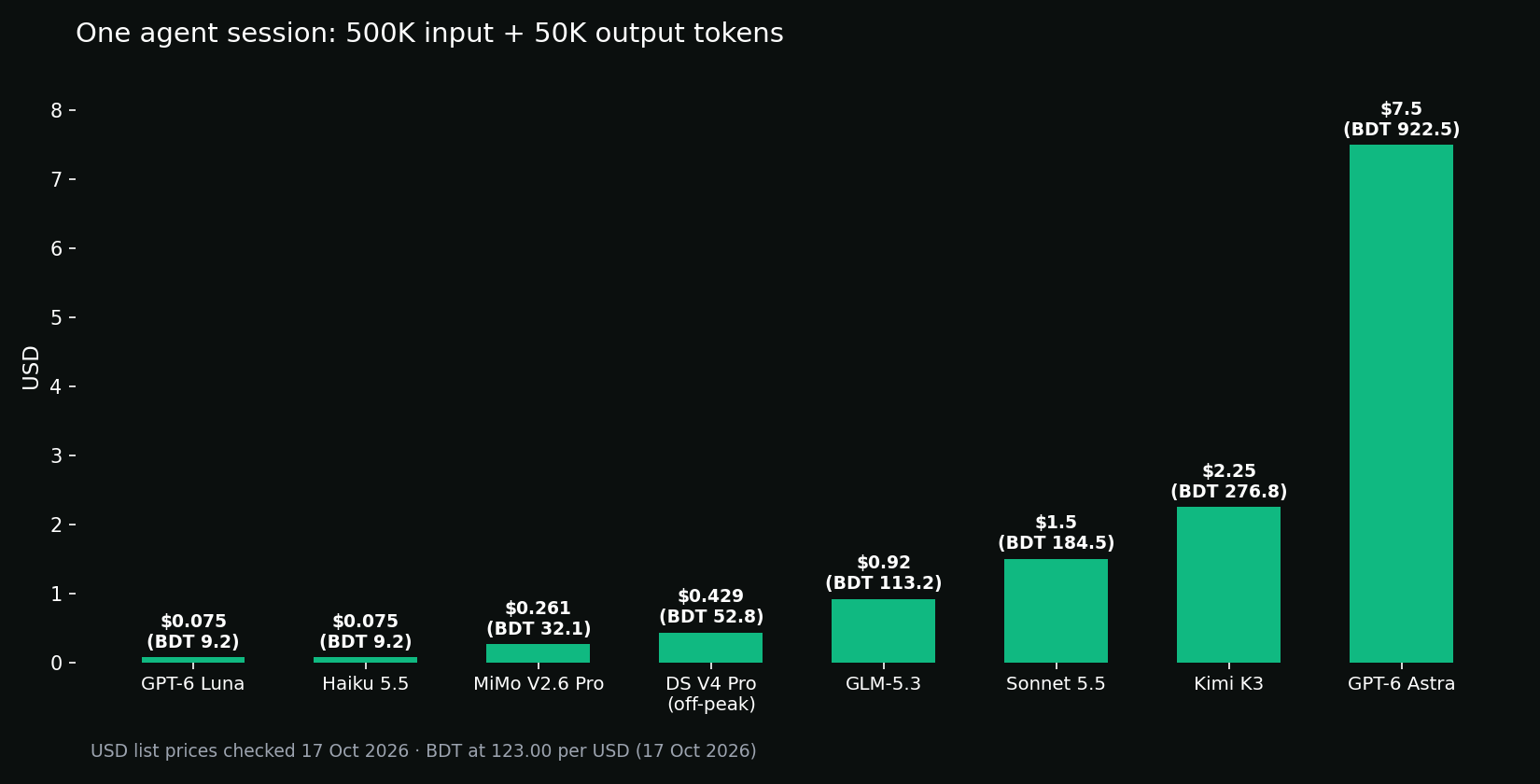
List prices are the unit; sessions are the bill. For a typical agent session — 500K input + 50K output tokens — using the verified list prices above (BDT at ৳123.00 per USD, 17 October 2026):
| Model | USD | BDT |
|---|---|---|
| GPT-6 Luna | $0.075 | ~৳9.2 |
| Claude Haiku 5.5 | $0.075 | ~৳9.2 |
| MiMo V2.6 Pro | $0.261 | ~৳32.1 |
| DeepSeek V4 Pro (off-peak) | $0.429 | ~৳52.8 |
| GLM-5.3 | $0.92 | ~৳113.2 |
| Claude Sonnet 5.5 | $1.50 | ~৳184.5 |
| Kimi K3 | $2.25 | ~৳276.8 |
| GPT-6 Astra | $7.50 | ~৳922.5 |
Arithmetic, shown so you can recheck it: session cost = (0.5 × input price) + (0.05 × output price). Sonnet 5.5: (0.5 × $2.00) + (0.05 × $10.00) = $1.00 + $0.50 = $1.50; × ৳123.00 = ৳184.50. DeepSeek off-peak: (0.5 × $0.66) + (0.05 × $1.98) = $0.33 + $0.099 = $0.429; × ৳123.00 = ৳52.77 ≈ ৳52.8. DeepSeek at peak costs exactly double: $0.858 per session, so run heavy jobs off-peak in Dhaka (peak is 07:00–10:00 and 12:00–16:00 on weekdays).
On a blended 1M tokens at an 80% input / 20% output mix, the full spread runs from $0.18 (GPT-6 Luna or Haiku 5.5) to $18.00 (GPT-6 Astra or Fable 5.1) — exactly 100x. The takeaway for budget planning: model choice is a two-orders-of-magnitude decision before you write a single line of optimization code.
Cache discounts change the ranking#
The list table understates caching's effect. Effective cached-input prices (per 1M), checked 17 October 2026:
| Model | Standard input | Cached input | Discount |
|---|---|---|---|
| MiMo V2.6 Pro | $0.435 | $0.0036 | 99% off |
| Claude Haiku 5.5 | $0.10 | $0.01 | 90% off |
| GPT-6 Luna | $0.10 | $0.01 | 90% off |
| GPT-6.1 Sol | $2.00 | $0.10 | 95% off |
| Claude Sonnet 5.5 | $2.00 | $0.10 | 95% off (cut 7 Oct) |
| Meta Muse Wonder 1.0 | $4.00 | $0.20 | ~95% off |
| Claude Opus 5.5 | $4.00 | $0.20 | 95% off |
| Kimi K3 | $3.00 | $0.30 | 90% off |
| Grok 4.7 | $2.00 | $0.50 | 75% off ($1.00 long-context) |
| DeepSeek V4 Pro | $1.32 / $0.66 | $0.044 / $0.022 | ~97% off |
| Gemini 4 Argon | $2.00 | $0.10 | 95% off |
| GLM-5.3 | $1.40 | ~$0.26 | ~80% off |
The statistic that should change how you pick models: with a warm cache, Sonnet 5.5's input ($0.10/M) costs the same as Haiku 5.5's standard input — the "cheap model" advantage disappears on repeat-prompt workloads. For the full mechanics, see prompt caching explained and our Anthropic vs OpenAI vs Bedrock comparison.
What this means in Bangladesh#
Two caveats before you budget in taka. First, the USD/BDT conversion above uses the market rate of ৳123.00 per USD (17 October 2026) — if you pay a dollar-billed provider with an international card, your bank's conversion plus markup lands higher than the market rate, and it drifts monthly. Second, these are provider list prices. The tokens.bd model catalog sets its own prices per model — some match list (GPT-6 Luna lists $0.10/$0.50 and the catalog shows $0.11/$0.55), some are routed prices that differ slightly (Sonnet 5.5 is $2.20/$11.00 on the catalog vs $2/$10 list; Gemini 3.8 Flash is $1.65/$8.25 routed vs $0.75/$3.75 official; Kimi K3 is $3.30/$16.50 vs $3/$15). On tokens.bd you pay in taka via bKash or Nagad with no international card — the catalog's ৳ figure is exactly what you pay, which our BDT pricing guide explains in detail. As of 17 October 2026 the catalog carries 60+ models but not yet Haiku 5.5, Gemini 4 Argon, or Reflection Beam — the three newest price-relevant entries above.
LLM API pricing FAQ#
Which LLM API is cheapest per 1M tokens right now? By list price, it's a tie: Claude Haiku 5.5 and GPT-6 Luna both charge $0.10 per 1M input and $0.50 per 1M output — a blended $0.18 per 1M tokens at an 80/20 mix. With caching, Xiaomi's MiMo V2.6 Pro wins on input: cache hits cost $0.0036 per 1M, 99% off its already-cheap $0.435 list rate.
Why do tokens.bd catalog prices differ from the list prices in this table? This table shows each provider's own list price. Tokens.bd routes some models through partner infrastructure (notably OmniRouter), so the catalog shows routed prices — e.g. Sonnet 5.5 at $2.20/$11.00 instead of $2/$10 — and sets separate BDT prices. Check /models for exactly what you'll pay.
Which of these prices expire soon? Three: Gemini 4 Argon's $2/$10 intro price doubles to $4/$20 on 1 December 2026. GPT-5.6 Sol's $4/$20 promo ends 21 November 2026 (list $5/$30). Gemini 3.8 Flash's $0.75/$3.75 doubles on 1 January 2027. Haiku 5.5's long-context rate ($0.50/$2.50 for prompts over 100K tokens) is permanent list pricing, not a promo.
Do cache discounts change which model is cheapest? Yes, dramatically on repeat-prompt workloads. Sonnet 5.5 with cached input ($0.10/M) matches Haiku 5.5's standard input price — so a coding agent with a warm 500K-token cache pays $0.05 in input on Sonnet versus $0.05 on Haiku, and the quality gap is free. That is why caching behavior belongs next to list price in every comparison.
How fresh is this data? Every price above was verified against a current source on 17 October 2026 — the provider's own pricing page where fetchable, plus two or more independent trackers for each number. Pricing posts in this series are refreshed every 14 days under our freshness rule; the provider's page is the authority between refreshes.
Provider list prices checked 17 October 2026. USD/BDT at ৳123.00 (17 October 2026, mid-market). Promotional prices and catalog prices change; the maker's page is the authority for list prices, and the model catalog for prices on Tokens.
Sources: Anthropic pricing (official) · OpenAI GPT-6 Astra model docs (official) · DeepSeek pricing (official) · Gemini API pricing tracker · Anthropic pricing tracker · Haiku 5.5 launch report · Gemini 4 Argon price-doubling breakdown · Gemini 4 Argon launch pricing · Muse Wonder 1.0 pricing · Muse Wonder overview · GPT pricing 2026 · Kimi K3 pricing · GLM-5.3 pricing · MiMo V2.6 Pro on OpenRouter · Beam 1.0 hosted pricing · Beam open-weights release · Grok pricing · USD/BDT rate · tokens.bd model catalog