
TL;DR: The three frontier families stack up very differently in October 2026. Price: OpenAI sells both the cheapest model (GPT-6 Luna, $0.10/$0.50 per 1M) and the most expensive (GPT-6 Astra, $10/$50) — a 100x spread inside one vendor. Coding quality: independent Artificial Analysis scoring (v4.3.2) puts Claude Opus 5.5 first (57.62), Sonnet 5.5 second (56.00), GPT-6 Astra (52.67), Gemini 4 Argon (52.56), and GPT-6.1 Sol (51.83) — with Google's DeepSWE lead (77.9%) as the vendor-claimed exception. Speed: Sonnet 5.5 is the measured throughput leader at 127.2 tok/s, roughly 2.3x GPT-6.1 Sol. Prices checked 16 October 2026.
Everyone asks "which one is best" — GPT, Claude, or Gemini. The honest answer is that the three vendors have specialized in different corners of the trade-off space, and the right pick depends on which corner your workload lives in. This is not another migration guide: our Sonnet 4.5 migration checklist covers switching, and our $0.10/1M showdown covers the two cheapest models head to head. This post compares all three families across three dimensions — price, speed, and coding quality — so you can route each workload to the family that wins it.
The three stacks at a glance#
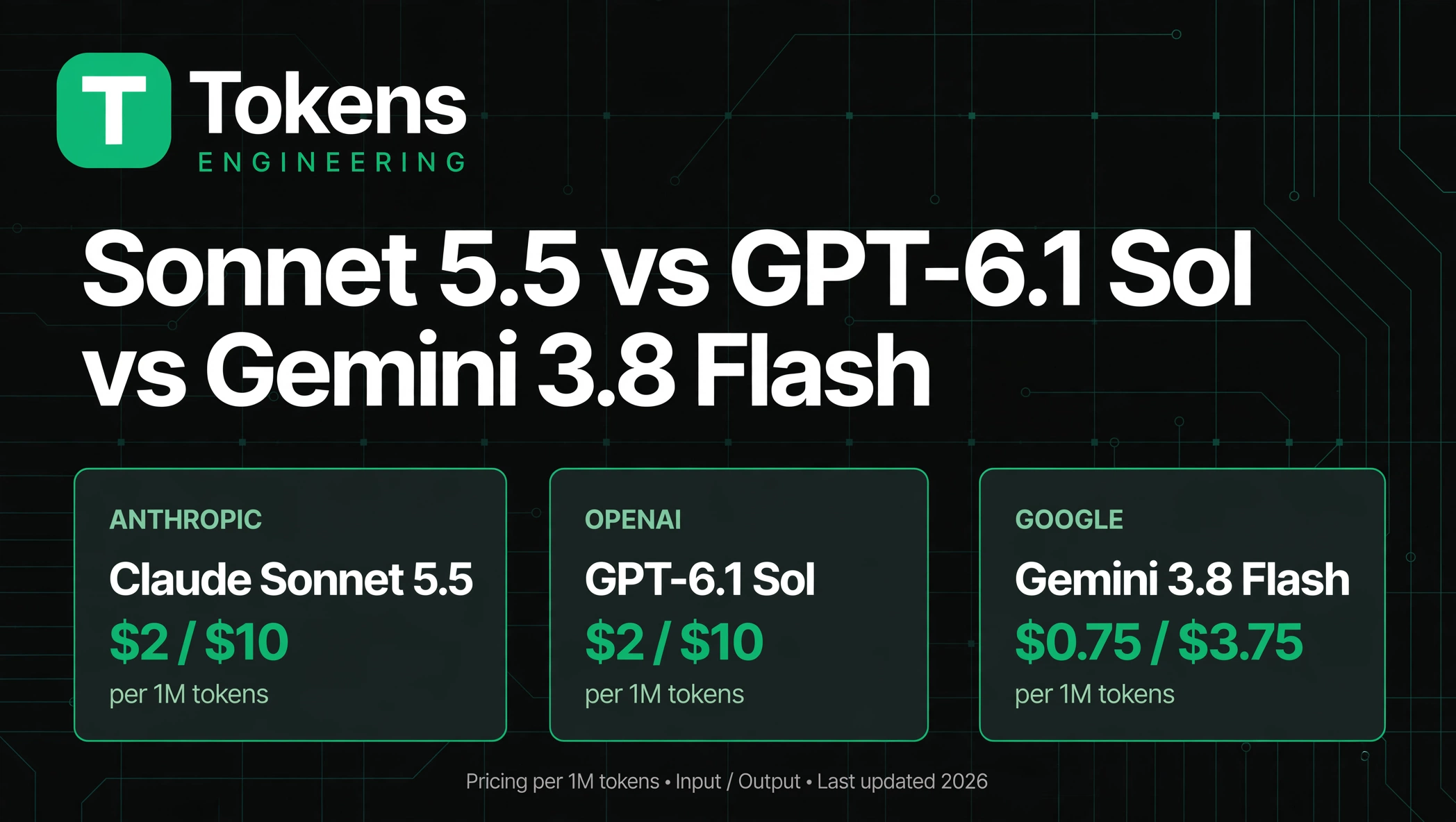
List prices checked 16 October 2026, USD per million tokens. Each vendor now fields a flagship, a mid-tier workhorse, and a cheap model:
| Flagship | Mid-tier | Cheap | |
|---|---|---|---|
| OpenAI (GPT) | GPT-6 Astra — $10 / $50 (3 Sep 2026) | GPT-6.1 Sol — $2 / $10 (29 Sep 2026) | GPT-6 Luna — $0.10 / $0.50 (22 Sep 2026) |
| Anthropic (Claude) | Opus 5.5 — $4 / $20 (22 Sep 2026) | Sonnet 5.5 — $2 / $10 (28 Sep 2026) | Haiku 5.5 — $0.10 / $0.50 (7 Oct 2026) |
| Google (Gemini) | Gemini 4 Argon — $2 / $10 intro, $4 / $20 from 1 Dec 2026 (13 Oct 2026) | — | Gemini 3.8 Flash — $1.65 / $8.25 (Tokens catalog rate) |
A note on the mid-tier column: GPT-6.1 Sol replaced GPT-6 Sol (29 Sep) at the same $2/$10 rate but with cheaper cached input ($0.10 vs $0.20 per 1M). Google has no true mid-tier — its ladder jumps from the $2/$10 frontier (Argon) straight to the $1.65/$8.25 Flash, with the 3.8 Flash priced below Argon's intro rate on input but more than 3x below on output. The 3.8 Flash figures are the Tokens catalog rate (verified on /models 16 October 2026); Google's own list price may differ. Context windows: 1M for the Claude 5.5 pair, ~1.05M for GPT-6, 1M for Argon.
Price: the honest ladder#
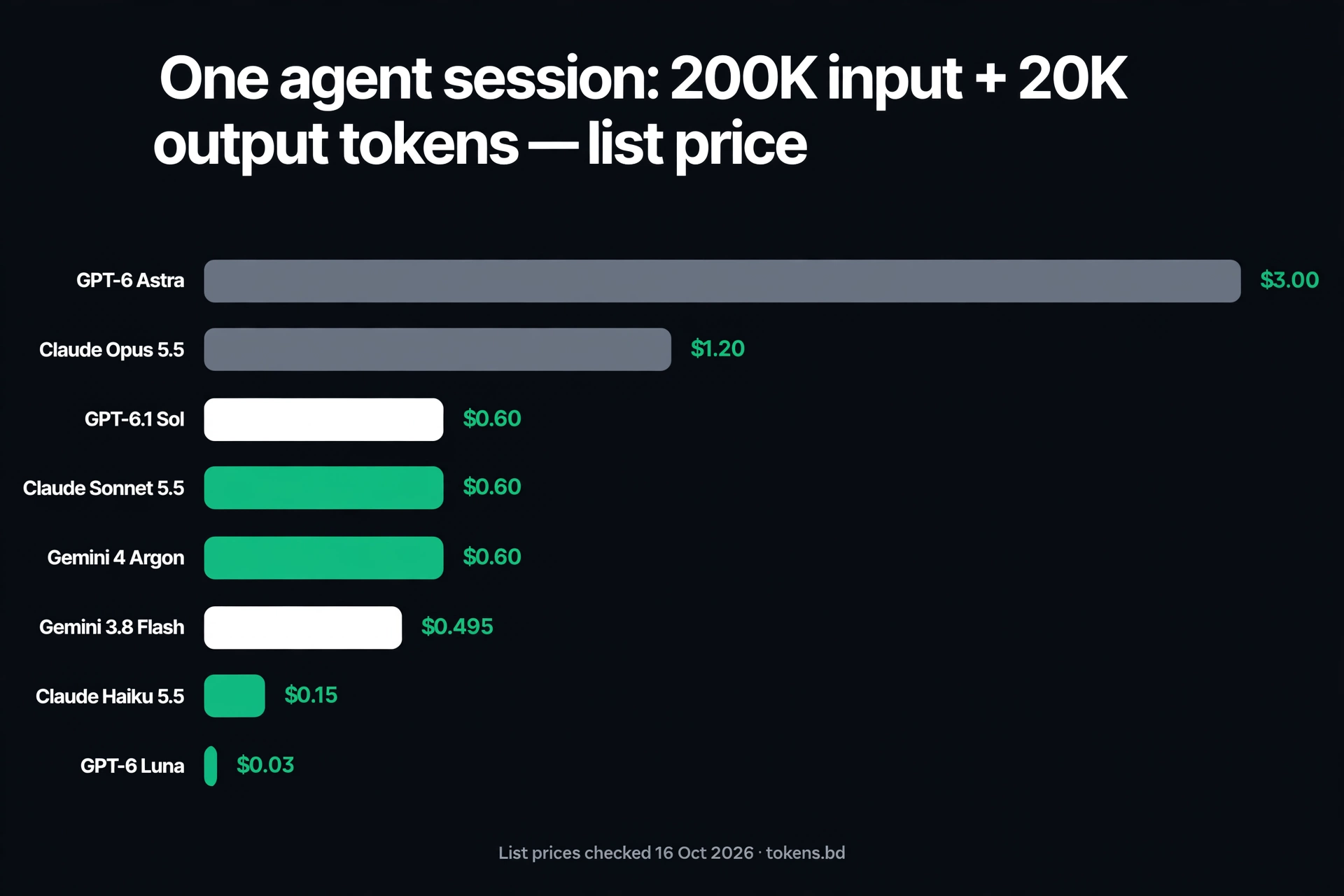
Sticker prices lie; sessions don't. A 200K-input, 20K-output agent session at list price costs:
| Model | Session math | Session cost |
|---|---|---|
| GPT-6 Astra | 0.2M × $10 + 0.02M × $50 | $3.00 |
| Claude Opus 5.5 | 0.2M × $4 + 0.02M × $20 | $1.20 |
| GPT-6.1 Sol | 0.2M × $2 + 0.02M × $10 | $0.60 |
| Claude Sonnet 5.5 | 0.2M × $2 + 0.02M × $10 | $0.60 |
| Gemini 4 Argon (intro) | 0.2M × $2 + 0.02M × $10 | $0.60 |
| Gemini 3.8 Flash | 0.2M × $1.65 + 0.02M × $8.25 | $0.495 |
| Claude Haiku 5.5 | 0.2M × $0.50 + 0.02M × $2.50 (5x tier past its 100K-token cliff) | $0.15 |
| GPT-6 Luna | 0.2M × $0.10 + 0.02M × $0.50 | $0.03 |
All three mid-tier models cost exactly the same per session: $0.60. That is the quiet fact of the October market — the $2/$10 tier has converged across all three vendors, and the competition moved to quality and speed. The cheap tier is where the vendors differ most: Luna holds its $0.03 all the way to a 272K-token cliff; Haiku 5.5 costs the same on small calls but 5x more on this long-context session because 200K tokens crosses its 100K cliff. (Full breakdown in the showdown post.)
Two price details that matter more than the headline rate. First, cached input — what repeated context costs on the second turn and beyond: Luna and Argon read cached input at $0.01/1M and $0.10/1M respectively (10% and 5% of input rate); GPT-6.1 Sol and Sonnet 5.5 tie for the cheapest mid-tier cache at $0.10/1M — Anthropic halved Sonnet's cache reads from $0.20 on 7 October 2026. On long agent sessions over a warm repository, the cache rate decides the bill more than the input rate. Second, Argon's intro price expires 30 November — from 1 December it doubles to $4/$20, exactly matching Opus 5.5. If you like Argon, buy the next six weeks cheap; see our Argon breakdown for the deadline math.
Coding quality: where each one wins#
Benchmark tables from vendors are marketing with footnotes — each lab reports the tests it wins. The only fair referee is an independent harness running everyone through the same gauntlet. Artificial Analysis did exactly that (Intelligence Index v4.3.2, October 2026):
| Model | AA Intelligence Index (independent) |
|---|---|
| Claude Opus 5.5 | 57.62 |
| Claude Sonnet 5.5 | 56.00 |
| GPT-6 Astra | 52.67 |
| Gemini 4 Argon | 52.56 |
| GPT-6.1 Sol | 51.83 |
Claude leads the independent index by a clear margin — Opus first, Sonnet a point and a half behind it. Astra and Argon sit within a tenth of each other. But "which is best at coding" is more specific than a general index, so here is where each model actually wins, with the source of every number labeled:
- Terminal-driven coding (Terminal-Bench 4.0): Sonnet 5.5 scores 70.6% on Anthropic's harness (vendor-reported), ahead of Opus 5.5's 66.4% and Google's 57.4% for Argon. Artificial Analysis's independent run narrows it but keeps the order: Sonnet 5.5 64%, GPT-6.1 Sol 56%.
- Long-horizon software engineering (DeepSWE v1.1): Argon 77.9%, the best published number on this test (Google-reported), ahead of Opus 5.5's 74.2% and Astra's 74.1%. GPT-6.1 Sol scores 75.2% at high effort on OpenAI's own run — note that its score falls to 71.9% at max effort, so more reasoning is not a free upgrade on this model.
- Merge-ready code (FrontierSWE v2): Astra 65.5% beats Opus 5.5 (62.3%) and Argon (55.0%) — all from Google's own comparison table, so read it as the strongest case for the two non-Google models, since Google chose to publish it.
- IDE-assisted coding (CursorBench 4.0): Opus 5.5 57.8% edges Sonnet 5.5's 55.5% (Anthropic-reported). OpenAI and Google don't publish on this one.
- Reliability on attempted answers: Argon posts the lowest hallucination rate Artificial Analysis has measured among leading models (15% on AA-Omniscience); GPT-6 Astra (51%) and GPT-6.1 Sol (54%) sit at the other end of that chart. Gemini accuracy is the trade: Argon's answer accuracy is 50% against Astra's 63% on the same evaluation.
The pattern across all of it: Claude wins terminal and IDE coding, Google wins long-horizon engineering and long context, OpenAI wins merge-readiness and cost efficiency. No single model sweeps the board — which is exactly why routing matters more than picking a winner.
Speed: tokens per second and task time#
Three different speed numbers, and only one of them is what users feel:
- Output throughput (tokens/sec). Artificial Analysis measured Sonnet 5.5 at 127.2 tok/s and GPT-6.1 Sol at 55.7 tok/s, both at max effort — Sonnet is ~2.3x faster per generated token. Anthropic separately claims Sonnet 5.5 generates output more than 30% faster than Sonnet 5 (vendor claim, first-party harness). No throughput figure I could verify today exists for Gemini 4 Argon or GPT-6 Astra; Google's published tables are silent on tokens-per-second.
- Cost per completed task. On AA's harness, one Intelligence Index task cost $7.67 on Sonnet 5.5 against $0.72 on GPT-6.1 Sol — the slower model finishes the same task for about a tenth of the money. Raw speed and bill speed are different things.
- Wall-clock for interactive work. For a developer staring at a terminal, the combination that matters is throughput plus fewer wasted turns: Sonnet 5.5's speed lead is why it keeps getting routed as the interactive default even where Opus scores higher — a failed Opus turn at 40 tokens/sec is worth less than a successful Sonnet turn at 127.
The practical reading: if a human is waiting, route to Sonnet 5.5; if a background agent is looping, route to GPT-6.1 Sol or GPT-6 Luna and let the tokens-per-dollar do the work. Effort levels cut both ways — higher effort means more thinking tokens, which bills at the output rate and slows the turn. See our reasoning-effort guide for the dial.
Which one for which job#
- Interactive coding sessions (a human in the loop) → Claude Sonnet 5.5. Fastest measured throughput, strongest terminal-coding scores, and it lives in the tokens.bd catalog at $2.20/$11.00 per 1M — one key, BDT payments.
- Background agents and bulk coding work → GPT-6.1 Sol, or GPT-6 Luna for the cheapest tier. Same $2/$10 list as Sonnet, ~10.7x cheaper per completed task on the independent harness, and the cheapest cached-input rate of the mid-tier.
- Long-horizon engineering (multi-hour agent runs, huge repos) → Gemini 4 Argon while the intro price lasts — best published DeepSWE score, 1M-token output, and the widest long-context lead (GraphWalks 84.2% vs Astra's 71.8%). Just know the price doubles 1 December.
- The hardest calls only → GPT-6 Astra or Claude Opus 5.5. Reserve the flagships for the escalation rung; most runs should never reach this tier. See the escalation pattern.
- Cheap first rung → GPT-6 Luna (in the catalog at $0.11/$0.55 per 1M) for long context, or Haiku 5.5 for terminal work under 100K tokens per call.
All three families route through one API shape on Tokens — the same base-url switch for every model:
from openai import OpenAI

client = OpenAI(
    base_url="https://tokens.bd/v1",   # OpenAI-compatible gateway
    api_key="tkbd_your_key_here",
)

# Swap the model string to route by family — same key, same code
resp = client.chat.completions.create(
    model="openai/gpt-6-luna",            # OpenAI cheap tier
    # model="anthropic/claude-sonnet-5.5",  # Anthropic mid tier ($2.20/$11.00 on Tokens)
    # model="google/gemini-3.8-flash",      # Google cheap tier ($1.65/$8.25 on Tokens)
    messages=[{"role": "user", "content": "Refactor this module for clarity."}],
    max_tokens=4000,
)
print(resp.choices[0].message.content)
On Tokens today the routable options are GPT-6 Luna, GPT-5.6 Luna/Sol, Claude Sonnet 5.5, and Gemini 3.7/3.8 Flash — 60+ models in the catalog. GPT-6.1 Sol, Opus 5.5, Haiku 5.5, and Gemini 4 Argon are not in the catalog yet; those run through the makers directly for now.
The Bangladesh angle#
At today's rate of about ৳123.06 per dollar, the 200K-token session from the chart above costs ৳3.69 on GPT-6 Luna and ৳369.18 on GPT-6 Astra — a 100x spread for the same task shape. The three mid-tier models each cost ৳73.84 per session. Scale that to a team running 10 such sessions a day: Luna comes to about ৳1,108/month; Astra to about ৳110,754/month. That is the difference between an experiment and a budget line — and it is why the routing section above matters more here than anywhere: no international card is needed either way, since Tokens bills in BDT via bKash/Nagad. Put each family's key under per-key spend caps so the $3/session tier can never surprise you, and let prompt caching eat the repeated context on long sessions.
GPT vs Claude vs Gemini FAQ#
Which family is cheapest for coding agents? OpenAI's cheap tier: GPT-6 Luna lists at $0.10/$0.50 per 1M — same headline rate as Claude Haiku 5.5, but Luna holds it to a 272K-token cliff vs Haiku's 100K. For mid-tier work all three vendors converged at $2/$10; pick by quality and speed, not price.
Is GPT-6.1 Sol or Claude Sonnet 5.5 better for coding? They share the same $2/$10 list price. Independent Artificial Analysis scoring gives Sonnet 5.5 the edge (56.00 vs 51.83) and Sonnet wins terminal coding 64% to 56% on AA's harness — but costs ~10.7x more per completed task there ($7.67 vs $0.72). Sonnet for interactive speed, Sol for background cost.
Should I switch to Gemini 4 Argon? It has the best published DeepSWE score (77.9%) and the cheapest frontier price until 30 November ($2/$10, then $4/$20). If your workloads are long-horizon engineering runs, the next six weeks are the cheapest frontier pricing on the market. It's not in the Tokens catalog yet, so you'd run it through Google directly for now.
Which model is fastest? Claude Sonnet 5.5: 127.2 tokens/sec on Artificial Analysis's independent measurement, about 2.3x GPT-6.1 Sol (55.7 tok/s), and Anthropic claims 30%+ faster output than Sonnet 5. No verifiable throughput figure exists today for Gemini 4 Argon or GPT-6 Astra.
Can I use all of these through Tokens? The catalog currently covers GPT-6 Luna, GPT-5.6 Luna/Sol, Claude Sonnet 5.5, and Gemini 3.7/3.8 Flash. GPT-6.1 Sol, Opus 5.5, Haiku 5.5, and Gemini 4 Argon aren't in the catalog as of 16 October 2026 — those go through the makers' own APIs for now.
List prices checked 16 October 2026. Promotional prices and model defaults change; the maker's pricing page is the authority for list prices, and the model catalog for prices on Tokens.
Sources: OpenAI API pricing 2026 · GPT-6 Sol and Luna launch · GPT-6 Sol/Luna pricing and benchmarks · Claude Sonnet 5.5 pricing and setup · Sonnet 5.5 vs GPT-6.1 Sol — independent benchmarks · GPT-6.1 Sol vs Sonnet 5.5 vs Opus 5.5 · Gemini 4 Argon independent benchmark picture · Gemini 4 Argon vs GPT-6 Astra · Gemini 4 Argon benchmark table · Gemini 4 Argon pricing and availability · USD/BDT rate 16 Oct 2026 · Tokens model catalog