
TL;DR — Meta released Muse Wonder 1.0 and Muse Wonder Full on 12 October 2026 — the company's first frontier-class AI models, built for long-running coding agents. Wonder costs $4/$20 per million input/output tokens through the Meta Model API (cached input $0.20), exactly matching Claude Opus 5.5's price. On the independent Artificial Analysis Intelligence Index, Wonder Full scores 56 and Wonder 52, against 58 for Opus 5.5 and 53 for GPT-6 Astra. Both models are closed-weight — a clean break from Meta's open Llama era. Prices checked 13 October 2026.
Meta just entered the frontier race#
For two years, Meta's AI story was open weights: Llama checkpoints anyone could download, fine-tune, and run. Meanwhile the frontier — the most capable models, the ones behind the best coding agents — belonged to Anthropic, OpenAI, and Google. That split ended on Monday, 12 October 2026, when Meta's Superintelligence Lab (MSL), led by former Scale AI CEO Alexandr Wang, released two models it describes as frontier-class: Muse Wonder and the larger Muse Wonder Full.
The timing is not subtle. Anthropic cut Opus 5.5's price 20% to $4/$20 on September 22. OpenAI's GPT-6 Astra sits at $10/$50. Meta priced Wonder at exactly Opus 5.5's number — a deliberate signal that it wants to be compared head-to-head with the model most coding-agent teams already use. This post does that comparison with real numbers, so you can decide whether the new entrant earns a slot in your stack.
What Muse Wonder 1.0 actually is#
Two models, two very different access stories:
Muse Wonder (muse-wonder-1.0) | Muse Wonder Full | |
|---|---|---|
| Released | 12 October 2026 | 12 October 2026 |
| Available via | Meta Model API, Muse Code, OpenRouter (meta/muse-wonder) | Muse Code only (Power/Maximum plans) |
| Public API price | $4 / $20 per 1M in/out | No public API price |
| Context window | 1M tokens | 1M tokens |
| Input modalities | Text, images, video, audio, PDF | Text, images, video, audio, PDF |
| Reasoning effort | minimal / low / medium / high / xhigh / max | Same |
| Open weights | No | No |
Three details matter for developers. First, the API speaks three wire formats — OpenAI Responses, OpenAI Chat Completions, and Anthropic Messages — so existing code needs a base_url change, not a rewrite (the same one-line pattern from our OpenAI SDK guide). Second, it supports tool calling, structured output, search grounding, and computer use out of the box — this is a model built for agents, not chat. Third, the weights are closed: unlike every Llama release, you cannot download Wonder. Meta trained at its Prometheus data center in Ohio and is keeping the checkpoint.
That last point is the real story for the industry. Meta spent two years arguing open-source was its strategy; Wonder's price tag and closed weights say the strategy changed. Whether that matters to you depends on whether you ever planned to self-host — most teams calling APIs never did.
The price: $4 in, $20 out#
List prices checked 13 October 2026, USD per million tokens:
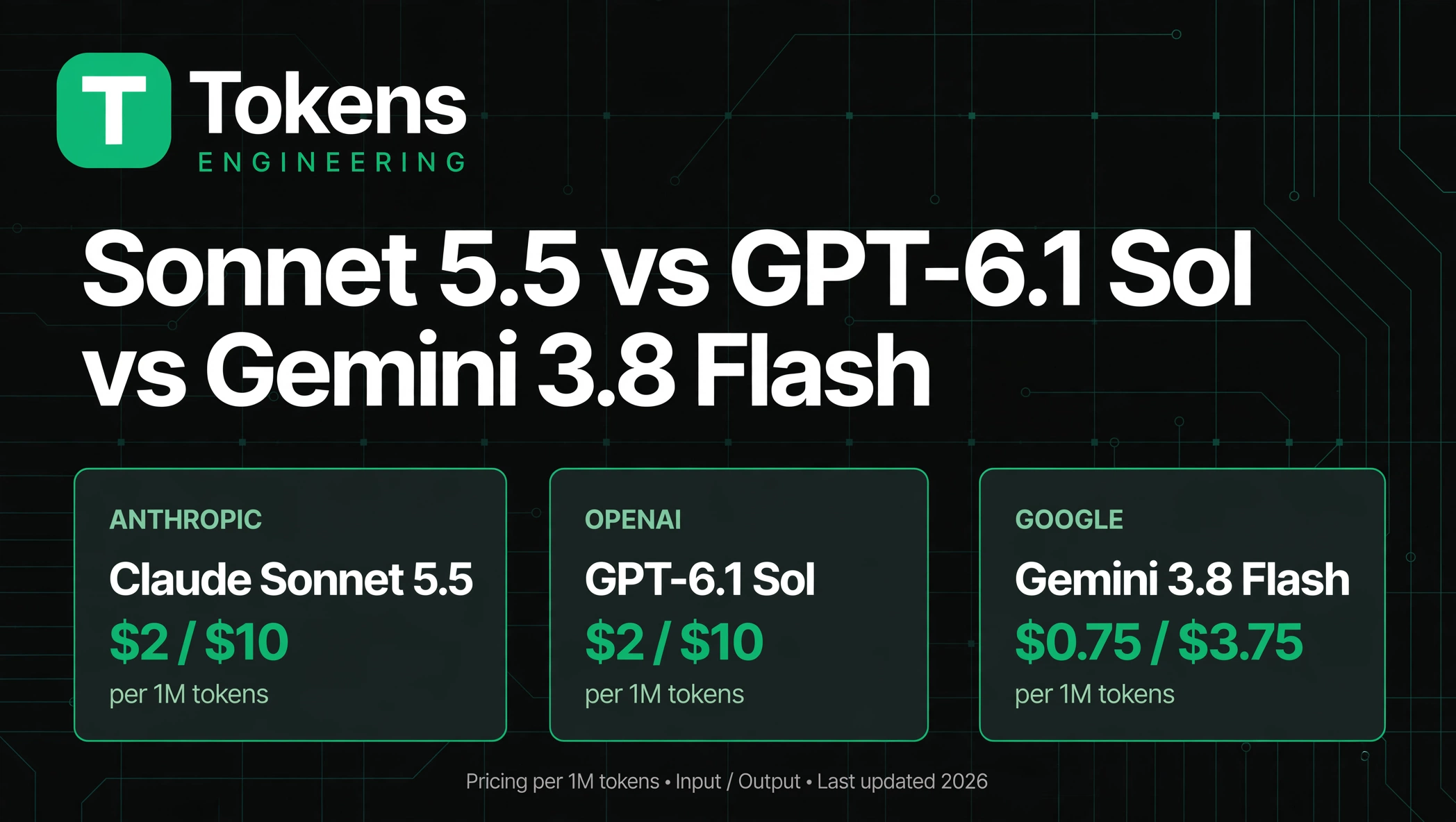
| Model | Provider | Input / 1M | Output / 1M | Cached input / 1M |
|---|---|---|---|---|
| Muse Wonder 1.0 | Meta | $4.00 | $20.00 | $0.20 |
| Claude Opus 5.5 | Anthropic | $4.00 | $20.00 | $0.20 |
| Claude Sonnet 5.5 | Anthropic | $2.00 | $10.00 | — |
| Claude Fable 5.1 | Anthropic | $10.00 | $50.00 | — |
| GPT-6.1 Sol | OpenAI | $2.00 | $10.00 | — |
| GPT-6 Astra | OpenAI | $10.00 | $50.00 | — |
Two things to read out of this table. First, Wonder's pricing is a photocopy of Opus 5.5's — Meta is not competing on price, it's competing on capability-per-dollar at the exact tier the market already accepted. Second, the cached-input discount is 20×: $4.00 down to $0.20 per million. For agentic coding loops that re-send the same codebase context every turn, prompt caching is not optional at these prices — it is the difference between a $3 session and a much larger one. (Mechanics in our prompt caching guide.)
For Bangladeshi developers paying in taka: Meta bills in USD, so at ৳120 to the dollar Wonder works out to roughly ৳480 input / ৳2,400 output per million tokens — illustrative only; your card's rate decides. One important check for the local angle: as of 13 October 2026, Muse Wonder 1.0 is not yet listed in the tokens.bd model catalog (60+ models checked today; the catalog carries Meta's Muse Spark 1.3 at $1.38/$4.68 per 1M). If Wonder lands there, you'll get the platform's fixed taka pricing instead of card-rate roulette — worth checking before you wire Meta billing directly.
How it benchmarks — and how to read the numbers#
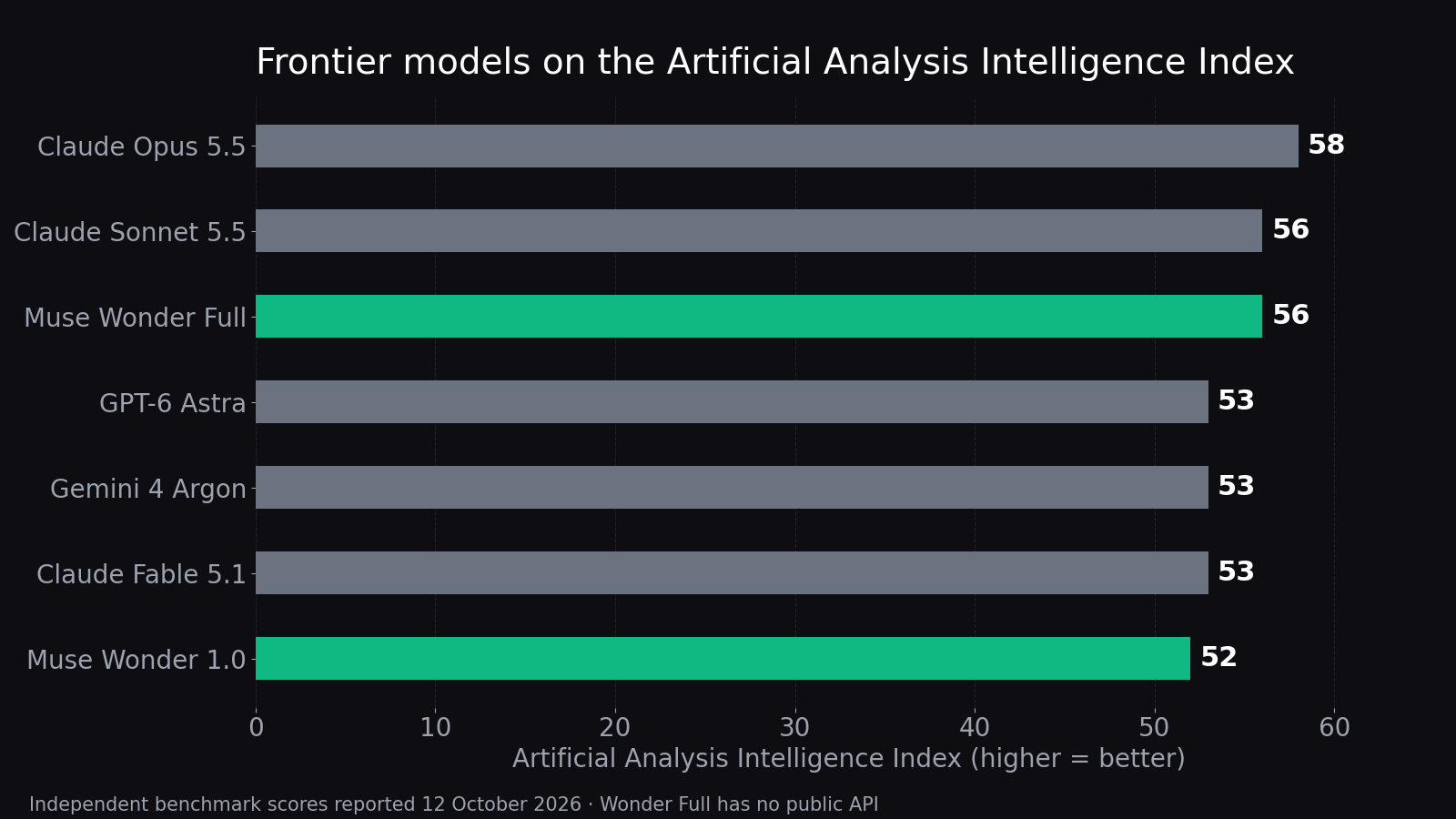
Meta's own model card places Wonder and Wonder Full alongside Fable 5.1 and GPT-6 Astra. Vendor charts always flatter the home team, so the more useful numbers come from Artificial Analysis, which tests every model itself:
| Model | AA Intelligence Index |
|---|---|
| Claude Opus 5.5 | 58 |
| Claude Sonnet 5.5 | 56 |
| Muse Wonder Full | 56 |
| GPT-6 Astra | 53 |
| Gemini 4 Argon | 53 |
| Claude Fable 5.1 | 53 |
| Muse Wonder 1.0 | 52 |
The honest read: Wonder Full ties Sonnet 5.5 at 56 and sits two points behind Opus 5.5 — genuinely frontier-adjacent, not a marketing rounding error. The standard Wonder at 52 trails GPT-6 Astra by a point. On coding-specific tests, Meta reports Wonder Full jumping from 33% to 57% on Terminal-Bench 4.0 and hitting 68 on the Coding Agents Index, in the top tier with Anthropic's best. One caveat worth noting: on Artificial Analysis's factual-knowledge test (AA-Omniscience), Wonder Full scores only 30 — lower than rivals. For code and agent work that matters less than it sounds; for research-style Q&A, it matters more.
The benchmark that should make security teams pay attention: Wonder is Meta's pitch for work where provider-side refusals are the bug. Several closed frontier models score near zero on exploit-reproduction tests because they refuse the task; Meta's framing is that a filter blocking a legitimate red-team step is itself a security risk. Whether you buy the philosophy or not, it tells you who Meta is courting: enterprise security, finance, and legal teams, not just coders.
Three things that actually differentiate it#
Beyond the scores, Meta is selling three ideas:
- Active Memory. The model is designed to carry important context about you across conversations and pull up the details that matter for the task. Every agent vendor is chasing persistent memory right now; Meta is betting it's the feature that makes an assistant feel like yours rather than a fresh intern every session. Treat it as a capability claim to verify on your own workload, not a settled fact.
- Active Focus. When blocked, the model is supposed to try other approaches, ask for clarification, and check in before important actions — the behaviors that separate a useful agent from one that confidently does the wrong thing for forty minutes. Again: verify on your tasks.
- Agent-first API surface. Six reasoning-effort levels (
minimalthroughmax), native tool calling, structured output, search grounding, and computer use, in three interchangeable API formats. This is the least hype-y of the three and the most immediately useful: you can slot Wonder into an existing OpenAI-compatible pipeline today.
Worked example: what a coding session actually costs#
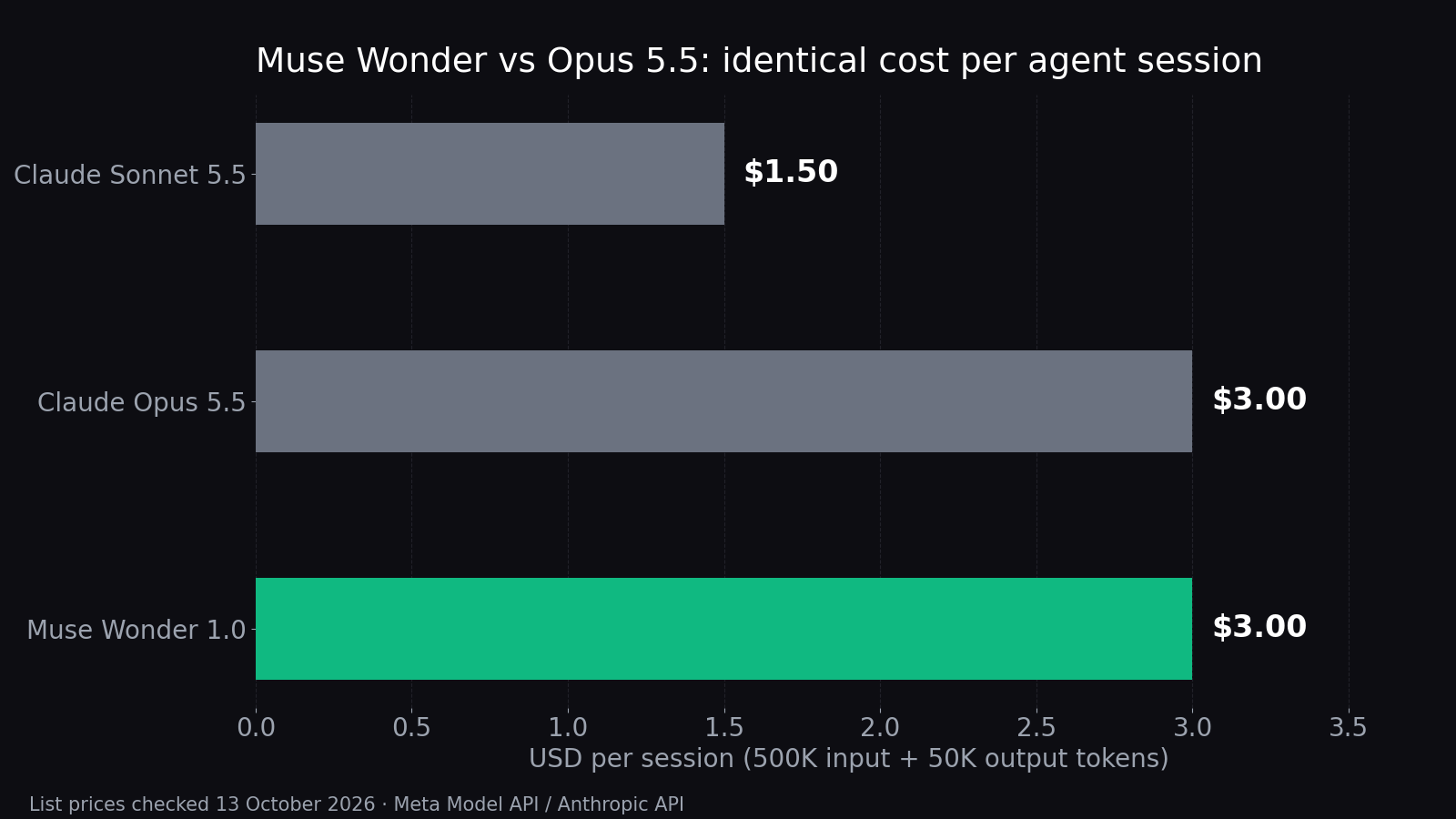
Take one typical agent coding session: 500K input tokens (a decent-size repo context) and 50K output tokens (the fix plus explanation). Arithmetic from the list prices above:
| Muse Wonder 1.0 | Claude Opus 5.5 | Claude Sonnet 5.5 | |
|---|---|---|---|
| Input: 0.5M | 0.5 × $4.00 = $2.00 | 0.5 × $4.00 = $2.00 | 0.5 × $2.00 = $1.00 |
| Output: 0.05M | 0.05 × $20.00 = $1.00 | 0.05 × $20.00 = $1.00 | 0.05 × $10.00 = $0.50 |
| Session total | $3.00 | $3.00 | $1.50 |
Wonder and Opus 5.5 cost exactly the same per session — the price war here is fought on benchmarks, not dollars. Sonnet 5.5 does the same session for half. Scale it: 100 sessions a day is $300/day on Wonder or Opus, $150/day on Sonnet — roughly $9,000 vs $4,500 a month (100 × $3.00 × 30 = $9,000; 100 × $1.50 × 30 = $4,500). The switching question is therefore never "is Wonder cheaper" — it's "does Wonder finish tasks Sonnet can't, and does it beat Opus on your tasks enough to matter." Only your evals answer that.
A minimal integration, if you want to run that eval — the OpenAI-compatible endpoint:
from openai import OpenAI

client = OpenAI(
    base_url="https://api.meta.ai/v1",
    api_key="YOUR_META_API_KEY",
)

resp = client.chat.completions.create(
    model="muse-wonder-1.0",
    messages=[{"role": "user", "content": "Refactor this function to stream results."}],
    # reasoning effort: minimal, low, medium, high, xhigh, max
    extra_body={"reasoning_effort": "high"},
)
print(resp.choices[0].message.content)
Same base_url-swap pattern as any other OpenAI-compatible model — the effort parameter is the only Wonder-specific knob, and it bills thinking tokens at the $20 output rate, so test medium before max.
Should you switch?#
A decision framework, not a verdict:
- If you run Opus 5.5 today: Wonder is a free experiment — same price, same API shape. Run 30–50 of your real tasks on both, compare success rate and cost per finished task, and keep your fallback chain pointed at whichever loses. Do not switch on benchmark scores alone.
- If you run Sonnet 5.5: Wonder costs 2× per token for roughly tied benchmark scores. Switch only the workloads where Sonnet demonstrably fails and Wonder succeeds — long-horizon agents, security-sensitive reviews — and keep Sonnet as the default. Escalation beats replacement.
- If you're on Muse Spark or another Meta model: Wonder is the upgrade path Meta clearly intends, but note it's closed-weight and roughly 3–4× the per-token price of Spark 1.3's standard tier ($4/$20 vs $1.38/$4.68 per 1M). Budget the jump before you commit.
- If you're in Bangladesh paying by card: hold off wiring Meta billing directly until you've checked whether tokens.bd picks Wonder up — one key, taka pricing, and no international-card friction is worth waiting a few days for. Yesterday's Claude payment-options guide covers why direct USD billing is painful here.
Muse Wonder FAQ#
When was Muse Wonder 1.0 released? 12 October 2026, by Meta's Superintelligence Lab — alongside the larger Muse Wonder Full. It replaces Muse Spark as Meta's flagship model line.
How much does Muse Wonder 1.0 cost? $4 per million input tokens and $20 per million output tokens through the Meta Model API, with cached input at $0.20 per million — identical to Claude Opus 5.5's list price. Prices checked 13 October 2026.
Is Muse Wonder open source? No. Unlike Meta's Llama models, neither Wonder nor Wonder Full ships downloadable weights. Wonder is API-only; Wonder Full is restricted to Muse Code subscribers on Power/Maximum plans.
How does Muse Wonder compare to Claude Opus 5.5 and GPT-6 Astra? On the independent Artificial Analysis Intelligence Index: Opus 5.5 scores 58, Muse Wonder Full 56, GPT-6 Astra 53, and standard Muse Wonder 52. Wonder matches Opus 5.5 on price exactly, so the comparison comes down to measured performance on your own tasks.
Can I use Muse Wonder from Bangladesh without an international card? Not directly — Meta bills the API in USD by card. As of 13 October 2026 Muse Wonder is not yet in the tokens.bd catalog; if it gets added, you'd get fixed taka pricing on one key. Check the model catalog for its current status.
List prices checked 13 October 2026. Model availability and benchmark scores change; the provider's pricing page is the authority for list prices.
Sources: VentureBeat — Meta's Muse Wonder models · dev.to — Muse Wonder benchmarks, pricing, API · AI Daily Post — Meta launches Muse Wonder · vandatateam — Muse Wonder review · Oossa — Muse Wonder launch · Digital Soul Hub — what Wonder offers · scriptbyai — LLM API pricing October 2026 · omidsaffari — Claude Opus 5.5 costs · tokens.bd model catalog