
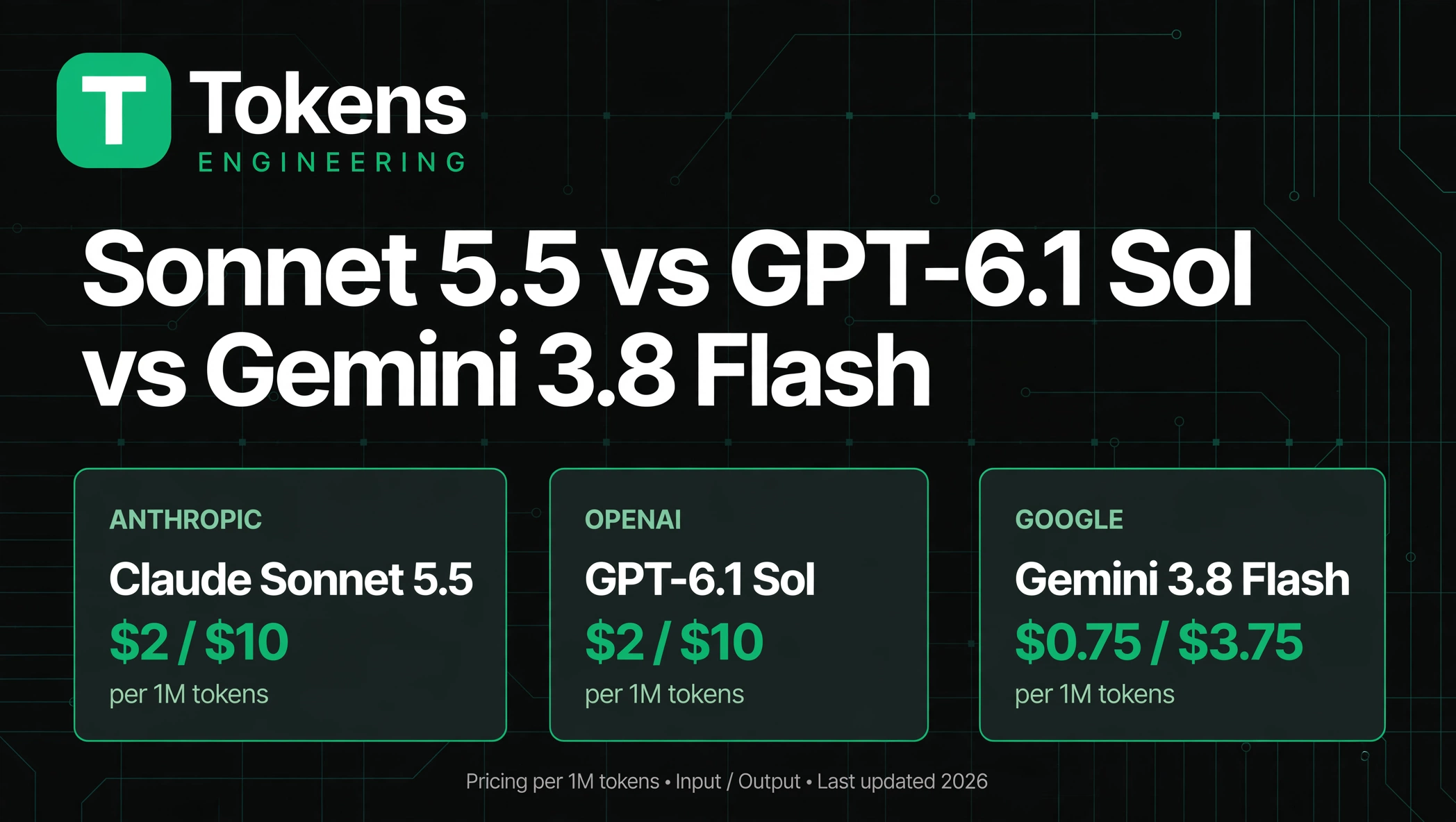
TL;DR — Claude Sonnet 4.5 retires on November 30, 2026, and three models are competing to replace it: Claude Sonnet 5.5 and GPT-6.1 Sol, both at $2/$10 per 1M tokens, and Gemini 3.8 Flash at $0.75/$3.75 on introductory pricing through December 31, 2026. On the one coding benchmark all three vendors report — DeepSWE v1.1 — the scores are 71.0% (Sonnet 5.5), 75.2% (GPT-6.1 Sol), and 73.7% (Gemini 3.8 Flash). List prices checked 12 October 2026.
Why this comparison matters now#
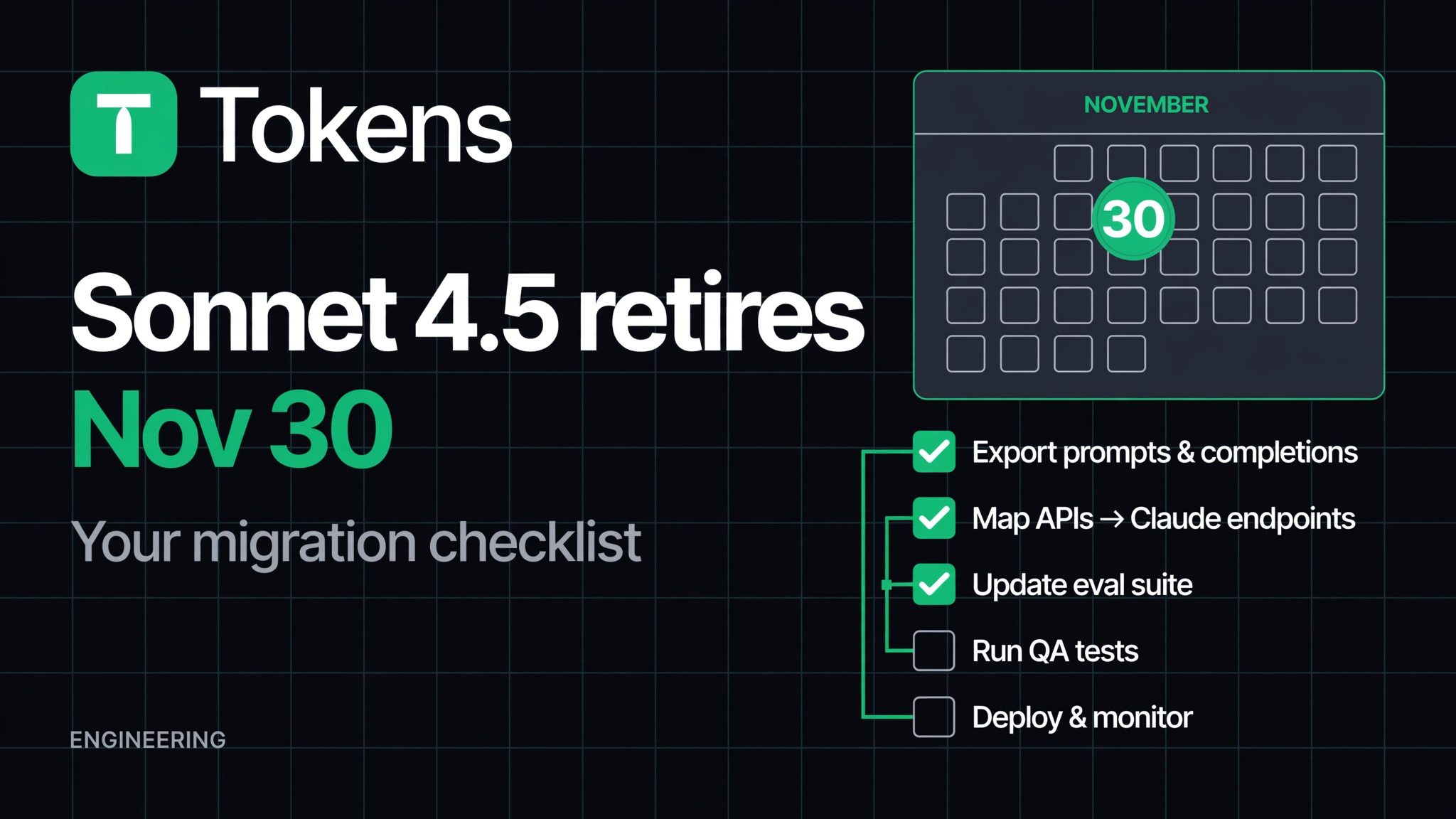
Retirements force decisions. Claude Sonnet 4.5 stops serving on November 30, 2026 — about seven weeks from now — and our migration checklist covers the mechanics of moving off it. But that post leaves the bigger question open: move to what? The three credible answers all shipped within a month of each other: Gemini 3.8 Flash on September 2, GPT-6.1 Sol on September 29, and Claude Sonnet 5.5 on September 28 (via tech-insider.org's release-wave roundup).
This post compares them on the three things that should drive the choice — price, measured coding performance, and what switching actually costs you — so you can pick before the retirement deadline picks for you.
The three contenders at a glance#
All list prices below are USD per million tokens, checked 12 October 2026.
| Claude Sonnet 5.5 | GPT-6.1 Sol | Gemini 3.8 Flash | |
|---|---|---|---|
| Provider | Anthropic | OpenAI | |
| Released | 28 Sep 2026 | 29 Sep 2026 | 2 Sep 2026 |
| Input / 1M | $2.00 | $2.00 | $0.75* |
| Output / 1M | $10.00 | $10.00 | $3.75* |
| Context window | 1M | ~1.05M | 1M |
| Cached input / 1M | $0.10 | $0.10 | Not disclosed |
*Introductory pricing through 31 December 2026; standard rates of $1.50/$7.50 apply from 1 January 2027 (reported by trendintech.com, softreviewed.com, and gcn.com).
Sonnet 5.5 kept Sonnet 5's price structure exactly — no repricing. GPT-6.1 Sol matches it dollar for dollar, which is the point: OpenAI is asking you to choose on capability, not cost. Google undercuts both by roughly 63% on input and output — but only until New Year's Eve. Price sources: the scriptbyai.com pricing table (updated Oct 9, 2026) and dataist.ai's Sonnet 5.5 pricing coverage both confirm the $2/$10 figures; tech-insider.org confirms Flash's $0.75/$3.75 intro rate.
What the same session costs on each#
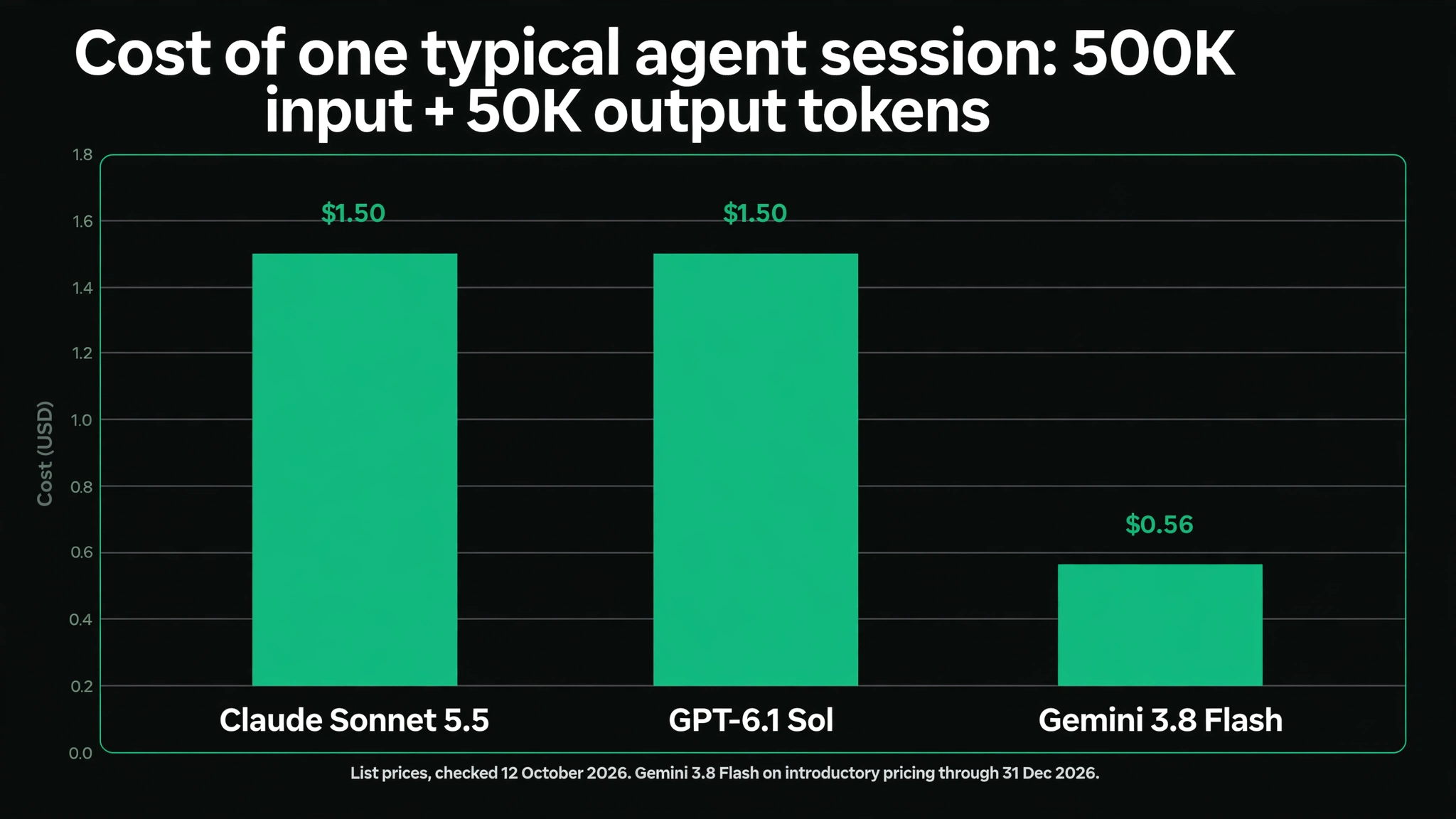
Price-per-token is not the bill. Take one typical agent session — 500K input tokens plus 50K output tokens (the same workload we used in our BDT pricing guide):
| Model | Input: 0.5M | Output: 0.05M | Session total |
|---|---|---|---|
| Claude Sonnet 5.5 | 0.5 × $2.00 = $1.00 | 0.05 × $10.00 = $0.50 | $1.50 |
| GPT-6.1 Sol | 0.5 × $2.00 = $1.00 | 0.05 × $10.00 = $0.50 | $1.50 |
| Gemini 3.8 Flash | 0.5 × $0.75 = $0.375 | 0.05 × $3.75 = $0.1875 | $0.56 |
At ৳123.31 per USD (11 October 2026, the rate used across our pricing posts): the Sonnet 5.5 / GPT-6.1 Sol session costs about ৳185, the Flash session about ৳69 — roughly 62% cheaper. After Flash's introductory pricing expires, the same session at $1.50/$7.50 costs $1.125 (about ৳139) — still 25% below the other two.
The benchmark picture, honestly labeled#
Vendor benchmarks are vendor benchmarks — but when all three vendors report the same benchmark, the comparison is as fair as it gets. That benchmark is DeepSWE v1.1 (113 real-repo software engineering tasks):
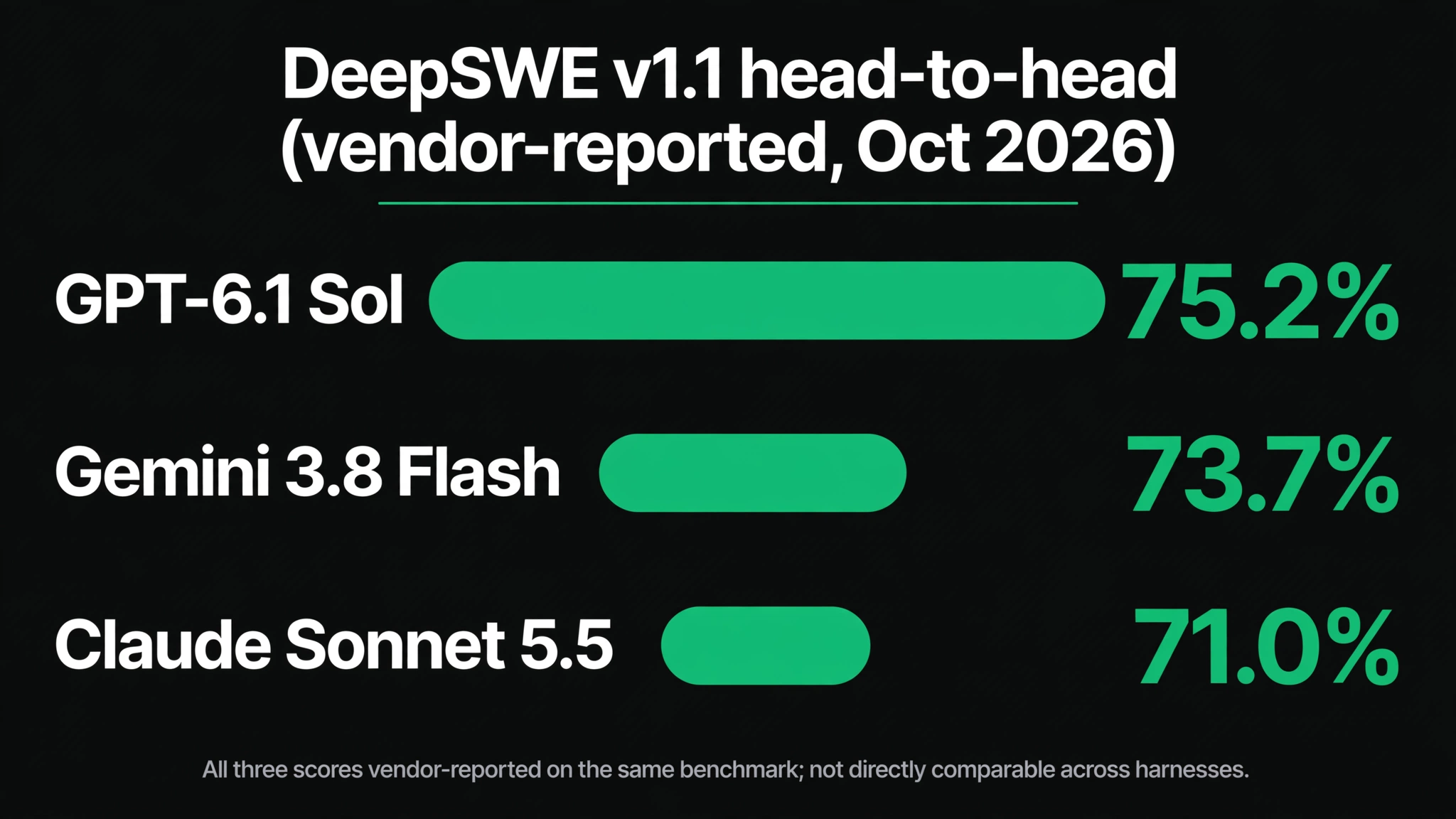
The spread is 4.2 points — the tightest three-way race at the coding frontier in 2026. For context, here are the other reported coding scores, each attributed to who reported them:
| Benchmark | Sonnet 5.5 | GPT-6.1 Sol | Gemini 3.8 Flash |
|---|---|---|---|
| DeepSWE v1.1 | 71.0% (Anthropic, via codersera.com) | 75.2% (OpenAI, via codersera.com) | 73.7% (Google, via gcn.com) |
| SWE-Bench Pro | 81.3% (Anthropic) | not reported | not reported |
| Terminal-Bench 4.0 | 70.6% (Anthropic) | not reported | not reported |
| AutomationBench | 44.7% (Anthropic) | 35.4% medium (OpenAI) | not reported |
| AA Intelligence Index | 56 (Artificial Analysis, independent) | 52 (Artificial Analysis, independent) | not reported |
Two honest caveats. First, independent runs compress vendor gaps: Mercor's independent DeepSWE run had GPT-6.1 Sol and Claude Opus 5.5 tied at 72.3% (via thomas-wiegold.com), below OpenAI's 75.2% vendor figure — so treat the Sol–Flash–Sonnet gap above as direction, not gospel. Second, no vendor publishes the full picture: Anthropic doesn't report DeepSWE for GPT models, OpenAI doesn't report SWE-Bench Pro, and Google's numbers come from its own launch materials. The one independent metric that covers two of the three — Artificial Analysis' Intelligence Index — has Sonnet 5.5 at 56 and GPT-6.1 Sol at 52. Always benchmark on your own workload before committing; our coding benchmarks roundup explains how to read these leaderboards critically.
The hidden decider: cache economics#
At identical list prices, Sonnet 5.5 and GPT-6.1 Sol look interchangeable. They're not — because real agent workloads are cache-heavy, and the cache terms differ in the details:
- Sonnet 5.5: cache reads cost $0.10/1M since Anthropic halved them on October 7, 2026; cache writes $2.50/1M (dataist.ai).
- GPT-6.1 Sol: cached input $0.10/1M — a 95% discount off the input rate; cache writes $2.50/1M (tech-insider.org's spec table).
- Gemini 3.8 Flash: no public cache pricing as of the check date.
Take that 500K-input session again, with 90% of the context as a warm cache (system prompt + repo context reused across turns, the normal agentic pattern — see prompt caching explained):
- Fresh 50K at $2.00/1M = $0.10; cached 450K at $0.10/1M = $0.045. Total input cost $0.145 instead of $1.00 — an ~85% saving on the input side, on either Sonnet 5.5 or GPT-6.1 Sol.
For a cache-heavy workload, the effective cost ranking can flip: a cached Sonnet 5.5 session can undercut an uncached Flash one. If your workload re-reads large contexts — and most coding agents do — cache terms matter more than the sticker price. Run your own 50-turn cost comparison before deciding.
The verdict: who should switch to what#
- Staying on Claude and want the safest move: Sonnet 5.5. It's a straight API swap for Sonnet 5 at the same price, leads on agentic benchmarks (AutomationBench 44.7% vs Sol's 35.4%), and has the best-documented cache behavior. The independent Intelligence Index (56 vs 52) agrees it's the stronger model of the two $2/$10 options.
- Already on OpenAI and running agentic coding: GPT-6.1 Sol. Top vendor-reported DeepSWE score (75.2%), near-Astra coding at one-fifth of Astra's cost, and the most aggressive cached-input discount in the field. Watch two migration gotchas flagged by independent reviewers:
none/minimalreasoning effort are gone (low is now the floor), and prompts over 272K tokens bill the whole request at 2× input / 1.5× output — not just the overflow. - Optimizing for cost per task: Gemini 3.8 Flash. Within 1.5 points of GPT-6.1 Sol on DeepSWE at ~62% lower per-session cost — the best value ratio of the three. But price in the January 1 reset ($1.50/$7.50), verify cache behavior for your workload since Google hasn't published cache rates, and note the tunable
thinking_leveldepth control for trading reasoning against cost.
One model to watch, not to buy yet: Gemini 4 Argon leads AutomationBench at 78% and tops human-preference rankings — but it's still gated behind Google's Fairwind Program with no public API. Don't plan a migration around a model you can't call.
For the full ten-model field — including budget options like MiMo V2.6 Pro and MiniMax M3 — see our frontier coding models guide. Its rule of thumb pairs well with this comparison: start cheap by default, and escalate to one of the three models above only when the task earns it.
How to switch, concretely#
The good news: switching models is a configuration change, not a rewrite. On tokens.bd, all three providers go through one OpenAI-compatible endpoint:
from openai import OpenAI

client = OpenAI(
    base_url="https://tokens.bd/v1",   # OpenAI-compatible gateway
    api_key="YOUR_TOKENS_BD_KEY",       # one key, all providers
)

resp = client.chat.completions.create(
    model="anthropic/claude-sonnet-5.5",  # swap the model id, nothing else
    messages=[{"role": "user", "content": "Refactor this handler for retries"}],
)
The migration checklist, in order:
- Swap the model id. On tokens.bd, Sonnet 5.5 is
anthropic/claude-sonnet-5.5and Gemini 3.8 Flash isgoogle/gemini-3.8-flash(catalog checked 12 October 2026). GPT-6.1 Sol is not yet in the tokens.bd catalog — the closest OpenAI mid-tier there is GPT-5.6 Sol — so Sol means direct OpenAI billing for now. - Re-tune the thinking dial. Each model exposes effort differently: Sonnet 5.5 uses adaptive thinking, GPT-6.1 Sol takes low/medium/high/xhigh/max reasoning effort (medium is the default and already strong), and Gemini 3.8 Flash has a
thinking_levelcontrol. Start at the default, measure, then adjust — our thinking-budgets guide covers the cost arithmetic. - Re-validate your cache assumptions. Cache behavior is per model and per provider — switching models pays full input price again on the first run. Prime the cache in staging before cutting over.
- Test on your suite, not the leaderboard. Vendor numbers compress or invert on real workloads. Port your acceptance tests first; the retirement gives you seven weeks, use them.
FAQ#
Which of the three is cheapest? Gemini 3.8 Flash, by a wide margin — $0.75/$3.75 through December 31, 2026, about 62% cheaper per typical agent session than the other two. After the January 1, 2027 reset to $1.50/$7.50 it stays the cheapest, but the gap narrows to ~25%.
Is GPT-6.1 Sol available on tokens.bd? Not yet — as of 12 October 2026 the catalog lists GPT-5.6 Sol ($5.50/$33.00) and GPT-6 Luna ($0.11/$0.55) on the OpenAI side. Sonnet 5.5 ($2.20/$11.00) and Gemini 3.8 Flash ($1.65/$8.25) are both available on tokens.bd with BDT payment. See the model catalog for current listings.
I'm still on Sonnet 4.5. What's the deadline? November 30, 2026. Sonnet 5.5 is the drop-in successor at the same list price; our Sonnet 4.5 migration checklist walks through the cutover steps.
Do the vendor benchmark numbers settle it? No. They're all vendor-reported on vendor-chosen harnesses, and independent runs (like Mercor's DeepSWE run) routinely compress the gaps. The shared-benchmark table above is the fairest public comparison available — but your own workload is the only benchmark that decides your bill.
What about Opus 5.5 or GPT-6 Astra? Both exist above this tier (Opus 5.5 at $4/$20, GPT-6 Astra at $10/$50) for workloads that need maximum capability. Our Sonnet vs Opus coding guide covers when the bigger model is actually worth it.
Sources#
All facts verified 12 October 2026. List prices: scriptbyai.com AI LLM API Pricing 2026 (updated Oct 9, 2026) — https://www.scriptbyai.com/gpt-gemini-claude-pricing/ · dataist.ai on Sonnet 5.5 pricing and cache terms — https://dataist.ai/news/anthropic-says-claude-sonnet-5-5-cuts-task-costs-without-cheaper-tokens/ · tech-insider.org September 2026 release-wave roundup (Sonnet 5.5 Sep 28, GPT-6 Sol/Luna Sep 22, Gemini 3.8 Flash Sep 2; Sonnet 5.5 pricing $2/$10, cache reads halved to $0.10 on Oct 7) — https://tech-insider.org/sonnet-5-5-vs-gpt-6-luna-vs-gemini-3-8-2026/ · tech-insider.org GPT-6.1 Sol vs Gemini 4 Argon spec table (Sep 29 release, $2/$10, $0.10 cached input, $2.50 cache write) — https://tech-insider.org/gpt-6-1-sol-vs-gemini-4-argon-2026/ · trendintech.com GPT-6.1 Sol vs Sonnet 5.5 vs Gemini 3.8 Flash (Oct 2026 verdict, Flash intro pricing through Dec 31 2026 → $1.50/$7.50) — https://trendintech.com/gpt-6-1-sol-vs-sonnet-5-5-vs-gemini-3-8-flash-2026/ · codersera.com Claude Sonnet 5.5 guide (benchmark table from Anthropic's system card: SWE-Bench Pro 81.3%, Terminal-Bench 4.0 70.6%, AutomationBench 44.7%, DeepSWE 71.0%) — https://codersera.com/blog/claude-sonnet-5-5-complete-guide-2026/ · codersera.com GPT-6.1 Sol guide (DeepSWE 75.2%, AA Intelligence Index 51.83) — https://codersera.com/blog/gpt-6-1-sol-complete-guide-2026/ · thomas-wiegold.com GPT-6.1 Sol review (independent: AA index 52 vs Sonnet 56, Mercor DeepSWE tie at 72.3%, effort-level changes, 272K pricing threshold) — https://thomas-wiegold.com/blog/gpt-6-1-sol-review/ · tech-insider.org Gemini 3.8 Flash API tutorial (73.7% DeepSWE, thinking_level control, $0.75/$3.75 intro) — https://tech-insider.org/gemini-3-8-flash-api-setup-tutorial-2026/ · gcn.com on the Gemini 3.8 Flash launch (DeepSWE 73.7%, intro pricing window) — https://gcn.com/google-ships-gemini-flash-stronger-agentic/21390/ · dev.to Real-SWE private-enterprise benchmark (Flash 31.2% at $2.50/rollout vs Astra 33.8% at $4.67) — http://dev.to/shaam_ai/fable-51-vs-gpt-6-astra-vs-gemini-38-flash-on-real-swe-16k3 · tokens.bd model catalog (Sonnet 5.5 $2.20/$11.00, Gemini 3.8 Flash $1.65/$8.25, GPT-6 Luna $0.11/$0.55; GPT-6.1 Sol not listed) — https://tokens.bd/models