
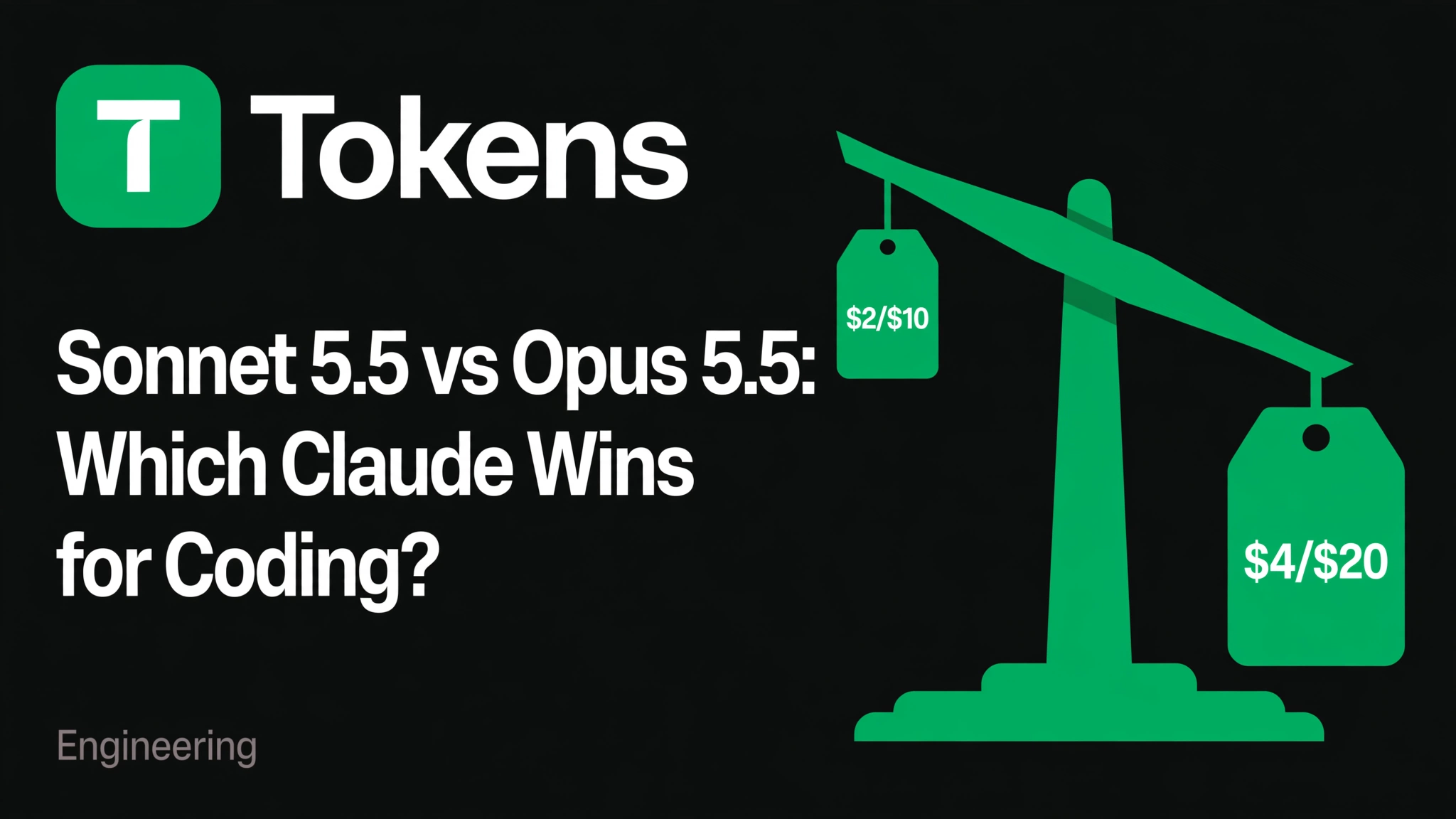
TL;DR: Claude Opus 5.5 costs exactly twice what Sonnet 5.5 does per token ($4/$20 vs $2/$10 per 1M), but on most coding and agentic benchmarks Sonnet 5.5 matches or beats Opus — including Terminal-Bench (70.6% vs 66.4%) and two office-work evals — at roughly 40% higher output speed. Opus 5.5 earns its 2x price only on hard reasoning (SWE-Bench Pro 89.9% vs 81.3%), long-horizon agents, and knowledge-heavy work. For everything else, Sonnet 5.5 first — and raise its effort level before you escalate models.
Claude Opus 5.5 and Claude Sonnet 5.5 shipped six days apart in September 2026 — Opus on September 22, Sonnet on September 28. They look like the same family, and in some ways they are: both have a 1M-token context window, 128K max output, a June 2026 knowledge cutoff, and adaptive thinking. But the price list says Opus is exactly twice the model: $4 per million input tokens and $20 per million output tokens, against Sonnet's $2 and $10.
Twice the price per token does not mean twice the bill. In coding, it often doesn't even mean a bigger bill for the smaller model — or a better result for the bigger one. This post puts both models' list prices, vendor benchmarks, and independent test numbers side by side, works out what a real agent session costs on each, and ends with a decision rule you can apply today.
The prices, side by side#
List prices from Anthropic's pricing page, USD per million tokens, checked 11 October 2026.
| Price per 1M tokens | Claude Sonnet 5.5 | Claude Opus 5.5 |
|---|---|---|
| Input | $2.00 | $4.00 |
| Output | $10.00 | $20.00 |
| Cache read | $0.20 | $0.20 |
| 5-minute cache write | $2.50 | $5.00 |
| 1-hour cache write | $4.00 | $8.00 |
| Batch input / output | $1.00 / $5.00 | $2.00 / $10.00 |
| Thinking | Adaptive (default high on API) | Adaptive, always on (default medium on API) |
| Median output speed | 127 tok/s | 91 tok/s |
| API model ID | claude-sonnet-5-5 | claude-opus-5-5 |
Three rows in that table deserve a second look.
Cache reads cost the same. Opus 5.5 reads its prompt cache at 5% of its input price instead of the usual 10%, which lands both models at $0.20 per million cached tokens. Coding agents re-read a long cached prefix on nearly every turn, and cached input is usually the biggest line on an agent bill — so for cache-heavy agentic loops, the Opus premium applies mainly to fresh input and output, not to the whole request. (Prompt caching explained walks through the math.)
Opus always thinks. Thinking can be reduced on Sonnet 5.5 (down to between_tools for fast simple calls), but on Opus 5.5 adaptive thinking cannot be disabled at all. Since reasoning tokens are billed at the output rate — the expensive side — there is a floor under every Opus request that Sonnet can duck under. See how thinking budgets are priced.
Opus is slower. Independent testing by Artificial Analysis measured median output speed at 127 tokens/second for Sonnet 5.5 against 91 for Opus 5.5 — roughly 40% faster for Sonnet, turn after turn. On long agent sessions that latency compounds, and you feel it.
On Tokens, the Anthropic option today is Sonnet 5.5 (anthropic/claude-sonnet-5-5) at $2.20 in / $11.00 out per million tokens — ৳275 / ৳1,375 in BDT, payable without an international card. Opus 5.5 is not in the 60+ model catalog (checked 11 October 2026; see the model list). Which turns out to matter less than you'd think.
What the benchmarks actually say#
Vendor-reported numbers from Anthropic's launch pages and system card (Sonnet 5.5 at max effort unless noted):
| Benchmark | Sonnet 5.5 | Opus 5.5 | Winner |
|---|---|---|---|
| Terminal-Bench 4.0 (agentic terminal tasks) | 70.6% | 66.4% | Sonnet |
| SWE-Bench Pro (hard software engineering) | 81.3% | 89.9% | Opus |
| SWE-Bench Multilingual | 90.3% | 93.9% | Opus |
| FrontierCode 1.1 | 46.2% | 54.4% | Opus |
| OSWorld 2.1 (computer use) | 80.1% | 81.8% | Opus (narrow) |
| GDPval-AA v2.1 (Elo) | 1844 | 1846 | Tie |
| HealthBench Professional | 69.2% | 65.6% | Sonnet |
| AutomationBench | 44.7% | 42.5% | Sonnet |
| Humanity's Last Exam (no tools) | 56.9% | 64.4% | Opus |
Independent testing tells a consistent story. On Artificial Analysis's Intelligence Index v4.3.2, Sonnet 5.5 scores 56.00 against Opus 5.5's 57.62 — just 1.6 points apart, with Sonnet second only to Opus on the whole board. Sonnet even led on AA's own Terminal-Bench run (64% vs 60%).
The pattern is clear: Opus 5.5 wins on hard reasoning and deep knowledge — SWE-Bench Pro by 8.6 points, FrontierCode by 8 points, knowledge questions without tools by 7.5 points. On everyday coding, terminal tasks, office work, and computer-use, Sonnet 5.5 is at parity or ahead, for half the per-token price.
The per-task cost trap#
Half the per-token price only becomes a cheaper bill if you compare the models at the same settings. Artificial Analysis's cost measurements are the ones to read twice:
- At high effort, a full Index task costs $1.12 on Sonnet 5.5 (46.75 points) against $1.82 on Opus 5.5 (53.58 points). Opus costs about 63% more per task and gains roughly 7 points.
- At max effort, the economics invert: Sonnet 5.5 costs $7.67 per task against Opus 5.5's $5.98 — the cheaper model becomes the pricier one. That's a verbosity effect: Sonnet at max effort burned about 193K output tokens per task against Opus's roughly 119K.
The lesson isn't "Opus is cheaper at max." It's that effort choice matters more than model choice. Dropping Sonnet 5.5 from max to high effort cut the per-task bill to a seventh for 83% of the score. Before escalating from Sonnet to Opus, try raising — or lowering — the effort dial on the model you're already on. The escalation ladder (cheap model, then more effort, then the frontier model) is described in our frontier-models guide.
Worked example: one coding session's bill#
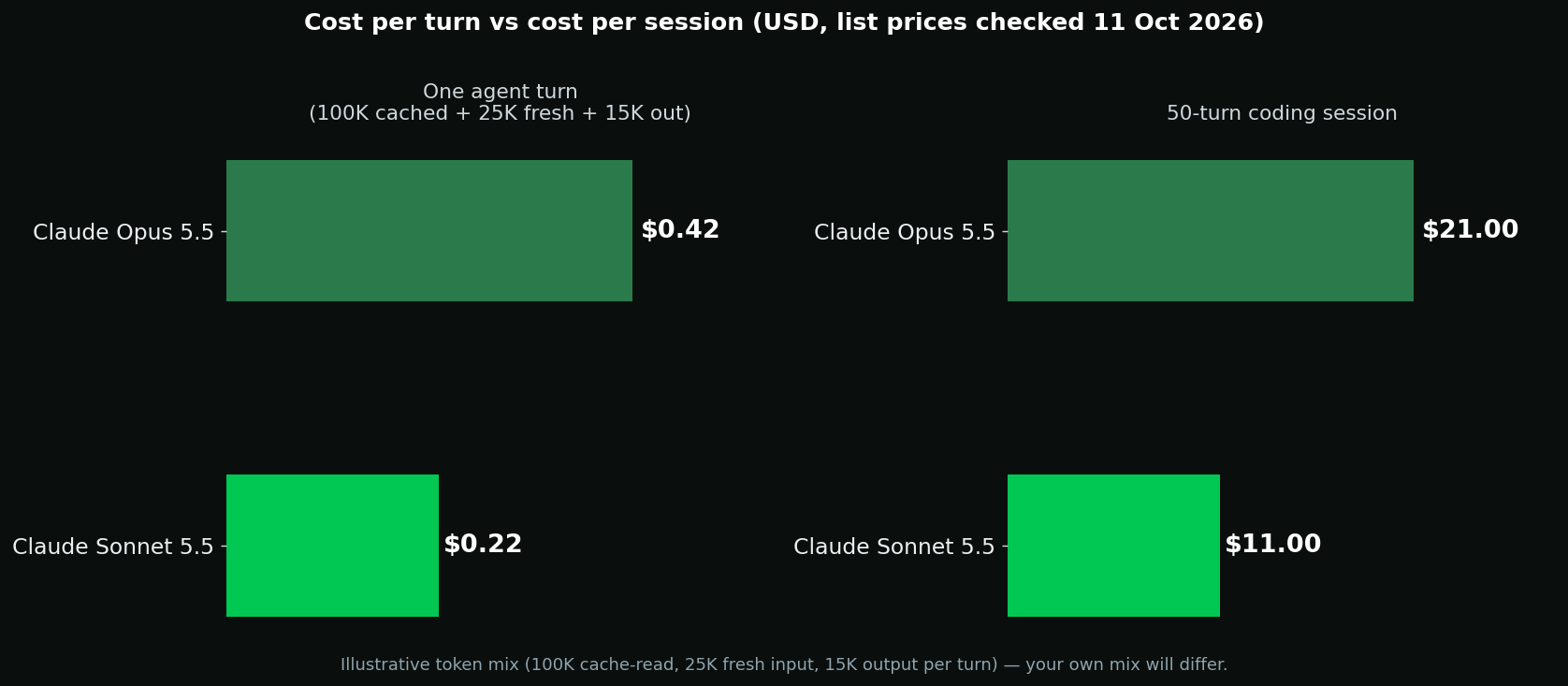
These are assumptions to show the arithmetic, not measurements — your token mix will differ. Take one agent turn: 100K cache-read input, 25K fresh input, 15K output.
- Sonnet 5.5: 100K × $0.20/M = $0.02, plus 25K × $2.00/M = $0.05, plus 15K × $10.00/M = $0.15 → $0.22 per turn
- Opus 5.5: $0.02, plus 25K × $4.00/M = $0.10, plus 15K × $20.00/M = $0.30 → $0.42 per turn
Over a 50-turn session: $11.00 on Sonnet vs $21.00 on Opus — Opus costs about 1.9×. Even if Sonnet needs 30% more turns to finish the same job (65 turns vs 50), Sonnet still wins: $14.30 against $21.00. Opus only bills less when it finishes a task in fewer than about 53% of the turns Sonnet needs — nearly twice as fast, with no retries.
To put your own numbers through this method, see how to estimate your monthly token bill. And whatever model you pick, put a ceiling on it — per-key spend caps exist for exactly this.
When Opus earns its 2x price — and when it doesn't#
| Use Opus 5.5 when… | Use Sonnet 5.5 when… |
|---|---|
| The task is hard reasoning: gnarly debugging, architecture decisions, security-sensitive changes (SWE-Bench Pro gap is 8.6 points) | It's everyday coding, bug fixes, refactors, tests |
| Long-horizon agentic work where sustained judgment matters | Latency matters — Sonnet outputs ~40% faster |
| Knowledge-heavy work without tools (HLE gap is 7.5 points) | Cache-heavy agent loops — cache reads cost the same on both |
| Failure is expensive and there's no cheap retry | You're running at scale and the bill compounds |
A practical routing rule: default every coding agent to Sonnet 5.5, and escalate only the tasks an objective check fails on — then decide whether raising Sonnet's effort level closes the gap before you reach for Opus. Most teams find that Opus earns its price on a small minority of turns, which is exactly why the escalation pattern exists: try cheap first, verify, escalate only what fails.
On Tokens, that default is straightforward: Sonnet 5.5 is in the catalog at $2.20/$11.00 per million tokens (৳275/৳1,375), called as anthropic/claude-sonnet-5-5 through the same OpenAI-compatible endpoint as everything else — see the model catalog and the docs.
Sonnet vs Opus FAQ#
Is Claude Opus 5.5 twice as good as Sonnet 5.5? No. It costs exactly twice per token, but on Artificial Analysis's Intelligence Index it scores 57.62 against Sonnet 5.5's 56.00 — 1.6 points apart — and Sonnet wins or ties on Terminal-Bench, HealthBench, AutomationBench, GDPval-AA, and OSWorld. Opus's real lead is concentrated in hard reasoning benchmarks like SWE-Bench Pro (89.9% vs 81.3%).
Which model is faster for coding agents? Sonnet 5.5. Independent testing measured median output speed at 127 tokens/second for Sonnet 5.5 versus 91 for Opus 5.5, and Sonnet's adaptive thinking can be dialed down for simple calls while Opus 5.5's cannot be disabled.
Can Sonnet 5.5 really be more expensive than Opus 5.5 per task? Yes — at max effort. Artificial Analysis measured $7.67 per Index task for Sonnet 5.5 at max effort versus $5.98 for Opus 5.5, because Sonnet generated about 60% more output tokens (193K vs ~119K). At high effort the economics flip back in Sonnet's favour: $1.12 vs $1.82 per task. Set effort deliberately.
Should I route simple tasks to Sonnet and hard ones to Opus automatically? That escalation pattern works well, with one addition: raise Sonnet's effort level before escalating to Opus. It's the middle rung between "cheap model" and "frontier model," and it keeps your prompt cache warm — caches are per model, so switching models pays full input price again.
Where can I call these models from Bangladesh without an international card?
Claude Sonnet 5.5 is on Tokens (anthropic/claude-sonnet-5-5, $2.20/$11.00 per 1M tokens) with BDT payment options — no foreign card needed. Opus 5.5 is not currently in the catalog.
List prices checked 11 October 2026. Promotional prices and model defaults change; the maker's page is the authority for list prices, and the model catalog for prices on Tokens.