
TL;DR: Google made Gemini 4 Argon (
gemini-4-argon) generally available on 13 October 2026 at an introductory price of $2/$10 per 1M input/output tokens with cached input 95% off at $0.10/1M. That price doubles to $4/$20 on December 1, 2026. It leads Google's published coding benchmarks on DeepSWE v1.1 (77.9%) but trails Claude Opus 5.5 on terminal coding and GPT-6 Astra on merge-readiness. The next six weeks are the cheapest frontier-model pricing on the market.
Google's first new frontier model in a while comes with a price tag that has an expiry date. Gemini 4 Argon launched to limited availability on September 30 — only vetted cyber defenders in Google's Fairwind Program could touch it — and went generally available on October 13, 2026. With general availability came the one detail enterprise buyers plan budgets around: the $2/$10 introductory price ends November 30. This post is the developer-practical version: what changed, what it actually costs in dollars and taka, how the benchmarks read, and whether switching makes sense.
What actually launched#
- Model ID:
gemini-4-argon, live in the paid Gemini API, Google AI Studio, Antigravity (Ultra plan), Gemini Enterprise, the Gemini app (Pro/Ultra subscribers), Android Studio (Canary), and Firebase AI Logic. It is not on the API's free tier. - What it is: a newly trained sparse mixture-of-experts model (knowledge cutoff March 2026), positioned for "deep work" — long-horizon coding, finance, legal analysis, cybersecurity, and science.
- New engineering detail: the API output limit jumps to 1 million tokens, up from 64K.
- Watch out: output billing includes thinking tokens — the model's internal reasoning is charged at the $10/$20 output rate. If you've read our reasoning-effort guide, the same rule applies here: invisible tokens bill at the expensive rate. For the mechanics of how prefix caching cuts that input bill, see prompt caching explained.
The price deadline, in full#
Google's published pricing (checked 16 October 2026, USD per 1M tokens):
| Tier | Input | Output | Cached input | From Dec 1 |
|---|---|---|---|---|
| Standard | $2.00 | $10.00 | $0.10 | $4.00 / $20.00 / $0.20 |
| Batch & Flex | $1.00 | $5.00 | $0.05 | $2.00 / $10.00 / $0.10 |
| Priority | $3.60 | $18.00 | $0.18 | $7.20 / $36.00 / $0.36 |
Three things to note. First, the 95% cached-input discount is unusually generous and matters a lot for agentic workflows that re-read context — cache economics are doing half the work in this pricing story. Second, Batch and Flex trade speed for half price, which is a genuine option for overnight evaluation sweeps. Third, this is the standard rate; Google subscriptions and API usage bill separately.
How the price stacks up against rivals#
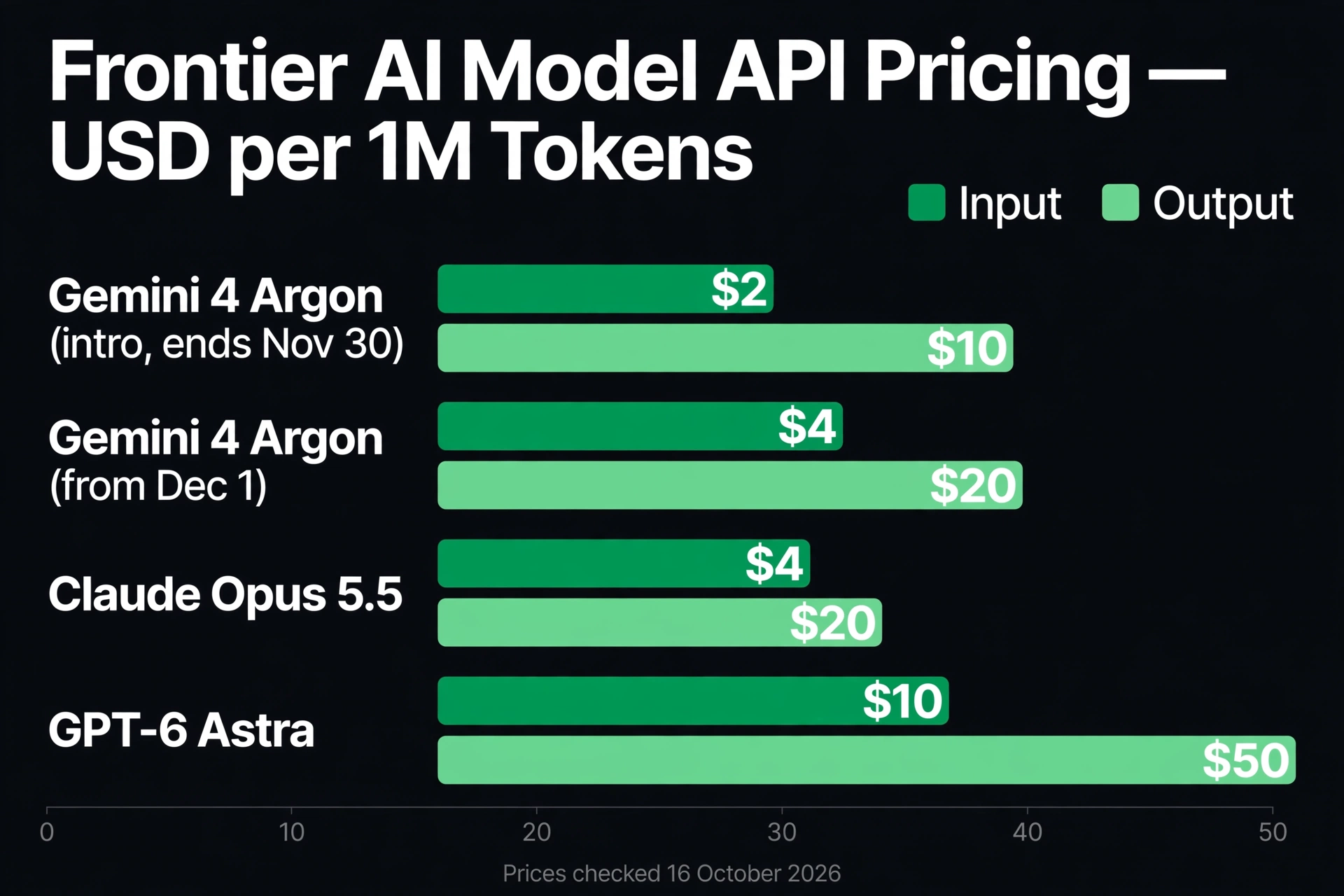
Published list prices, checked 16 October 2026:
| Model | Input / 1M | Output / 1M | vs Argon intro |
|---|---|---|---|
| Gemini 4 Argon (intro, to Nov 30) | $2.00 | $10.00 | — |
| Gemini 4 Argon (from Dec 1) | $4.00 | $20.00 | 2× more |
| Claude Sonnet 5.5 | $2.00 | $10.00 | Same price |
| GPT-6.1 Sol | $2.00 | $10.00 | Same price |
| Claude Opus 5.5 | $4.00 | $20.00 | Same as Argon from Dec 1 |
| Meta Muse Wonder | $4.00 | $20.00 | Same as Argon from Dec 1 |
| GPT-6 Astra | $10.00 | $50.00 | 5× more |
The framing that matters: through November 30, Argon is priced at the mid-frontier tier ($2/$10, same as Sonnet 5.5 and GPT-6.1 Sol). From December 1 it moves to the top-frontier tier ($4/$20, same as Opus 5.5). So the question isn't "is Argon cheap" — it's "is Argon as good as Opus 5.5, because that's what you'll pay for it in six weeks?"
The benchmarks: where it leads, where it doesn't#
Google's published results (model card, October 2026) against its two closest frontier rivals:
| Benchmark | Gemini 4 Argon | GPT-6 Astra | Claude Opus 5.5 |
|---|---|---|---|
| DeepSWE v1.1 (long-horizon coding) | 77.9% | 74.1% | 74.2% |
| Vals Index (professional work) | 68.9% | 63.1% | 67.0% |
| AutomationBench | 51.3% | 41.4% | 42.5% |
| Vibe Code Bench | 91.9% | 89.6% | 90.3% |
| CWE-Bench v1 (security) | 68.0% | 68.0% | 67.0% |
| Terminal-Bench 4.0 | 57.4% | 58.2% | 66.4% |
| FrontierSWE v2 (would-it-merge) | 55.0% | 65.5% | 62.3% |
| GraphWalks (256K–1M long context) | 84.2% | 71.8% | 66.8% |
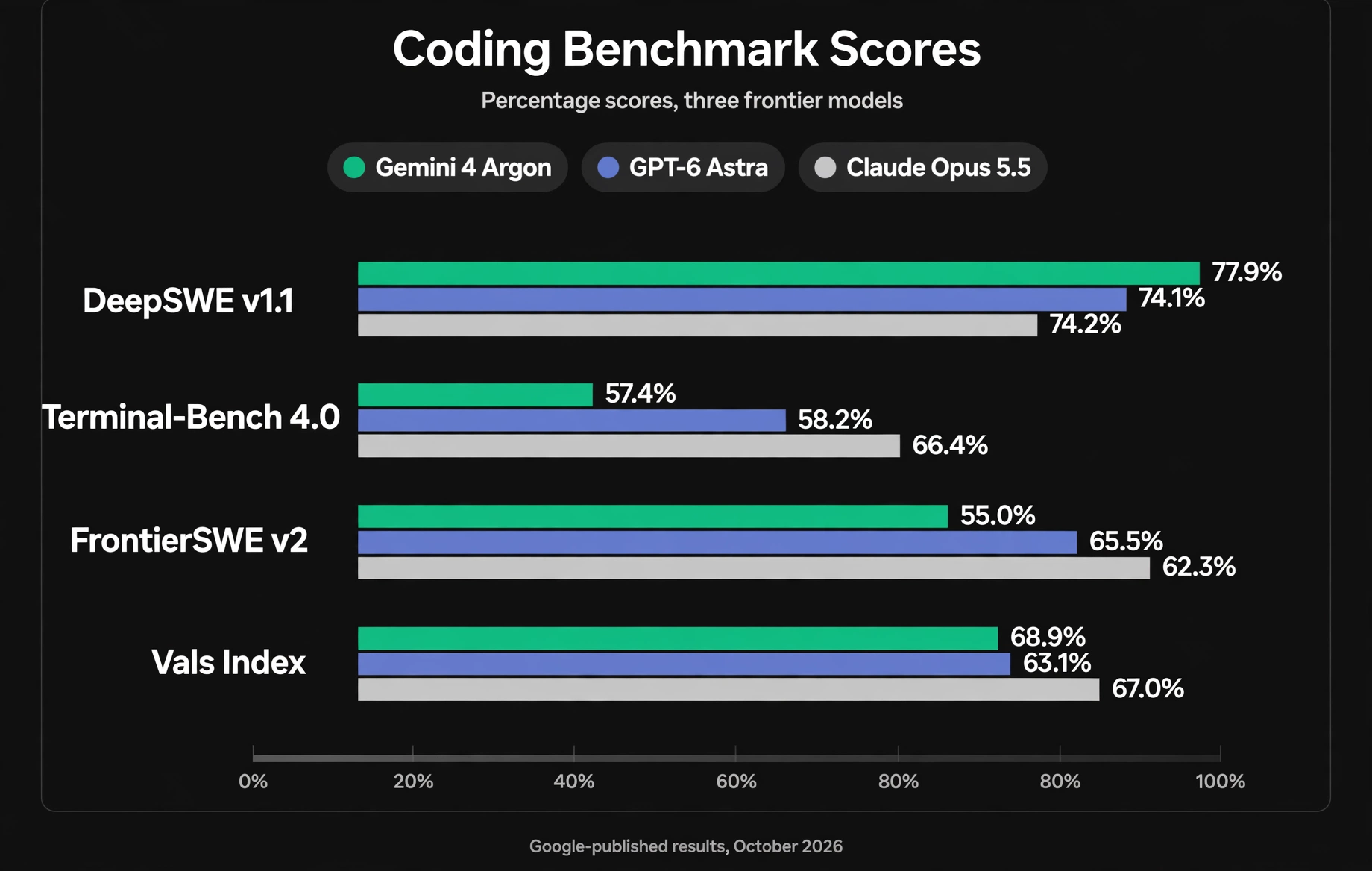
Read one row at a time, because the story splits. Argon leads the long-horizon and long-context rows — DeepSWE, Vals Index, AutomationBench, and a widening GraphWalks lead as context grows (99.7% at 128K, 84.2% at 256K–1M). It loses the two most terminal-adjacent coding benches: Opus 5.5 takes Terminal-Bench by nine points, Astra takes FrontierSWE's "would this merge" judgment by ten. And the independent checks are mixed: Artificial Analysis scores Argon 53 on its Intelligence Index, at a per-task cost of $1.99 at intro pricing ($3.98 at standard) — cheaper than Sonnet 5.5's ~$7.60 per task. Google's DeepSWE number hasn't been independently reproduced yet, so treat the headline 77.9% as vendor-reported until third-party runs land.
The real cost in taka: a worked session#
Take a realistic agent session — 1M fresh input tokens and 200K output tokens (including thinking), exchange rate 1 USD ≈ ৳123.05 (checked 16 October 2026):
| Intro (to Nov 30) | From Dec 1 | Claude Opus 5.5 | GPT-6 Astra | |
|---|---|---|---|---|
| Input: 1.0M | $2.00 | $4.00 | $4.00 | $10.00 |
| Output: 0.2M | $2.00 | $4.00 | $4.00 | $10.00 |
| Session total | $4.00 ≈ ৳492 | $8.00 ≈ ৳984 | $8.00 ≈ ৳984 | $20.00 ≈ ৳2,461 |
Arithmetic check: intro 1.0 × $2.00 = $2.00; 0.2 × $10.00 = $2.00; total $4.00; $4.00 × 123.05 = ৳492.20 ≈ ৳492. Dec 1: $8.00 × 123.05 = ৳984.40 ≈ ৳984. Astra: $20.00 × 123.05 = ৳2,461.00 = ৳2,461.
One session at intro pricing costs a fifth of the same session on GPT-6 Astra — ৳1,969 less per heavy session. And with the 95% cache discount, a 900K-cached/100K-fresh input split costs $0.29 for the input side (0.9 × $0.10 = $0.09 + 0.1 × $2.00 = $0.20) instead of $2.00. If your agent re-reads context heavily, caching does as much for the bill as the intro price does.
Should you switch?#
Honest answer: run a six-week experiment, don't migrate yet.
- Benchmark it on your tasks, not Google's. The benches where Argon shines (long-horizon planning, huge contexts) and where it lags (terminal commands, merge judgment) are different skills. Pick three representative tasks from your own workflow and run Argon against your current model.
- Watch output tokens, not just input. Thinking bills at the output rate, and frontier models with deep reasoning burn output fast. Track tokens-per-task, not just task success.
- Use the cache. The 95% cached-input discount is the quiet half of the value proposition; prefix-stable agent loops will see it, one-shot prompts won't.
- Decide before December 1. If your own benchmarks justify Argon, the six-week window is the cheapest evaluation you'll get. After that, you're paying Opus 5.5 prices — so the bar is Opus 5.5 quality, not intro-price generosity.
- Check the catalog. Gemini 4 Argon was not yet listed on the tokens.bd model catalog as of 16 October 2026 (Google entries are 3.7/3.8 Flash only). If it lands there, Bangladesh developers get it with BDT billing via bKash/Nagad instead of an international card — check /models for availability.
Gemini 4 Argon FAQ#
When does Gemini 4 Argon's introductory price end? November 30, 2026. From December 1, 2026 the standard price doubles from $2/$10 to $4/$20 per 1M input/output tokens, with cached input rising from $0.10 to $0.20. Batch/Flex and Priority tiers double proportionally.
Is Gemini 4 Argon cheaper than Claude Opus 5.5? Through November 30, yes — $2/$10 vs $4/$20, half the price. From December 1 they cost the same, so the longer-term comparison is quality vs Opus 5.5, not price.
How does Gemini 4 Argon compare to GPT-6 Astra for coding? Mixed, by Google's own published numbers: Argon leads DeepSWE v1.1 (77.9% vs 74.1%) and long-context tests, while Astra leads FrontierSWE v2 (65.5% vs 55.0%) and they tie on CWE-Bench v1 (68.0%). Independent third-party reproductions are still pending.
What is the model ID for the Gemini 4 Argon API?
gemini-4-argon. It's available through the paid Gemini API and AI Studio — not the free tier.
Does Gemini 4 Argon's price include thinking tokens? Thinking tokens are billed at the output rate ($10/1M intro, $20/1M standard), so heavy-reasoning tasks cost more than the input/output headline split suggests. The 1M-token output limit means one response can now carry a very large thinking trace.
Prices checked 16 October 2026. Introductory pricing ends 30 November 2026; Google's pricing page is the authority for list prices.
Sources: VentureBeat (Gemini 4 Argon broadly available, https://venturebeat.com/technology/google-makes-gemini-4-argon-broadly-available-with-limited-time-low-api-pricing-of-2-10-per-1m-token) · The Rundown (Argon pricing and free plan, https://www.therundown.ai/tools/gemini-4-argon) · InnoAI (Argon features, benchmarks, pricing, https://innoai.cc/gemini-4-argon-features-benchmarks-pricing/) · R&D World (independent benchmark roundup, https://www.rdworldonline.com/googles-overdue-gemini-4-argon-reaches-the-frontier-with-mixed-results-for-science/) · memeburn (Argon vs Sonnet 5.5 independent tests, https://memeburn.com/gemini-4-argon-vs-claude-sonnet-5-5/)