Updated 7 November 2026: three weeks after launch. DeepSeek's API price is unchanged. Independent tests now exist — Vals.ai scores 1017 at 31.8% on Terminal-Bench 4.0 against DeepSeek's 42.3% claim, while confirming the upgrade over the September build. MiniMax M3.1 Flash and Kimi K3.1 Pro have launched since, and tokens.bd now lists the 1017 checkpoint as its own entry at $0.30/$0.80 per 1M tokens. The original 18 October analysis follows, updated throughout.
TL;DR: DeepSeek released DeepSeek-V4.1-Flash-1017 on 17 October 2026 at unchanged prices — $0.15/$0.60 per 1M tokens off-peak on its own API, $0.30/$0.80 on tokens.bd's dedicated 1017 entry. Three weeks on, independent testing exists: Vals.ai measures 31.8% on Terminal-Bench 4.0 versus DeepSeek's 42.3% claim, but the same harness scores the September build at 19.7% — so the roughly +12-point upgrade is real even if the headline is inflated. Two rivals launched since: MiniMax M3.1 Flash matches 1017's price exactly, and Kimi K3.1 Pro costs $2/$10 list with a much higher independent score. For long-context agent sessions with warm caches, 1017 is still the cheap default to beat — but route on your own evals, not the vendor table.
DeepSeek had a busy week in mid-October. First a roughly five-hour outage knocked its servers offline, then on Saturday 17 October it pushed out DeepSeek-V4.1-Flash-1017, described in its own technical notes as "a minor update to DeepSeek-V4.1-Flash, delivering substantial improvements across reasoning, coding, agentic tasks, and visual benchmarks" — plus shorter outputs and faster task completion. Reuters picked up the release the same day.
What shipped on 17 October#
The concrete facts, all from DeepSeek's own release materials and Reuters' coverage:
- New checkpoint, same API name. The update ships under DeepSeek's existing
deepseek-flashAPI model name — there is no new model ID to migrate to, and DeepSeek made no change to its API prices. If your code already callsdeepseek-flash, the 1017 checkpoint is what answers now. - MIT-licensed weights on Hugging Face. The full weights are downloadable under the MIT license (about 510 GB), so you can self-host or fine-tune. The model card is at
deepseek-ai/DeepSeek-V4.1-Flash-1017. - Same architecture, tuned harder. 552B-parameter sparse mixture-of-experts, 8B active parameters on input and 16B on output, 1,048,576-token context window, roughly 384K max output. The headline engineering number is the compressed KV cache: about 890 bytes per token, so a full 1M-token context needs under 1 GB of GPU cache memory.
- Faster and shorter by design. DeepSeek says the checkpoint reduces task execution time and output length — both of which cut the bill directly, since output tokens are the expensive side. DeepSeek also published a rate card for new Search and Fetch APIs at $0.75 per 1,000 successful requests — a separate retrieval product; billing started 1 November 2026.
What changed: the benchmark table#
DeepSeek published scores for the 1017 checkpoint against the previous V4.1-Flash across eleven benchmarks, all run in harnesses DeepSeek names (Claude Code for Terminal-Bench 4.0, Mini-SWE-V2 for DeepSWE v1.1). These are DeepSeek's own numbers — and, as the next section shows, independent testing now exists to check them against.
| Benchmark | 1017 | V4.1-Flash | Gain |
|---|---|---|---|
| Terminal-Bench 4.0 | 42.3 | 31.2 | +11.1 (+36%) |
| ProgramBench | 29.1 | 20.3 | +8.8 (+43%) |
| Apex Bench v1.1 | 72.1 | 64.6 | +7.5 |
| HLE (no tools) | 42.6 | 36.8 | +5.8 |
| Automation-Bench v1.0.6 | 60.5 | 54.8 | +5.7 |
| Chartography (with tools) | 83.0 | 78.9 | +4.1 |
| Agents' Last Exam | 35.4 | 31.8 | +3.6 |
| BabyVision (with tools) | 92.5 | 89.6 | +2.9 |
| DeepSWE v1.1 | 77.0 | 74.2 | +2.8 |
| NL2Repo-Bench | 68.2 | 65.4 | +2.8 |
| ZeroBench-main (with tools) | 51.0 | 49.0 | +2.0 |
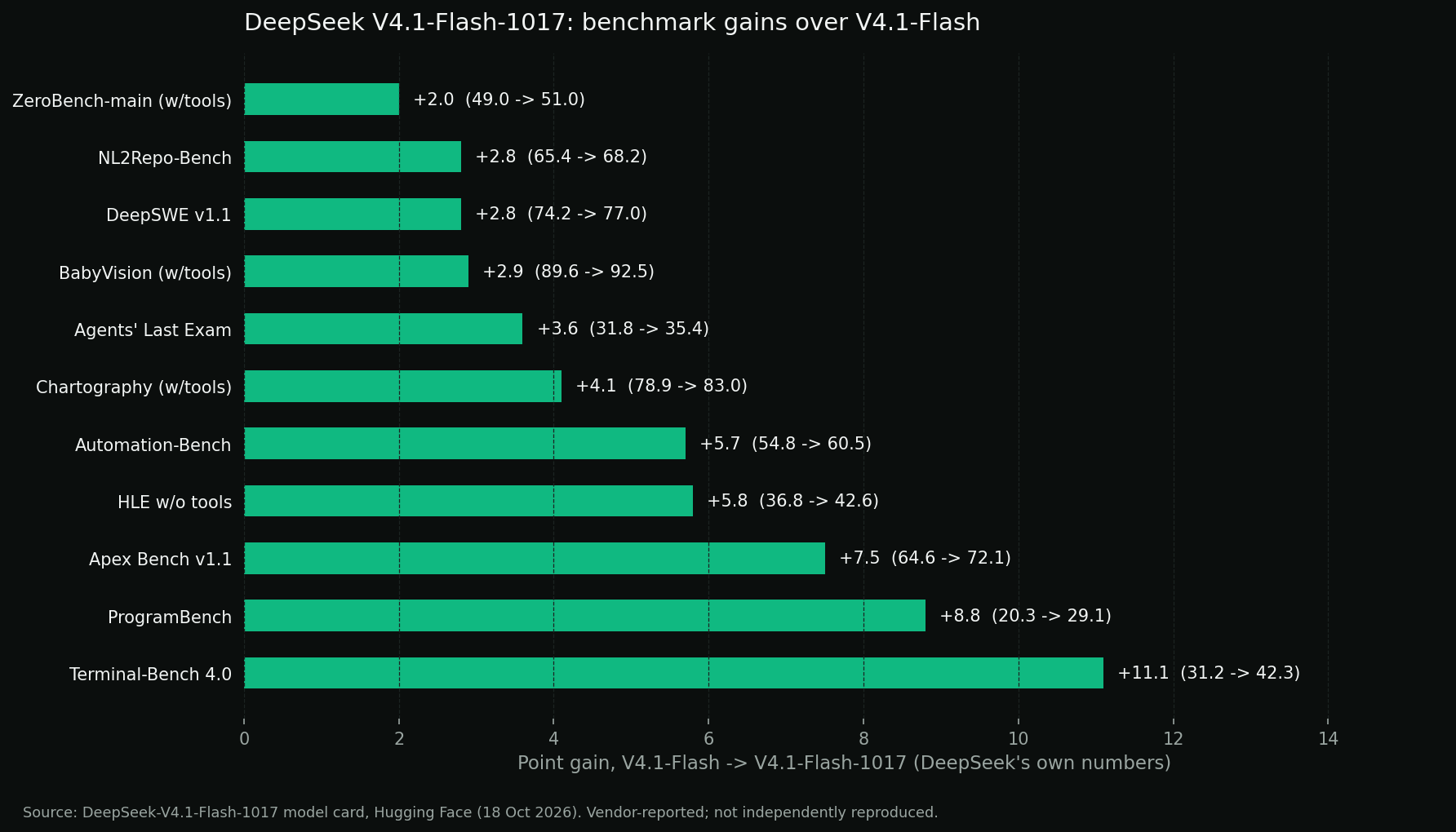
Two results matter most. On DeepSWE v1.1 the checkpoint scores 77.0 — ahead of Opus 5 (74.0) and GPT-5.6 Sol (73.0) on DeepSeek's table — and it beats Kimi K3 on 10 of 11 tests and GPT-5.6 Sol on 9 of 11.
Do the independent scores back DeepSeek's claims?#
Short answer: the upgrade is real, the headline number is inflated. Three weeks after launch, independent evaluators have now run the checkpoint — and the most important check is Vals.ai's Terminal-Bench 4.0 reproduction, updated 29 October 2026.
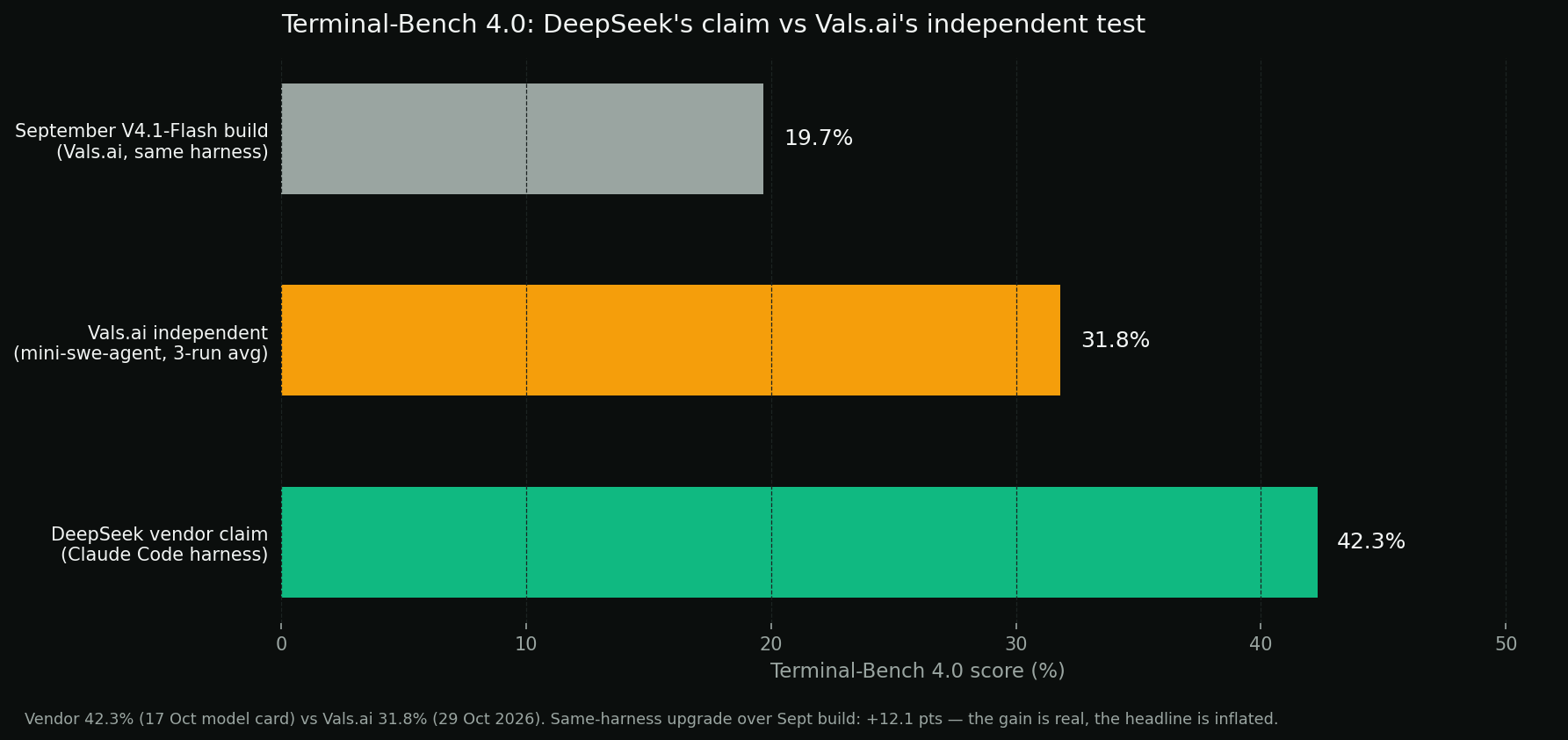
Vals.ai ran the same 66 Terminal-Bench 4.0 tasks with the mini-swe-agent harness, averaged over three runs. It scored 1017 at 31.82% (±2.62) — a full 10.5 points below DeepSeek's 42.3% claim, far outside the margin of error. The gap is specific to DeepSeek's own models: Vals found DeepSeek's published Opus 5, GPT-5.6 Sol and GLM-5.3 figures within about 2 points of its own measurements, so the difference is the harness (DeepSeek used Claude Code), not a general measurement error.
But here is the part that matters for your routing decision: on the same Vals harness, the September build of V4.1-Flash scored 19.70%. The 1017 checkpoint's 31.82% is a +12.1-point improvement on identical ground — almost exactly the +11.1-point gain DeepSeek claimed. The vendor's absolute number is inflated; the vendor's delta is confirmed. If you upgraded from the September build, your agents genuinely got better. If you were choosing between 1017 and a frontier model on the strength of "42.3%", that comparison was never real. The rest of the independent picture, checked 7 November 2026:
- Artificial Analysis Intelligence Index: 45 (version 4.3.2, max effort), up from 39 for the September build. For scale: MiniMax M3.1 Flash sits at 42–43 and Kimi K3.1 Pro at 55. (Artificial Analysis has since rescored under Index v5.0, where 1017 is 32.6 — never mix the two versions in one table.)
- Vals.ai Vibe Code Bench v1.1: 87.73% (±2.75), rank 11 of 119, at $0.58 per test — against MiniMax M3.1 Flash at 73.94% and $1.15 per test.
- LMArena Code Arena: WebDev Elo 1665 (snapshot 22 October 2026, 923,854 votes), ahead of MiniMax M3.1 Flash at 1589.
- Offensive cyber (Vals.ai, first finding, 20 October): 1017 completed 16.3 of 21 objectives on a three-run average, ahead of GPT-6 Sol Daybreak at 15.7 and Grok 4.7 at 12. Vals calls this a first finding with the full evaluation still to come, so treat it as a signal, not a settled benchmark.
The honest summary: 1017 is a genuinely better model than the September Flash — every independent signal agrees on the direction — but a mid-tier coding model with a strong price, not the near-frontier model the vendor table implied.
The rivals that launched since 17 October#
1017 had the cheap tier almost to itself for about 48 hours. Then two models arrived that change the comparison, and a third arrived that does not compete on price at all.
MiniMax M3.1 Flash went generally available on 19 October at exactly 1017's price: $0.15/$0.60 per 1M tokens, $0.015 cache reads, flat at any context length. On MiniMax's own numbers it edges 1017 on Automation-Bench (62.2% vs 60.5%) and trails on DeepSWE (73.7% vs 77.0%). On independent numbers the gap flips: Artificial Analysis puts M3.1 Flash at 42–43 against 1017's 45, and Vals' Vibe Code Bench has 1017 ahead by nearly 14 points at half the per-test cost. Its open weights shipped on 23 October (~252 GB) under the MiniMax Community License — open weights, not open source: commercial use needs attribution, and businesses over $20M annual revenue need MiniMax's written authorization. See the full M3.1 Flash guide.
Kimi K3.1 Pro launched 23 October and is the first cheap-tier rival that is genuinely frontier-adjacent: $2.00/$10.00 per 1M tokens on Moonshot's list (cached input $0.20), Terminal-Bench 4.0 at 65.7% on Moonshot's numbers, and Artificial Analysis Intelligence Index 55 — fourth overall. Its open weights shipped on 4 November as promised: 96 shards, 1.56 TB, under a custom Kimi licence (model-as-a-service businesses over $20M revenue in any 12 months need a separate Moonshot agreement). Note the price carefully: $3.00/$12.00 is tokens.bd's selling price for K3.1 Pro, not Moonshot's list price. See the Kimi K3.1 Pro open-weights guide.
GPT-6 Cyber launched 5 November and is not a rival in the usual sense: $20/$100 per 1M tokens, gated behind Daybreak Red membership plus a separate model approval, and rated Critical under OpenAI's Preparedness Framework. Its vendor-reported 48.5% on ExploitGym is a specialist number for authorised vulnerability discovery, not general coding. See the GPT-6 Cyber breakdown.
| Model | List in / out per 1M | Context | Headline benchmark (source) | Weights |
|---|---|---|---|---|
| DeepSeek V4.1-Flash-1017 | $0.15 / $0.60 | 1M | DeepSWE 77.0 (vendor); AA Index 45 | MIT, ~510 GB |
| MiniMax M3.1 Flash | $0.15 / $0.60 | 1M | Automation-Bench 62.2% (vendor); AA Index 42–43 | Community licence, ~252 GB |
| Kimi K3.1 Pro | $2.00 / $10.00 | 1M | Terminal-Bench 65.7% (vendor); AA Index 55 | Custom Kimi licence, 1.56 TB |
| GPT-6.1 Terra | $1.00 / $5.00 | 1.05M | Computer use; AA Index n/a | Closed |
| GPT-6 Cyber | $20.00 / $100.00 | 1.05M | ExploitGym 48.5% (vendor) | Closed, gated |
What it costs#
DeepSeek kept the price exactly where V4.1-Flash was. Per-million-token API prices, checked 7 November 2026:
| Route | Input / 1M | Output / 1M | Cache read / 1M |
|---|---|---|---|
| DeepSeek API, off-peak | $0.15 | $0.60 | $0.003 |
| DeepSeek API, peak (2x) | $0.30 | $1.20 | $0.006 |
| tokens.bd (DeepSeek V4.1 Flash 1017 entry) | $0.30 | $0.80 | — |
| tokens.bd (DeepSeek V4.1 Flash) | $0.24 | $0.86 | — |
| MiniMax M3.1 Flash (list) | $0.15 | $0.60 | $0.015 |
| GPT-6 Luna (list) | $0.10 | $0.50 | $0.01 |
| Claude Haiku 5.5 (list, under 100K) | $0.10 | $0.50 | $0.01 |
| GPT-6.1 Terra (list) | $1.00 | $5.00 | $0.05 |
| Claude Sonnet 5.5 (list) | $2.00 | $10.00 | $0.10 |
| Kimi K3.1 Pro (list) | $2.00 | $10.00 | $0.20 |
| Kimi K3 (list) | $3.00 | $15.00 | $0.30 |
| GPT-6 Cyber (list) | $20.00 | $100.00 | $2.00 |
Three pricing details that decide real bills:
- Peak hours are Dhaka daytime. DeepSeek doubles every rate during 01:00–04:00 and 06:00–10:00 UTC on weekdays — that is 07:00–10:00 and 12:00–16:00 in Dhaka. Batch work that can wait for the evening or night runs at half price automatically. Weekends and Chinese public holidays are off-peak all day.
- Cache reads are the real story. At $0.003 per million off-peak, a cache hit costs 50x less than a cache miss ($0.15). For agents that carry a warm repository context across turns, the cache rate decides the bill more than the input rate — see prompt caching explained for the mechanics.
- No context cliff — and the cliffs that do exist. Haiku 5.5 and GPT-6 Luna match or beat Flash on raw per-token price, but Haiku jumps 5x past 100K prompt tokens ($0.50/$2.50 on the whole request) and Luna doubles past 272K ($0.20/$0.75). GPT-6.1 Terra has the same 272K cliff ($2.00/$7.50). Flash holds its rate all the way to 1M tokens — full breakdown in our $0.10/1M showdown.
The same session on every cheap model#
One agent session — 200K input tokens, 20K output — at the prices above:
| Model | Session cost (USD) | Session cost (BDT) |
|---|---|---|
| GPT-6 Luna (list) | $0.030 | ~৳3.7 |
| DeepSeek 1017, off-peak | $0.042 | ~৳5.2 |
| MiniMax M3.1 Flash (list) | $0.042 | ~৳5.2 |
| DeepSeek V4.1 Flash, tokens.bd | $0.065 | ~৳8.1 |
| DeepSeek V4.1 Flash 1017, tokens.bd | $0.076 | ~৳9.5 |
| DeepSeek 1017, peak | $0.084 | ~৳10.5 |
| Claude Haiku 5.5 (past 100K cliff) | $0.150 | ~৳18.7 |
| GPT-6.1 Terra (list) | $0.300 | ~৳37.4 |
| Claude Sonnet 5.5 (list) | $0.600 | ~৳74.7 |
| Kimi K3.1 Pro (list) | $0.600 | ~৳74.7 |
| Kimi K3 (list) | $0.900 | ~৳112.1 |
| GPT-6 Cyber (list) | $6.000 | ~৳747.2 |
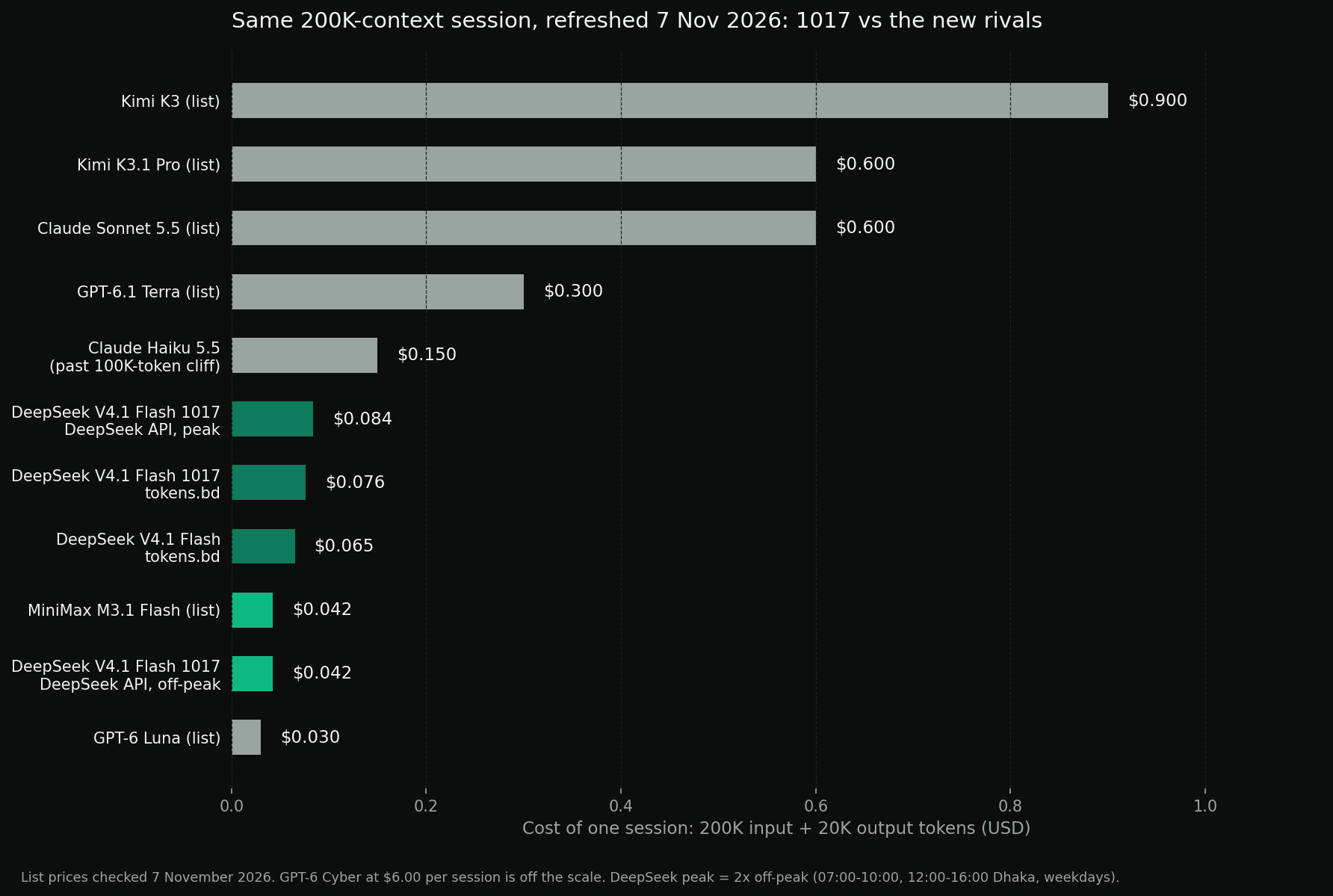
BDT figures use ৳124.54 per USD (mid-market rate, 7 November 2026), up from ৳123.20 on 18 October. On tokens.bd the taka price on each model page is set by the platform, not converted at checkout — the ৳ number you see is the number you pay, with no international card needed.
Scale it to a month of daily agent work (1M input + 60K output per workday, 20 days): DeepSeek off-peak and MiniMax M3.1 Flash both come to about $3.72/month (~৳463); GPT-6 Luna about $2.60/month (~৳324); the tokens.bd 1017 entry about $6.96/month (~৳867); Kimi K3.1 Pro at list about $52/month (~৳6,476); Kimi K3 about $78/month (~৳9,714).
Reliability and the fine print, three weeks on#
Outages. The 15 October outage lasted 4 hours 52 minutes per DeepSeek's status page; DeepSeek compensated affected users with a credit refund of 8–14 October API spend. Then on 3 November, web chat plus the V4 Pro and V4.1 Flash APIs were partially disrupted from about 08:58 UTC — DeepSeek listed all three as investigating, and user-report trackers put elevated reports at roughly three and a half hours, though DeepSeek itself has not confirmed a duration. The status page's July–October uptime for the V4.1 Flash API is 99.47%. The cheapest API is still not the most reliable one, so keep a fallback chain configured. No outage has been recorded 4–7 November.
Search and Fetch billing. The two retrieval APIs that launched alongside 1017 are now billed: $0.75 per 1,000 successful requests each, from 1 November 2026. They were free through October — so if you built a retrieval loop on them during the free window, check your November invoice.
The US federal ban. On 20 October the US Department of Homeland Security published FASCSA Order #2026-01, ordering federal civilian agencies to remove DeepSeek products — including third-party products built on DeepSeek — from their IT systems. Private companies are not directly covered. If you sell to US federal customers, that is a compliance conversation to have now.
One positive: DeepSeek open-sourced DeepInfer, the inference framework that powers V4.1-Flash in production, on 20 October under Apache 2.0. No new checkpoint has shipped since 1017 — V4.1 Pro is still in training, so 1017 remains the current Flash.
Should you switch?#
If you already call deepseek-flash: you already switched. The 1017 checkpoint serves under the same API name at the same price — this release is a free upgrade, not a migration. The independent scores confirm the upgrade is real; verify with one eval run on your own tasks, since vendor benchmarks are a starting signal, not proof.
If you run agents on Haiku 5.5 or GPT-6 Luna for cost reasons: Luna still wins the shortest sessions on raw price ($0.030 vs $0.042). But the moment your context crosses 100K tokens, Haiku's 5x cliff makes Flash roughly 3x cheaper per session — with a 1M context window and $0.003 cache reads behind it.
If you are choosing between 1017 and MiniMax M3.1 Flash: they cost exactly the same, so decide on evidence, not price. Independent scores favour 1017 on coding (AA Index 45 vs 42–43, Vibe Code Bench 87.7% vs 73.9%), while MiniMax's own table favours M3.1 Flash on automation (62.2% vs 60.5%). Run both on your own tasks for a week — the difference is small enough that your workload, not the leaderboard, should decide.
If you run Kimi K3 or Sonnet 5.5 as your workhorse: 1017 does not replace them on raw capability — and the new Kimi K3.1 Pro at $2/$10 list is now the obvious middle rung: frontier-adjacent scores (AA Index 55, Terminal-Bench 65.7%) at a third less than Kimi K3's list price. Route routine and medium-difficulty agent turns to 1017 first, escalate to K3.1 Pro when an objective check fails, and keep the frontier model for the turns where failure is expensive.
If you self-host: the MIT weights are still the story. 510 GB of weights is not a laptop project, but the 890-bytes-per-token KV cache makes 1M-context serving dramatically cheaper in GPU memory than the previous generation. For teams already serving open weights, this checkpoint is worth an eval slot — and note the licence contrast: MiniMax's and Kimi's weights ship under custom community licences with revenue conditions, while DeepSeek's are MIT.
Calling it#
Nothing changes in your code if you already use the Flash alias. For a fresh integration through tokens.bd's OpenAI-compatible endpoint, pin the checkpoint by name:
from openai import OpenAI

client = OpenAI(
    base_url="https://tokens.bd/v1",  # OpenAI-compatible; pay in BDT
    api_key="YOUR_TOKENS_BD_KEY",
)

resp = client.chat.completions.create(
    model="deepseek-ai/deepseek-v4.1-flash-1017",  # $0.30 in / $0.80 out per 1M on tokens.bd
    messages=[{"role": "user", "content": "Review this diff for race conditions..."}],
)
print(resp.choices[0].message.content)
The older deepseek/deepseek-v4.1-flash entry ($0.24 in / $0.86 out per 1M on tokens.bd) is still listed. Direct from DeepSeek, it is base_url="https://api.deepseek.com/v1" with model="deepseek-flash" — off-peak hours (outside 07:00–10:00 and 12:00–16:00 Dhaka on weekdays) halve the rate automatically. The full catalog is on the models page.
DeepSeek V4.1-Flash-1017 FAQ#
Do I need to change my model ID to get the 1017 checkpoint?
No. DeepSeek serves it under the existing deepseek-flash API name at unchanged prices. On tokens.bd, the DeepSeek V4.1 Flash 1017 entry tracks the checkpoint by name. If you pinned an older dated snapshot ID, update it; otherwise you are already running 1017.
Is 1017 still the best cheap coding model after MiniMax M3.1 Flash and Kimi K3.1 Pro? For long-context agent work at the lowest price, yes — 1017 and M3.1 Flash cost exactly the same ($0.15/$0.60 list), and independent scores favour 1017 on coding (AA Index 45 vs 42–43; Vibe Code Bench 87.7% vs 73.9%). Kimi K3.1 Pro is a different tier: much stronger (AA Index 55) at $2/$10 list, so it is the escalation target, not the cheap default. Test both cheap models on your own tasks before committing.
Can I trust the benchmark gains? The direction, yes; the exact margins, no. Vals.ai's independent Terminal-Bench 4.0 run scores 1017 at 31.82% against DeepSeek's 42.3% claim — but the same harness scores the September build at 19.70%, confirming the roughly +12-point upgrade DeepSeek claimed. Treat vendor tables as directional and independent reproductions as the check.
What does it cost in taka? At ৳124.54 per USD (7 November 2026): a 200K-input/20K-output agent session costs roughly ৳5.2 off-peak on DeepSeek's API, ৳10.5 at peak, and ৳9.5 via tokens.bd's 1017 entry. A month of daily agent work (1M + 60K tokens per workday) runs about ৳463 on the off-peak rate. On tokens.bd the listed taka price is fixed — no FX drift, no card markup.
Should I self-host the MIT weights instead of using the API? Only if you already serve open-weight models — the weights are ~510 GB. For everyone else, the API (or tokens.bd with BDT billing) is cheaper than the hardware. Note the licence contrast: DeepSeek's weights are MIT, while MiniMax M3.1 Flash and Kimi K3.1 Pro ship under custom community licences with revenue conditions.
API prices checked 7 November 2026; tokens.bd catalog checked the same day. Benchmark figures are DeepSeek's own unless marked independent, from the 17 October 2026 model card; independent figures are Vals.ai (29 October 2026), Artificial Analysis (Index v4.3.2) and LMArena (22 October 2026). Promotional prices and checkpoints change; the provider's pricing page is the authority.
Sources: DeepSeek API pricing, api-docs.deepseek.com · DeepSeek-V4.1-Flash-1017 model card, Hugging Face · Vals.ai Terminal-Bench 4.0 reproduction, getmegabrain · Vals.ai vs vendor numbers, sdd.sh · Artificial Analysis Intelligence Index via modelcompare.ai · LMArena Code Arena WebDev · MiniMax M3.1 Flash open-weights guide, aireiter · Kimi K3.1 Pro open weights, theainewsreport · Kimi K3.1 Pro pricing, mercatus-ai · GPT-6 Cyber launch, eesel.ai · DHS FASCSA Order #2026-01, stackscout · DeepSeek Search/Fetch billing + 3 Nov outage, recatools · DeepInfer open source + Vals cyber finding, fourweekmba · Reuters via Economic Times · USD/BDT rate, fx-rate.net · tokens.bd model catalog