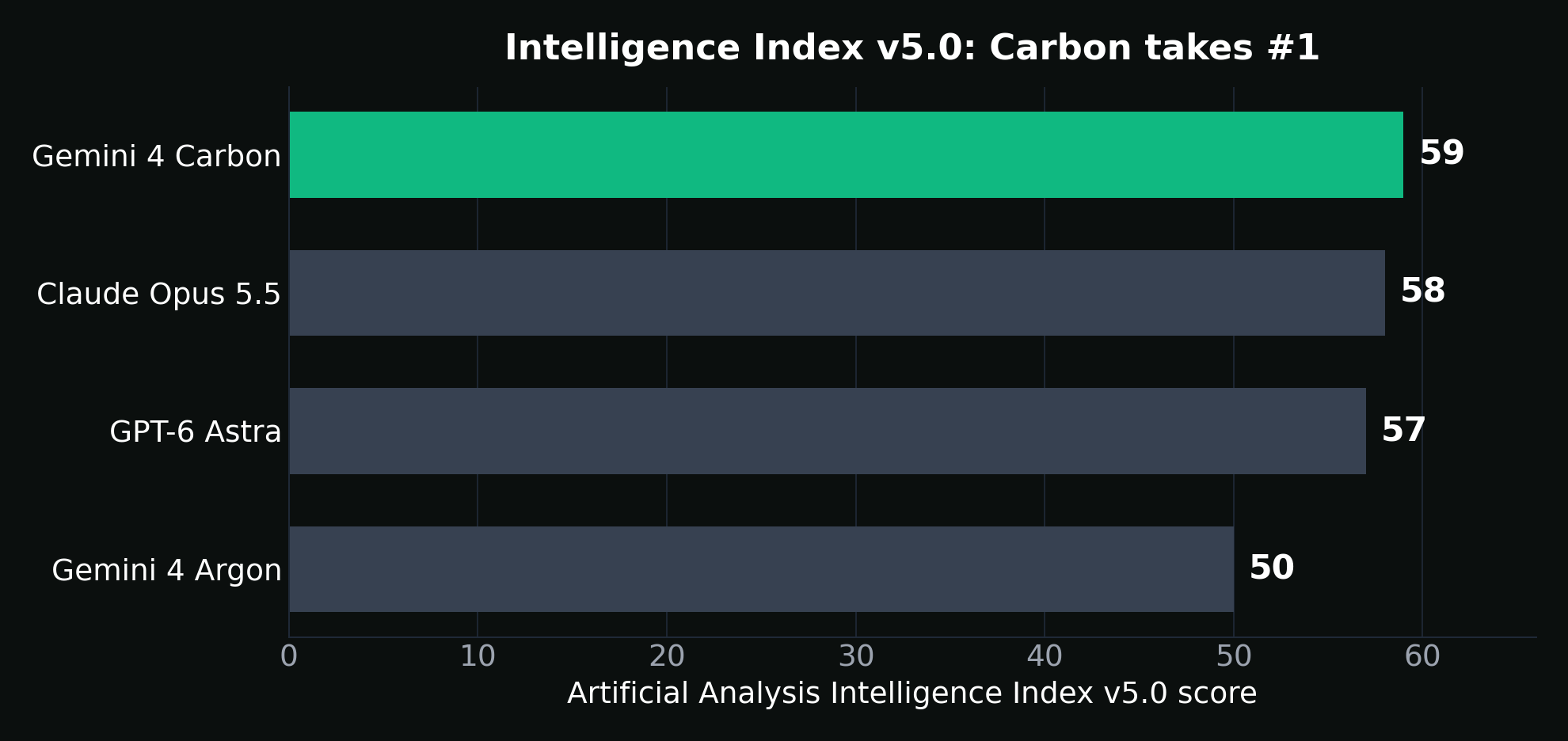
TL;DR: Google announced Gemini 4 Carbon on 28 October 2026, its new frontier model, and it debuts at #1 on the Artificial Analysis Intelligence Index v5.0 with a score of 59, ahead of Claude Opus 5.5 (58) and GPT-6 Astra (57). Its headline results are cybersecurity scores — 88.2% on SEC-bench Pro, 54.8% on ExploitGym, 71.0% on CWE-bench — all measured without guardrails. Announced pricing matches Argon: $2 per million input tokens and $10 per million output at intro, with cached input 95% off, stepping up to $4/$20 after an intro period Google has not dated. The catch: you cannot use it yet — access starts with a subset of cyber defenders through Google's Fairwind Program, and developers, businesses, and consumers get it "as soon as possible" with no date. There is no public API ID and no model card yet, and Carbon is not on tokens.bd. All facts checked 29 October 2026.
Google's frontier pace is now the story itself. Gemini 4 Argon reached general availability on 13 October 2026; fifteen days later, its successor is announced. Carbon is not a sidegrade — it takes the #1 spot on the independent index Argon sat 9 points lower on, and it reframes the frontier around one job: cybersecurity defense, from finding a vulnerability to proving it exploitable to patching it at the root cause. This post is the developer-practical version: what Carbon is, what the benchmarks actually say (and which ones Google ran itself), what it costs in dollars and taka, when you can actually call it, and what to do while you wait.
What is Gemini 4 Carbon?#
Gemini 4 Carbon is Google DeepMind's next frontier model, announced 28 October 2026 and described by DeepMind SVP Koray Kavukcuoglu as "our strongest model with state-of-the-art cybersecurity and long horizon capabilities." It builds directly on Argon, which launched two weeks earlier, and it is designed for sustained agentic work: Google says its internal teams have run Carbon for days on multi-step engineering tasks, persisting through dead ends to root-cause and patch subtle bugs across large codebases and low-level systems.
Two things define the model. First, the long horizon: this is a model built to stay on a hard task rather than answer and stop, which is why its token appetite is so large (more on that below). Second, the security framing: every headline benchmark is a step in the defense lifecycle — find, validate, patch — rather than a general chat score. On the practical side, Artificial Analysis lists a 1M-token context window and multimodal input (text, image, video, and speech in; text out). Google's announcement itself publishes no model card or spec sheet, so treat the context and modality details as listing data, not Google-confirmed specs. There is no public API ID yet, which means no integration guide, no SDK snippet, and no way to buy access outside the gated rollout.
What do the benchmarks actually say?#
Lead with the table, then read it honestly. The independent composite first:
| Artificial Analysis Intelligence Index v5.0 | Score |
|---|---|
| Gemini 4 Carbon | 59 |
| Claude Opus 5.5 | 58 |
| GPT-6 Astra | 57 |
| Gemini 4 Argon | 50 |
All scores checked 29 October 2026 against Artificial Analysis' Carbon write-up. Note the version discipline: Argon scored 53 on the older v4.3.2 index, so the v5 gap is 9 points, not 6 — never compare scores across index versions. Carbon also leads four of the index's nine evaluations, and on the refreshed AA-Omniscience test it scores 54 with 58% accuracy — 6 points ahead of Opus 5.5 — though its 11% hallucination rate is worse than Argon's 4% (and far better than the 50% recorded for both Opus 5.5 and GPT-6 Astra). On a second composite, the Vals Index v2.2, Carbon posts 70.4%, a shade ahead of Opus 5.5 at 70.2% and Argon at 69.2%.
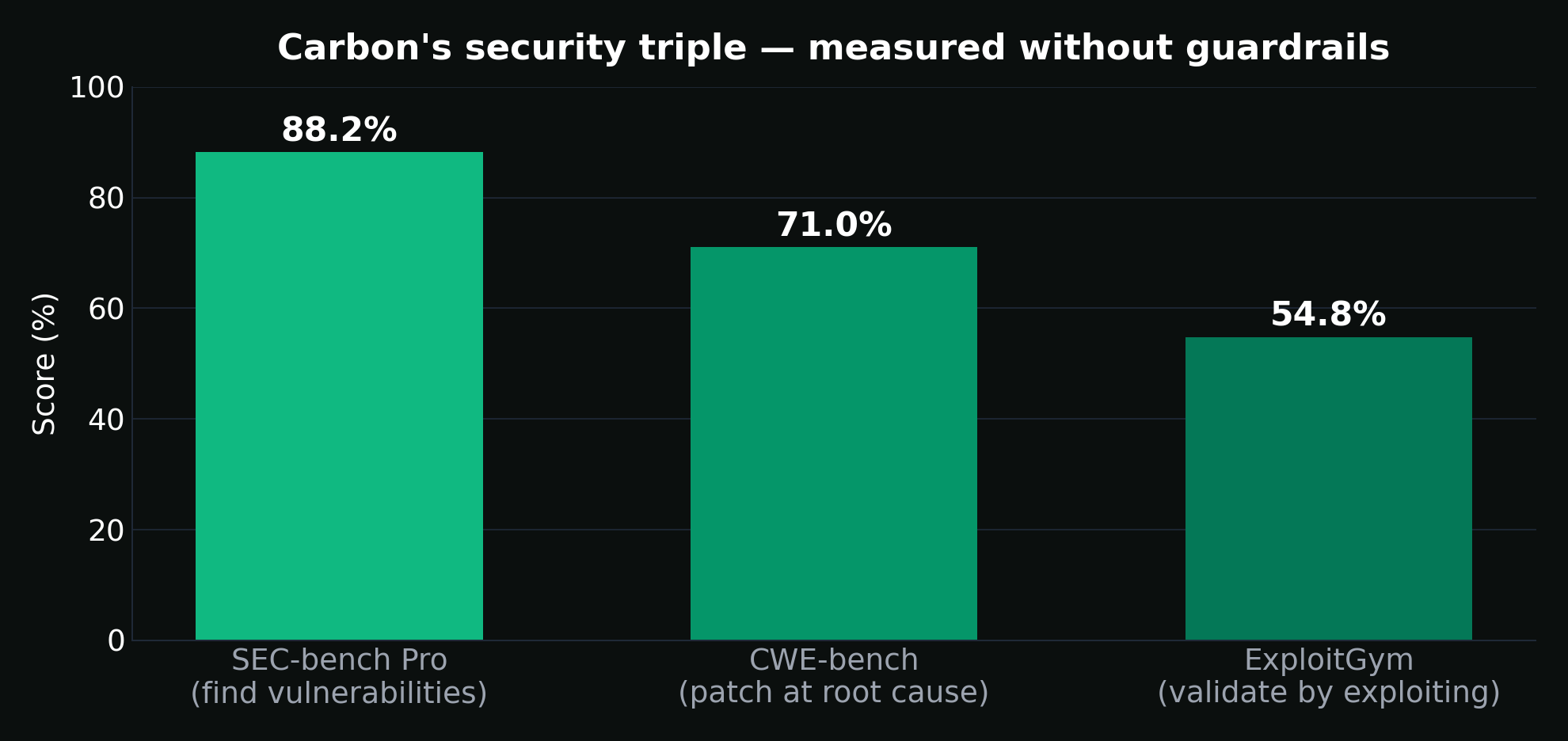
The security triple is the sharper story — and the one that needs the most careful reading:
| Benchmark | What it measures | Carbon | | --- | --- | | SEC-bench Pro | Finding real vulnerabilities | 88.2% | | ExploitGym | Validating risk by exploiting a flaw | 54.8% | | CWE-bench | Patching at the root cause | 71.0% |
All three checked 29 October 2026 against Google's announcement. Google states these external benchmarks were evaluated without guardrails, which is the right condition for measuring raw capability and the wrong condition for predicting what the safeguarded product will do. Treat them as capability ceilings, not deployment promises.
Google's internal claims sit a level below that in reliability: more than 2x the secure-code success rate of Argon on internal benchmarks, a Chrome-team report of more than 10x better high-quality patches than "another lab's large frontier model" (the rival is unnamed), and Wiz reporting Carbon leading on web penetration testing for its Scan for Good initiative. None of those have been independently reproduced.
Two more honest numbers. On Artificial Analysis' separate Coding Agent Index — a different index that scores the model plus its agent harness, not the model alone — Carbon running in Google's Antigravity CLI scores 59, behind Claude Code with Opus 5.5 at 62. Do not mix that 59 with the Intelligence Index 59; they measure different things. And the long-horizon tax is real: Artificial Analysis recorded 200 million output tokens across its index evaluation at Carbon's high reasoning setting (versus 110 million for Argon and a 64-million median), and a median 97.5 seconds before the first output token against a 3.6-second median. A model that thinks for days costs days' worth of tokens — the benchmark lead and the token appetite are the same phenomenon.
What does Carbon cost?#
Google's announced pricing, checked 29 October 2026. The intro rate is identical to Argon's; the step-up is published but its date is not:
| Tier | Input / 1M | Output / 1M | Cached input / 1M | | --- | --- | | Introductory | $2.00 | $10.00 | $0.10 (95% off) | | Standard (after intro, date undated) | $4.00 | $20.00 | $0.20 (95% off) |
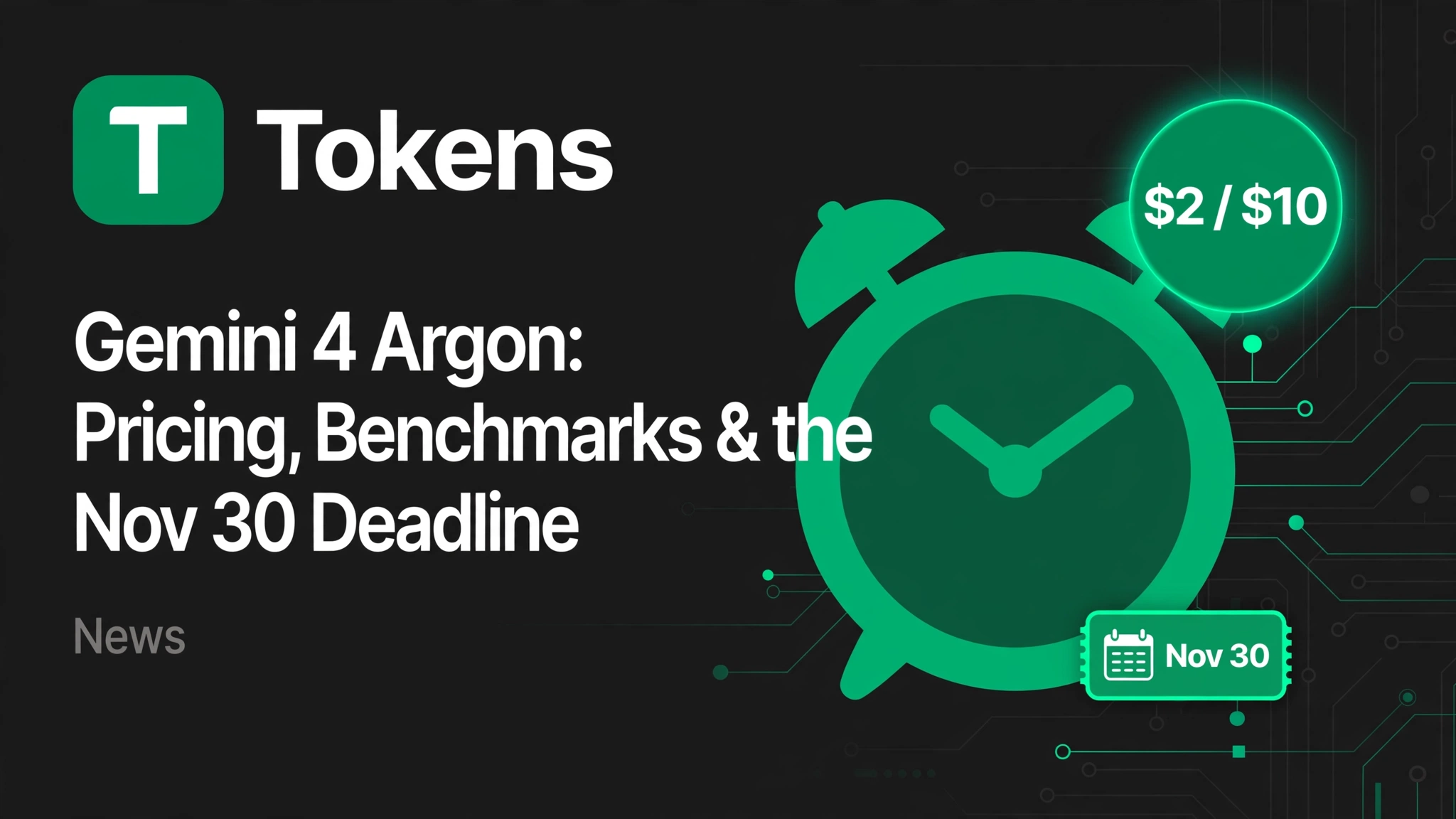
For contrast, Argon's intro price ends 30 November 2026, when it doubles to the same $4/$20. Carbon's intro end date is unpublished — do not assume it matches Argon's. Artificial Analysis' per-task cost math uses standard pricing throughout, which is why its Carbon figure ($7.76 per Intelligence Index task) sits near Argon's ($7.68) despite the 9-point lead: at standard rates, Carbon costs about 23% less per task than Claude Opus 5.5 ($10.04) and about 1.2x GPT-6 Astra ($6.25). At intro rates, the same token mix would cost half: $3.88 per task.
This post's own computed dataset applies those rates to a concrete session — 200K input tokens and 20K output tokens, the shape of a serious coding-agent session — at tokens.bd catalog prices checked 29 October 2026, converted at $1 = ৳124.17 (exchange-rates.org, 29 October 2026):
| Session (200K in + 20K out) | Cost | Cost in BDT | | --- | --- | | Gemini 4 Carbon, intro ($2/$10) | $0.60 | ৳74.50 | | Gemini 4 Carbon, standard ($4/$20) | $1.20 | ৳149.00 | | Claude Opus 5.5 via tokens.bd ($4/$20) | $1.20 | ৳149.00 | | Claude Sonnet 5.5 via tokens.bd ($2/$10) | $0.60 | ৳74.50 | | GPT-6 Luna via tokens.bd ($0.15/$0.60) | $0.042 | ৳5.22 |
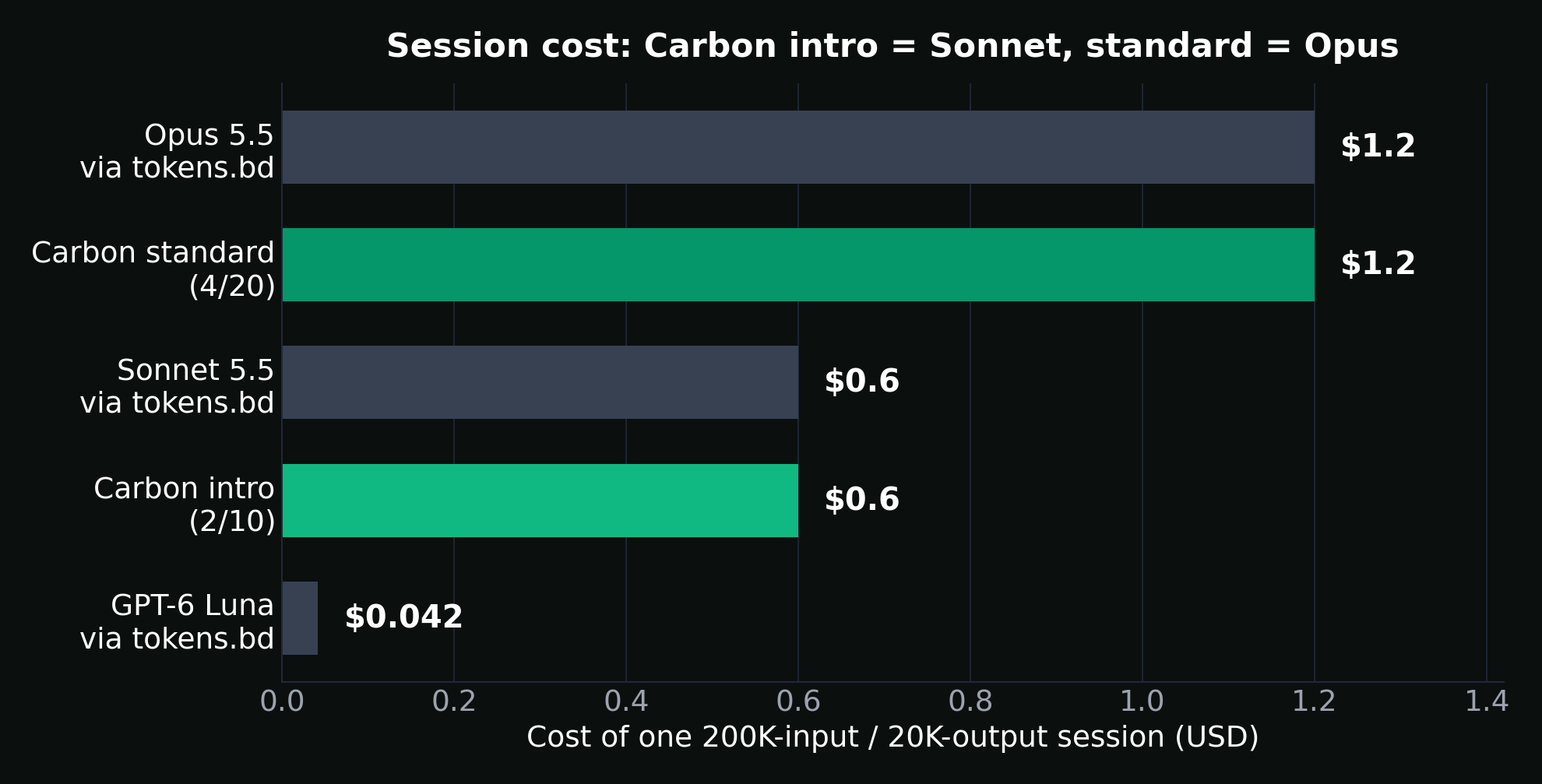
The framing that matters is the same one Argon forced: at intro pricing, Carbon costs exactly what Sonnet 5.5 costs; at standard pricing, exactly what Opus 5.5 costs. So the real question is not "is Carbon cheap" — it is "is Carbon as good as Opus 5.5, because that is what you will pay for it once the intro ends?" On the Intelligence Index, yes by one point; on the Coding Agent Index, no by three. On a plan budget, the gap is stark: $10 of Weekly 5X credit buys about 16 Carbon sessions at intro rates (8 at standard), versus about 238 Luna-rate sessions — the frontier session is 14x the cheap session at intro, 29x at standard. Reserve frontier sessions for the work that earns them.
When can developers actually use it?#
Google's rollout is deliberate, and the honest answer is: not yet, and no date is published. The stages, checked 29 October 2026:
| Stage | Who gets it | When | | --- | --- | | 1 — now | A subset of cyber defenders | This week (from 28 Oct) | | 2 — next | Additional trusted partners via the Fairwind Program (650+ partners, per AI Weekly) | Gradually, undated | | 3 — later | Developers, businesses, and consumers via product surfaces | "As soon as possible" after feedback and guardrail iteration — no date |
Google says it is engaged in the U.S. government's voluntary pre-release model testing process, which is part of why the rollout is gated. The Argon precedent is instructive but not a promise: Argon was announced 30 September for Fairwind partners only and reached general availability 13 October — a 13-day gap. Carbon may follow a similar path or a much longer one; the announcement gives no signal either way, so plan against "no date," not against "two weeks."
And the tokens.bd answer, stated plainly: Carbon is not on tokens.bd, and this post does not promise it. The Google shelf on tokens.bd today (checked 29 October 2026 on tokens.bd/models) is Gemini 3.7 Flash and 3.8 Flash only. When a Gemini 4 model lands on the gateway, the session math above is the price to compare — until then, the models you can actually call are the ones in the catalog. Our Gemini 4 Argon post covers the predecessor's pricing deadline in full, and our Oct 23 shutdown checklist covers the deprecation wave running alongside these launches.
Should you switch to Carbon?#
A ranked verdict, because "should you switch" depends on who you are:
- Cyber defenders in the Fairwind orbit: apply now. You are the only group with a live path to access, and Carbon's security triple is directly your workload. Measure it on your own vulnerabilities, not Google's.
- Security teams outside Fairwind: prepare, don't wait passively. Build the evaluation harness now — a fixed set of your own repos' real vulnerabilities with known patches — so the day access arrives you measure Carbon against your baseline instead of reading launch posts.
- General developers: stay on the catalog. Carbon is unbuyable today, and its standard price equals Opus 5.5's. The switch question becomes real only at general availability, when the comparison is Carbon vs Opus vs Sonnet on your tasks.
- Budget planners: treat the intro price as a windfall, not a plan. It halves the session cost, but its end date is unpublished. Any budget that only works at $2/$10 breaks the day the step-up lands.
What should you do this week?#
- If you defend systems: check whether your organization qualifies for Google's Fairwind Program — that is the only access queue that exists today.
- If you write code with agents: keep your frontier sessions on the models you can actually call, and keep the cheap model as the default. The session table above is the arithmetic: a Luna-rate session costs ৳5.22, a Carbon-rate session ৳74.50 at intro.
- If you evaluate models: freeze a benchmark set now. Launch-week numbers are vendor-shaped; your own fixed set is the only comparison that survives the hype cycle. Our frontier comparison shows how the three families stacked up before Carbon entered the table.
- If you are waiting for Carbon on a gateway: watch for three signals, in order — a public API ID, a general-availability date, and a Batch/Flex tier announcement (Argon has them; Carbon's tiers are unannounced). Until the first appears, there is nothing to integrate.
Gemini 4 Carbon FAQ#
Can I use Gemini 4 Carbon today? Only if you are in the first rollout cohort: a subset of cyber defenders getting access this week through Google's Fairwind Program. Developers, businesses, and consumers have no access date yet — Google says "as soon as possible" after feedback and guardrail iteration.
What does Gemini 4 Carbon cost? Announced pricing is $2 per million input tokens and $10 per million output at intro, with cached input 95% off ($0.10/1M), stepping up to $4/$20 ($0.20 cached) after an intro period Google has not dated. A 200K-input/20K-output session costs $0.60 at intro rates, $1.20 at standard rates.
Is Gemini 4 Carbon on tokens.bd? No. The Google shelf on tokens.bd (checked 29 October 2026) is Gemini 3.7 Flash and 3.8 Flash only. This post does not promise Carbon's arrival; when a Gemini 4 model lands, the session math above is the price to compare.
How is Carbon different from Argon? Carbon is the successor, announced fifteen days after Argon's general availability. It scores 9 points higher on the Artificial Analysis Intelligence Index v5.0 (59 vs 50), leads the security benchmark triple Argon never topped, and carries the same intro pricing — but it is gated to cyber defenders while Argon is generally available, and its intro end date is unpublished where Argon's is 30 November 2026.
Is Carbon really better than Claude Opus 5.5? On the Intelligence Index, yes by one point (59 vs 58) at a lower per-task cost ($7.76 vs $10.04 at standard pricing). On the separate Coding Agent Index, no — Claude Code with Opus 5.5 leads 62 to 59. And Carbon's security benchmarks were run without guardrails while its internal claims are unreproduced, so the honest answer is "leads on the published composites, unproven on your workload."
Prices, benchmarks, and rollout stages checked 29 October 2026 against Google's announcement, Artificial Analysis' Carbon write-up, and tokens.bd's live catalog. Model list prices and availability change; the provider's pricing page is the authority, and the model catalog for prices on tokens.bd.
Sources: Google — Introducing Gemini 4 Carbon (28 Oct 2026) · Artificial Analysis — Gemini 4 Carbon is the new #1 · The Decoder — Gemini 4 Carbon two weeks after Argon · WinBuzzer — Gemini 4 Carbon leads test for fixing vulnerable code · AI Weekly — Google ships Gemini 4 Carbon, tops AA index at 59 · OfficeChai — Gemini 4 Carbon benchmarks · tokens.bd model catalog · tokens.bd pricing · USD/BDT rate, exchange-rates.org
Google deprecated the older Gemini generation too — see Gemini 2.5 Deprecated: Your Dec 1 Migration Checklist.
See also: Kimi K3.1 Pro Open Weights Are Live: 1.56 TB Guide.
See also: Gemini API Pricing 2026: Every Model, Free Tier, Cost