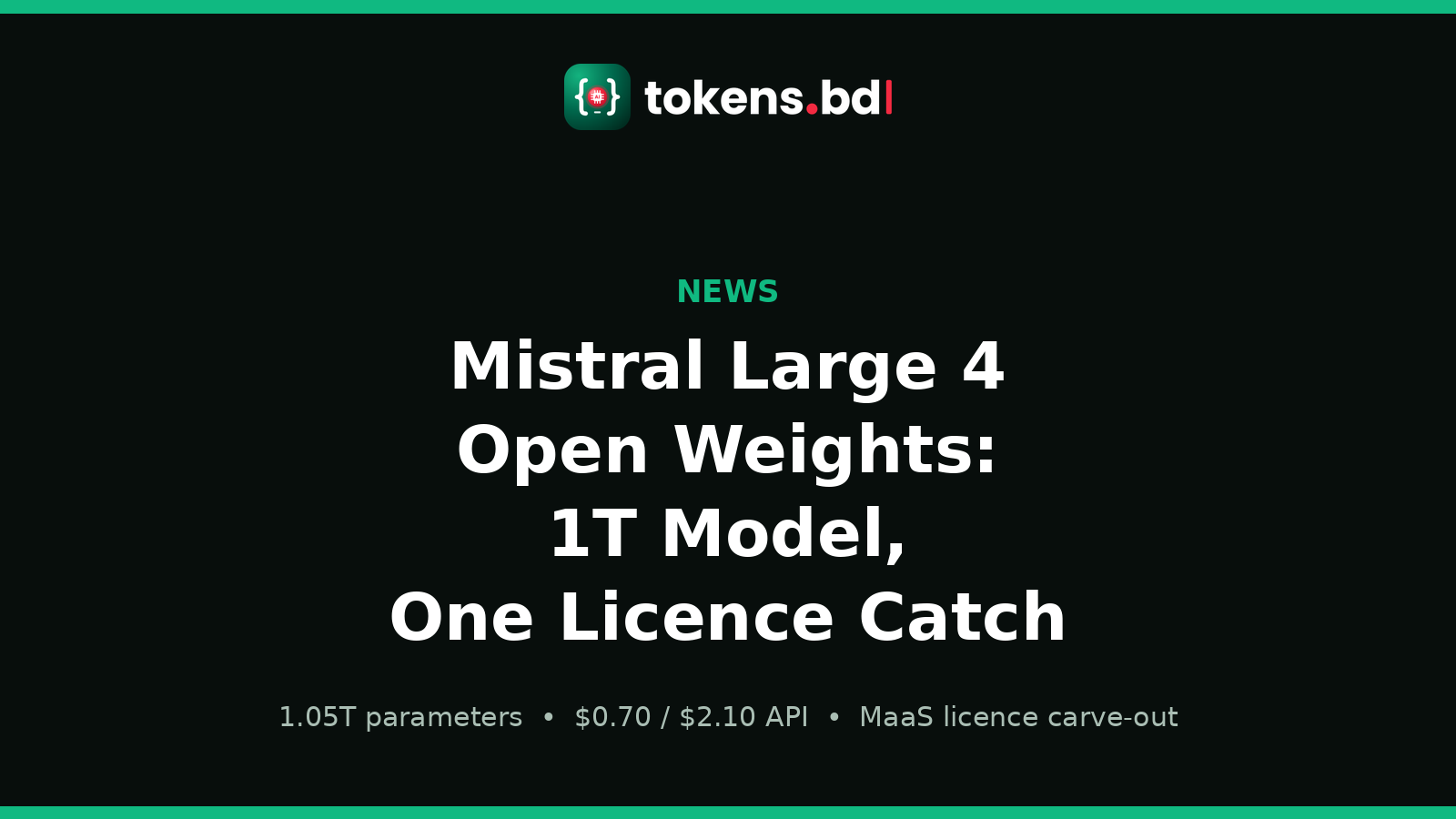
TL;DR: Mistral AI released the open weights of Mistral Large 4 — nicknamed "Le Chonk" — on 29 October 2026, three weeks after its 6 October preview. It is a 1.05-trillion-parameter mixture-of-experts model with a 1-million-token context, aimed squarely at agentic coding and defensive cybersecurity. The API price halved from preview to $0.70 per million input tokens and $2.10 per million output tokens (cached input $0.07). The catch is in the licence: the Mistral Ecosystem Open-Weight Licence lets you use, modify, fine-tune and commercialise the model — unless you run a Model-as-a-Service business, which needs a separate commercial licence. It is not on tokens.bd's catalog, so do not wait for a tokens.bd key to try it; the routes today are Mistral's API, OpenRouter, Microsoft Foundry and NVIDIA NIM, or self-hosting the weights. All facts checked 30 October 2026.
Mistral's announcement landed with an unusually honest pair of messages. The first is the pitch: after three more weeks of reinforcement learning, the released model is, by Mistral's numbers, the best open-weight model for coding and defensive cybersecurity. The second is the warning, in Mistral's words: during the preview it saw "a potential for uplift to conduct real attacks," and it is tightening guardrails in response. A model useful for finding vulnerabilities is, by definition, also useful for exploiting them. That tension is the whole story: the most capable open cyber model yet, with the sharpest licence boundary yet attached to an open release.
What is Mistral Large 4?#
Mistral Large 4 is a natively multimodal mixture-of-experts model: about 1.05 trillion parameters in total, with 128 routed experts of which four are active per token plus one shared expert, giving roughly 49 billion active parameters per token excluding embeddings and output layers — 52 billion including them. It accepts text and image input and produces text and code, through a 1.6-billion-parameter Pixtral-style vision encoder, with a 1-million-token context window and fluency in more than 160 languages, including every official language of the European Union. Mistral says it trained the model from scratch in its own European datacenters on 3,800 NVIDIA Grace Blackwell GPUs.
The weights are published on Hugging Face as mistralai/Mistral-Large-4-1T-A52B: an FP8 checkpoint of roughly 1,060 GB and a quantised NVFP4 checkpoint of roughly 610 GB for Blackwell GPUs, plus day-one GGUF quantisations. Serve them with vLLM or SGLang. Three selectable reasoning modes — Low, Medium and High, High by default — replace the preview's "None" mode, so you can trade reasoning depth against cost per task. An embedded DSpark speculative-decoding draft head, which proposes blocks of three tokens, was measured by Mistral at up to 1.9x higher throughput than serving the target model alone.
| Fact (checked 30 October 2026) | Mistral Large 4 |
|---|---|
| Total parameters | ~1.05 trillion (MoE) |
| Active per token | ~49B excl. embeddings, ~52B incl. |
| Experts | 128 routed, 4 active + 1 shared |
| Context window | 1 million tokens |
| Input / output | Text + image in, text + code out |
| Reasoning modes | Low / Medium / High (High default) |
| Weights | Hugging Face mistralai/Mistral-Large-4-1T-A52B |
| API id | mistral-large-4 via Mistral API |
| Licence | Mistral Ecosystem Open-Weight Licence (modified MIT) |
What does Mistral Large 4 cost?#
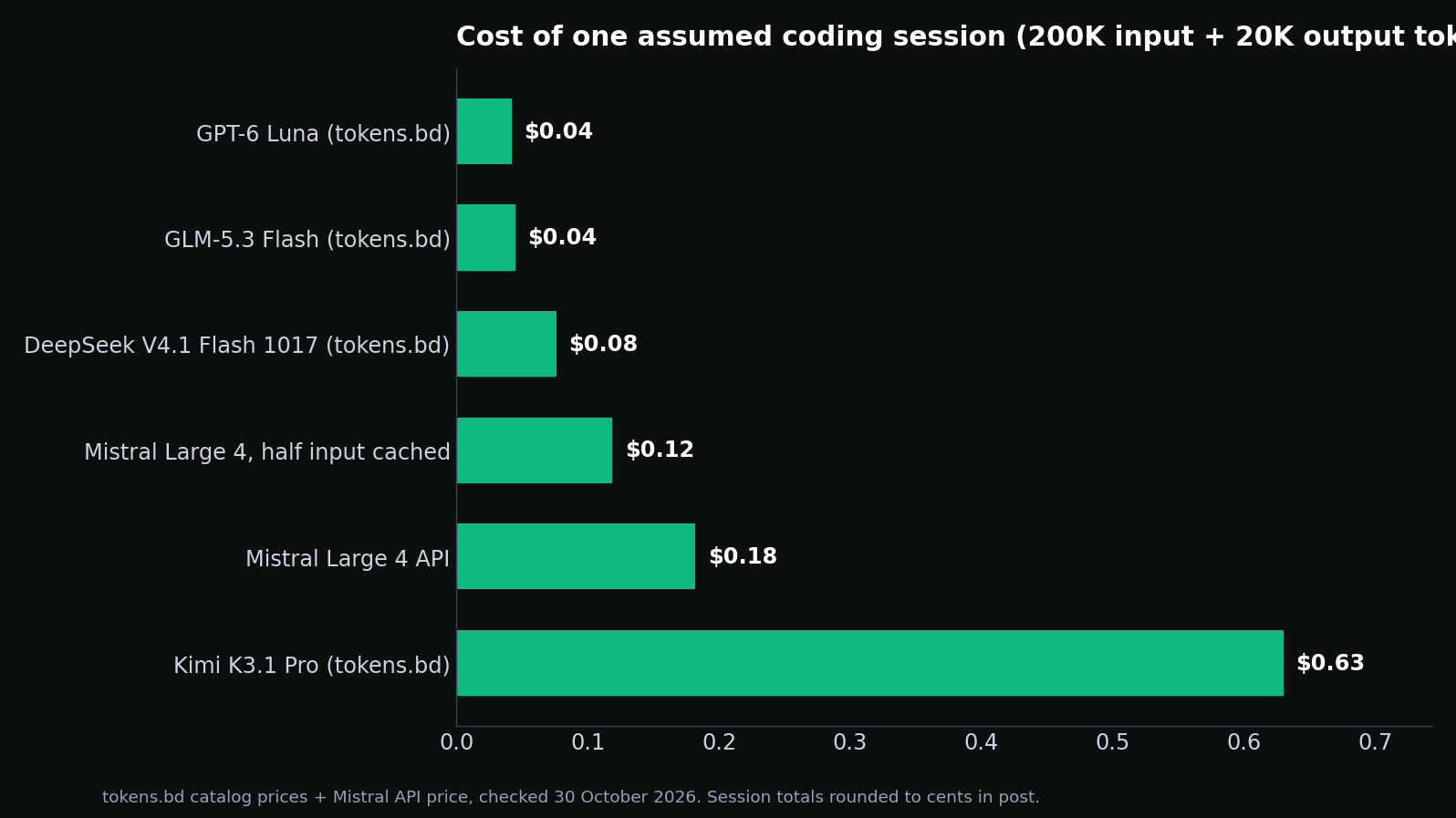
Start with the API, because that is the price most developers will actually pay. Mistral halved the preview pricing: $0.70 per million input tokens, $0.07 per million cached input tokens, and $2.10 per million output tokens, down from $1.36 and $4.18 at preview. On the standard assumed session used across this blog — 200,000 input tokens and 20,000 output tokens — that is $0.14 of input plus $0.042 of output, $0.182 per session, or about ৳22.59 at $1 = ৳124.14 (30 October 2026). If half your input hits the cache, the same session drops to $0.119: $0.07 fresh input, $0.007 cached input, $0.042 output. The preview-price session would have cost $0.356, so the cut is roughly half — real money on agent workloads that run thousands of sessions, but not a price revolution: this is still a large-model price, not a cheap-model price.
| API route (200K in + 20K out, prices checked 30 October 2026) | Input cost | Output cost | Session total | In BDT (≈৳124.14/$) |
|---|---|---|---|---|
| Mistral Large 4 API ($0.70/$2.10) | $0.140 | $0.042 | $0.182 | ≈৳22.59 |
| Mistral Large 4, half input cached ($0.70/$0.07/$2.10) | $0.077 | $0.042 | $0.119 | ≈৳14.77 |
| Mistral Large 4 at preview prices ($1.36/$4.18) | $0.272 | $0.084 | $0.356 | ≈৳44.14 |
Put that session next to the tokens.bd catalog prices checked the same day and the positioning is clear: Large 4's API session costs about 4.3x a GPT-6 Luna session ($0.042) and 2.4x a DeepSeek V4.1 Flash 1017 session ($0.076), but only about 0.29x a Kimi K3.1 Pro session ($0.63). It is priced as a capable open frontier model, not as a budget model — and Artificial Analysis' independent task-cost measurement tells the same story from the other side: an average Intelligence Index task costs $2.06 on Large 4, down 63% from $5.54 at preview, but still 3.4x DeepSeek V4.1 Flash's $0.60 per task. The efficiency gain is real, but the absolute price is not the cheapest in its class.
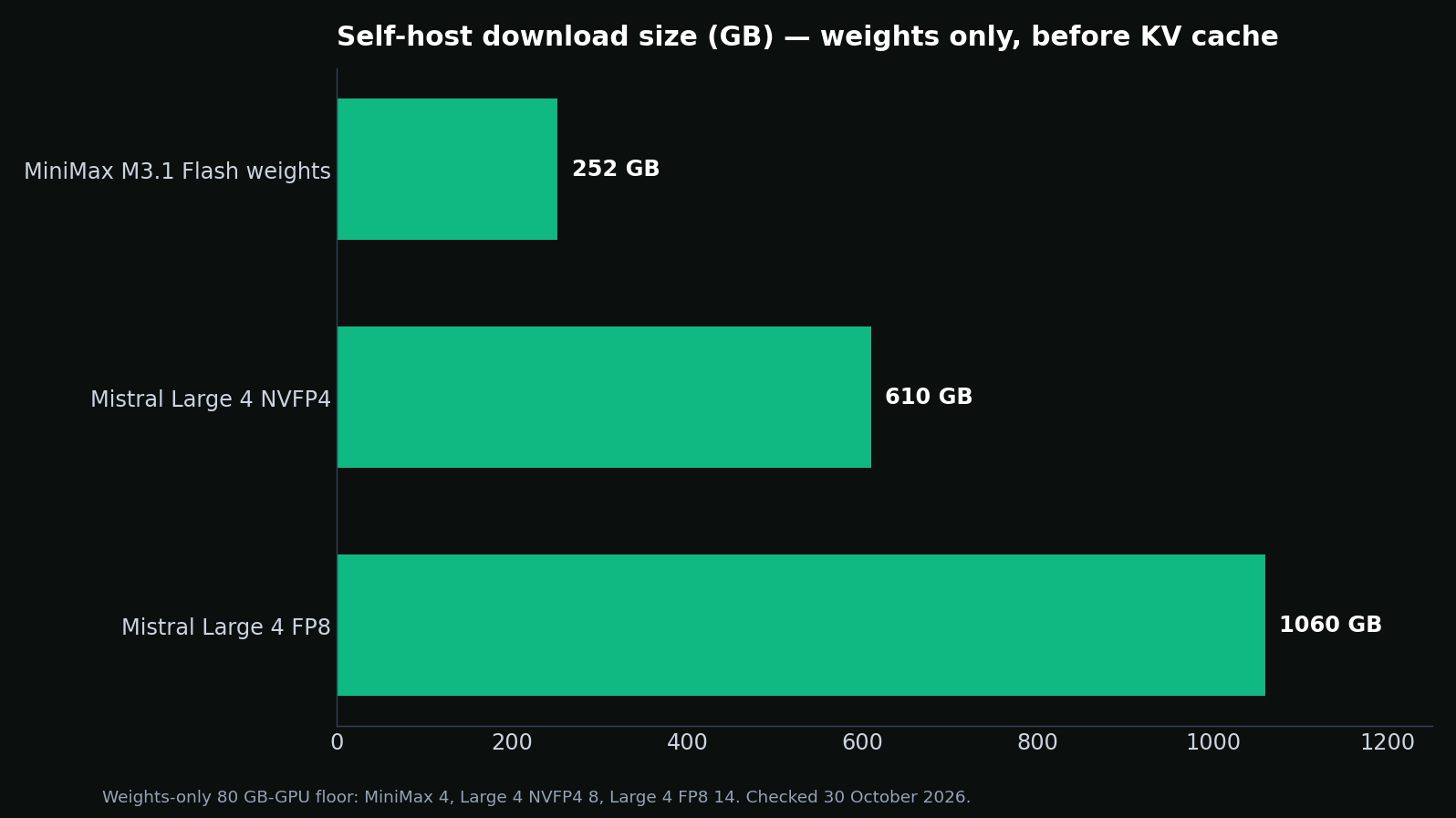
Self-hosting is where the trillion parameters bite. The weights alone are roughly 1,060 GB in FP8 and 610 GB in NVFP4 — 4.2x the 252 GB MiniMax M3.1 Flash download covered in our self-host guide. Divide by an 80 GB H100 and you get a weights-only floor of 14 GPUs for FP8 and 8 for NVFP4, before a single byte of KV cache, activations or serving overhead — so treat those as floors, not deployment recipes. The documented reality is bigger iron: SGLang's documentation puts the standard version on eight NVIDIA B300 GPUs and a more compressed variant on four GB300s, chips that carry far more memory per GPU than an 80 GB H100. Nobody runs this on a workstation: this is a cluster or cloud-GPU commitment whose rental bill dwarfs the $0.18 API session. For most developers the API is the sane route; self-hosting is for teams with a sovereignty, privacy or customisation reason strong enough to pay for it.
| Checkpoint (weights only, before KV cache) | Download size | 80 GB-GPU floor (weights only) | Documented requirement |
|---|---|---|---|
| Mistral Large 4 FP8 | ~1,060 GB | 14 GPUs | 8× NVIDIA B300 (SGLang docs) |
| Mistral Large 4 NVFP4 | ~610 GB | 8 GPUs | 4× GB300, compressed variant |
| MiniMax M3.1 Flash (comparison) | 252 GB | 4 GPUs | See our self-host guide |
How good is it, really?#
Every benchmark number in this section is vendor-reported — Mistral's announcement, its model card, or a benchmark run Mistral cites — not an independent test, and the honest way to read them is as claims to be confirmed by outside testers. With that caveat, the pattern is consistent: Large 4 leads open models on coding and cyber tasks, while trailing Chinese open models on aggregate intelligence. On Terminal-Bench 4.0 it reports 41%, up 13 points from 28.3% at preview, with output tokens down 30% — the single biggest jump in the release, and the one that most justifies the three extra weeks of reinforcement learning. On Cognition's private FrontierCode 2.0 it reports 19.7%, ahead of DeepSeek V4.1 Flash (19.3%), GLM-5.3 (17.8%) and Kimi K3 (17.3%). On Artificial Analysis' Coding Agent Index it reports 48%, effectively tied with GLM-5.3 as the leading open model, while using 47% fewer tokens per task on average — the efficiency claim that matters most for agent bills, since tokens per task is what you actually pay for.
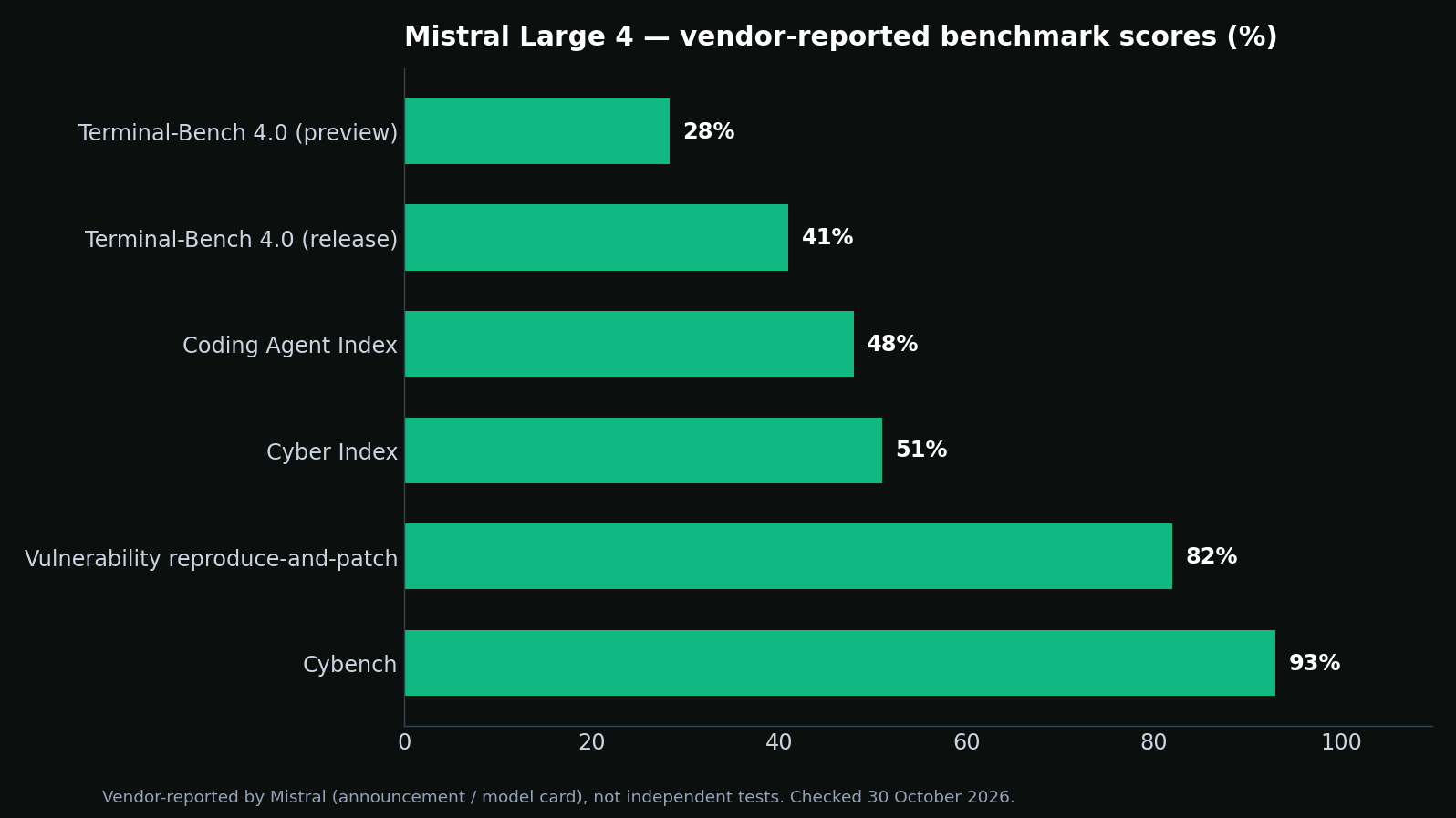
The cyber numbers are the reason this release is aimed at defenders rather than general chat. Large 4 reports 51% on Artificial Analysis' Cyber Index, which covers finding, reproducing, validating and patching vulnerabilities without breaking existing functionality; 82% on a vulnerability reproduce-and-patch test; and 93% on Cybench, a set of 40 challenges drawn from security competitions. On the defensive side of the ledger, Mistral reports a 96.6% average refusal rate on malicious cyber requests across the cyber-related prompts of JailbreakBench, StrongREJECT and AgentHarm, described as the highest it measures among open models, plus 97.1% on the B3 Agent Security Benchmark, up from 93.3% at preview. A specialised pen-testing variant stays restricted to vetted partners testing owned or authorised systems. The general-intelligence picture is more modest: on Artificial Analysis' Intelligence Index v5, Large 4 scores 26 — the highest among Western open-weight models, but behind DeepSeek V4.1 Flash and GLM-5.3 at 32, and far behind frontier closed models (Gemini 4 Carbon, covered in our 29 October post, tops the same index at 59). Buy it for coding and cyber work, not general intelligence.
What is the licence catch?#
The Mistral Ecosystem Open-Weight Licence is a modified MIT licence: free to use, modify, fine-tune and commercialise, with one condition that changes the economics for an entire class of business. If you or your affiliates operate a Model-as-a-Service offering — that is, you sell hosted access to the model itself — you must obtain a separate commercial licence from Mistral before using it commercially. Self-hosters, fine-tuners and end-product builders face no commercial obligation under the licence; the obligation bites only when the model is the product you resell. The announcement does not define where a SaaS product wrapping the model ends and a MaaS offering begins, and that undefined boundary is the real risk: building an AI product on Large 4 is fine, but offering "Large 4 as an API" as your business is not covered by the open licence at all — it needs a Mistral deal first. The same caution applies to the specialised offensive pen-testing variant, which stays restricted to vetted partners regardless of the open licence — the public weights are the defensive model, not the unrestricted one.
For gateway and API businesses this is the key point: a gateway cannot simply host these weights and resell access under the open licence — that is exactly the MaaS case carved out. Any provider offering Large 4 as a hosted API is either operating under a commercial licence from Mistral or outside the licence terms; ask which, in writing, before building on it. For everyone else — a security team self-hosting for its own codebases, a developer fine-tuning an internal tool, a startup shipping a product that uses the model — the licence is as open as it reads.
Who should use Mistral Large 4 — and who should skip it?#
Ranked by fit, from strongest to weakest:
- Security teams doing defensive work. Vulnerability discovery, reproduction, validation and patching is the model's stated home turf, with the strongest open cyber numbers reported. If your backlog is triaging real vulnerabilities, evaluate this first.
- European and sovereignty-constrained organisations. Trained from scratch in Mistral's own European datacenters, downloadable and inspectable, with 160+ languages including every official EU language — the compliance story writes itself for teams that cannot send code to a US or Chinese API.
- Coding-agent builders who pay per token. 48% on the Coding Agent Index at 47% fewer tokens per task than the tied leader is a bill-level advantage if it holds up independently: fewer tokens per completed task beats a lower price per token.
- Teams that fine-tune. Open weights plus a permissive licence for non-MaaS use is the combination that makes customisation possible at all; closed models cannot be fine-tuned this way.
- Everyone who just wants a cheap API. Skip it. At $0.182 per assumed session it costs multiples of the cheap models, and its aggregate intelligence trails cheaper open rivals. Use it where its coding and cyber edge earns the premium, not as a default.
How does it compare with the other open-weight options?#
MiniMax M3.1 Flash is the small, cheap, self-hostable option (428B MoE, ~23B active, $0.15/$0.60, 252 GB download); DeepSeek V4.1 Flash is the aggregate-intelligence leader among open weights (Intelligence Index 32) at a low task cost; GLM-5.3 is the coding-index co-leader. Large 4 is the biggest, the most cyber-specialised and the most expensive to self-host — and the only one with a MaaS carve-out. Mistral is charging, in hardware and licence terms, for the capability it built, while keeping the weights open for defenders, builders and sovereign teams, and closed commercially to resellers.
| Model (checked 30 October 2026) | Scale | API price / 1M in/out | Assumed session | Self-host download | Licence note |
|---|---|---|---|---|---|
| Mistral Large 4 (Mistral API) | 1.05T MoE, ~52B active | $0.70 / $2.10 | $0.182 | ~1,060 GB FP8 | Modified MIT + MaaS carve-out |
| MiniMax M3.1 Flash (MiniMax API) | 428B MoE, ~23B active | $0.15 / $0.60 | $0.042 | 252 GB | Open weights; see our self-host guide |
| DeepSeek V4.1 Flash 1017 (tokens.bd) | Open-weight flagship | $0.30 / $0.80 | $0.076 | — (API via gateway) | Via gateway, not self-host here |
| GLM-5.3 Flash (tokens.bd) | Open-weight, coding co-leader | $0.17 / $0.55 | $0.045 | — (API via gateway) | Via gateway, not self-host here |
| Kimi K3.1 Pro (tokens.bd) | Open-weight frontier | $2.10 / $10.50 | $0.630 | — (API via gateway) | Via gateway, not self-host here |
All tokens.bd prices checked 30 October 2026 on the model catalog; Mistral's API price is Mistral's own list price, not a tokens.bd price, because Large 4 is not in the tokens.bd catalog. Session = 200,000 input + 20,000 output tokens; totals rounded to cents.
Can I use Mistral Large 4 through tokens.bd?#
Not today. The tokens.bd catalog checked 30 October 2026 contains no Mistral model at all, so there is no tokens.bd key, plan or price for Large 4 — and this post promises none. Treat any future catalog addition as a catalog-watch item, not a commitment, and note the licence section above: a gateway offering hosted Large 4 access needs Mistral's commercial licence, so availability through any gateway is a business question, not just a technical one. The routes that work today are Mistral's own API (mistral-large-4, $0.70/$2.10) and Mistral Studio, OpenRouter, Microsoft Foundry — the first cloud to carry it — and NVIDIA NIM containers, or self-hosting the Hugging Face weights with vLLM or SGLang if you have the hardware. If you are choosing between those routes, the decision is simple: API for evaluation and small workloads, hosted endpoints for production without hardware, self-hosting only for sovereignty, privacy or deep customisation. For ordinary coding rather than cyber or frontier agent work, the cheaper models on tokens.bd's catalog remain the better buy; Large 4 earns its premium only where its coding and cyber edge applies. See pricing for how tokens.bd plans bill the models it does carry.
Mistral Large 4 FAQ#
Is Mistral Large 4 really open source? It is open-weight under a modified MIT licence, not a plain MIT licence: use, modify, fine-tune and commercialise freely, except that Model-as-a-Service businesses need a separate commercial licence from Mistral. That one carve-out is the difference between "open" and "open for everyone including resellers."
How big is the download, and what hardware do I need? Roughly 1,060 GB for FP8 and 610 GB for NVFP4. The weights-only floor is 14× 80 GB GPUs for FP8 and 8× for NVFP4, before KV cache and overhead; SGLang's documentation puts the standard version on eight NVIDIA B300 GPUs and a compressed variant on four GB300s — cluster hardware, not a workstation project.
What changed since the 6 October preview? Three more weeks of reinforcement learning: Terminal-Bench 4.0 rose from 28.3% to 41%, output tokens fell 30%, API pricing roughly halved ($1.36/$4.18 to $0.70/$2.10), and the weights — preview was API-only — are now public. The Intelligence Index score moved only from 25 to 26, so the gains are concentrated in coding and cyber, not general intelligence.
Should I switch from DeepSeek or GLM to Large 4? Only for coding or defensive cybersecurity, where its reported numbers lead or tie and token efficiency per task matters. On aggregate intelligence and cost per task, DeepSeek V4.1 Flash still leads — so for general work, the cheaper models win.
Is the pen-testing version public? No. The specialised offensive variant stays restricted to vetted partners, for testing owned or authorised systems only. The public weights are the defensive model, whose guardrails refused 96.6% of malicious cyber requests in Mistral's tests.
All facts, prices and benchmark claims checked 30 October 2026 against Mistral's announcement as reported by Unite.AI, Skimwire, AI Weekly and other outlets, the Hugging Face model card as reported, and tokens.bd's own catalog and pricing pages. Benchmark figures are vendor-reported unless stated as Artificial Analysis measurements; the provider's documentation is the authority if prices or licence terms change.
Sources: Mistral's 1-trillion-parameter Le Chonk checkpoint lands on Hugging Face — Unite.AI · Mistral Large 4 open weights: specs, license, cyber claims — Skimwire · Mistral Opens 1T 'Le Chonk' Large 4 Under Modified MIT License — AI Weekly · Mistral Large 4 open weights bring on-prem AI control — AppStack Insider · Mistral ships Large 4 weights, strong at coding but behind China overall — Pivot News · Models and prices — tokens.bd · Pricing and plans — tokens.bd
For the wider ranked roundup that puts Large 4 alongside Beam, MiniMax M3.1 Flash and the other open-weight options, see Best Free Open-Weight AI Models (2026).