
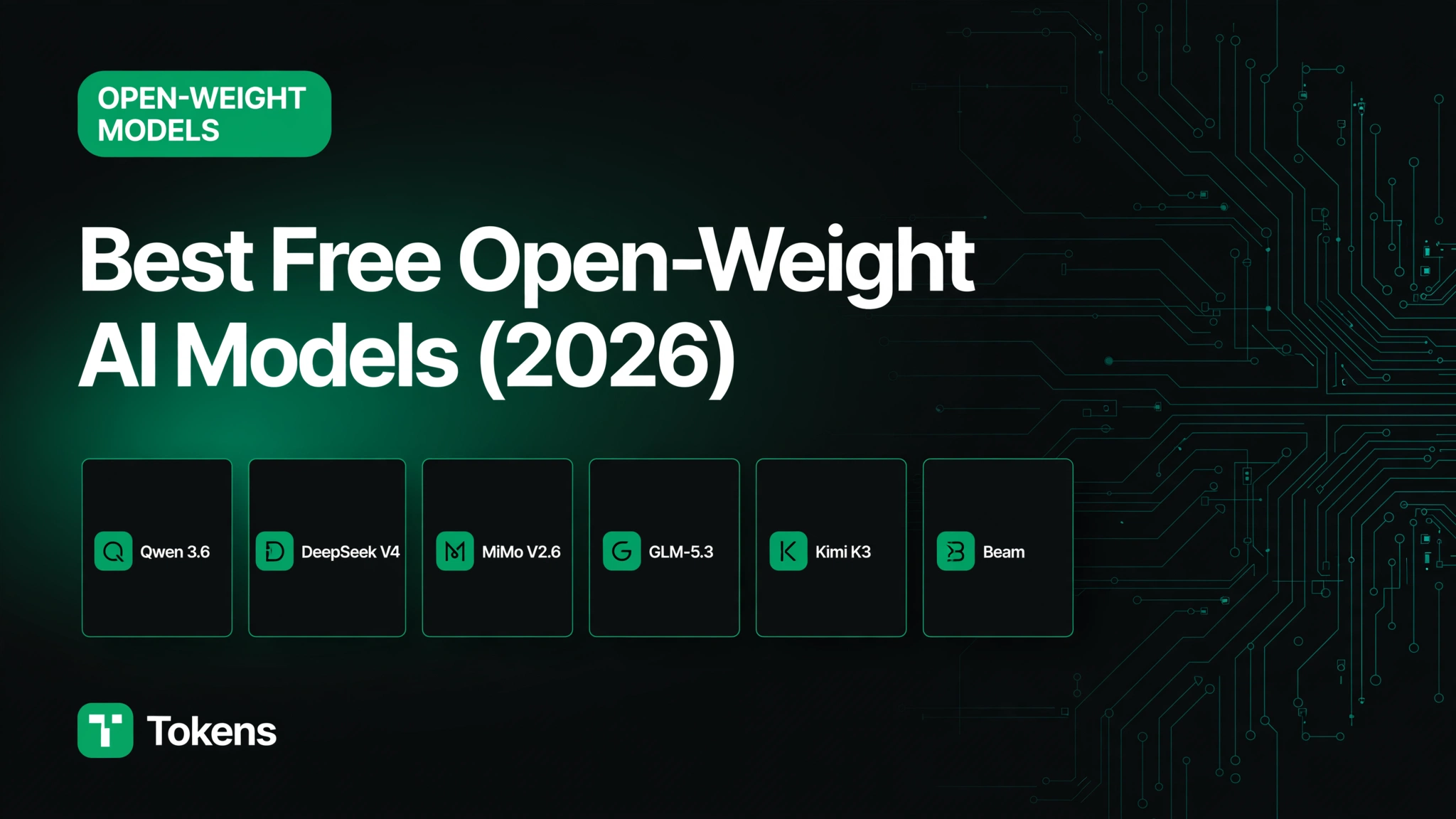
TL;DR: The best open-weight model in October 2026 is Xiaomi's MiMo-V2.6-Pro — the top-scoring open model on Artificial Analysis's Intelligence Index v4.3.2 (46.32) under an MIT license. The most practical one for a laptop or single GPU is Qwen 3.6-27B (Apache 2.0, 77.2 on SWE-Bench Verified). Reflection AI's Beam (501B parameters) is the one to watch, but its weights are not out yet — early access only, Apache 2.0 weights promised later in October. And the uncomfortable math: self-hosting only beats a cheap hosted open-weight API past roughly 5 million tokens a day.
"Open weights" is not "open source"#
The first thing to get right, because it costs people real money: open weights ≠ open source. A model can be free to download while its license restricts how you use it. Two clauses actually bite in 2026:
- Llama 4 restricts free use for companies above 700 million monthly active users (Meta's license).
- Qwen models larger than 35B require a separate agreement once you pass 100 million monthly active users (Alibaba's license).
For a solo developer or a startup, both are non-issues. For a large company, they are deal-breakers you only discover when the lawyers arrive. The models on permissive licenses — Apache 2.0 or MIT — genuinely are free forever: download, fine-tune, self-host, sell the product. That is why the license column in the table below matters as much as the benchmark column.
The models actually worth running right now#
Scores from Artificial Analysis's Intelligence Index v4.3.2 (read 5 October 2026) and vendors' own reported benchmarks. Checked 13 October 2026.
| Model | Params | License | Context | Notable score | Runs on |
|---|---|---|---|---|---|
| MiMo-V2.6-Pro (Xiaomi) | MoE, frontier-class | MIT | Long | 46.32 — highest open-weight score | Datacenter |
| GLM-5.3 (Z.ai) | MoE, frontier-class | Open (Z.ai terms) | 1M | 44.78 | Datacenter |
| Kimi K3 (Moonshot) | 2.8T total / 104B active | Kimi K3 License | 1M | 43.59 | Datacenter |
| Qwen 3.8-27B (Alibaba) | 27B dense | Apache 2.0 | 262K | 33.70 | Single GPU |
| Qwen 3.6-27B (Alibaba) | 27B dense | Apache 2.0 | 262K (ext. to 1M) | 77.2 SWE-Bench Verified (vendor) | Single GPU |
| DeepSeek V4.1-Flash (DeepSeek) | MoE | MIT | 128K | 39.46 | Datacenter |
| Qwen3-Coder (Alibaba) | 32B class | Apache 2.0 | 256K | Strong on coding tasks | Single GPU |
Three things this table is really saying:
- The frontier of open weights moved to China. MiMo, GLM-5.3, Kimi K3, DeepSeek V4, Qwen — every top open-weight model right now comes from a Chinese lab. Western open models (Llama 4, Mistral) are far behind on scores in 2026.
- "Open weights" no longer means "runs on your machine." The best models are 1–3 trillion parameter MoEs that need roughly 1TB of VRAM — about 8× H200 GPUs — just to load. The practical workstation models are the dense 27–32B ones.
- The 27B sweet spot is real. Qwen 3.6-27B at Apache 2.0, vendor-reported 77.2 on SWE-Bench Verified and 83.9 on LiveCodeBench, runs on a single 24GB GPU at 4-bit quantization. It punches above models ten times its size.
Beam: the one to watch, not the one to use#
Reflection AI unveiled Beam on 5 October 2026: a text-only mixture-of-experts model with 501 billion total parameters and only 23 billion active per token, a 1-million-token context window, and pretrained on 23.8 trillion tokens. Reflection claims Beam matches Z.ai's GLM-5.2 on reasoning while using 3–4× less inference compute. Its self-reported scores: 80.9 on SWE-Bench Verified, 80.1 on Terminal-Bench 2.1, 97.8 on AIME 2026 — not independently verified as of 13 October 2026.
The weights are not public yet. Reflection says they ship under Apache 2.0 later in October 2026 with a technical report and model card; right now there is only a waitlist. Do not plan around Beam until the weights land on a public hub. This is exactly the kind of release worth checking back for — a genuinely permissive license on a 501B model would reset what "free" can do.
Running one on your own machine#
For anything up to the 32B class, Ollama remains the zero-friction path: free, MIT-licensed, one command to pull and run, and an OpenAI-compatible API so your existing code works unchanged.
# One command. Free, unlimited, your data never leaves the machine.
ollama run qwen3.6:27b        # best all-round open coding model, Apache 2.0
ollama run qwen3-coder:32b    # coding-specialized alternative
ollama run deepseek-v4-pro    # frontier-class MoE (quantized, needs big VRAM)
Hardware tiers that actually matter in 2026:
- 8–16GB VRAM (laptop/consumer GPU): 7–14B quantized models. Great for drafting, autocomplete, small refactors.
- 24GB VRAM (single prosumer GPU): 27–32B at Q4 — Qwen 3.6-27B, Qwen3-Coder. The practical ceiling for serious local coding work.
- Datacenter (8× H200 class): the frontier MoEs — MiMo-V2.6-Pro, GLM-5.3, Kimi K3, DeepSeek V4.1. "Open weights" at this tier means auditable and self-hostable, not free in any sense that includes the hardware.
The math on when "free" stops being free#
Running weights yourself is free of API bills, not free of costs. An H100 rents for roughly $2–4/hour, an H200 for $3–5/hour — $48–144 a day before you count your ops time. The current rule of thumb, and it has held all year:
- Single-host models (Qwen 3.8-27B, Gemma 4, quantized small models): self-hosting beats a hosted API only past roughly ~5M tokens/day of sustained volume.
- Frontier MoEs (MiMo-V2.6-Pro, GLM-5.3, DeepSeek V4.1): only past ~30–50M tokens/day.
Below those thresholds, a hosted API wins on total cost once you price your own time — and hosted open-weight prices have collapsed so far that the bar keeps rising. Market-wide hosted rates for GLM-5.3 Flash sit around $0.15/$0.50 per million (tokens.bd lists $0.17/$0.55) — that is the number self-hosting has to beat.
When paying a little beats free#
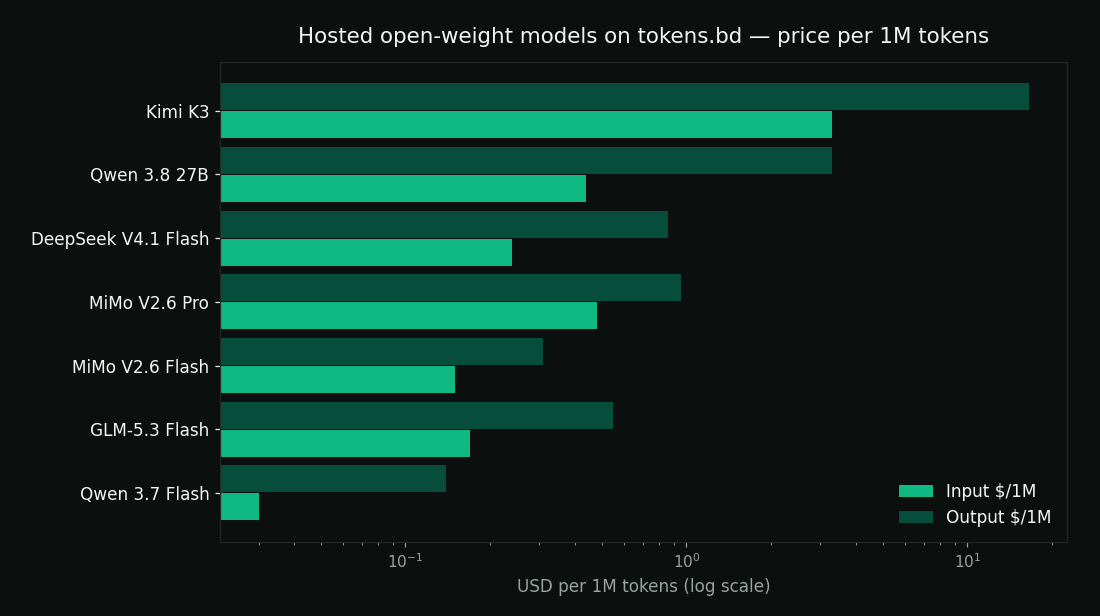
That is the whole argument in one chart. The open-weight models that need datacenter GPUs to run are available hosted for cents per million tokens. Look at the numbers:
- MiMo-V2.6-Pro — the top open-weight model on the Intelligence Index — is $0.48 in / $0.96 out. The hosted API for the world's best open model costs less per million than a cup of cha.
- DeepSeek V4.1 Flash is $0.24 / $0.86.
- Qwen 3.7 Flash is $0.03 / $0.14.
- Three models — Ling 3.0 Flash Sante, Ling 3.1 Flash, and Laguna S 2.1 — list at $0.00 / $0.00: free hosted tiers.
One agent session of 200K input + 20K output tokens:
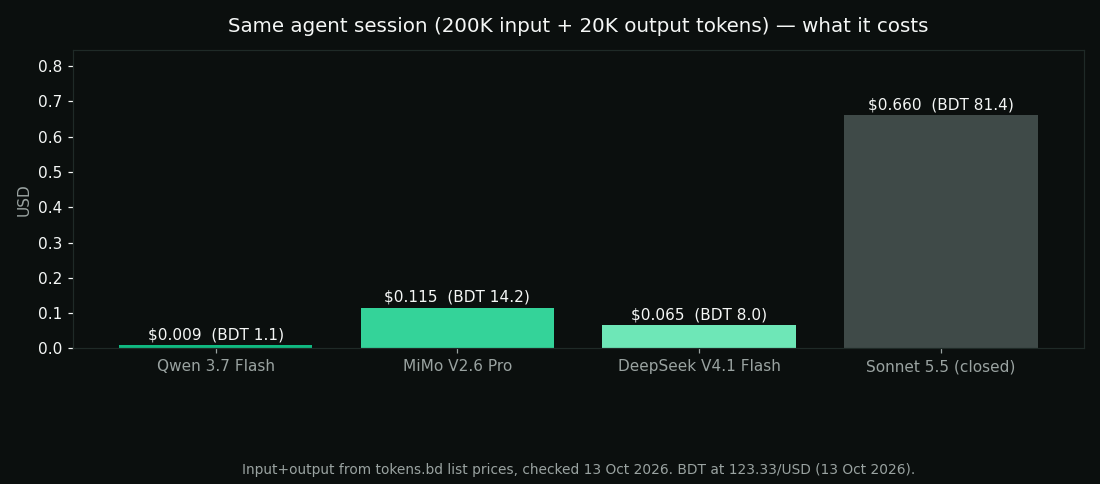
The arithmetic, recomputed from the catalog: 0.2M × $0.03 + 0.02M × $0.14 = $0.0088 ≈ $0.009 on Qwen 3.7 Flash — about ৳1.1 at 123.33 BDT/USD (13 October 2026). The same session on a closed frontier model runs $0.66, about ৳81. For Bangladeshi developers, the hosted route also sidesteps the international-card problem entirely — taka-set pricing, bKash/Nagad, no dollar invoice. For the full BDT breakdown of what 1M tokens costs, see LLM API pricing in BDT.
The 2026 playbook#
| Your situation | Do this |
|---|---|
| Hobby / learning / private data | Run Qwen 3.6-27B or Qwen3-Coder locally with Ollama. Free forever, nothing leaves your machine. |
| Startup, moderate volume | Hosted open-weight models via one API key — 60+ models including MiMo, GLM, DeepSeek, Kimi and Qwen on tokens.bd. |
| High, steady volume (5M+ tokens/day) | Price out self-hosting against the hosted rate; below that threshold, the hosted API wins. |
| Hardest tasks (complex refactors, agentic work) | Escalate to a closed frontier model for those turns only, not the whole workload. |
The pattern is escalation, not allegiance: free local for the private and the trivial, cheap hosted open-weight for the bulk, frontier closed models for the turns that earn it. That is also the routing pattern in what an AI gateway is for — one key, per-model fallback, and the bill stays boring. For the cheapest closed models to pair with this setup, see cheapest LLM APIs for coding.
FAQ#
What is the best free open-weight AI model in October 2026? Xiaomi's MiMo-V2.6-Pro — 46.32 on Artificial Analysis's Intelligence Index v4.3.2 (read 5 October 2026), the highest score of any open-weight model, under an MIT license. It needs datacenter hardware to self-host; use it via a hosted API.
Which open-weight model should I run on my own computer?
Qwen 3.6-27B under Apache 2.0. Vendor-reported 77.2 on SWE-Bench Verified, runs on a single 24GB GPU at 4-bit quantization via ollama run qwen3.6:27b.
Is Reflection AI's Beam available yet? No. Unveiled 5 October 2026 (501B parameters, 23B active), with Apache 2.0 weights promised later in October 2026. As of 13 October 2026 it is early-access waitlist only.
When is it cheaper to use a hosted API than to self-host an open model? Below roughly 5M tokens/day for single-host models and 30–50M tokens/day for frontier MoEs, a hosted API wins once you count GPU rental and ops time.
Are open-weight models really free for commercial use? Mostly. MIT and Apache 2.0 licenses permit commercial use, modification and fine-tuning. Watch for revenue/usage gates: Qwen models above 35B need a separate agreement past 100M monthly active users, and Llama 4 restricts free use above 700M MAU.
Sources#
- Best Open-Source LLM 2026: MiMo, GLM-5.3, Kimi, DeepSeek — Codersera, updated ~5 Oct 2026 (Intelligence Index scores, licenses, self-host thresholds)
- Best open-weight models for coding — Faros.ai (license clauses: Llama 4 700M MAU, Qwen 100M MAU)
- AI Model Leaderboard October 2026 — Swfte (Kimi K3 launch context, GLM-5.2/DeepSeek V4 Pro positioning)
- The Open-Weight AI Race: DeepSeek V4, Kimi K2.6, and Qwen 3.6 — Teliaz (Qwen 3.6-27B benchmarks: 77.2 SWE-Bench Verified, 83.9 LiveCodeBench, 94.1 AIME 2026)
- Reflection unveils Beam open-weight AI model — AIStockWire (Beam specs, weight-release timeline, unverified benchmarks)
- Reflection AI Beam: 501B-Param Open Model Debuts — Tech-Insider (self-reported 80.9 SWE-Bench Verified, 80.1 Terminal-Bench 2.1)
- What is Ollama? Complete Guide (October 2026) — Thunder Compute (Ollama licensing, pricing, setup)
- Models and prices — tokens.bd model catalog, checked 13 October 2026 (all hosted price figures)
- USD to BDT exchange rate — 123.33 BDT/USD on 13 October 2026