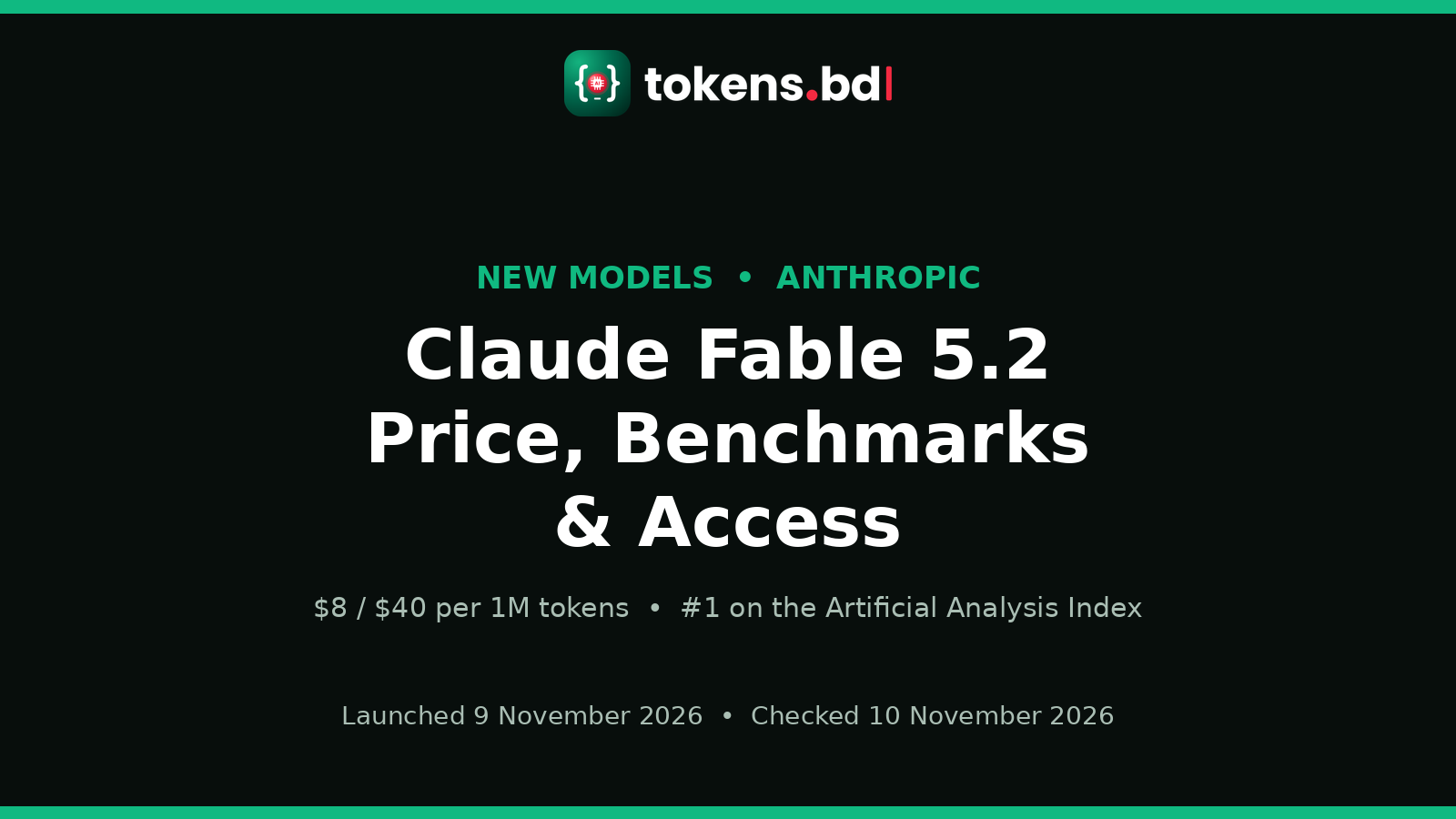
TL;DR — Checked 10 November 2026: Anthropic launched Claude Fable 5.2 (and its restricted twin, Claude Mythos 5.2) on 9 November 2026. It costs $8 per million input tokens and $40 per million output tokens — a 20% cut from Fable 5.1's $10/$50 — with an optional fast mode at $16/$80. It is #1 on the independent Artificial Analysis Intelligence Index v5.0.1 with a score of 65, ahead of Gemini 4 Carbon (60), Claude Opus 5.5 (59), and GPT-6 Astra (57). A heavy coding session (500K input + 50K output tokens) costs $6.00 (≈৳745) on Fable 5.2, or $2.88 (≈৳358) with prompt caching. The API ID is
claude-fable-5-2, it is live today on the Claude Platform, AWS, Google Cloud, and Azure — and it is not on tokens.bd yet (catalog checked 10 November 2026). Do not confuse it with "Claude Fable 5.5", a leak name for a model Anthropic has not released.
What is Claude Fable 5.2?#
Claude Fable 5.2 is Anthropic's new flagship model — the most capable Claude anyone can sign up and use today. It replaces Fable 5.1 at the top of the Claude lineup, and it arrives with an unusual combination: it is both stronger and cheaper than its predecessor. Anthropic announced it on 9 November 2026 alongside Claude Mythos 5.2, which is the same underlying model with fewer cybersecurity and biology safeguards, available only to vetted organisations.
The headline numbers, all from Anthropic's own launch post: outputs run up to 30% faster than Fable 5.1, the price drops 20%, and the model takes first place on the Artificial Analysis Intelligence Index — the first independent confirmation, published the same day. Anthropic's own benchmark table puts Fable 5.2 ahead of Opus 5.5 on nearly every test it reports, with the biggest jumps in agentic coding and long-horizon work: FrontierCode 2.0 rises from 32.4% (Fable 5.1) to 49.1%, and the Remote Labor Index — a measure of multi-hour autonomous work — more than doubles, from 17.9% to 41.3%.
The launch post spends most of its space on what the model did in pre-release testing, and these are Anthropic's own claims, not independently verified results: a team of 1,000 Fable 5.2 agents formalised the proof of Fermat's Last Theorem in 30 hours (the first formalisation took 11 days); it solved two open problems in black-hole physics; it designed three working electronic devices — a home voice-assistant hub, a USB speakerphone, and a handheld virtual pet — from a one-paragraph prompt; and it built a bootable operating system from an empty folder in eight days. Treat these as demonstrations of long-horizon agentic work, not promises about your next coding session.
Under the hood it is a 1M-token-context model with up to 128K output tokens and always-on adaptive thinking. It is available today on the Claude Platform API as claude-fable-5-2, on Amazon Bedrock as anthropic.claude-fable-5-2, on Google Cloud, and on Microsoft Foundry, plus paid Claude plans and Claude Code. It is not on the free plan.
How much does Claude Fable 5.2 cost?#
Fable 5.2 is the rare flagship launch that cuts the price. Every rate below is from Anthropic's Platform pricing docs, checked 10 November 2026. All prices are USD per million tokens.
| Model | Input | Output | Cache write (5-min) | Cache read | Batch |
|---|---|---|---|---|---|
| Claude Fable 5.2 | $8 | $40 | $10 | $0.20 | $4 / $20 |
| Claude Mythos 5.2 | $8 | $40 | $10 | $0.20 | $4 / $20 |
| Claude Fable 5.1 | $10 | $50 | $12.50 | $0.25 | $5 / $25 |
| Claude Opus 5.5 | $4 | $20 | $5 | $0.20 | $2 / $10 |
| Claude Sonnet 5.5 | $2 | $10 | $2.50 | $0.10 | $1 / $5 |
| Claude Haiku 5.5 | $0.10 | $0.50 | $0.125 | $0.01 | $0.05 / $0.25 |
| GPT-6 Astra (OpenAI) | $10 | $50 | $12.50 | $1.00 | $5 / $25 |
| Gemini 4 Carbon, standard (Google) | $4 | $20 | — | $0.20 | — |
Prices checked 10 November 2026. Haiku 5.5 rates shown are for prompts up to 100,000 tokens; longer prompts cost $0.50/$2.50. Carbon's intro price is $2/$10 with an undated step-up to the $4/$20 standard rate shown, and Carbon is still gated to cyber defenders — see our Gemini 4 Carbon guide. Astra charges $20/$75 on requests over 272K input tokens.
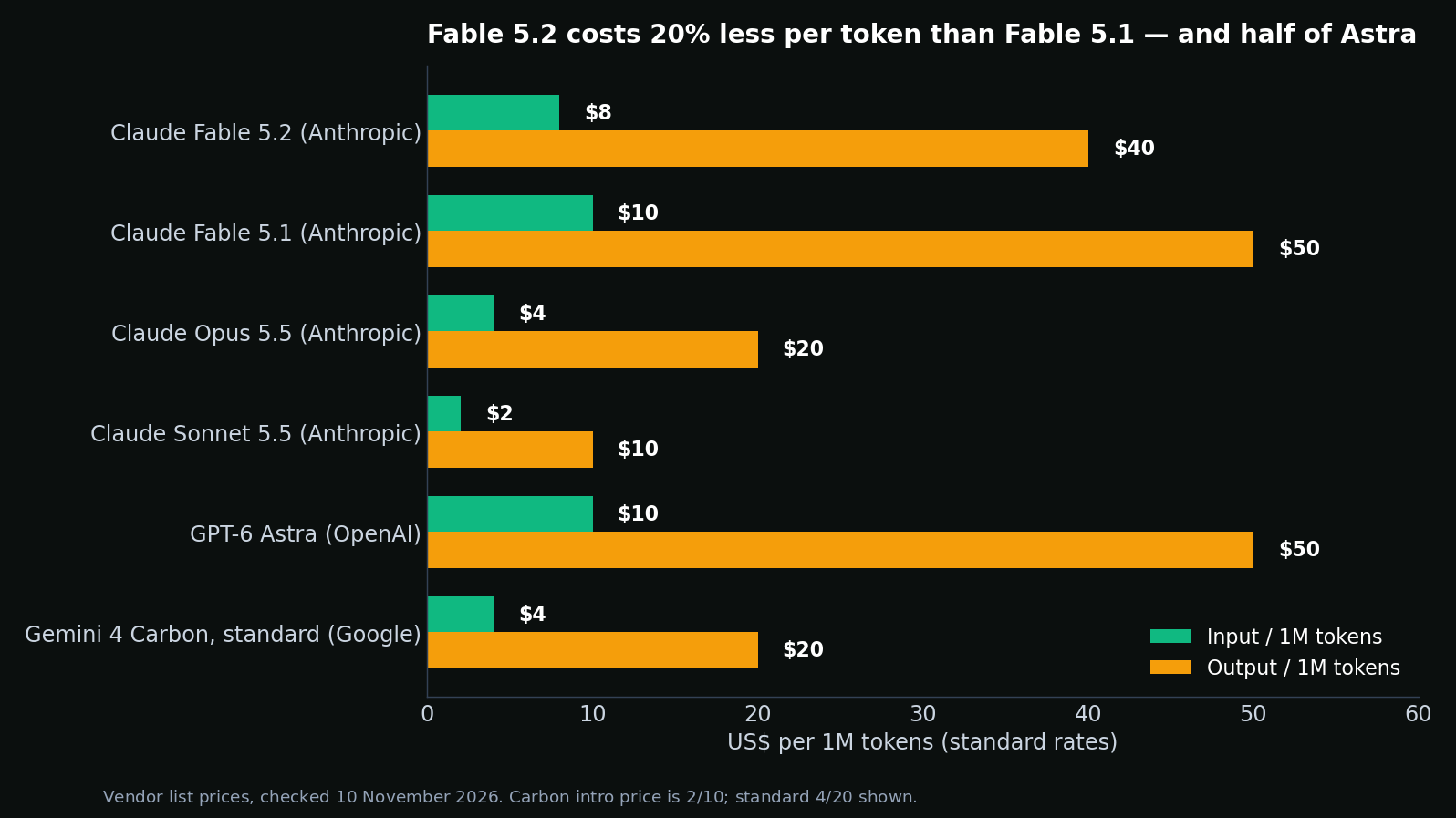
Three things to notice. First, the 20% cut is exact on both sides: (10 − 8) ÷ 10 = 20% on input, (50 − 40) ÷ 50 = 20% on output. Second, Fable 5.2 costs exactly twice Opus 5.5 — $8/$40 against $4/$20 — which makes the upgrade decision a clean question: is the extra capability worth double the per-token price for this task? Third, Fable 5.2's standard price is exactly Opus 5.5's fast-mode price, so the two models' rate cards interlock.
Fast mode is the new lever. For $16 input / $80 output — double the standard rate — Fable 5.2 generates up to 2.5× faster. It is available on the Claude API, Claude Code, Google Cloud, and Microsoft Foundry. Opus 5.5 has its own fast mode at $8/$40. Fast mode does not work with the Batch API, and prompt-caching and data-residency multipliers stack on top of it.
Caching is where Fable 5.2 quietly gets cheapest. A cache read costs $0.20 per million tokens — 2.5% of the input price, far below the standard 0.1× multiplier other Claude models use. A 5-minute cache write costs $10 (1.25× input); a 1-hour write costs $16 (2×). The Batch API halves both input and output to $4/$20, and the 1M-token context window is billed at standard rates — no long-context surcharge, unlike Astra's 272K cliff.
On subscriptions, Pro ($20/month, $17 annual) pays for Fable with usage credits; Max ($100/month) and Ultra ($200/month) include it for up to half the weekly limit, plus $100 and $200 a month in API credits. Launch week adds one to three extra Fable resets for eligible paid subscribers, by subscription length.
How good is Fable 5.2? The benchmarks#
Two sets of numbers matter: Anthropic's own, and the independent ones. Anthropic's table is vendor-reported — the company chose the tests and ran them — so read it as the best case. Artificial Analysis runs its own evaluations and publishes the bill alongside the score, which makes it the more useful check.
Anthropic's benchmark table (vendor-reported, checked 10 November 2026):
| Benchmark | Fable 5.2 | Fable 5.1 | Opus 5.5 | GPT-6 Astra | Gemini 4 Carbon |
|---|---|---|---|---|---|
| FrontierCode 2.0 (agentic coding) | 49.1% | 32.4% | 45.5% | 42.8% | 41.1% |
| FrontierSWE v2 (agentic coding) | 69.9% | 56.3% | 62.3% | 65.5% | 61.2% |
| AutomationBench (business workflows) | 51.4% | 31.4% | 42.5% | 41.4% | 53.9% |
| Terminal-Bench-Science 0.1 | 74.6% | 52.6% | 58.7% | 68.1% | 64.8% |
| WANDR (agentic search) | 82.1% | 68.7% | 72.3% | — | — |
| OSWorld 2.1 (computer use) | 89.3% | 83.5% | 87.2% | 79.5% | 81.5% |
| RoboDojo Sim (robotics) | 64.9% | 27.6% | 39.4% | 29.8% | — |
| Remote Labor Index | 41.3% | 17.9% | 21.3% | 20.8% | — |
| Humanity's Last Exam (with tools) | 74.2% | 65.6% | 67.7% | 57.2% | — |
| Chartography (visual charts) | 73.4% | 44.8% | 64.4% | 71.0% | 72.5% |
Fable 5.2 leads on nine of the ten rows above. The two exceptions are instructive: Gemini 4 Carbon still leads AutomationBench (53.9% vs 51.4%), and Opus 5.5 edges ahead on the AA-Briefcase Elo rating (1800 vs 1785) even though Fable 5.2 wins the same test's rubric score. No model sweeps everything.
The most useful line in Anthropic's own post is a trade-off, not a score: at high effort, Fable 5.2 scores about the same as Opus 5.5 at max effort on FrontierCode 2.0 (45.3% vs 45.5%) for roughly half the cost per task. The top of the effort ladder is for the hardest problems, not the default.
The independent check — Artificial Analysis Intelligence Index v5.0.1 (published 9 November 2026):
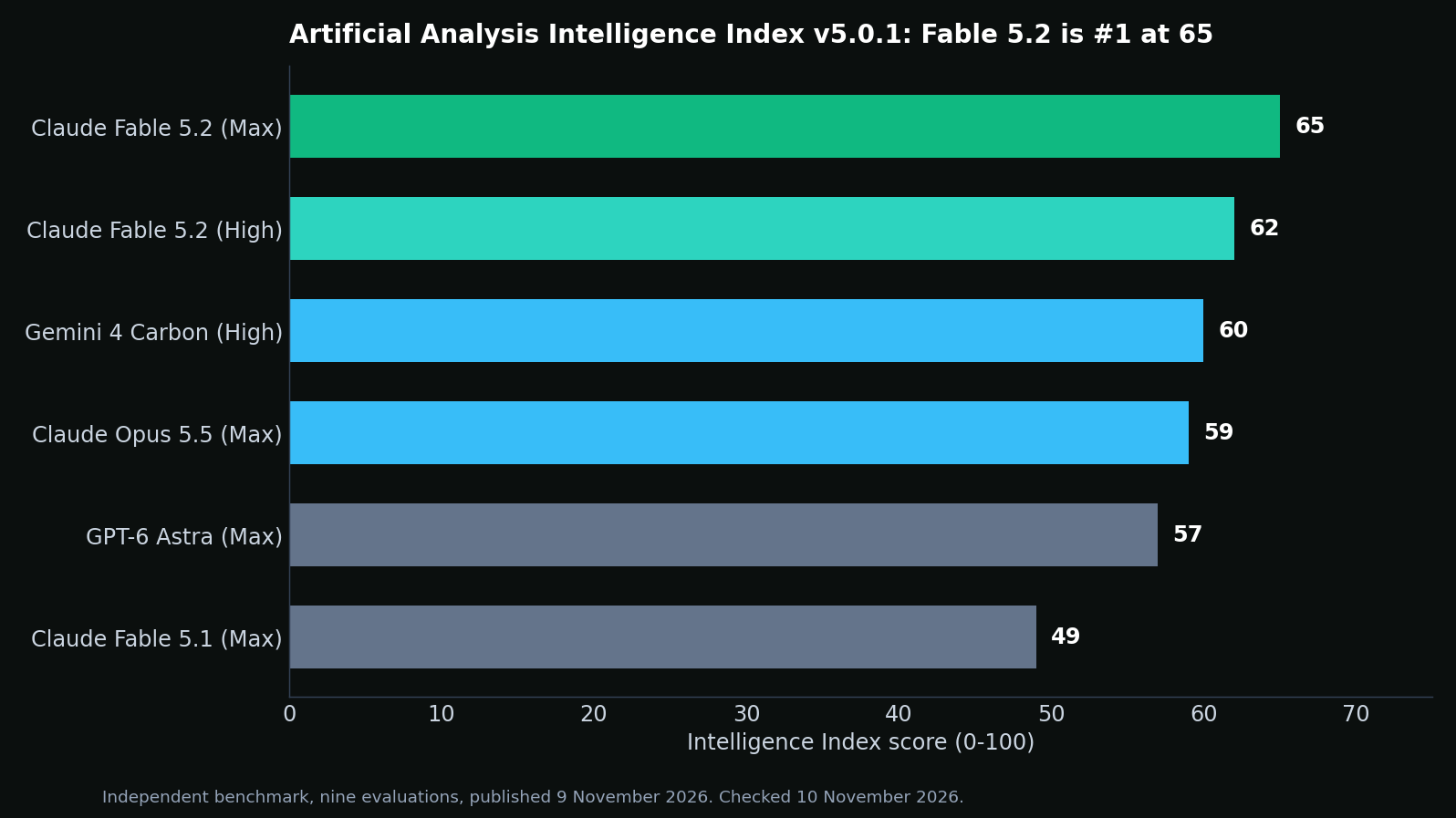
Artificial Analysis puts Fable 5.2 at 65 on the Intelligence Index — first of 74 models, five points ahead of Gemini 4 Carbon (60), six ahead of Opus 5.5 (59), seven ahead of GPT-6 Astra (57), and sixteen ahead of Fable 5.1 (49). At high and extra-high effort it still scores 62, which beats every other model at its best setting. Vals.ai's independent index agrees, ranking Fable 5.2 first at 71.3%.
But the same page publishes the cost of that lead, and it is steep. At max effort, running the index costs $26.54 per task — 2.6× Opus 5.5's $10.04 — and Fable 5.2 ranks 73rd of 73 models on cost, 72nd on speed, and 72nd on verbosity. The run averaged 44.1 minutes per task at max effort, with about 216 seconds to the first answer token. At high effort the picture flips: $9.08 per task, cheaper than Opus 5.5 at max, while scoring 62 to Opus's 59. That is the single most actionable finding in the launch: run Fable 5.2 on high, not max, unless the task genuinely needs the last three index points.
One more honest note from the independent data: on Terminal-Bench 4.0, Fable 5.2 scores 60% — level with Opus 5.5 and behind Gemini 4 Carbon and Claude Sonnet 5.5. The #1 overall ranking does not mean #1 on every test.
What does a coding session cost on Fable 5.2?#
Take one heavy agent coding session — 500K input tokens and 50K output tokens, fresh, no cache — and apply the list prices above. BDT at $1 = ৳124.20 (mid-market, checked 10 November 2026).
| Model | Session cost (USD) | Session cost (BDT) |
|---|---|---|
| Claude Fable 5.2, fast mode | $12.00 | ৳1,490.40 |
| Claude Fable 5.1 | $7.50 | ৳931.50 |
| GPT-6 Astra (≤272K input) | $7.50 | ৳931.50 |
| Claude Fable 5.2 | $6.00 | ৳745.20 |
| Claude Opus 5.5 | $3.00 | ৳372.60 |
| Gemini 4 Carbon, standard | $3.00 | ৳372.60 |
| Claude Fable 5.2, 80% cached | $2.88 | ৳357.70 |
| Claude Sonnet 5.5 | $1.50 | ৳186.30 |
| Gemini 4 Carbon, intro | $1.50 | ৳186.30 |
| Claude Haiku 5.5 | $0.08 | ৳9.32 |
Session costs checked 10 November 2026. Our arithmetic from vendor list prices at $1 = ৳124.20 BDT.
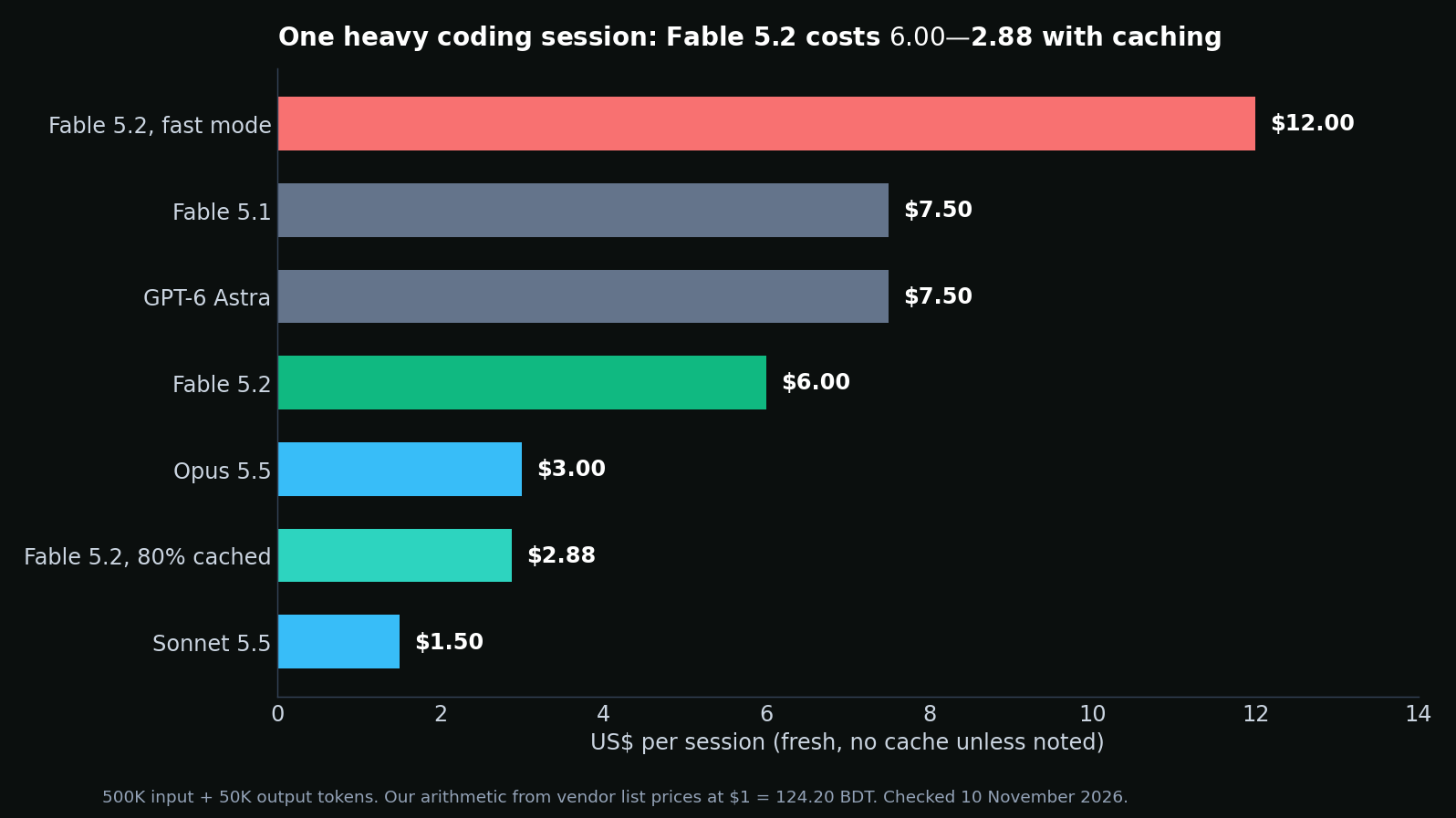
The cached row deserves a worked example, because it is the difference between Fable 5.2 being a luxury and being practical. In a multi-turn agent session the system prompt and repo context are the same on every turn, so cache them. With 80% of the 500K input as cache reads: 400K tokens at $0.20 per million = $0.08, plus 100K fresh input at $8 = $0.80, plus 50K output at $40 = $2.00 — $2.88 total, 52% cheaper than the $6.00 uncached session, and cheaper than an uncached Opus 5.5 session at $3.00. One honest footnote: the first turn pays to write the cache — 400K tokens at the $10 write rate is $4.00, paid once and amortised across every later turn. The longer the session, the more the write disappears.
What does $10 buy? At these session prices: about 1.7 Fable 5.2 sessions, 3.3 Opus 5.5 sessions, 6.7 Sonnet 5.5 sessions, and 133 Haiku 5.5 sessions. Anthropic's $100 monthly API credit on the Max plan buys about 17 Fable 5.2 sessions — or 33 on Opus 5.5. The pricing ladder is doing exactly what it is designed to do: Fable 5.2 is the model you send the work Opus 5.5 fails, not the model you send everything.
When should you use Fable 5.2 — and when should you not?#
Anthropic's own guidance is unusually blunt, and it is the right default: start with Opus 5.5 for most coding and knowledge work, and move up to Fable 5.2 only when the scope and complexity demand it. Fable 5.2 is for the most ambitious, open-ended technical work — multi-day migrations, research-grade problems, work where a failed attempt costs more than the tokens. It can also play two supporting roles Anthropic names explicitly: Advisor, where Haiku, Sonnet, or Opus consult it on the hard parts of a problem, and Orchestrator, where it delegates simpler tasks down to smaller models.
Use Fable 5.2 when:
- Opus 5.5 has already failed the task, or the task is the kind Opus 5.5 is known to fail — long-horizon refactors, ambiguous requirements, multi-step research.
- The work is genuinely open-ended: a migration, a novel algorithm, a problem with no known-good approach.
- You can afford the effort ladder: run it on high, not max. The independent data says high scores 62 (still #1) at $9.08 per task, while max buys three more points for nearly triple the cost.
- Your prompts are cacheable. Long system prompts and repo context turn the $0.20 cache-read rate into the real price of the model.
Do not use Fable 5.2 when:
- The task is routine coding, drafting, or classification. Sonnet 5.5 at $1.50 a session and Haiku 5.5 at $0.08 do that work for a quarter and an eightieth of the price respectively.
- You need speed. At max effort it is among the slowest models Artificial Analysis measures — 44 minutes per index task, 216 seconds to first token. Fast mode helps, at double the price.
- Your organisation runs on zero data retention. Fable 5.2 requires 30-day retention for most customers; a zero-retention workspace gets a 400 error on every request unless Anthropic authorises an exception (Enterprise Frontier Safeguards, currently in private beta, is the route around it).
- The work is cybersecurity or biology research. Fable's safeguards block most of those tasks — that is what Mythos 5.2 is for, and it is gated behind verification.
How do you access Fable 5.2?#
On the API it is a one-line change — the model ID is claude-fable-5-2 — but read the migration section below before you flip production traffic:
import anthropic

client = anthropic.Anthropic()
response = client.messages.create(
    model="claude-fable-5-2",
    max_tokens=8192,
    messages=[{"role": "user", "content": "Refactor this module to async Rust."}],
)
print(response.content[0].text)
Through the Claude apps and Claude Code, Fable 5.2 appears in the model picker on paid plans — Pro pays with usage credits, Max and Ultra include it for up to half the weekly limit. The launch-week promo adds one to three extra Fable resets depending on subscription length. On the cloud platforms it is anthropic.claude-fable-5-2 on Bedrock, and available on Google Cloud and Microsoft Foundry from launch day.
For developers in Bangladesh, the access question has a second half: payment. Direct Anthropic billing needs an international card, which is the exact friction our OpenAI API guide walks through for OpenAI. Fable 5.2 is not on tokens.bd yet — the catalog (47 models, checked 10 November 2026) still tops out at Claude Opus 5.5, Sonnet 5.5, and Haiku 5.5, all at Anthropic's list prices, reachable through the model catalog with BDT payment via pricing. If Fable 5.2 lands there, this post will be updated rather than duplicated.
What breaks when you switch to Fable 5.2?#
Anthropic's own migration guide lists four changes that can break code that works today on Fable 5.1 or Opus 5.5. Check them before you switch, because three fail loudly with a 400 and one fails silently.
- Editing conversation history now fails on every account. Fable 5.2 runs the preserved-thinking prefix check for all accounts: if you change the system prompt, the tool list, or any earlier message and then send back a thinking block produced after that point, the request returns a 400 (
Invalid signature in thinking block). On Fable 5.1, accounts created before 31 August 2026 were exempt. Keep history append-only, or send thethinking-binding-controls-2026-08-01beta to control the behaviour. - Only Fable 5.2 and Mythos 5.2 can read Fable 5.2's thinking blocks. If a router, retry, or refusal fallback moves a conversation to Opus 5.5, Fable 5.1, or a fallback model (Opus 4.8 / Opus 5), the API silently drops those blocks. The request still succeeds and dropped blocks are not billed — but the next turn runs without that reasoning, so expect higher cost and latency on the first turn after any switch.
- The old computer-use tool is gone.
computer_20251124returns a 400 on every platform except Amazon Bedrock. Declarecomputer_toolset_20260801instead. - Advisors must match. With the beta advisor tool, a Fable 5.2 executor accepts only a Fable 5.2 or Mythos 5.2 advisor.
Two more behaviour changes catch people who only swap the model string. First, the default effort is high on the API where Opus 5.5 defaults to medium, so a request that omits effort silently runs one level higher — and costs more — with no error to catch. (In Claude apps and Claude Code, medium is the default.) Second, forced tool use returns a 400: tool_choice of any or a named tool is rejected, as it already was on Opus 5.5 — as are thinking: {"type": "disabled"}, budget_tokens, and non-default temperature, top_p, or top_k. And the retention rule bears repeating: confirm 30-day retention on the workspace before you flip production traffic, or the API rejects every call.
If Claude Code, claude.ai, the Agent SDK, or Managed Agents build your requests, switching is mostly a model-picker change — these are API-surface issues for code that builds the messages array itself.
What is Claude Mythos 5.2?#
Mythos 5.2 is the same underlying model as Fable 5.2 — same weights, same 1M context, same $8/$40 pricing, same fast mode — with fewer cybersecurity and biology safeguards. Fable blocks most penetration testing, exploit generation, binary vulnerability work, and biology research, falling back to Opus 4.8 for cyber and Opus 5 for biology; Mythos does that work directly. Anthropic says Fable 5.2's safeguards now produce about 55% fewer blocks than Fable 5.1 (60% fewer in cybersecurity, 40% fewer in biology), but the blocks are still there by design.
Access is the difference: Mythos 5.2 is restricted to verified organisations through Anthropic's Cyber and Life Sciences Verification Programs, plus Enterprise customers using Claude Security. On the benchmarks, Mythos 5.2's cyber numbers are the strongest Anthropic reports: 76.3% on CyScenarioBench and 89.6% on CVE Rediscovery, finding 10.2% more vulnerabilities than Opus 5.5. For most developers the answer is simple: you will use Fable 5.2, and Mythos 5.2 is a specialist tool for vetted security and life-sciences teams.
Claude Fable 5.2 FAQ#
How much does Claude Fable 5.2 cost? $8 per million input tokens and $40 per million output tokens on the Claude API — 20% less than Fable 5.1's $10/$50. Fast mode costs $16/$80 for up to 2.5× faster generation, the Batch API halves both rates to $4/$20, and cache reads cost $0.20 per million tokens. Prices checked 10 November 2026.
Is Claude Fable 5.2 better than Claude Opus 5.5? On capability, yes — it leads Opus 5.5 on nearly every benchmark Anthropic reports and scores 65 vs 59 on the independent Artificial Analysis Index. On value, it depends: Fable 5.2 costs twice as much per token, and Anthropic itself recommends starting with Opus 5.5 and moving up only when the work demands it. At high effort, Fable 5.2 roughly matches Opus 5.5 at max for about half the cost per task.
What is the difference between Fable 5.2 and Mythos 5.2? They are the same model with different safeguards. Fable 5.2 has strong cybersecurity and biology safeguards and is available to all users; Mythos 5.2 has fewer of those safeguards and is restricted to verified organisations in cybersecurity and life sciences. Same price, same API shape, different access.
Can I use Claude Fable 5.2 on tokens.bd?
Not yet — the catalog (47 models, checked 10 November 2026) lists Claude Opus 5.5, Sonnet 5.5, and Haiku 5.5, but no Fable model. The direct route is the Claude Platform API (claude-fable-5-2), AWS Bedrock, Google Cloud, or Microsoft Foundry. If it lands on tokens.bd, this post will be updated.
What breaks when I switch to Fable 5.2?
Four things, per Anthropic's migration guide: editing earlier conversation history returns a 400 on every account; thinking blocks only work on Fable/Mythos 5.2; the old computer_20251124 tool is gone; and a Fable 5.2 executor needs a Fable/Mythos 5.2 advisor. Also confirm 30-day data retention (zero-retention workspaces get a 400), and set effort explicitly — the API default is high, one level above Opus 5.5's medium.
Sources: Introducing Claude Fable 5.2 and Claude Mythos 5.2, Anthropic · Claude Platform pricing, Anthropic · Claude plans and pricing, Anthropic · Artificial Analysis Intelligence Index v5.0.1 — Fable 5.2 at 65, via OfficeChai · Fable 5.2 migration: the four breaking changes, The Tech Lane · Fable 5.2 migration guide walkthrough, ImportStatic · GPT-6 Astra pricing $10/$50, LaoZhang AI Blog · USD/BDT mid-market rate, Finnhub · tokens.bd model catalog
All prices, benchmarks, and availability checked 10 November 2026. Benchmarks in Anthropic's table are vendor-reported unless marked independent; Artificial Analysis and Vals.ai figures are independent. Fable 5.2 is not on tokens.bd — see the model catalog for the current Claude shelf.