
TL;DR: Dozens of LLM APIs cost $0 right now. Gemini Flash is free via Google AI Studio (roughly 15 requests/min, no card), OpenRouter's
:freemodels give 50 requests/day free — 1,000/day after a one-time $10 credit purchase — Groq serves open models free at 30 requests/min, and Cerebras allows about 1M tokens/day. The catches: free-tier prompts may train the vendor's models (Gemini), free lineups rotate and retire without warning (GitHub Models died 30 July 2026), and no free tier is production-grade. Limits checked 14 October 2026.
Last week we covered which open-weight models are worth running yourself. That's one way to spend $0 — this post is the other: hosted APIs you can call for free. These are genuinely different beasts. Self-hosting costs you hardware and ops time; free API tiers cost you nothing but impose quotas, data policies, and a habit of disappearing. This post maps every serious free LLM API, the exact limits of each, and the four catches the roundup posts bury.
Three kinds of "free"#
Not all free is the same. When a provider says free, it means one of three things:
-
A permanent free tier. No card, a quota that resets — daily, monthly, or per-minute. Gemini's Flash tier, Groq's developer tier, and OpenRouter's
:freemodels live here. The quota is the product constraint; everything else works like the paid API. -
One-time trial credits. A lump of tokens or dollars that expires or runs out. DeepSeek has offered a one-time 5-million-token grant to new API sign-ups; Cerebras's FAQ ties a $5 credit offer to adding a verified payment method, and it expires 30 days after grant. Useful for an evaluation sprint, useless for anything ongoing.
-
$0-priced models on a gateway. The model is free because someone else subsidizes it — usually as marketing. OpenRouter's rotating
:freevariants and Z.ai's GLM Flash models at $0 work this way. The models can vanish from the lineup with no notice.
Neither OpenAI nor Anthropic offers a permanent free API tier — both are trial-credits-only — so if your code speaks the OpenAI API format, the free route to "OpenAI-class" models runs through the gateways and open-model hosts below, not the two frontier labs.
Every free tier, compared#
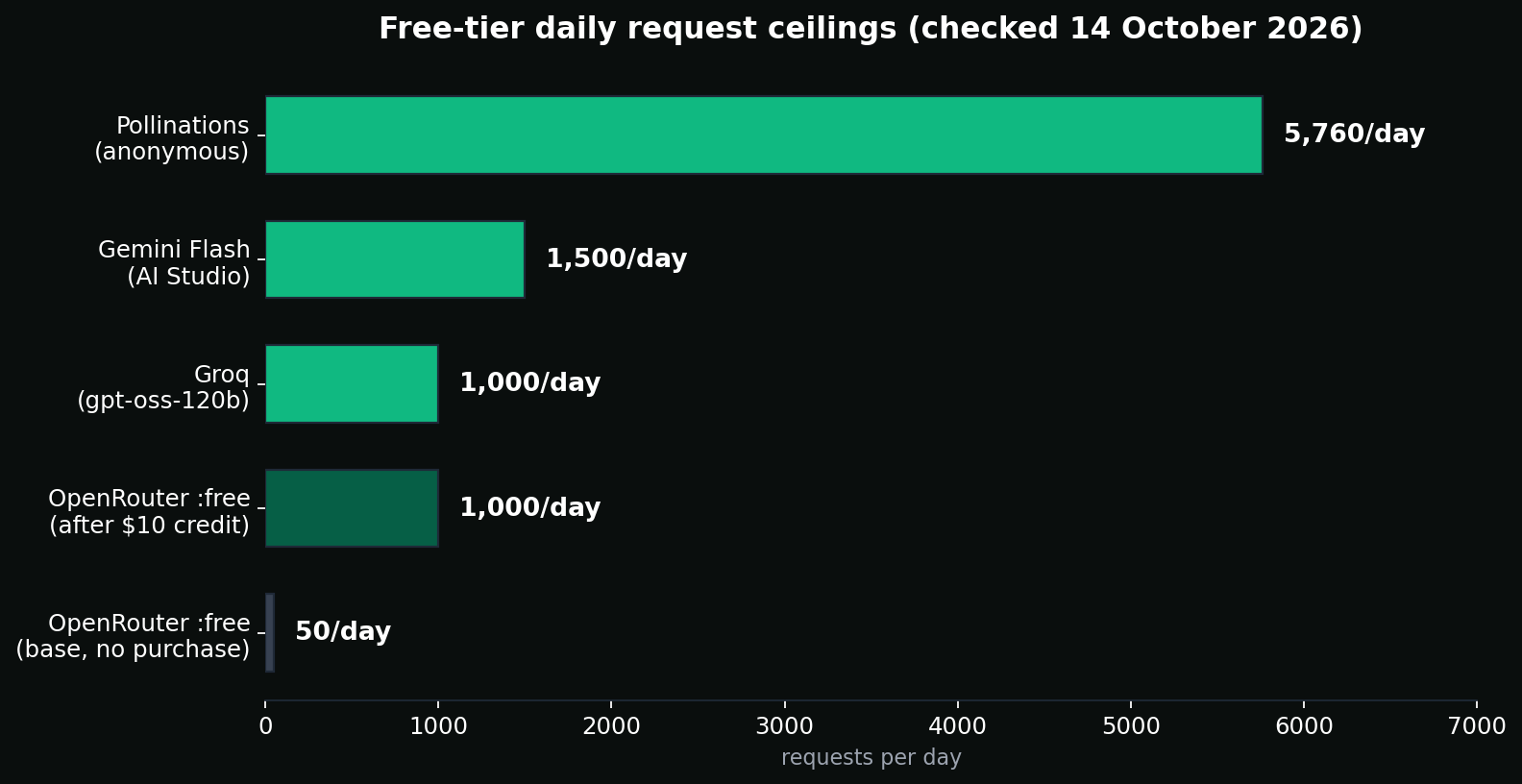
All limits checked 14 October 2026. Free tiers churn constantly — treat every number as a snapshot, not a contract.
| Provider | What is free | Typical limit | Card needed | The catch |
|---|---|---|---|---|
| Google AI Studio (Gemini) | Flash / Flash-Lite class models, free of charge | ~15 RPM / ~1,500 requests/day (Flash); per project, varies by account | No | Free-tier content may be used by Google to improve its products (paid tier commits to the opposite); enabling billing on a project removes the free tier entirely |
| OpenRouter | Rotating set of :free model variants | 50 requests/day, 20 RPM; 1,000/day after the account has ever bought $10 of credit | No | Lineup rotates; upstream providers can rate-limit you separately; a negative credit balance can error even free models |
| Groq | Hosted open models, OpenAI-compatible | e.g. gpt-oss-120b: 30 RPM, ~1,000 requests/day, ~200K tokens/day (per model) | No | Limits are per organization, not per key; subject to change |
| Cerebras | ~1M tokens/day free tier | 30 RPM, 60K–100K tokens/min | No | Context capped on free models; the separate $5 credit offer needs a verified payment method per their FAQ and expires in 30 days |
| Mistral (La Plateforme, "Experiment") | All models incl. Mistral Large and Codestral | ~1B tokens/month, ~1 request/sec | No | Trains on free-tier data, with an opt-out — set it; retention configurable |
| Cohere | Trial API key (Command A class) | ~20 RPM, ~1,000 requests/month | No | No production or commercial use on the trial key |
| NVIDIA NIM | Preview endpoints (e.g. Kimi K3, DeepSeek V4 Pro as of Oct 2026) | No published limits | No (verified NVIDIA account) | Preview program — models and terms change without notice |
| Z.ai | GLM Flash models at $0 | Standard API rate limits | No | Only the Flash-class models are $0 |
| DeepSeek | One-time 5M-token grant on API sign-up | One-time, not a recurring tier | No | Trains on API data with an opt-out; once the grant is spent, it's paid-only |
| Pollinations | Text, image, audio, video over plain HTTP | 1 request / 15 sec anonymous (~5,760/day) | No key at all | Best-effort throughput; possible watermarks on media |
| Cloudflare Workers AI | Serverless inference | 10,000 neurons/day | No (Cloudflare account) | Neuron budget shared across all Workers AI usage |
Best free option for each job#
- Coding prototypes and agents: OpenRouter
:free— one key, OpenAI-compatible, and coding-class free IDs (qwen3-coder-style) keep appearing in rotation. Groq is the faster alternative for hosted open models. Verify the exact model ID before every session; free IDs vanish. - General side projects: Gemini Flash via AI Studio. The highest request ceiling of the bunch and genuinely capable models — just never send anything you wouldn't show Google. If the data is sensitive, Groq's no-training policy is the safer free pick.
- High-volume experiments: Mistral's Experiment tier (~1B tokens/month) or Cerebras (~1M tokens/day). Read the training clauses first: Mistral trains unless you opt out.
- Zero-setup tinkering: Pollinations — no key, no account, plain HTTP. Fine for a weekend experiment, not for anything you care about.
The four catches free-tier roundups hide#
1. Your prompts can train their models. This is the big one. Gemini's free tier may use your content to improve Google's products; Mistral's Experiment tier trains with an opt-out; DeepSeek trains with an opt-out. Groq commits to no training. OpenAI and Anthropic don't train on API data by default. If your prompts contain customer data, proprietary code, or anything under NDA, the free tier is not free — it's a discount paid in data.
2. Free tiers get retired. GitHub Models — previously on every "free LLM API" list — closed to new customers in June 2026 and was fully retired on 30 July 2026 (GitHub's own changelog); playground, catalog, and inference API all went dark. Build anything load-bearing on a free tier and you inherit this exact risk. Treat free tiers as expendable scaffolding: one key, one config line, replaceable in an afternoon.
3. The lineup rotates. OpenRouter's :free models are a rotating set — the ID that works today can be gone next month, and rate limits can be breached at the upstream provider rather than the platform. Pin a fallback chain (two or three :free IDs) instead of one hard-coded model.
4. Quotas are per-project and unpublished. Google doesn't publish fixed per-model free limits; live values only appear behind login in AI Studio's rate-limit dashboard, and the numbers have been cut before (quotas were tightened in December 2025). Verify your own project's limits before depending on them — and never enable billing on your prototyping project if you want to stay on the free tier.
The $10 move: 20x the free quota, forever#
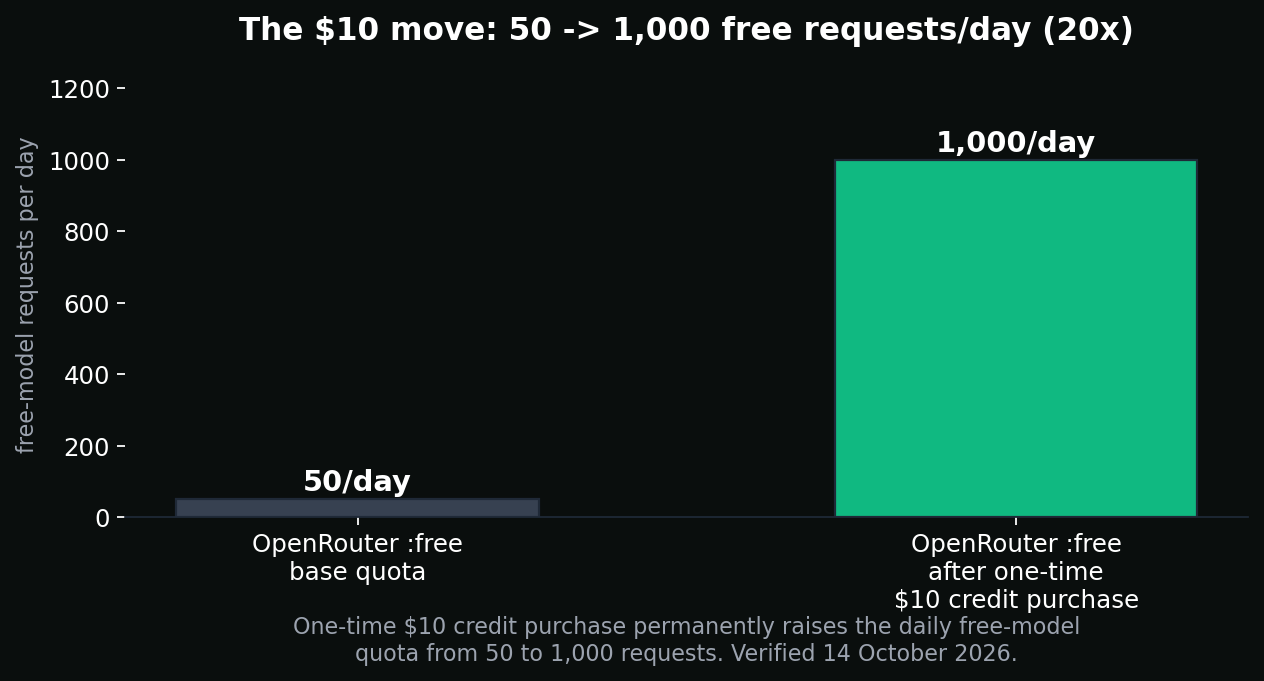
The single highest-leverage action in this whole post: buy $10 of OpenRouter credit once. That one-time purchase permanently raises your free-model quota from 50 to 1,000 requests a day — a 20x increase (1,000 ÷ 50 = 20) that never expires — and the $10 also spends as $10 of paid credits. No subscription, no card-on-file risk beyond the single top-up, no recurring charge.
Compare with the alternatives: Groq and Cerebras give you more generous day-one quotas without any payment, but each is a single provider's lineup. The $10 OpenRouter move buys you the quota on an aggregator that routes across dozens of vendors — which is exactly what you want when free lineups rotate.
How far does "free" get you: a worked example#
Assume one agent coding session = 50 API requests and 550K tokens (500K input + 50K output). These are assumptions to show the arithmetic — replace them with your own.
| Free tier | Daily ceiling | Sessions per day |
|---|---|---|
| Gemini Flash | 1,500 requests | 1,500 ÷ 50 = 30 |
OpenRouter :free (base) | 50 requests | 50 ÷ 50 = 1 |
OpenRouter :free (after $10 purchase) | 1,000 requests | 1,000 ÷ 50 = 20 |
| Groq (gpt-oss-120b) | ~1,000 requests, ~200K tokens | Requests allow 20, but the token ceiling binds first at ~200K tokens |
| Cerebras | ~1M tokens | 1,000,000 ÷ 550,000 ≈ 1.8 |
Two lessons. First, request caps and token caps bind independently — Cerebras's generous-sounding 1M tokens/day covers fewer than two heavy agent sessions, while its request cap would allow far more. Always check both numbers. Second, a single long-context session blows through token-based quotas fast: free tiers are for short turns and experiments, not for dumping a whole repo into context every turn.
When free runs out#
Free tiers are for experiments, prototypes, and learning — not for production, and not for data you can't afford to share. No SLA, no support, rate-limit roulette, and the occasional unannounced retirement. When a project graduates:
- Pay per token on the model catalog — 60+ models, prices in USD and BDT, no monthly fee on the pay-as-you-go wallet.
- Weekly 5X — ৳25/week — $10 in credits, roughly ~5K requests: the cheapest paid on-ramp once free quotas stop covering your habit (full pricing).
- Per-key spend caps with alerts at 50%, 75% and 90% — the guardrail that stops one buggy agent from burning the budget. Compare the gateway options first in Tokens vs OpenRouter, and wire it up with the docs.
The honest summary: use the free tiers hard for everything experimental, keep anything serious on a metered key with a cap, and never let a side project graduate onto a free tier's terms.
Free LLM API FAQ#
Which free LLM API is best for coding?
OpenRouter's :free variants give you one OpenAI-compatible key across a rotating set of models, with coding-class free IDs appearing regularly — but the IDs churn, so verify the current lineup before each session. Groq's free tier is the more stable alternative for fast hosted open models. Neither replaces a paid tier for daily driver work.
Do free tiers use my data for training? Some do. Gemini's free tier may use your content to improve Google's products; Mistral's Experiment tier trains with an opt-out; DeepSeek trains with an opt-out. Groq commits to no training, and OpenAI and Anthropic don't train on API data by default. Paid tiers generally carry no-training commitments — this is one of the real things you buy when you start paying.
Is there a free OpenAI API?
No. Neither OpenAI nor Anthropic offers a permanent free API tier — both are trial-credits-only. The closest $0 routes to OpenAI-class models are OpenRouter's :free IDs (gpt-oss-class models appear in rotation), Groq's free tier, and Pollinations. Any "free GPT API" post you find is describing one of these routes, not an official OpenAI free tier.
Can I use free tiers commercially? Often not. Cohere's trial key explicitly excludes production and commercial use; others vary by provider and can change with the tier. Read the terms for the specific tier you use — and note that a free tier's terms can change without the provider owing you notice.
What happened to GitHub Models' free tier? GitHub closed GitHub Models to new customers in June 2026 and fully retired it — playground, catalog, inference API, and BYOK — on 30 July 2026. It's the textbook example of why free tiers are scaffolding, not foundations.
All limits checked 14 October 2026. Free tiers change constantly — the provider's own docs are the authority, and the model catalog is the authority for prices on Tokens.
Sources: Free LLM API: real limits and catches (2026) · free-llm: 45+ providers with free tiers · Borrowed inference 2026-09 provider audit · OpenRouter free tier, verified 2026-10-08 · 9 free LLM APIs compared: rate limits, card rules and the catch · Gemini provider card: limits and terms · Gemini 3.5 Flash-Lite model card, official docs · AI Studio free-tier setup guide · GitHub Models retirement record