
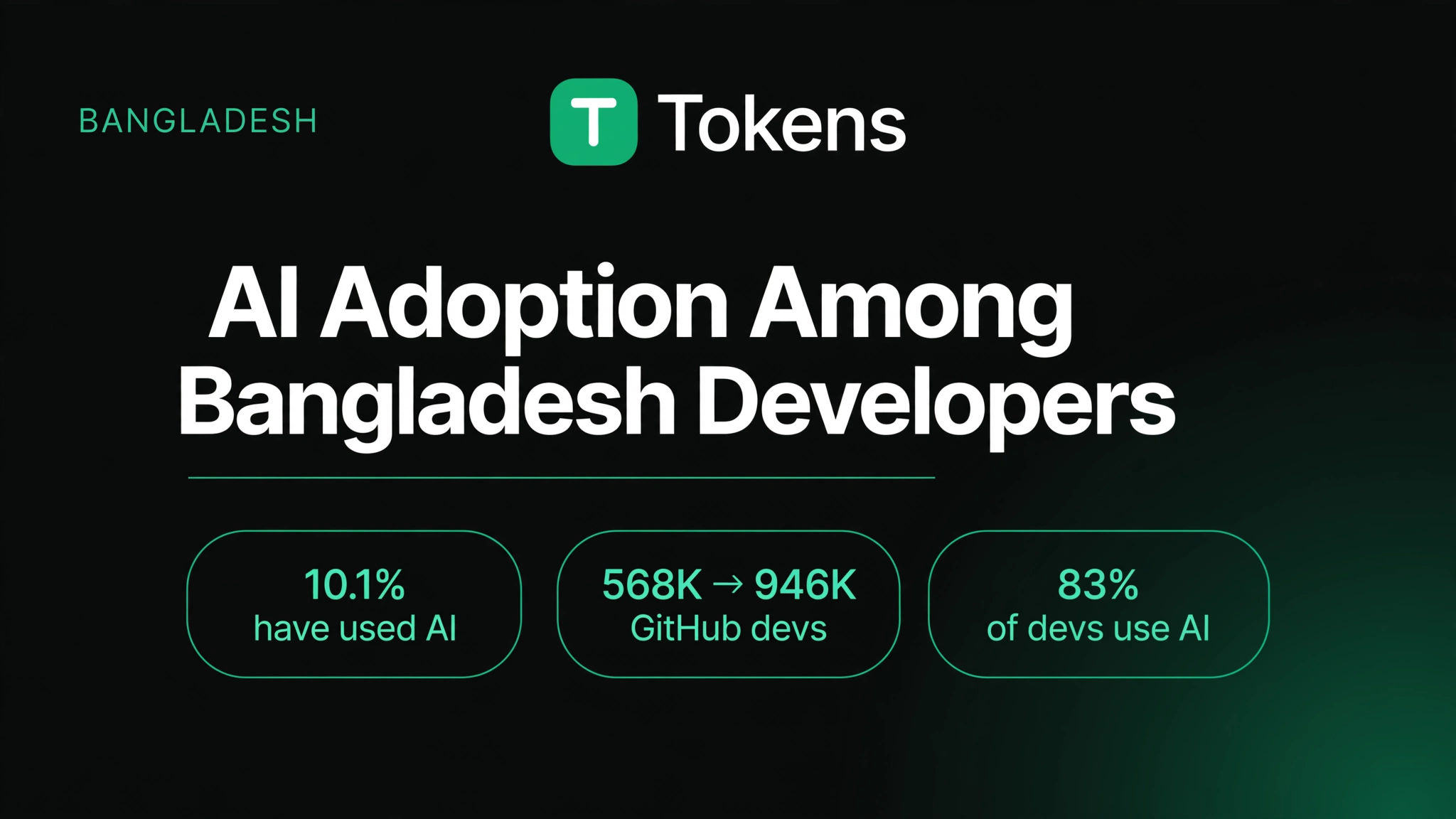
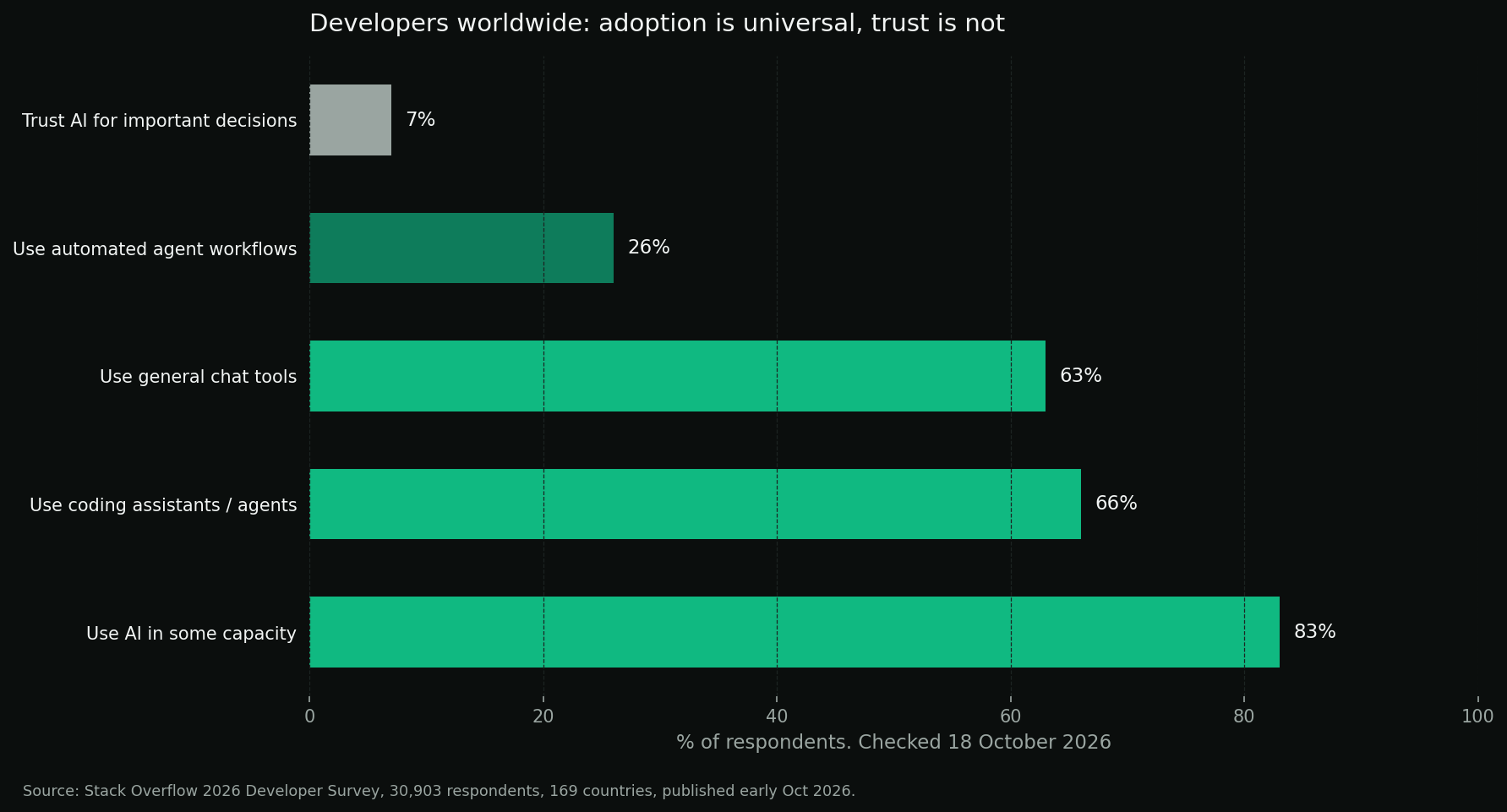
TL;DR: Globally, AI has become the developer default: 83% of developers use AI in some capacity and Claude Code is now the most-used coding agent (66%), ahead of GitHub Copilot (59%), per Stack Overflow's October 2026 survey. In Bangladesh, the picture splits: the developer community is growing fast — 568K to 946K Bangladeshi developers on GitHub in one year — but only 10.1% of Bangladeshi adults have ever used AI, versus a 43% global median (Gallup, September 2026). Among Bangladeshi organizations, 84.5% have yet to adopt AI at all (ECRL, July 2026). All figures checked 18 October 2026.
Angle note: no post in the last 14 days answers this question. Our pricing statistics post mapped global price data, and the benchmarks comparison compared model quality scores. This is the first adoption-data roundup with a Bangladesh lens — it answers "what do 2026 surveys actually say about AI adoption among developers in Bangladesh," not what models cost or which one scores highest.
The headline numbers#
Every figure below is from a named survey published in 2025–2026. Checked 18 October 2026.
| Stat | Value | Source |
|---|---|---|
| Developers worldwide who use AI in some capacity | 83% | Stack Overflow Developer Survey 2026 (30,903 respondents, 169 countries, published early Oct 2026) |
| Most-used AI coding agent | Claude Code, 66% of agent users (GitHub Copilot 59%) | Stack Overflow 2026 |
| Developers who use AI daily | ~80% (at least an hour a day) | Stack Overflow 2026 |
| Developers who trust AI for important decisions | 6.6% | Stack Overflow 2026 |
| Bangladeshi adults who have ever used AI | 10.1% (1.8% daily) | Gallup/Microsoft global research, first-round (37 countries), Sep 2026 |
| Global median for "ever used AI" | 43% | Same Gallup round |
| Bangladeshi organizations yet to adopt AI at org level | 84.5% | ECRL Business AI Adoption & Investment Survey, July 2026 |
| Bangladeshi developers registered on GitHub | 568K → 946K in one year | Kaz Software, citing GitHub data |
| Bangladeshi freelancers | 650K+ professionals, $500M+/yr in foreign exchange | Operators' Edge industry analysis |
| Internet users in Bangladesh | 82.8M | Kaz Software, Aug 2026 |
Globally: AI is already the developer default#
The most important survey of the month landed in early October: Stack Overflow's 2026 Developer Survey, polling 30,903 developers across 169 countries, found AI use has effectively plateaued at saturation — 83% of developers now use AI in some capacity. Among those, 65.9% use coding assistants or agents and 62.5% use general-purpose chat tools; 26.2% have moved to automated agent workflows. Of daily AI users, nearly a third spend four or more hours a day with the technology.
The headline shift inside those numbers: Claude Code has overtaken GitHub Copilot as the most-used AI coding agent — 66% versus 59% among developers using agents. In Stack Overflow's April 2026 pulse survey, Claude Code was at 55%; it gained 11 points in six months. The model preferences behind that shift are nearly tied on current usage (Anthropic 74.6%, OpenAI 74.3%), but when developers were asked which provider they want to keep using next year, Anthropic pulled ahead 49% to 32%. Preference, not habit, is breaking toward Anthropic.
JetBrains' surveys converge on the same conclusion from a different population. Their 2025 State of Developer Ecosystem report (24,534 developers, 194 countries) put regular AI use at 85%, and their January 2026 AI Pulse survey found 90% of professional developers use at least one AI tool at work — with Claude Code at 24% of US/Canadian developers, growing sixfold in about a year. Vendor numbers point the same way: Microsoft said in its FY2026 Q4 earnings call that GitHub Copilot reached 50 million users (vendor-reported; Microsoft didn't specify paid vs. active).
But the survey's most important number is the gap, not the growth. Only 6.6% of developers trust AI for important decisions. Nearly half — 48% — trust it only when they can verify the output themselves, and 78.7% say knowing where an AI-generated answer came from matters to how they evaluate it. Developers also draw a clear line by task: 67% use AI to generate code in areas they already know, 61% use it to debug — but only 20% use it to deploy, operate, or troubleshoot production systems. The profession's posture is: use it everywhere you can inspect it, slow down everywhere else.
Bangladesh: the adoption ladder's bottom rungs#
Now the contrast. Gallup's global AI research (conducted with Microsoft, first round of 37 countries, reported 28 September 2026) put Bangladesh near the bottom of the global table: only 10.1% of Bangladeshi adults have ever used AI — 1.8% daily, 3.4% weekly, 4.9% monthly or less. Another 25.7% are aware of AI but have never used it, and 64.2% say they are not aware of it at all. The median across the 37 surveyed countries is 43%.
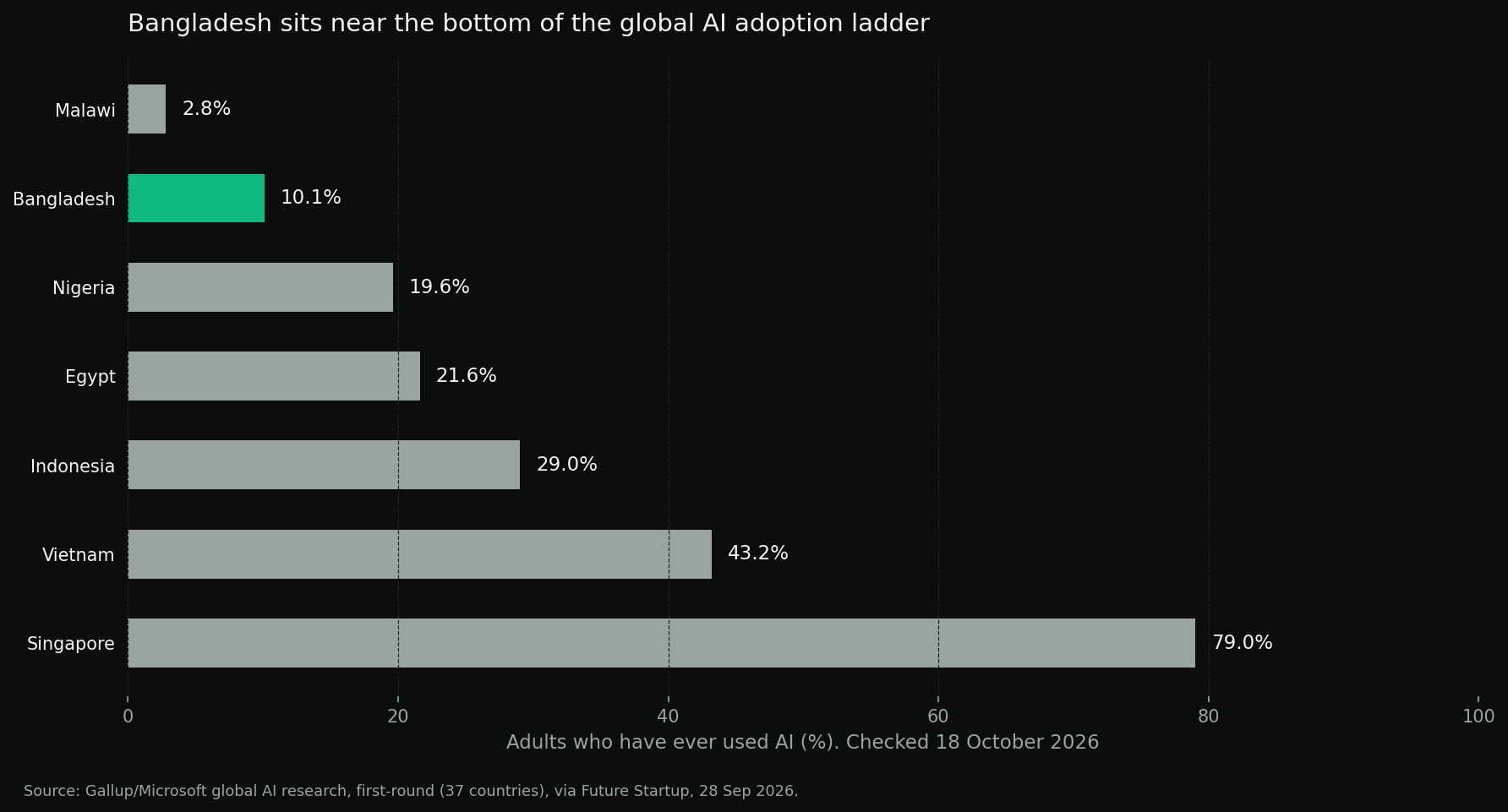
Regional peers aren't exactly thriving either — Vietnam sits at 43.2%, Indonesia at 29.0% — but Bangladesh trails them by wide margins. Singapore's 79.0% shows what the top of the ladder looks like. The country-level gap is mostly awareness, not cost: two-thirds of the country hasn't met the technology yet.
That matters because the developer population is growing fast. Bangladeshi developers registered on GitHub jumped from roughly 568,000 to nearly 946,000 in a single year, and the country's 82.8 million internet users give every new developer a path online. The community is scaling; the awareness ladder hasn't caught up.
The enterprise gap: 84.5% of organizations still on the sidelines#
ECRL's Business AI Adoption & Investment Survey (July 2026) measured the organizational side: only 11.3% of surveyed Bangladeshi organizations have fully adopted AI, and 4.2% are implementing it — 84.5% have yet to adopt AI at all. Among corporates, 18.2% have adopted and 6.8% are implementing; among SMEs, adoption was effectively zero. PwC's 29th CEO Survey (Bangladesh edition) found roughly one in five CEOs report using AI to a large or very large extent across business functions.
The barriers ECRL found are instructive — and fixable. Organizations that hadn't adopted cited high implementation cost (25%), lack of skilled workforce (23%), unclear ROI (17%), data privacy (12%), and lack of awareness (10%). Cost and skills together are nearly half the answer. That maps to the country's draft National AI Policy 2026–2030, which describes adoption as "nascent and largely concentrated in isolated pilot projects within fintech, e-commerce, and academic research," with awareness and expertise "limited among youth, professionals, and policymakers."
One important nuance: individual use is growing much faster than organizational adoption. ECRL reports 62% of employees use AI in the workplace, up from 44% in 2024, while 96% of Bangladeshi internet users reportedly use AI-powered tools in daily life. The tools are in people's pockets; the companies haven't caught up. That bottom-up adoption is the usual path — the UK and US went through the same phase in 2023–24 — and it means Bangladesh's enterprise gap is a lag, not a wall.
The freelancer reality: AI is already changing the job market#
The sharpest numbers in this roundup aren't about adoption — they're about exposure. Bangladesh is the world's seventh-largest freelancing country, with 650,000+ professionals earning over $500 million a year in foreign exchange. That workforce is exactly where AI's displacement pressure lands first.
The Stanford HAI AI Index 2026 found that employment for software developers aged 22–25 — the age band Bangladesh's digital economy runs on — fell nearly 20% from its 2022 peak by September 2025. And research on Bangladesh's freelance economy has documented cases of lower-skilled gig workers seeing earnings fall 50–60% as clients either adopt AI tools directly or use AI's existence to push rates down, on the assumption that routine work is now trivially reproducible.
This is the honest version of the “AI proficiency becomes a job requirement” finding — JetBrains' 2025 survey says 68% of developers expect employers to require AI-tool proficiency. For Bangladeshi freelancers competing globally, that requirement is already live: clients who use AI themselves won't pay pre-AI rates for work AI can draft.
What the numbers mean for a Bangladeshi developer#
Reading these surveys together gives four practical takeaways:
- The verification skill is the skill. Global data says the differentiator isn't who uses AI most — it's who knows when to trust it. 48% of developers trust AI only when they can verify it. Learn to review AI output rigorously; that's the durable advantage as the tools get cheaper.
- The payment barrier is gone. Cost was the #1 adoption barrier for Bangladeshi organizations — but for an individual developer, it no longer holds. On tokens.bd, cheap coding models make a typical agent session cost a few taka, and the Weekly 5X plan at ৳25/week covers hundreds of cheap-model sessions with no international card. Our student-budget guide works through the exact math.
- Coding agents are where the profession moved. Claude Code's jump to the #1 agent spot in six months says the market is standardizing on agentic workflows. If you're still only using a chatbot, the cheapest coding APIs post is the practical on-ramp — and tokens.bd's OpenRouter comparison shows how to get the same models with BDT payments.
- Bottom-up is the playbook. Enterprises are slow, but 62% of employees already use AI at work. Individual developers don't need to wait for their company's AI policy — the BDT pricing guide shows exactly what 1M tokens costs in taka, and Bangla-language work is getting cheaper too (see Bangla NLP with LLMs).
AI adoption in Bangladesh: FAQ#
What percentage of developers use AI in 2026? About 83% of developers worldwide use AI in some capacity, per Stack Overflow's October 2026 survey of 30,903 developers across 169 countries. JetBrains' January 2026 survey found 90% of professional developers use at least one AI tool at work.
How many people in Bangladesh use AI? Only 10.1% of Bangladeshi adults have ever used AI — 1.8% daily, 3.4% weekly — per Gallup's global AI research (September 2026). 64.2% say they are not aware of AI. The median across 37 surveyed countries is 43%.
Which AI coding assistant is most popular in 2026? Claude Code — 66% of developers using AI coding agents use it, ahead of GitHub Copilot's 59% (Stack Overflow 2026). When developers were asked which provider they want to keep using next year, Anthropic led OpenAI 49% to 32%.
Are Bangladeshi companies adopting AI? Slowly. ECRL's July 2026 survey found only 11.3% of organizations have fully adopted AI and 84.5% have yet to adopt it at all. The top barriers are implementation cost (25%) and lack of skilled workforce (23%). Individual use is growing faster: 62% of employees use AI at work, up from 44% in 2024.
Is AI taking freelancing jobs in Bangladesh? The pressure is real. Employment for developers aged 22–25 fell about 20% from its 2022 peak (Stanford HAI AI Index 2026), and researchers have documented 50–60% earnings declines among lower-skilled Bangladeshi freelancers as clients adopt AI tools or use AI to push rates down. But Bangladesh's developer community is also growing fast — 568K to 946K GitHub users in a year.
Survey figures checked 18 October 2026. Surveys are snapshots of self-reported behavior — populations and methods differ between them, so treat cross-survey comparisons as directional, not exact.
Sources: Stack Overflow 2026 survey coverage · Stack Overflow AI findings analysis · JetBrains 2025 ecosystem report · AI coding statistics roundup · Gallup Bangladesh AI adoption · ECRL Business AI Adoption Survey 2026 (PDF) · Bangladesh freelance economy and AI exposure · PwC 29th CEO Survey Bangladesh edition (PDF) · LightCastle: AI adoption in the workplace · Kaz Software: AI software development in Bangladesh