TL;DR — Checked 12 November 2026: Google launched the Gemini Decisions API on 11 November 2026, powered by a new model, Gemini Decision 1 (
gemini-decision-1). It scores up to 1,000 yes/no, multiple-choice, and rubric questions in a single forward pass — no token-by-token decoding — at $0.10 per million input tokens with $0 output tokens, in 150–250 ms end to end. Google's own benchmark table puts it first in 7 of 9 tests against OpenAI's Decisions API and TypeSafe's Jev, with the lowest calibration error — but Jev is still cheaper per token ($0.042) and won the shared-suite cost comparison ($0.68 vs $0.88). The same day, Amazon reported replacing Claude Sonnet 4.6 with its Strands Decider and cutting ticket-classification cost 98%. One million 500-token decisions costs $50.00 (≈৳6,251.50) on Gemini Decision 1 or OpenAI Decisions, and $21.00 (≈৳2,625.63) on Jev direct. Gemini Decision 1 is not on tokens.bd — and Jev, which was on the catalog on 26 October, is no longer listed (checked live 12 November 2026).
Yesterday was the day decision models stopped being a curiosity: Google launched its entry in the morning, and by evening Amazon was on the front page of Hacker News saying it had replaced a frontier model with a decision model on a production ticketing system and cut the cost 98%. Two companies, two models, the same argument — most of what production software asks an AI model is not an essay question, and paying essay prices for a yes/no answer is waste.
What did Google actually launch on 11 November 2026?#
The Gemini Decisions API is a new endpoint on the Gemini API for fast, closed-set decisions, powered by the new Gemini Decision 1 model (gemini-decision-1). It is available through the Gemini API in Google AI Studio, with a no-cost tier for prototyping; Cloud support is coming soon, and integrations are rolling out across OpenRouter, LangChain, Vercel, LiteLLM, Pydantic AI, Pipecat, LiveKit, and OpenCode.
A request carries one shared multimodal input — text, images, audio, video, or PDFs, up to 256K tokens — plus up to 1,000 independent questions. Instead of generating answer text token by token, Gemini Decision 1 scores the candidate options in a single forward pass and returns probabilities and confidence scores. Median model compute is 50–100 ms, with 150–250 ms end-to-end latency, and Google says latency stays nearly flat from 1 to 100 questions per request. The shared input is billed once per request no matter how many questions you evaluate; each question adds only its own instruction and criteria tokens.
There are three question types, and the names matter because they are the whole API surface: noul (yes/no) estimates the probability that a condition holds; choice (multiple choice) picks from 2 to 255 choices, returning the winner and normalized probabilities for every candidate; score (ordered rubric) grades the input across a rubric starting at 0, returning a continuous weighted score and per-level probabilities. Every answer includes a confidence score from 0 to 1, so your code can route ambiguous cases to a fallback or a human reviewer. There are no output-token charges, no variable thinking-token bills, and no separate audio transcription or OCR costs — the bill is input tokens only.
Google's own teams already use it as a low-latency control plane: Gemini Notebook routes queries to the right model tier with up to 40% lower latency, Stitch generates playable wireframes in seconds, and Google Search uses it as a safety layer for MCP tools.
Here is Google's own example from the launch post — a photo of a breakroom counter plus a text note, checked against all three question types in one request:
from google import genai

client = genai.Client(http_options={"api_version": "v1beta"})

result = client.decisions.create(
    model="gemini-decision-1",
    input=[{"type": "image",
            "uri": "https://storage.googleapis.com/generativeai-downloads/images/spill.jpg",
            "mime_type": "image/jpeg"},
           {"type": "text",
            "text": "Breakroom counter check before the 9 AM client meeting."}],
    questions={
        "has_spill": {"type": "noul",
            "instructions": "Is there an uncleaned liquid spill on the counter?"},
        "next_action": {"type": "choice",
            "instructions": "Which cleanup action fits the scene?",
            "criteria": {
                "wipe_with_cloth": "Small counter spill with a cloth nearby.",
                "dispatch_janitorial": "Large floor hazard, broken glass, or active leak.",
                "ready_for_meeting": "Counter is clean and ready."}},
        "severity": {"type": "score",
            "instructions": "Rate the severity of the counter mess.",
            "criteria": ["Clean and ready.",
                         "Minor localized spill.",
                         "Major spill or safety hazard."]},
    },
)
One call, three typed answers, no parsing. That is the entire pitch.
How much does Gemini Decision 1 cost?#
Gemini Decision 1 costs $0.10 per million input tokens and $0 for output tokens — the same input price as OpenAI's Decisions API. The comparison that matters is against the text call it replaces, because that is where the money actually goes.
The table below is this post's original computed dataset. It prices the same workload — 1 million decisions, each on 500 input tokens, so 500 million input tokens — on every route a developer would actually consider, at list prices checked 12 November 2026 and converted at $1 = ৳125.03 (exchange-rates.org, 12 November 2026). The two Responses rows differ only in how much output a text call generates: 50 tokens of JSON-ish answer per decision, and a tight 10 tokens per decision.
| Route (1M decisions × 500 input tokens) | Input cost | Output cost | Total USD | Total BDT |
|---|---|---|---|---|
| Gemini Decision 1 ($0.10/1M in, $0 out) | $50.00 | $0.00 | $50.00 | ৳6,251.50 |
| OpenAI Decisions API ($0.10/1M in, $0 out) | $50.00 | $0.00 | $50.00 | ৳6,251.50 |
| Jev 1.14 direct ($0.042/1M in, $0 out) | $21.00 | $0.00 | $21.00 | ৳2,625.63 |
| GPT-6 Luna via Responses API, 50 output tokens/decision ($0.10 in / $0.50 out) | $50.00 | $25.00 | $75.00 | ৳9,377.25 |
| GPT-6 Luna via Responses API, 10 output tokens/decision ($0.10 in / $0.50 out) | $50.00 | $5.00 | $55.00 | ৳6,876.65 |
| GPT-6 Luna via tokens.bd Responses API, 50 output tokens/decision ($0.15 in / $0.60 out) | $75.00 | $30.00 | $105.00 | ৳13,128.15 |
Prices checked 12 November 2026. Luna list prices are OpenAI's; tokens.bd lists Luna at $0.15/$0.60 per 1M tokens. Gemini Decision 1 and OpenAI Decisions are Google-direct and OpenAI-direct only — neither is listed on tokens.bd's catalog.
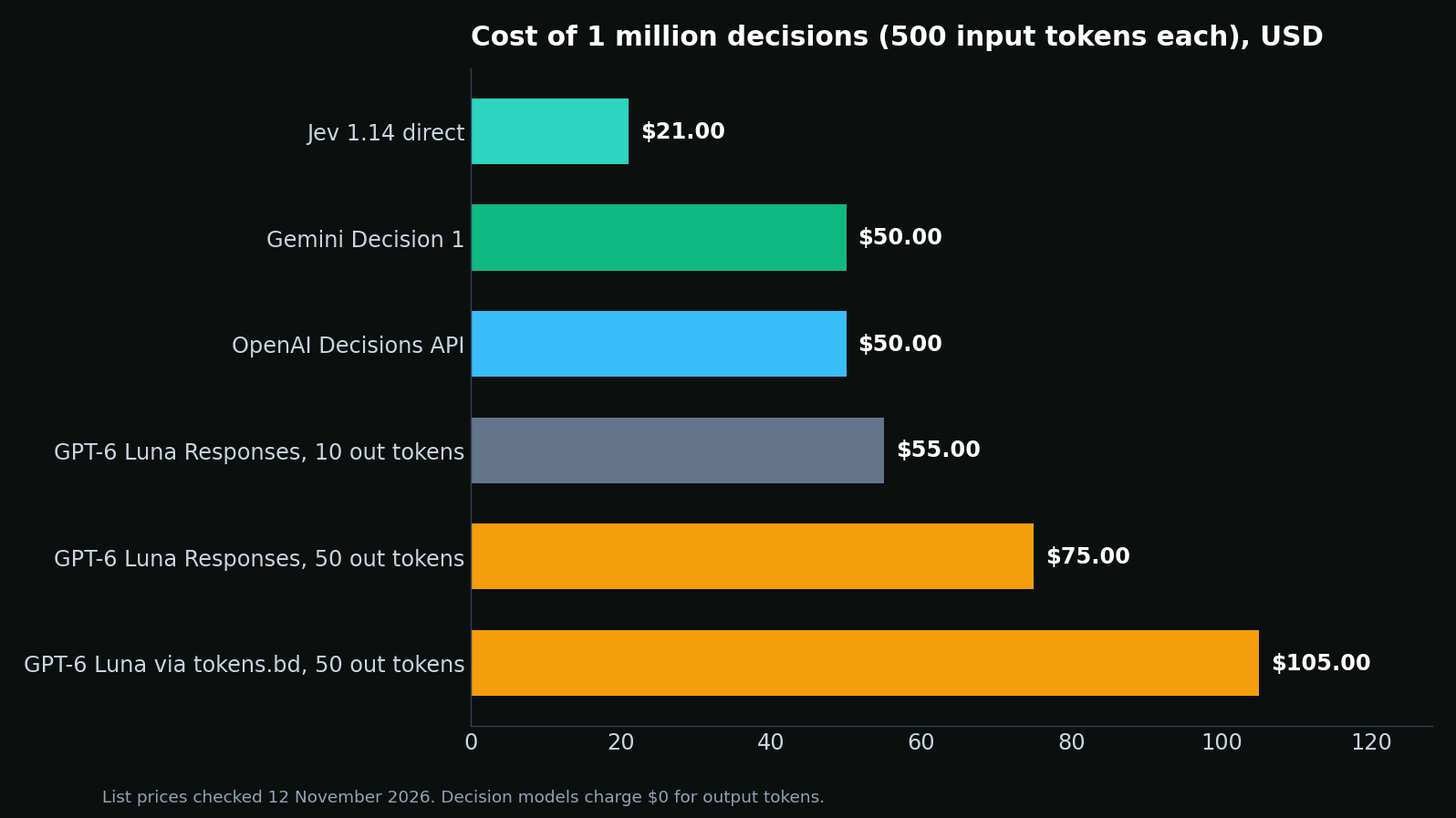
Three readings fall out. First, the two Decisions APIs are priced identically, so the choice between them is about capability: Gemini Decision 1 takes audio, video, and PDFs and 1,000 questions per request; OpenAI's takes text, images, and JSON and 400 questions. Second, Jev is still the cheapest decision route by a wide margin — $21 against $50 is 58% cheaper, $29 kept per million decisions. Third, the per-decision numbers are small enough to mislead: $0.00005 per Decision 1 call, $0.000021 per Jev call. At ten million decisions those fractions become $500 and $210. The tokens.bd row is the honest one for gateway users: with no decision model in the catalog, the only way to answer a branching question through the gateway today is a text call on Luna — $105 per million decisions at the catalog's $0.15/$0.60, against $50 direct.
How does Gemini Decision 1 compare with OpenAI Decisions and Jev?#
| Gemini Decision 1 | OpenAI Decisions API | TypeSafe Jev 1.14 | |
|---|---|---|---|
| Launched | 11 Nov 2026 | 22 Oct 2026 (GA) | 15 Sep 2026 |
| Model | Gemini Decision 1 (purpose-built) | GPT-6 Luna (constrained) | Jev 1.14 (purpose-built) |
| Input price / 1M | $0.10 | $0.10 | $0.042 |
| Output price | $0 | $0 | $0 |
| Cached input / 1M | — (shared input billed once) | $0.01 | — |
| Max questions / request | 1,000 | 400 | Not published as a cap |
| Question types | noul, choice (2–255), score | predicate, choice, score (2–10 levels) | noul, choice (up to 255), score (2–10 levels), box (experimental) |
| Input modalities | Text, image, audio, video, PDF | Text, image, native JSON | Text, JSON; images experimental (opt-in header, not production-ready) |
| Context window | 256K tokens | ~1.1M (Luna) | 64K per request; 262K experimental |
| Latency (vendor claim) | 150–250 ms end to end | ~100–180 ms | 70–500 ms |
| Availability | Gemini API (AI Studio); Cloud support coming soon | OpenAI API only | TypeSafe API; also on OpenRouter, Cloudflare Workers AI, Vercel AI Gateway |
| Free tier | No-cost tier in AI Studio for prototyping | None | None |
Prices and specs checked 12 November 2026 against Google's launch post and Decisions API docs, OpenAI's Decisions API guide, and TypeSafe's Jev docs.
Jev created the category in September and is still the price leader. OpenAI answered in October by constraining its cheapest frontier model to bounded answers. Google answered in November with a purpose-built model that matches OpenAI's price exactly and beats both rivals on breadth: more questions per request, more input modalities, a purpose-built model instead of a constrained generalist. The one dimension where Google does not lead is price — Jev's 2.4× advantage there is why Google's benchmark table includes a cost row, which Jev wins.
What do Google's benchmarks actually prove?#
Google published a comparison table with its launch post, testing Gemini Decision 1 against Jev 1.14, GPT-6 Luna on OpenAI's Decisions API, and its own Gemini 3.5 Flash-Lite. Decision 1 takes first place in 7 of the 9 benchmarks, with the lowest calibration error. The numbers below are Google's own figures — they have not been independently verified, and the table is the only source for them.
| Benchmark (Google's table) | Gemini Decision 1 | Jev 1.14 | GPT-6 Luna (OpenAI Decisions) |
|---|---|---|---|
| JevBench (public split) | 92.2% | 90.0% | 90.9% |
| Amazon ESCI (Macro-F1) | 58.7% | 56.7% | 54.7% |
| PubMedQA | 79.8% | — | 74.4% |
| New Yorker caption contest | 79.7% | 72.0% | 68.4% |
| When2Call (when to use a tool) | 79.9% | 82.0% | 70.4% |
| Mind2Web Multimodal | 86.2% | 86.8% | — |
| Calibration error, Top-1 ECE (lower is better) | 0.0250 | 0.0494 | 0.0721 |
| Cost of seven shared tests | $0.88 | $0.68 | $0.93 |
Benchmarks checked 12 November 2026 against Google's launch post and same-day coverage of its table (SiliconANGLE, MarkTechPost). Jev wins two of the nine tests; the audio and video tests have no Jev or OpenAI score because neither accepts those inputs.
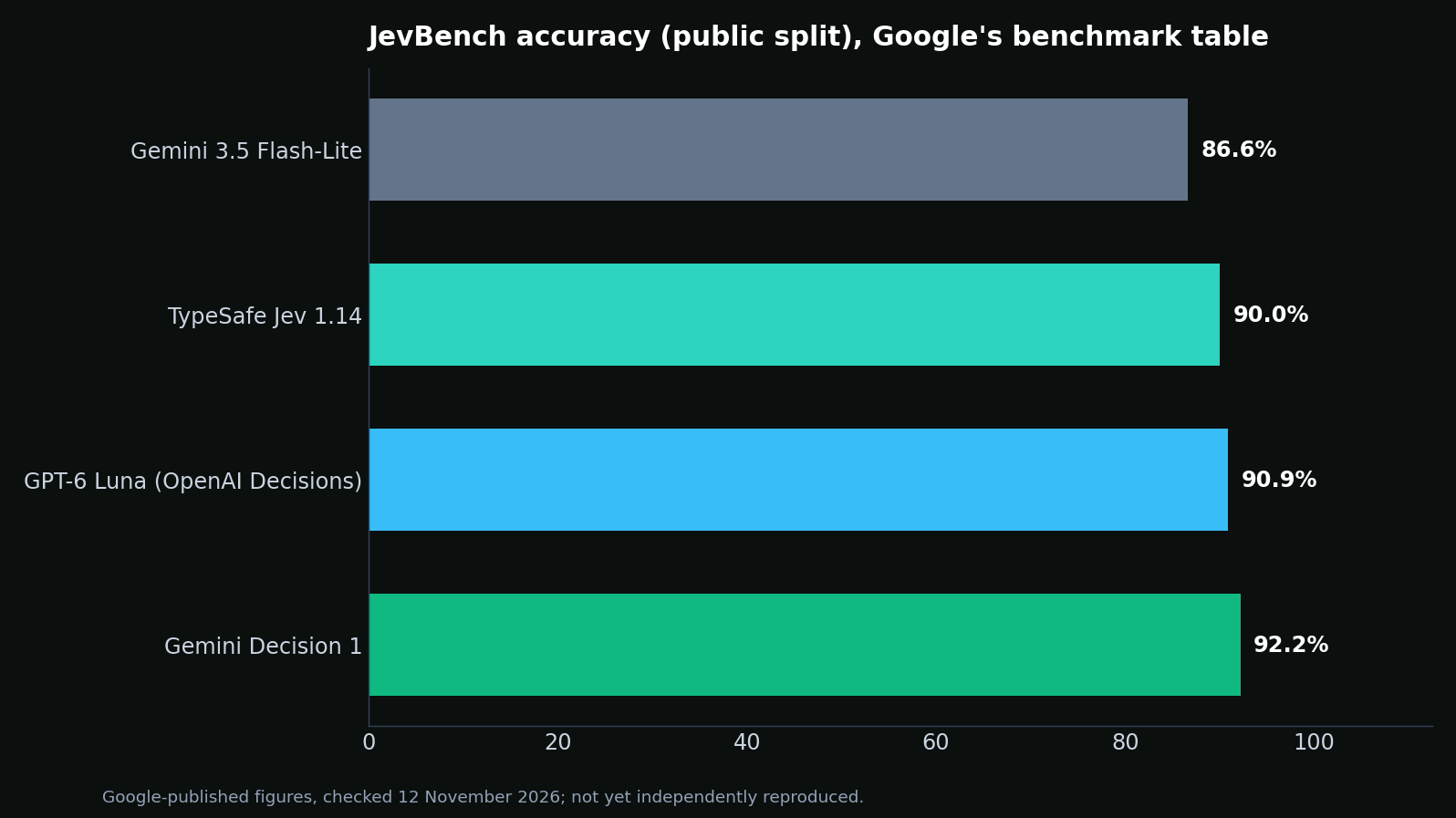
Two numbers deserve more attention than the headline. The first is calibration error: Decision 1's 0.0250 is about half of Jev's 0.0494 and about a third of Luna's 0.0721. Calibration is what makes a decision model usable in production — a model that says 90% and is right about nine times in ten lets your code trust its confidence and threshold on it. On this measure Google's lead is larger than on accuracy, and it is the strongest argument in the launch. The second is the cost row, which Jev wins: $0.68 against $0.88 for the seven shared tests. Decision 1 wins seven tests and still costs more to run them, because its input price is 2.4 times Jev's. Google built the more accurate, better-calibrated model; TypeSafe still sells the cheaper call.
The two tests Jev wins are also the two that matter most to agent builders. When2Call — judging when a model should use a tool — goes to Jev 82.0% to 79.9%, and Mind2Web Multimodal goes to Jev 86.8% to 86.2%. If your decision workload is routing agent tool calls, the cheaper model is also the better one on the published numbers.
Amazon's 98% saving: the same-day proof#
The second story of 11 November is the one that makes Google's launch feel like a movement rather than a product. Two Amazon engineers published that they replaced Claude Sonnet 4.6 with Amazon's Strands Decider — a decision model Amazon launched about a month earlier — on a large internal ticketing system, and the post hit #1 on Hacker News the same day.
The numbers from their post, as reported the same day: cost per ticket fell from $0.0222 with Sonnet to about $0.0005 with Decider — roughly $22,200 against $500 per million tickets, about 44 times cheaper, a 98% reduction. Average call time fell from 4,215 ms to 897 ms. Input tokens per ticket fell from 6,554 to 2,009, and output tokens from 170 to 1. The headline claim is that Decider "performed just as well" and will "save millions of dollars of token costs in a year."
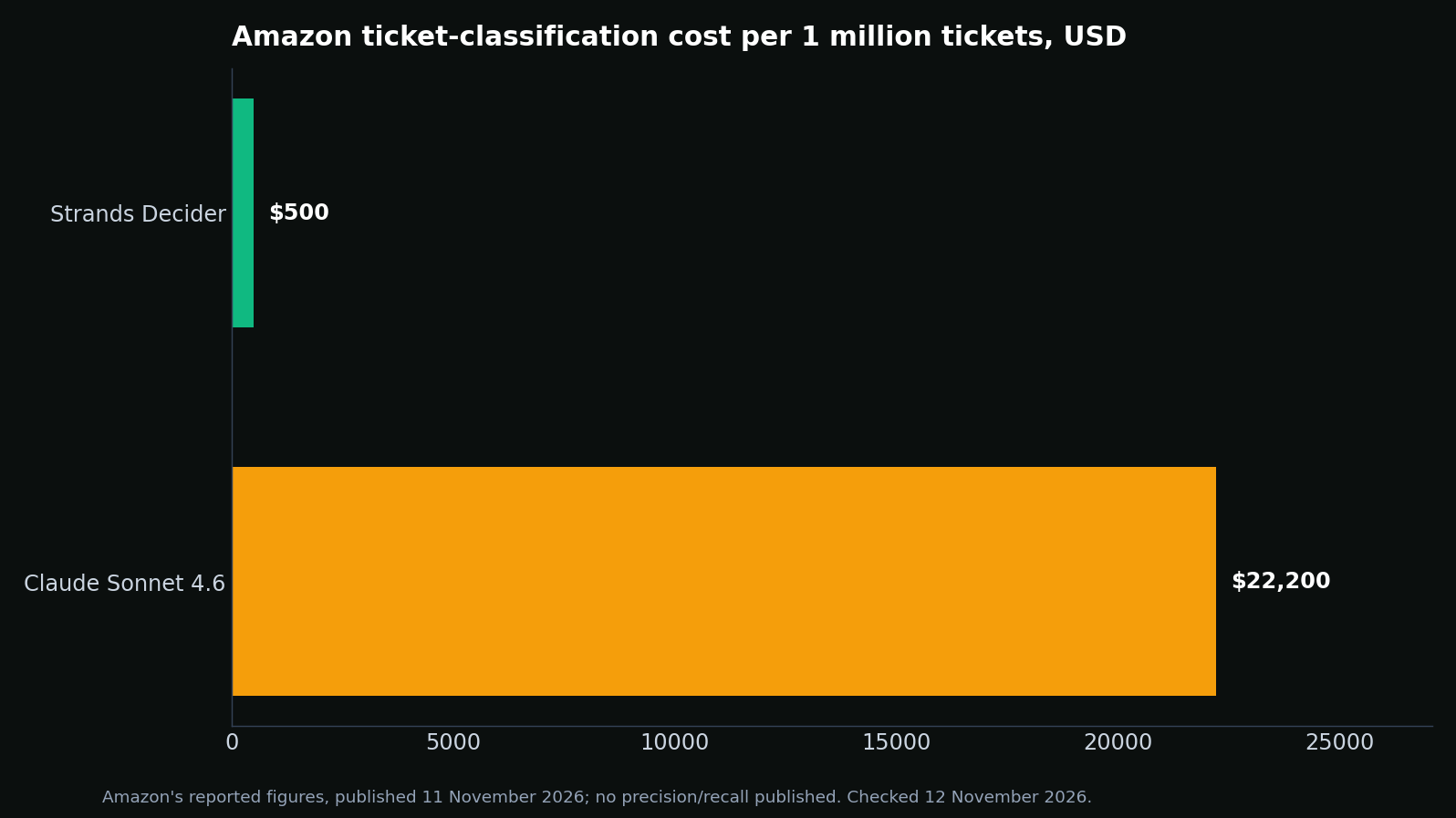
Read the caveats before the celebration. The post publishes no precision, recall, or sample size — "just as well" is doing a lot of work. "Millions" is a projection: no ticket volume is disclosed, so the math cannot be checked. It is Amazon's own product on Amazon's own blog, so it is a launch story as much as an engineering story. And the model has a 4,096-token window, so the team rewrote every label as a one- or two-sentence criterion and drops the oldest comments on long tickets. The authors' own limits are the most useful part: it worked because "the task is a closed choice from a known catalog, the volume is high, and the latency of the old path mattered." If you need explanation text, your catalog changes weekly, or the useful context won't fit in a few thousand tokens, a decision model probably can't do the job. The lesson is not "replace every model with a decision model" — it is "go back and check whether the job you gave a frontier model last year is still a frontier job."
Is Gemini Decision 1 on tokens.bd?#
No — and this post does not promise it. Gemini Decision 1 is a Google-direct API, available through AI Studio, and it is not in the tokens.bd catalog. Neither is OpenAI's Decisions API, which is an OpenAI endpoint, not a catalog model.
There is a second, bigger change since our last decision-model post on 26 October: Jev is no longer on tokens.bd. The catalog, checked live today, lists 47 models from 10 providers and contains no TypeSafe entry — the $0.04-per-million Jev route that post recommended is gone. That matches what Badsha told a customer live on 5 November, that Jev would be removed because it needs technical setup. The removal is now visible in the catalog, and this post is the first to record it.
That leaves gateway users with no decision model in the catalog today. The honest comparison for a developer in Bangladesh is therefore Decision 1 or OpenAI Decisions direct — both need an international card — against a text call through the gateway, which the cost table above prices at $105 per million decisions on Luna's catalog rate. When a decision model lands on a gateway, the $50 and $21 rows above are the prices to compare. Setup for the gateway's models is in the docs, and the catalog is at the model list.
Should you switch to a decision model?#
A ranked verdict, because "should you switch" depends on what your workload actually asks for:
- Jev 1.14 direct, if you want the cheapest decisions and text or JSON is enough. $21 per million 500-token decisions, no output charge, the best When2Call and Mind2Web scores on Google's own table, and a 262K experimental context behind a header. Accept text-only evidence in production (images are experimental) and an API that is still in early access.
- Gemini Decision 1, if your evidence is multimodal or your volume is agent routing. $50 per million decisions, 1,000 questions per request, audio, video, and PDF inputs no rival takes, the best calibration error in the category, and a no-cost tier in AI Studio to prototype on. The right pick when the evidence is a photo, a call recording, or a scanned claim form.
- OpenAI Decisions API, if you are already on OpenAI and need the largest context or JSON inputs. $50 per million decisions, native JSON inputs, prompt caching at $0.01 per million cached tokens, and Luna's ~1.1M-token window. The right pick when the state is a long conversation or a structured record.
- A text call, only when the decision needs words attached. If the same call must also write the reply, extract fields, or call a tool, generation is the job and no decision model can do it — but at 50 tokens per decision you are paying $75 per million where Decision 1 charges $50. Our model routing guide shows how to send only the branching calls to a decision route.
Do this week: list every place your code regexes, JSON-parses, or string-matches an LLM answer into a branch — those are decision calls wearing a text call's price — and try one on Gemini Decision 1's no-cost tier in AI Studio. If you route agent tool calls, run Jev and Decision 1 in parallel on your own labelled examples before switching: Jev leads When2Call on Google's table and costs less, Decision 1 leads on calibration, and the threshold you set from your own data matters more than either vendor's table. Our OpenAI Decisions vs Jev post explains the category in depth, and the function-calling guide covers the cases where a decision model is the wrong tool.
Gemini Decision 1 FAQ#
What is Gemini Decision 1?
Google's purpose-built decision model, launched 11 November 2026 with the Gemini Decisions API. Instead of generating text token by token, it scores up to 1,000 yes/no, multiple-choice, and rubric questions in a single forward pass and returns probabilities with confidence scores. Model id gemini-decision-1.
How much does Gemini Decision 1 cost? $0.10 per million input tokens, $0 for output tokens. The shared input is billed once per request no matter how many questions you evaluate. One million 500-token decisions costs $50.00 (≈৳6,251.50). There is a no-cost tier in Google AI Studio for prototyping.
How does it compare with OpenAI's Decisions API and Jev? On price, Decision 1 ties OpenAI Decisions at $0.10 per million input tokens; Jev is cheaper at $0.042. On Google's own table, Decision 1 leads 7 of 9 tests with the lowest calibration error (0.0250 vs Jev's 0.0494 and Luna's 0.0721), but Jev wins two tests (When2Call, Mind2Web) and the shared-suite cost ($0.68 vs $0.88). Decision 1 takes the most questions per request (1,000 vs 400) and the most input types (text, image, audio, video, PDF).
Is Gemini Decision 1 on tokens.bd? No. It is available direct from Google through AI Studio. It is also not in the tokens.bd catalog, and neither is OpenAI's Decisions API. Jev, which was on the catalog on 26 October, is no longer listed (checked live 12 November 2026).
When should I not use a decision model? When a human or regulator needs to know why (no decision model returns a rationale), when the answer must be generated text or fields in your own schema (use structured outputs instead), or when the decision is narrow, stable, and high-volume enough to train a dedicated classifier for. See our structured outputs guide for the text cases.
Prices, benchmarks, and access routes checked 12 November 2026 against Google's launch post and Decisions API docs, OpenAI's Decisions API guide, TypeSafe's Jev docs, Amazon's Strands Decider post, and tokens.bd's live catalog. Google's benchmark figures are Google-published and not yet independently reproduced; the model catalog and pricing cover tokens.bd.
Sources: Google — Gemini Decisions API: Fast, calibrated multimodal decisions (11 Nov 2026) · Google — Gemini API pricing · Google — Decisions API documentation · SiliconANGLE — Google enters decision model market with Gemini Decisions API (12 Nov 2026) · MarkTechPost — Google Launches Gemini Decisions API With Gemini Decision 1 (11 Nov 2026) · OpenAI — Decisions API guide · TypeSafe — Jev documentation · Amazon — Strands Decider ticket-classification post, via Medium analysis (11 Nov 2026) · tokens.bd model catalog · tokens.bd pricing · USD/BDT rate, exchange-rates.org