
OpenAI on Google Cloud: The Developer's Buying Guide
TL;DR: On 21 October 2026, OpenAI and Google Cloud announced that OpenAI's frontier models — GPT-6 Astra, GPT-6.1 Sol, GPT-6 Luna — plus the Codex coding agent will be sold through Google Cloud Marketplace and run in Model Garden, with general availability in the coming weeks (private preview for select enterprise customers now). Usage lands on your single Google Cloud invoice, draws down existing GCP spend commitments, and counts toward Flexible Savings Plans. The prices themselves don't change — OpenAI list rates still apply — so this is a procurement and governance story, not a discount. For developers in Bangladesh, the international-card barrier stays: GCP bills in USD. And on the same day, OpenAI tightened its Usage Policies: model routers and AI gateways need OpenAI's review and approval before offering its models, effective 20 November 2026 — check your gateway provider's status before that date. All facts checked 22 October 2026.
Yesterday OpenAI's models lived behind two doors: OpenAI's own API, or a cloud distributor. This week a third door opened — and it matters most if your company already writes big checks to Google Cloud. What exactly changed, what it costs, and which door you should walk through: that's this post.
What did OpenAI and Google actually announce?#
The deal is simpler than the headlines make it sound. OpenAI's newest models and the Codex coding agent are coming to Google Cloud's Model Garden — the catalog where GCP customers discover and deploy AI models — and they'll be purchasable through Google Cloud Marketplace. Reuters reported it on 21 October, and Google's own cloud blog (published the same day) confirms the mechanics. The story hit Hacker News' front page within hours — developers noticed.
This is the third leg of OpenAI's post-Microsoft distribution strategy. Its exclusive distribution arrangement with Microsoft expired in April 2026; AWS was added after that; Google Cloud is now the latest hyperscaler in the lineup. Google's positioning line, from its blog: it's "the only hyperscale cloud provider offering access to all three leading closed source LLMs" — Gemini, Claude, and GPT — alongside 200+ other models on one platform. That framing is marketing, but the neutral-platform pitch is real: hyperscalers are becoming the main commercial channels for frontier labs. Reuters notes the precedent — 47% of Anthropic's 2025 revenue came through Amazon and Google's cloud platforms, per its IPO filing. Nearly half. Distribution through clouds isn't a side channel anymore; it's the channel.
What the announcement does not include: a firm general-availability date ("coming weeks"), Marketplace-specific pricing, or a full model list beyond the three named models plus Codex. Treat any blog claiming otherwise as speculation.
Which OpenAI models are included — and which aren't?#
Google names three models rolling out now in private preview to select enterprise customers, with "more coming soon":
- GPT-6 Astra — the flagship, for coding, computer use, professional work, and scientific research.
- GPT-6.1 Sol — near-Astra intelligence at lower cost, aimed at agentic coding and professional work.
- GPT-6 Luna — the fast, cost-efficient everyday model for work at scale.
Codex rides along too: starting at announcement, customers can connect local Codex CLI and Desktop workflows to Google's platform for inference, and OpenAI models are "coming soon" to Gemini for business and Google Antigravity.
The prices that matter — OpenAI's list rates, which the Marketplace route transacts at. Checked 22 October 2026 against OpenAI's published rates (corroborated by independent trackers):
| Model | Input / 1M | Cached input / 1M | Output / 1M | In BDT (input / output) |
|---|---|---|---|---|
| GPT-6 Astra | $10.00 | $1.00 | $50.00 | ৳1,237.00 / ৳6,185.00 |
| GPT-6.1 Sol | $2.00 | $0.10 | $10.00 | ৳247.40 / ৳1,237.00 |
| GPT-6 Luna | $0.10 | $0.01 | $0.50 | ৳12.37 / ৳61.85 |
BDT at ৳123.70 per USD (mid-market, checked 22 October 2026). Arithmetic: e.g. $10.00 × 123.70 = ৳1,237.00; $50.00 × 123.70 = ৳6,185.00.
Two things to notice. First, the staircase is steep: Astra input costs 100× Luna input per token, and Sol sits at exactly one-fifth of Astra on both ends. Second, the models not named: the GPT-5.6 family doesn't appear in the announcement, and — honestly — neither does a full list. "More coming soon" is doing real work in that sentence. Don't assume your favorite model ID is covered until you see it in Model Garden.
How does buying OpenAI through Google Cloud Marketplace actually work?#
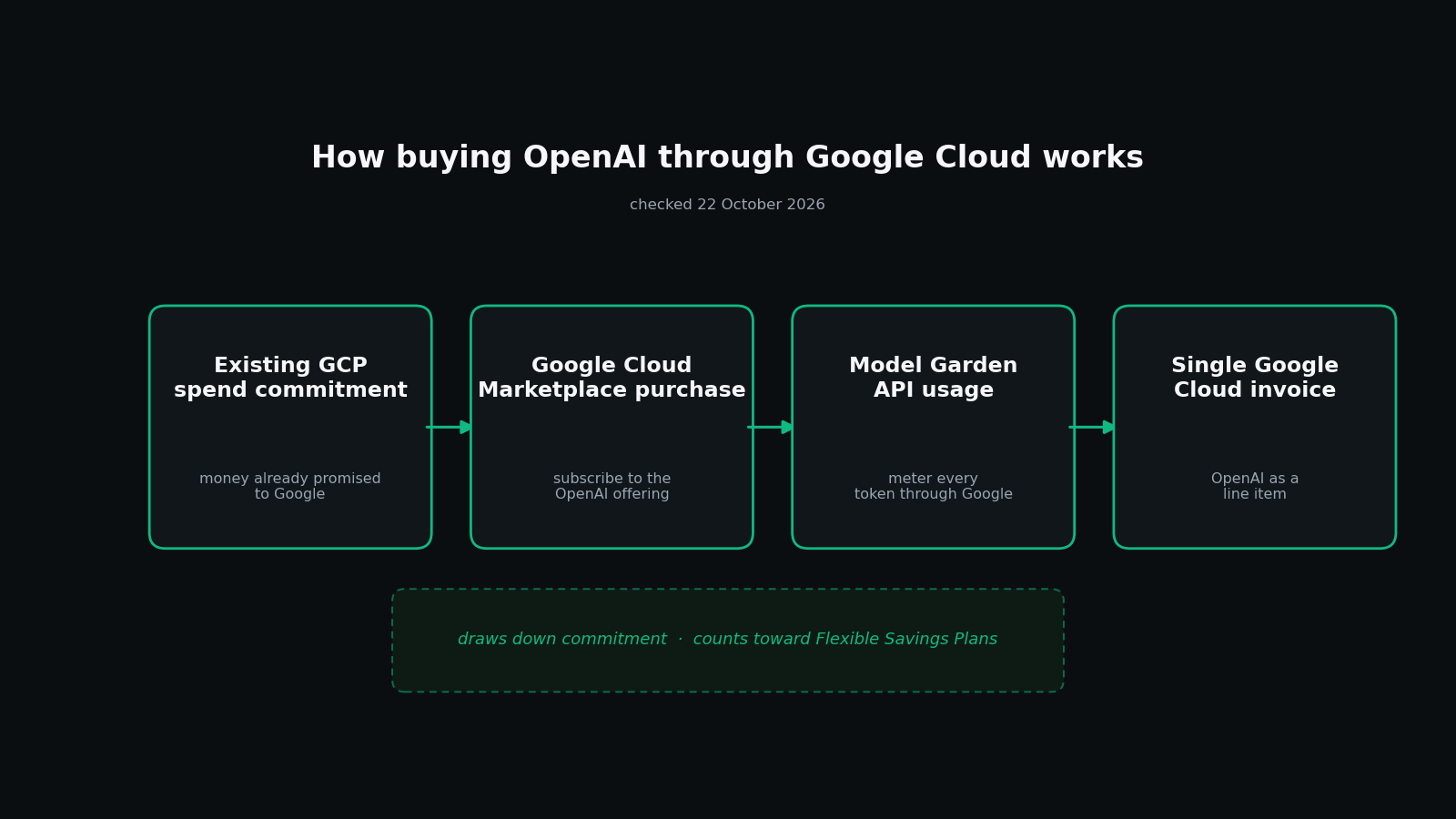
This is the part that changes procurement, and it's the one enterprise buyers should read twice. When the models reach general availability, the flow is: you subscribe to the OpenAI offering in Google Cloud Marketplace, call the models through Model Garden's APIs, and the metered usage shows up on your regular Google Cloud invoice — transacted directly through Marketplace, drawing down your existing cloud spend commitments, and counting toward Flexible Savings Plans (FSP) across model providers. That's from Google's official blog post, and it's the whole pitch in one sentence.
What that buys you, concretely:
- Commitment drawdown. Many enterprises hold committed-use or spend commitments with GCP — money already promised to Google. Marketplace purchases of OpenAI models consume that commitment instead of demanding a separate OpenAI contract and a separate procurement cycle. If your commitment would otherwise go partially unused, the marginal cash cost of OpenAI usage effectively drops to zero.
- One invoice, one vendor. Finance teams get a single Google Cloud bill with OpenAI usage as a line item, under whatever negotiated terms and payment rails you already have with Google.
- Enterprise governance. Google pairs the models with its own controls: VPC Service Controls protection, unified audit logging, authenticated identity for every agent and model interaction, data staying inside your designated perimeter (never used to train foundation models), with Zero Data Retention options and Confidential Compute both marked "coming soon."
- No lock-in theater, at least in theory. Google emphasizes dynamic model selection — swapping models by performance, latency, and cost without separate vendor contracts.
The switching cost is small in code terms. Your application calls Google's endpoint instead of OpenAI's; the familiar OpenAI SDK shape works with a base URL and key swap:
from openai import OpenAI

# Route 1: OpenAI directly
direct = OpenAI(api_key="sk-...")

# Route 2: an AI gateway — same SDK, one line changes
gateway = OpenAI(base_url="https://api.tokens.bd/v1", api_key="tk-...")

response = gateway.chat.completions.create(
    model="openai/gpt-6-luna",
    messages=[{"role": "user", "content": "Explain CAP theorem in two sentences."}],
)
(The GCP Model Garden route follows the same pattern through Google's endpoint — exact third-party model endpoint details are still under the private-preview interest form, so check the form response rather than guessing the URL shape.)
The honest caveat: right now this is a private preview for select enterprise customers, gated behind an interest form. "Coming weeks" is not a date. If you're not in the preview, nothing about your OpenAI access changes this month.
Does it cost more or less than buying from OpenAI directly?#
Here is the short answer, then the math. Nobody has announced a Marketplace discount. Google's blog says usage is "transacted directly through Google Cloud Marketplace" and draws down commitments — it does not say the per-token rate differs from OpenAI's list price. Until a rate card says otherwise, assume the token price is identical and the only financial lever is the commitment drawdown: if your company has GCP spend it must use anyway, OpenAI tokens bought through Marketplace consume dollars already spoken for.
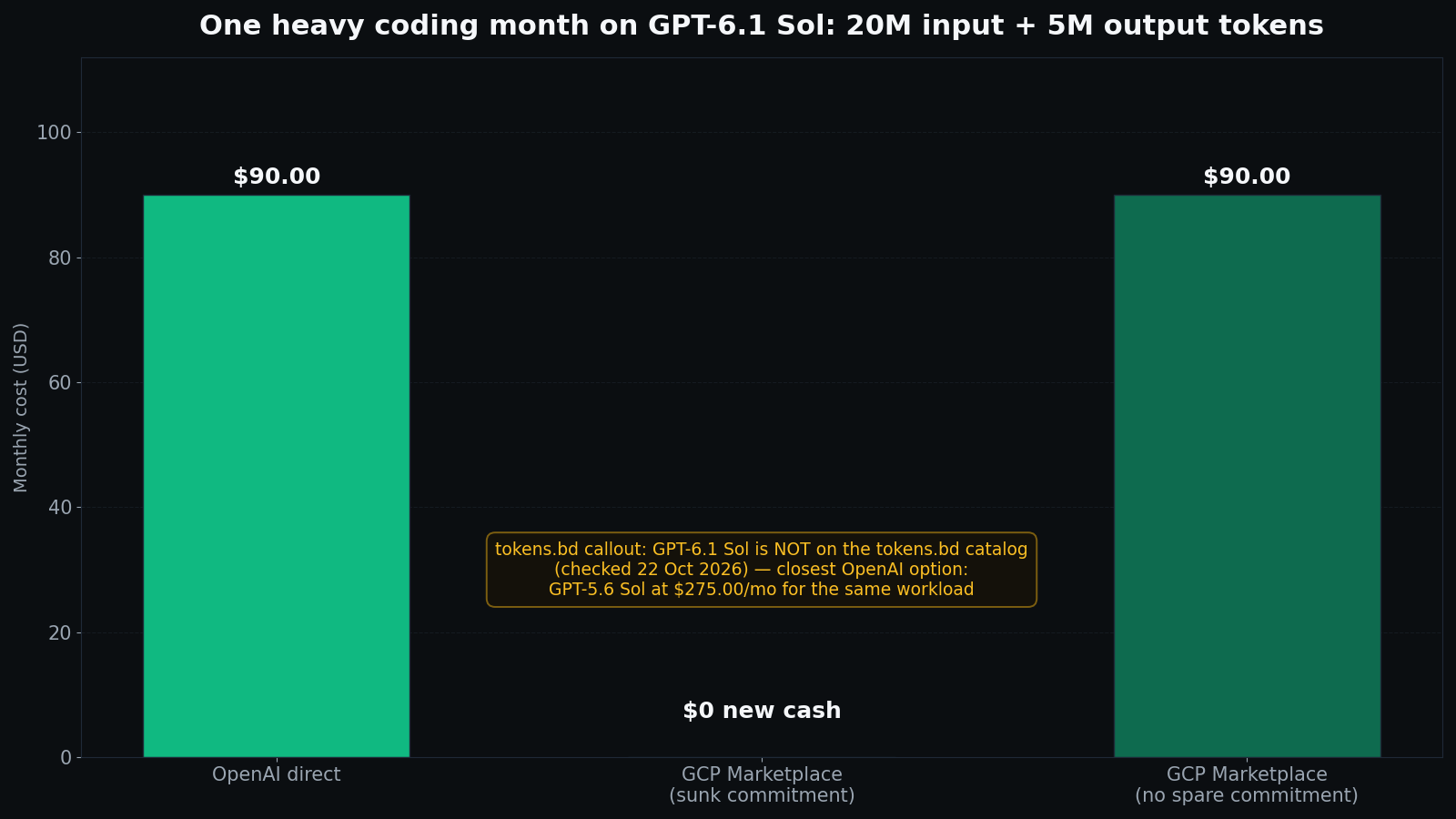
The original math, worked from today's numbers. Take a realistic heavy coding month on GPT-6.1 Sol — 20M input tokens, 5M output tokens:
| Route | Input math | Output math | Monthly total |
|---|---|---|---|
| OpenAI direct | 20 × $2.00 = $40.00 | 5 × $10.00 = $50.00 | $90.00 (৳11,133.00) |
| GCP Marketplace (with commitment to burn) | same $40.00 of commitment | same $50.00 of commitment | $90.00 of commitment — $0 new cash if the commitment was sunk |
| GCP Marketplace (no spare commitment) | same | same | $90.00 (৳11,133.00) — identical to direct |
| tokens.bd | GPT-6.1 Sol not on the catalog | — | see the honest gap below |
Prices checked 22 October 2026. BDT at ৳123.70 per USD: $90.00 × 123.70 = ৳11,133.00.
The honest gap, because a buying guide that hides it is a trap: neither of the two headline GCP models — GPT-6 Astra nor GPT-6.1 Sol — is on tokens.bd's catalog today (checked 22 October 2026 on tokens.bd/models). tokens.bd's OpenAI shelf is the budget tier: openai/gpt-6-luna at $0.11/$0.55 and openai/gpt-5.6-luna / openai/gpt-5.6-sol at $0.22/$1.32 and $5.50/$33.00 per 1M input/output. If your workload specifically needs Astra or 6.1 Sol, today's routes are OpenAI direct or — once it opens up — GCP Marketplace. If the workload runs on Luna, the gateway math is: 20M input + 5M output = 20 × $0.11 + 5 × $0.55 = $4.95 (৳612.32) — versus 20 × $0.10 + 5 × $0.50 = $4.50 (৳556.65) direct. A 45-cent premium for per-key spend caps, failover, and a BDT invoice — see the full breakdown in our gateway migration guide.
The bottom line on cost: the GCP route is a procurement optimization, not a price cut. Its value scales with how much committed GCP spend you'd otherwise waste and how much your procurement team charges you in time for every new vendor.
What does this change for a developer in Bangladesh?#
Directly: less than the headlines suggest. The announcement solves an enterprise procurement problem — commitment drawdown, single invoices, VPC Service Controls — and those are problems of companies with GCP organizations, negotiated contracts, and compliance teams. The Bangladeshi developer's core problem with OpenAI access has always been payment, and GCP doesn't fix that: Google Cloud bills in USD and needs an international-capable card, and Bangladesh Bank's FE Circular 26 (2019) caps international-card online payments at USD 300 per transaction with paperwork each time.
What the announcement does change for Bangladesh, indirectly, is the competitive map. With Microsoft's exclusivity gone and all three hyperscalers now distributing OpenAI models, the API itself is becoming a commodity line item — the differentiation moves to billing, governance, and access. That's exactly the lane an AI gateway plays in: one API key across 60+ models, per-key spend caps, and an invoice payable in taka via bKash/Nagad. If you can't put a card on file with OpenAI or Google, the GCP door is decorative — the gateway door is the one you can actually walk through. And for the Luna-tier workloads where tokens.bd's OpenAI shelf does compete, the price gap to direct is under ten percent, which buys you the failover and the spend caps.
One more Bangladesh-relevant wrinkle, verified today: OpenAI revised its Usage Policies on 21 October 2026, and operators of model routers and AI gateways now need OpenAI's prior review and approval before offering third-party access to its models — effective 20 November 2026, roughly a month to comply. The requirement targets platforms that redistribute direct access to OpenAI's models (it does not cover apps that simply use the models to power features). If you run production traffic through any gateway's OpenAI shelf — any provider's, not just one — check that provider's compliance status before November 20. It's the kind of policy line that quietly decides which shelves keep working.
Should you buy via GCP, direct OpenAI, or a gateway like tokens.bd?#
The decision, compressed into the table first:
| Your situation | Buy via | Why |
|---|---|---|
| Enterprise with GCP spend commitments to burn | GCP Marketplace | Draws down money already committed; single invoice; VPC-SC, audit logging, data-perimeter controls |
| Regulated industry needing Google's governance on OpenAI workloads | GCP Marketplace | Zero Data Retention (coming soon), isolated gateways, unified identity — none of this exists on the direct API |
| Solo dev / startup, no GCP footprint | OpenAI direct | Cheapest per token, no commitment games, full API surface on day one |
| Bangladesh developer without an international card | AI gateway (tokens.bd) | BDT payment via bKash/Nagad; GCP and direct both need USD cards |
| Multi-provider workloads needing failover | AI gateway | One key, automatic fallback across providers; GCP only covers the OpenAI leg |
| You need the exact OpenAI SLA and support terms | OpenAI direct (or GCP enterprise terms) | A gateway or marketplace resell doesn't transfer OpenAI's SLA to you |
| Your workload needs GPT-6 Astra / 6.1 Sol specifically | OpenAI direct today; GCP Marketplace when GA lands | Neither is on tokens.bd's catalog (checked 22 Oct 2026) — don't route around a gap that exists |
A few honest edges on this table. First, the GCP route's value is almost entirely in the commitment drawdown — without spare commitment, it's the same price as direct with an extra middleman. Second, private preview means most readers can't act on the GCP option this week; it's a planning input, not a purchase link. Third, the November 20 gateway-approval rule adds a compliance checkbox to the gateway row: ask your gateway provider whether they've completed OpenAI's review. Legitimate providers will answer plainly.
The one-line cross-link, as promised: if your codebase still names any of the 11 legacy models OpenAI retires this Friday, 23 October, read the migration checklist before you think about procurement — a dead model string doesn't care which invoice it was billed on.
What to do this week#
- If you're in a GCP enterprise: find out whether your org holds spend commitments and whether anyone has filled in the Model Garden private-preview interest form. The drawdown math only works if procurement is already in motion.
- If you buy OpenAI direct: nothing changes. Keep your keys; the new channel doesn't deprecate the old one.
- If you use a gateway for OpenAI models: ask the provider about the November 20 approval requirement. One email now beats a dead shelf later.
- If you're in Bangladesh without an international card: the GCP news doesn't unblock you — a BDT-billed gateway still does. Compare per-model on the catalog and pricing before committing.
FAQ#
When will OpenAI models actually be available on Google Cloud? General availability is "in the coming weeks" — no firm date has been announced. Right now it's a private preview for select enterprise customers; everyone else registers interest through Google's form and waits.
Will OpenAI models cost less on Google Cloud Marketplace? No discount has been announced. Assume OpenAI's list rates apply and the financial benefit is the commitment drawdown: usage consumes GCP spend you've already committed, appearing as a line item on your single Google Cloud invoice.
Can I use my existing GCP committed-use discounts on OpenAI usage? Per Google's announcement, Marketplace usage draws down existing cloud commitments and counts toward Flexible Savings Plans across model providers. The exact commitment mechanics for your contract live in your GCP billing terms — confirm with your account team.
I'm a developer in Bangladesh. Does this help me get OpenAI API access? Not directly. Google Cloud bills in USD and requires an international-capable card, so the payment barrier stands. If that's your blocker, an AI gateway with BDT billing (bKash/Nagad) remains the practical route — see OpenRouter alternatives for Bangladeshi developers.
What's this about OpenAI requiring approval for AI gateways? On 21 October 2026 OpenAI updated its Usage Policies: model routers and AI gateways that offer third-party access to OpenAI's models need OpenAI's prior review and approval, effective 20 November 2026. It doesn't apply to apps that simply use the models. If your production traffic goes through a gateway's OpenAI shelf, verify the provider's status before that date.
Prices and policy dates checked 22 October 2026. Rate cards, preview status, and gateway policies change — OpenAI's and Google Cloud's own pages are the authority, and the model catalog for prices on Tokens. BDT conversions at ৳123.70 per USD mid-market (checked 22 October 2026).
Sources: Reuters: OpenAI to sell its top models on Google Cloud · Google Cloud blog: OpenAI models in Model Garden · Crypto Briefing: OpenAI usage-policy update for gateways · Superpower Daily: approval requirement, effective Nov 20 · Blockchain.News: consistent safeguards for distributed access · Techbooky: private preview and GA timeline · NeoTeo: GPT-6.1 Sol API rates · Codersera: GPT-6.1 Sol vs Sonnet 5.5 pricing · OpenAI deprecations page (Oct 23 shutdown verified on track) · tokens.bd model catalog · USD/BDT rate