
TL;DR: Google AI Overviews don't simply cite whoever ranks first. Ahrefs' March 2026 analysis of 863,000 keywords found that only ~38% of AI Overview citations come from pages in Google's top 10 — and CXL found that 55% of cited passages sit in the first 30% of the page. Brand mentions correlate with AI visibility at r = 0.664, more than three times the correlation of backlinks (r = 0.218). For a brand-new site, that is genuinely good news: citation is decoupled from ranking, and the levers that earn it — front-loaded answers, original data, freshness, mentions — are all within reach from day one.
We know exactly how this looks from the bottom, because we are the bottom. This blog is roughly two weeks old in Google's index. As of 21 October 2026, our most-visible post had earned 102 impressions at an average position of 29, with zero clicks. Our head terms — the searches every LLM API site wants — sit at positions 40–90. A handful of posts have reached page one, and they are the exception. Classic SEO says a site like ours should expect a long wait: Ahrefs' 2025 ranking study found that only 1.74% of new pages reach Google's top 10 within a year.
And yet new sites do show up inside AI answers — in Google AI Overviews, in ChatGPT, in Perplexity — long before they rank for anything competitive. That gap between ranking and being cited is the most important shift in search in years, and it is measurable. This post pulls together the 2026 study data on how AI systems actually choose their sources, what doesn't work despite the hype, and the playbook a new site — this one — can realistically run. Study data checked 22 October 2026.
Do you need to rank #1 to get cited in an AI Overview?#
No — and increasingly, you don't even need the first page. Google's own documentation sets the formal bar surprisingly low: to appear in AI Overviews or AI Mode, a page only needs to be indexed and eligible to be shown with a snippet in Google Search. There is, in Google's words, no special optimization required. The data backs that up. Ahrefs (March 2026, 863,000 keywords) found that only ~38% of AI Overview citations come from top-10-ranking pages — down from 76% in July 2025, a decoupling that is accelerating as the systems mature. Other measurement firms put the overlap lower still: BrightEdge reports 17%, and SE Ranking measured 14% for AI Mode. Those numbers disagree because they measure different engines on different dates — but the direction is unanimous: a top-10 ranking helps, and it is nowhere near a requirement.
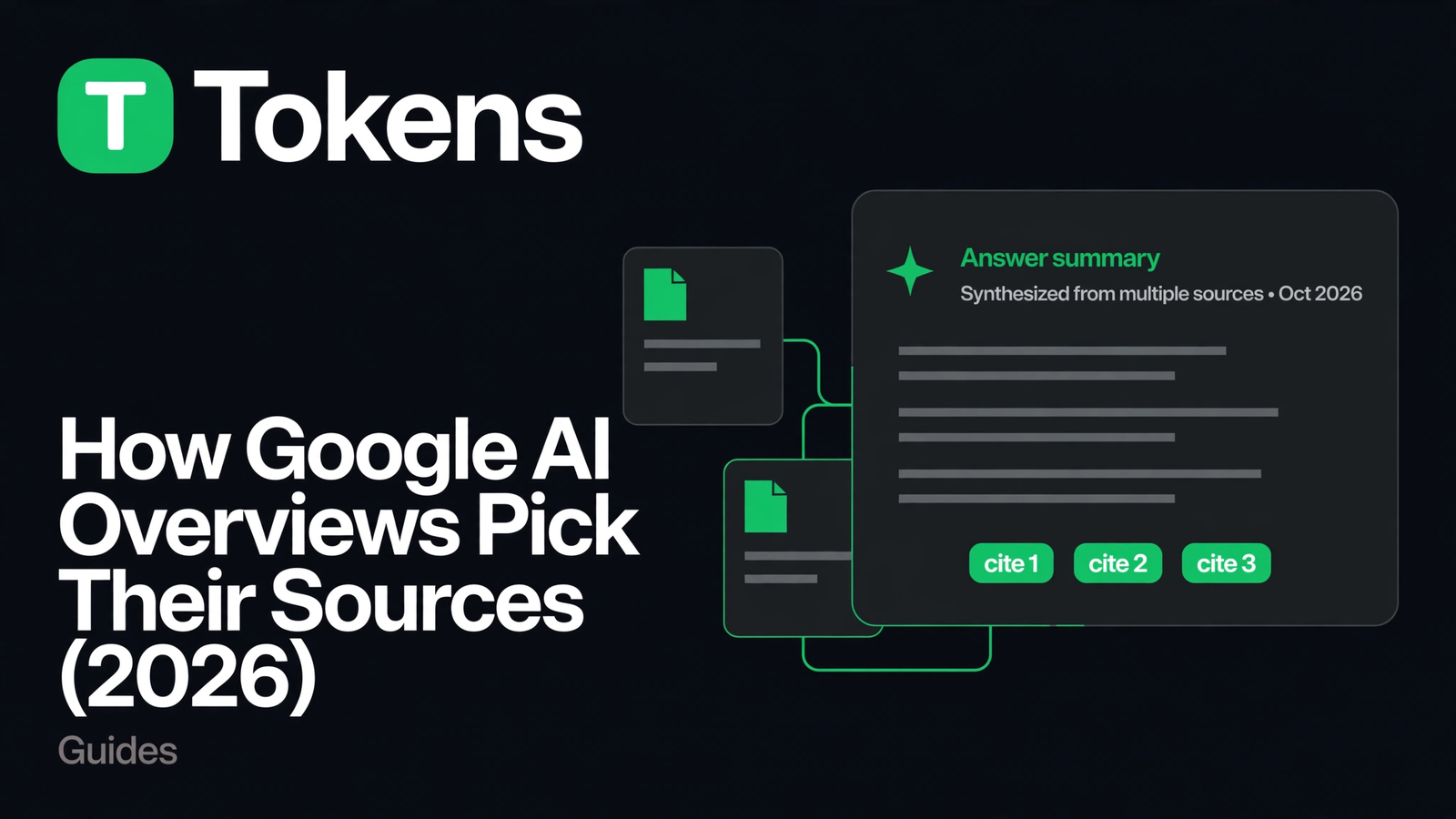
Why? Because AI answers aren't assembled from the ranking list. The system fans a question out into sub-queries, retrieves passages that answer each piece, and cites the passages it used. That changes the unit of competition from your domain vs. their domain to your passage vs. their passage. It also explains BrightEdge's finding (reported via PushLeads) that 82.5% of AI Overview citations point to deep pages — specific articles, docs, and catalog pages — not homepages. And the content type doing the citing-winning is familiar: NP Digital's analysis of 1.5 million AI responses found blogs are the most-cited content type in AI answers. A two-week-old blog post that answers one sub-question precisely is a legitimate citation candidate today, at position 29 or position 90. That's the opening this whole playbook is built on.
Where on the page do citations come from?#
From the top — overwhelmingly. CXL analyzed 100 AI Overview citations and found that 55% of the cited passages came from the first 30% of the page, with 24% from the middle and just 21% from the bottom 40%. The pattern holds across engines: Indig's analysis of 18,012 ChatGPT citations found 44.2% came from the first 30% of the cited page. Retrieval systems chunk pages and weigh early, answer-bearing text; readers do the same. The practical rule is the inverted pyramid that journalism has used for a century: put the answer — the number, the verdict, the price — in the first screenful, and let the depth follow for the humans who want it. A 2,500-word guide whose actual answer is buried at word 1,900 is, to a citation engine, a page without an answer.
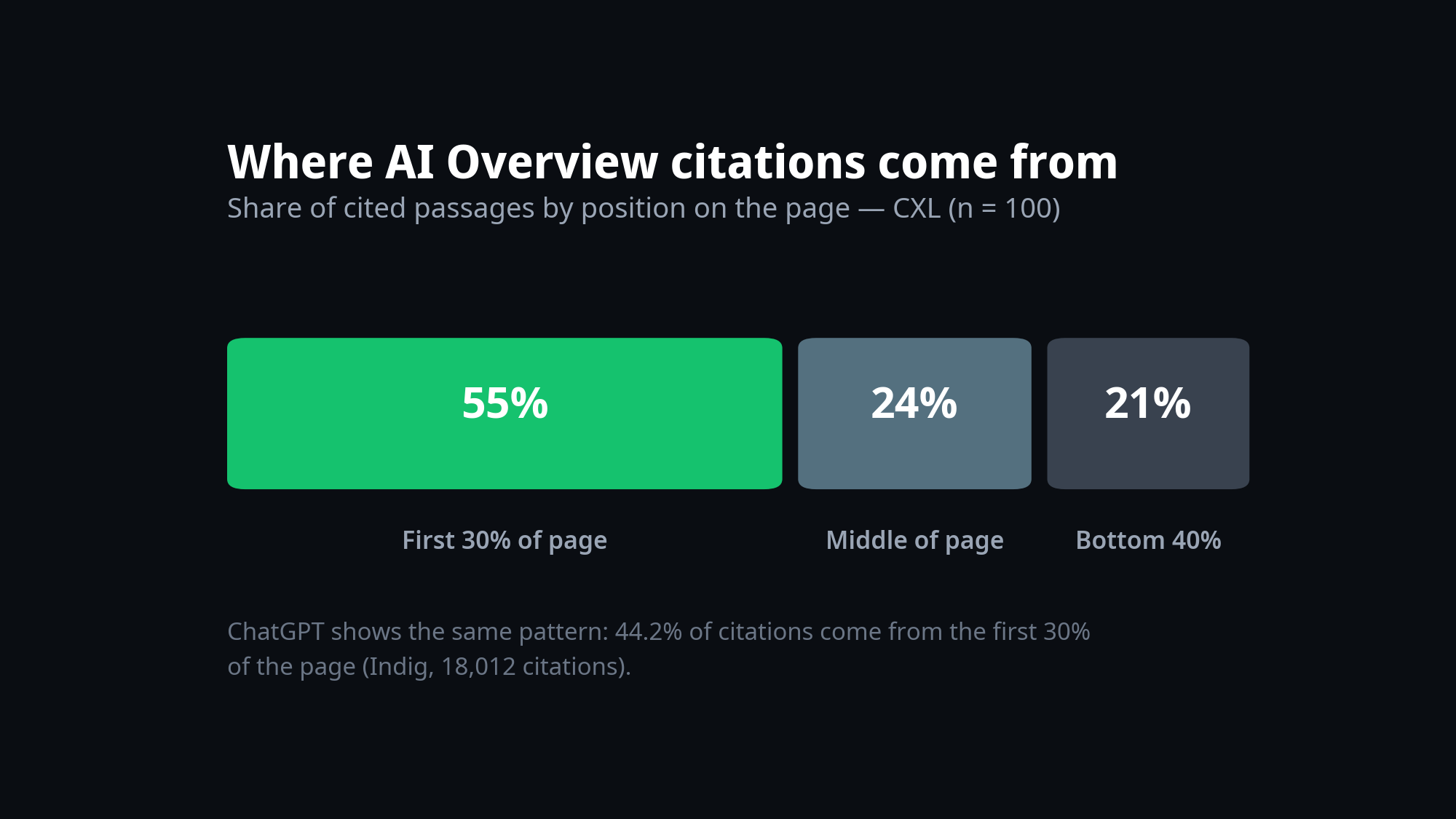
This is why every post on this blog now opens with a TL;DR block: 2–3 sentences carrying the headline numbers before any context. It feels redundant when you write it. It is, empirically, where more than half of all citations live. If you change one thing after reading this post, change that: write the first 30% of every page as if it were the whole page, because for AI citation purposes, it mostly is.
Which content formats get cited most?#
Lists, comparisons, and anything carrying original numbers. Ahrefs' best-lists research found that "best X" list posts accounted for 43.8% of all page types ChatGPT cited — the single largest category. The Princeton GEO study (presented at KDD 2024) tested what makes content more visible to generative engines and found that adding statistics, quotations, and citations raised visibility by up to ~40% in lab conditions — while keyword stuffing, the one tactic everyone reaches for, produced no gain. SE Ranking's AI research adds the structural detail: question-headed sections of 120–180 words earn roughly 70% more ChatGPT citations, and articles longer than 2,900 words see about 59% more citations than shorter ones. Length alone isn't the mechanism — a long article simply holds more self-contained, question-shaped answer blocks for the fan-out to retrieve.
Put together, the cited page of 2026 looks like this: a question for a heading, a complete 120–180-word answer directly beneath it, then the supporting table, dataset, or worked example. Original data is the compounding asset here. Anyone can restate a provider's pricing page; far fewer sites compute anything. Our own LLM API pricing statistics post exists for exactly this reason — it's arithmetic nobody else published, which makes it the kind of passage an AI can cite and a competitor can't copy without doing the work.
How much does freshness matter?#
A lot, and measurably. SE Ranking found that content updated within the last three months is roughly twice as likely to be cited as older content. Ahrefs' best-lists data tells the same story from the other side: 79.1% of the cited list posts in their sample had been updated in 2025. AI systems are answering questions about prices, versions, limits, and policies — facts with expiry dates — and they have learned to prefer sources whose facts are current. For fast-moving topics, a page that was accurate eight months ago and untouched since is treated as stale even if it happens to still be right. And an update that counts is a substantive one: re-checked figures, new examples, corrected claims — a pass that changes what the page says, not merely when it claims to have been said.
Two implications follow. First, build updates into the calendar, not the crisis list: a quarterly pass over your money pages — re-verify the numbers, extend what's thin, and stamp the new check date — is a citation strategy, not housekeeping. Second, the freshness signal rewards substantive updates. Re-dating a post without changing its content is one of the myths in the table below, and engines have every reason to discount it: sitemap lastmod values are only trusted when they reflect real changes. Our own rule is simple — every pricing table on this blog carries a "checked" date, and the date only moves when the numbers were actually re-verified that day.
Brand mentions or backlinks — what actually moves AI visibility?#
On the best data available, mentions — by a wide margin. Ahrefs studied 75,000 brands and measured how different signals correlate with a brand's visibility inside AI Overviews: brand mentions correlated at r = 0.664, while backlinks correlated at just r = 0.218. One correlation study isn't proof of causation, and big brands naturally collect both mentions and citations. But a threefold gap is hard to wave away, and it matches the mechanism: a language model learns which brands belong in an answer from the text it has read — roundups, comparisons, forum threads, docs, reviews — not from link graphs. If the web talks about your product when your category is discussed, you are a plausible answer. If it never does, no amount of link-building makes you one.
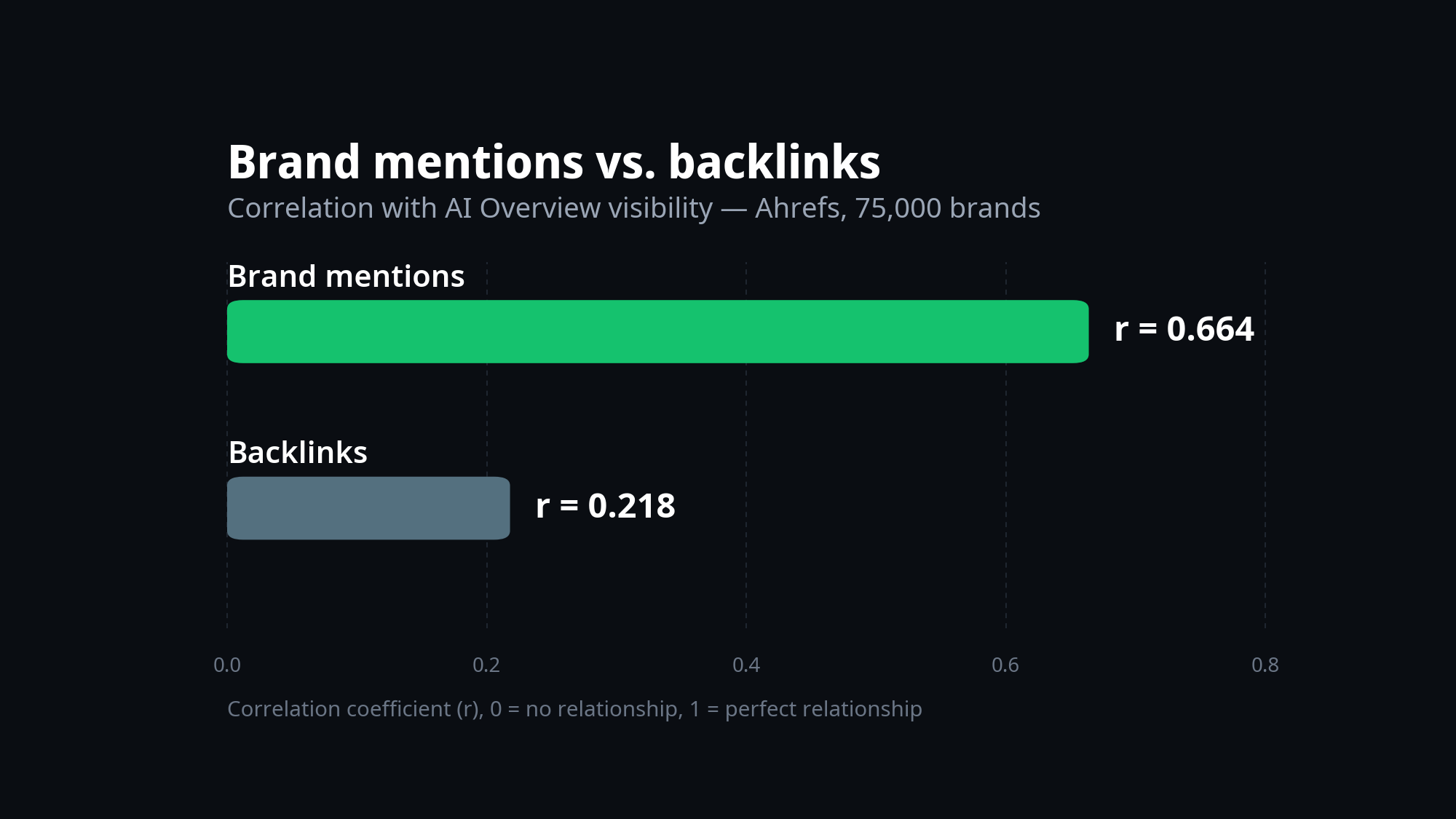
None of this makes backlinks useless. They still drive classic rankings, classic rankings still feed a minority of citations, and a link from a respected publication usually arrives with a mention attached. The shift is one of priority: for AI visibility specifically, being discussed beats being linked. A genuine presence in the places your category is compared — "best LLM gateway" threads, community recommendations, alternative-to pages — is worth more to an AI answer than a directory listing with perfect anchor text.
What doesn't work: five myths, checked#
Every new ranking channel attracts folklore. These five claims circulate constantly in SEO and GEO advice; here is what the evidence actually says.
| Myth | The claim | Verdict | What the evidence says |
|---|---|---|---|
| The llms.txt fix | "Add an llms.txt file and AI engines will cite you" | ❌ No effect at Google | Google does not use llms.txt at all — stated publicly by Google's Gary Illyes and John Mueller. Keeping the file is harmless; expecting citations from it is not a strategy. |
| FAQ schema | "FAQ/JSON-LD schema boosts AI citations by ~60%" | ⚠️ Unsupported | Ahrefs ran a controlled test adding JSON-LD to 1,885 pages and found no meaningful citation uplift. The "+60%" figure has no published study behind it. Schema still has classic-search uses — citations aren't one of them. |
| Keyword stuffing | "Repeat the target phrase so the AI notices you" | ❌ Counterproductive | In the Princeton GEO experiments, keyword stuffing produced no visibility gain, while statistics, quotations, and citations raised visibility by up to ~40%. |
| Indexing API for posts | "Use Google's Indexing API to force blog posts into the index" | ❌ Wrong tool | The Indexing API is documented for job-posting and broadcast-event pages, not articles. For blog posts, the supported path is an accurate sitemap, internal links from indexed pages, and time. |
| Fake date bumps | "Re-date old posts so they look fresh" | ❌ Risky | Freshness data (SE Ranking's ~2× lift) reflects updated content. Google's sitemap guidance is explicit that lastmod should reflect real changes; a site that cries wolf on dates trains the crawler to ignore its signals. |
Study data in this table summarized from the sources below; checked 22 October 2026.
A new site's citation playbook#
Everything above condenses into a routine a small site can actually run. This is ours:
- Fan out the question. AI systems split one query into sub-queries. Structure each post the same way: the page targets the head question, and every H2 is a real sub-question a user would ask, phrased in their words.
- Answer in the first 30%. Open with a TL;DR carrying the key numbers. 55% of AI Overview cited passages live there (CXL) — write that zone first, not last.
- Use 120–180-word answer blocks. Under each question heading, give a complete, self-contained answer of 120–180 words before going deeper (SE Ranking: ~70% more ChatGPT citations).
- Publish original numbers. Statistics, quotations, and citations raised AI visibility up to ~40% in the Princeton GEO tests. Compute something — a pricing index, a benchmark, a cost model — that only your site has.
- Go deep, then link it together. 82.5% of citations land on deep pages, not homepages (BrightEdge). Publish specific pages for specific questions — a model catalog, a pricing dataset, a migration guide — and interlink them so crawlers and retrievers can find every one.
- Keep AI crawlers unblocked. Check your robots.txt: if the crawlers used by Google, ChatGPT, Claude, or Perplexity are blocked, your pages can't be retrieved into answers. A surprising number of sites block them by accident via copied templates.
- Be fast. SE Ranking found pages with First Contentful Paint under 0.4s were cited 3× more than pages slower than 1.13s. Performance is a citation factor now.
- Earn mentions, not just links. Show up where your category is compared and recommended — communities, roundups, alternative-to pages. Mentions correlate with AI visibility at 0.664, triple the backlink figure.
- Refresh quarterly. Content updated within 3 months is ~2× as likely to be cited (SE Ranking). Re-verify facts, extend thin sections, and move the check date only when you did the work.
- Write the formats AI cites. Where they fit honestly, use ranked lists and comparisons — 43.8% of the pages ChatGPT cited in Ahrefs' sample were "best X" lists.
The honest caveat: citations are a brand asset, not a click asset#
Before you reorganize your roadmap around everything above, read the click data. Pew Research (July 2025) tracked real browsing behavior and found that when an AI summary appeared, users clicked a traditional search result on only 8% of visits, versus 15% when no summary was present — and clicked a citation link on roughly 1% of visits. AI answers absorb the click. A citation puts your brand inside the answer the user reads; it rarely sends that user to your site.
So measure this playbook correctly. The return on a citation is presence: the developer who asks an AI "which API gateway should I use in Bangladesh?" sees your name in the answer, and that recognition surfaces later as a branded search, a direct visit, or a signup that analytics attributes to "direct." Track branded search volume and direct traffic alongside organic clicks, or you'll conclude — wrongly — that nothing is working. And keep the classic game in perspective: with only 1.74% of new pages reaching the top 10 within a year (Ahrefs), rankings for a young site compound slowly regardless. Citations are the channel that doesn't make you wait. Write for the answer box now; let the rankings arrive when they arrive.
Frequently asked questions#
How do I get my site cited in Google AI Overviews? Be indexed and snippet-eligible (Google's stated requirement), then write for retrieval: front-load the answer in the first 30% of the page, use question headings with self-contained 120–180-word answers, include original statistics, and keep the page updated. Only ~38% of citations come from top-10 pages (Ahrefs), so a new site competes on passage quality, not domain seniority.
Does adding an llms.txt file help me get cited? Not at Google — Illyes and Mueller have both said Google doesn't use llms.txt. Its effect on other engines is unproven. It's a five-minute file, but no study links it to citations; spend the effort on content structure instead.
Do backlinks still matter for AI search visibility? For classic rankings, yes. For AI Overview visibility specifically, Ahrefs' 75,000-brand study found brand mentions correlate far more strongly (r = 0.664) than backlinks (r = 0.218). Prioritize being discussed in your category; treat links as a bonus that usually arrives with the mention.
How long does it take a new site to appear in AI answers? There's no fixed timeline and no application process. Because 62% of AI Overview citations come from outside the top 10, a new page can be cited as soon as it's indexed and matches a sub-question well — while classic top-10 rankings take most new pages more than a year, if they arrive at all (Ahrefs).
Is FAQ schema worth adding for AI citations? Not for citations: Ahrefs' controlled test on 1,885 pages found no meaningful uplift from adding JSON-LD. FAQ content itself — real questions with short answers — is still good structure for readers and retrievers; just don't expect the markup to do the work.
Sources#
- Google Search Central — AI features and your website (official position on AI Overviews eligibility): https://developers.google.com/search/docs/appearance/ai-features
- CXL, reported by Juan Auriti — where AI Overview citations come from on the page (55% from the first 30%; also Indig's 44.2% ChatGPT figure and Ahrefs' 38% top-10 overlap): https://dev.to/juanauriti/55-of-ai-overview-citations-come-from-the-first-30-of-your-page-heres-the-data-le7
- SE Ranking — AI search statistics (120–180-word sections, freshness, length, page speed): https://seranking.com/blog/ai-statistics/
- Princeton GEO study (KDD 2024), summarized by ClickRadius — statistics, quotations, citations: https://www.clickradius.io/institute/quotations-statistics-citations-the-three-geo-signals.html
- Ahrefs — best-lists research (43.8% of ChatGPT-cited page types; 79.1% updated in 2025): https://ahrefs.com/blog/best-lists-research/
- Ahrefs 75,000-brand study, reported by Growthner — brand mentions (0.664) vs backlinks (0.218): https://growthner.com/blog/brand-mentions-vs-backlinks-what-matters-more-for-ai-search-visibility/
- Pew Research Center (July 2025), reported by Search Engine Journal — clicks with and without AI summaries: https://www.searchenginejournal.com/pew-research-confirms-google-ai-overviews-is-eroding-web-ecosystem/551825/
- BrightEdge citation data, via PushLeads — 82.5% of citations point to deep pages: https://pushleads.com/how-to-rank-in-google-ai-overviews/
- Ahrefs controlled JSON-LD test (1,885 pages), reported by GrowthAgents — no citation uplift from schema: https://growthagents.ai/blog/schema-markup-alone-will-not-get-you-cited
- Google on llms.txt (Illyes / Mueller statements), tracked at llmtxt.info: https://llmtxt.info/does-google-use-llms-txt/
- Ahrefs ranking study, reported by Whitehat SEO — 1.74% of new pages reach the top 10 within a year: https://whitehat-seo.co.uk/blog/how-long-does-it-take-to-rank-on-google
- NP Digital — AI citation share by content source (blogs are the most-cited type, 1.5M responses): https://neilpatel.com/marketing-stats/ai-citation-share-by-content-source/